


We recently connected with Gillian Haigh and have shared our conversation below.
Gillian, looking forward to hearing all of your stories today. How did you learn to do what you do? Knowing what you know now, what could you have done to speed up your learning process? What skills do you think were most essential? What obstacles stood in the way of learning more?
When I started painting in my late teens in high school, I would generally rush through instructions, preferring to figure the material out on my own. Growing up I never encountered contemporary art or met a professional creative, so I developed my own ways of working and conception of what it meant to be an artist.
In my BFA at Emily Carr University of Art and Design, faculty encouraged material experimentation, particularly in the painting department. This consisted less of ‘teaching’ in a traditional sense of ‘demos’ or ‘lessons’; I never was taught the ‘correct’ way of painting, but rather collected snippets of painting knowledge from experiments and discussions with my peers and faculty. When faculty or peers shared a perl of knowledge like the recipe for a perfect black, or their review of the newest Gamblin oil medium, I recognized them as treasures and filed them away.
After graduating, I spent a year experimenting, redefining how I approached material away from the influence of an academic environment. My desire to build a distinct visual language and use of material, left me drifting not wanting to adopt the style and ideas of one mentor or artist. It was a very slow and frustrating process – if I relied too much on one reference or source, the work began to resemble someone else’s hand. The obstacle to ‘learning’ was learning too much and loosing my own voice and eccentricities.
I developed a real sensitivity and intense attention, both to material and history. In many ways my approach to ‘learning’ has shaped my work today; my propensity to reach broadly to collect and organize information, material, and imagery.

Great, appreciate you sharing that with us. Before we ask you to share more of your insights, can you take a moment to introduce yourself and how you got to where you are today to our readers.
My name is Gillian Noline Haigh, I am a Canadian artist based in Los Angeles California. I was born in Calgary, Alberta; a city in the prairies boarding the edge of the Canadian Rockies, but lived most of my 20s in Vancouver BC. I graduated with a BFA from Emily Carr University, Vancouver Canada and am currently a MFA candidate at UCLA. My work has been featured in exhibitions across Canada including; LA Beast Gallery (2024); Canton-Sardine (2023); Monica Reyes Gallery (2023); the Banff Centre (2022); the Morris and Helen Belkin Art Gallery (2019); and Headline Gallery (2021). Currently I have work available at LA Beast Gallery, and Provide Design Gallery (Vancouver).
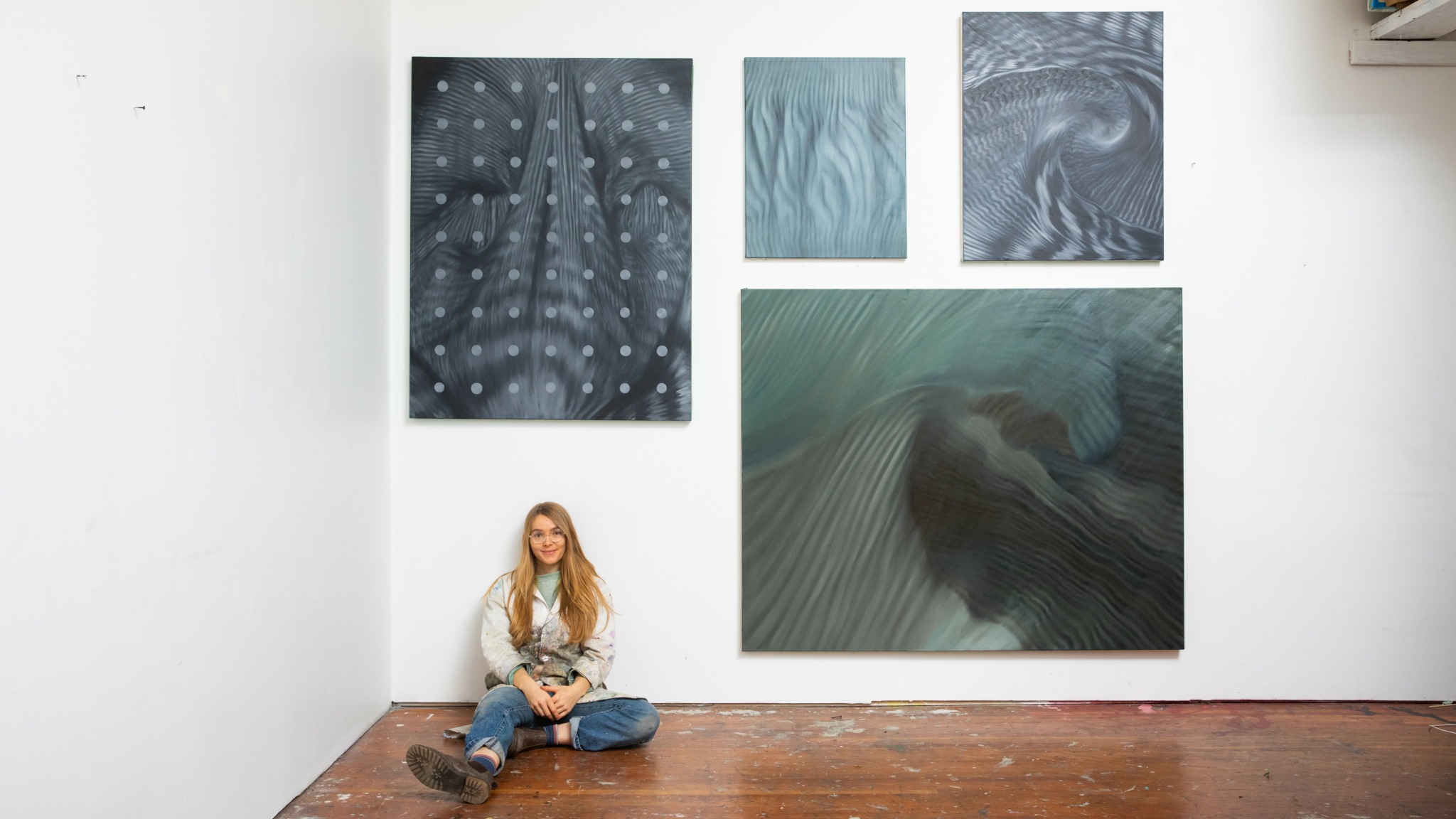
Grounded in painting, my practice exists within a larger framework of queer theory and feminist thought which pursues the boundary of perception and interpretation. Embracing both abstraction and figuration, my visual vocabulary is a spectral blurring of traditional structures of representation.
Informing my painting practice is my work with archives and subsequent writing projects. My approach to building and maintaining archives is a foil to how I approach making work. Rather than deconstructing, I am building systems. But what draws me to both activities is they presuppose an intense attention both to larger fields, and minute details in order to inform an awareness of a larger territory of information. My work on the archives of artist and art historian Ian Wallace, and museum director, curator, and scholar Jo-Anne Bernie Danzker, are both living archives, so along with preparing them for future research, I needed to create a procedure to add to the archive. I see these systems of collection, of similar consequence to my work – both provide a structure for the function of accumulation.

Is there something you think non-creatives will struggle to understand about your journey as a creative?
When I started my professional work in the arts, I had a notion of a forward and linear trajectory of my work and career. But I’ve come to learn art making and being an artist is not about progress so much as continuing to move; sometimes you have wins and take a step forward, but almost as often you encounter a problem and take a step back or to the side. To make a sustainable practice you have to celebrate the wins, but know the ‘mistakes’ or misdirections are usually a lot more informative.

Any resources you can share with us that might be helpful to other creatives?
The richest resource and support in any art space is community. I was a fairly withdrawn in my undergraduate degree, busy with sports and working outside of school, so I really only built relationships with my peers and other artists until after graduating. Being an artist can be incredibly taxing and challenging; loosing your studio space, rejection, burnout, financial , and I could not be where I am today without the help and support of friends, mentors, and my wider arts community.
Contact Info:
- Website: https://gilliannhaigh.com/
- Instagram: https://www.instagram.com/gillian.n.haigh/ @gillian.n.haigh


Image Credits
For the photo of me please credit – Eric Tigges
For other photos please credit me – Gillian Haigh