

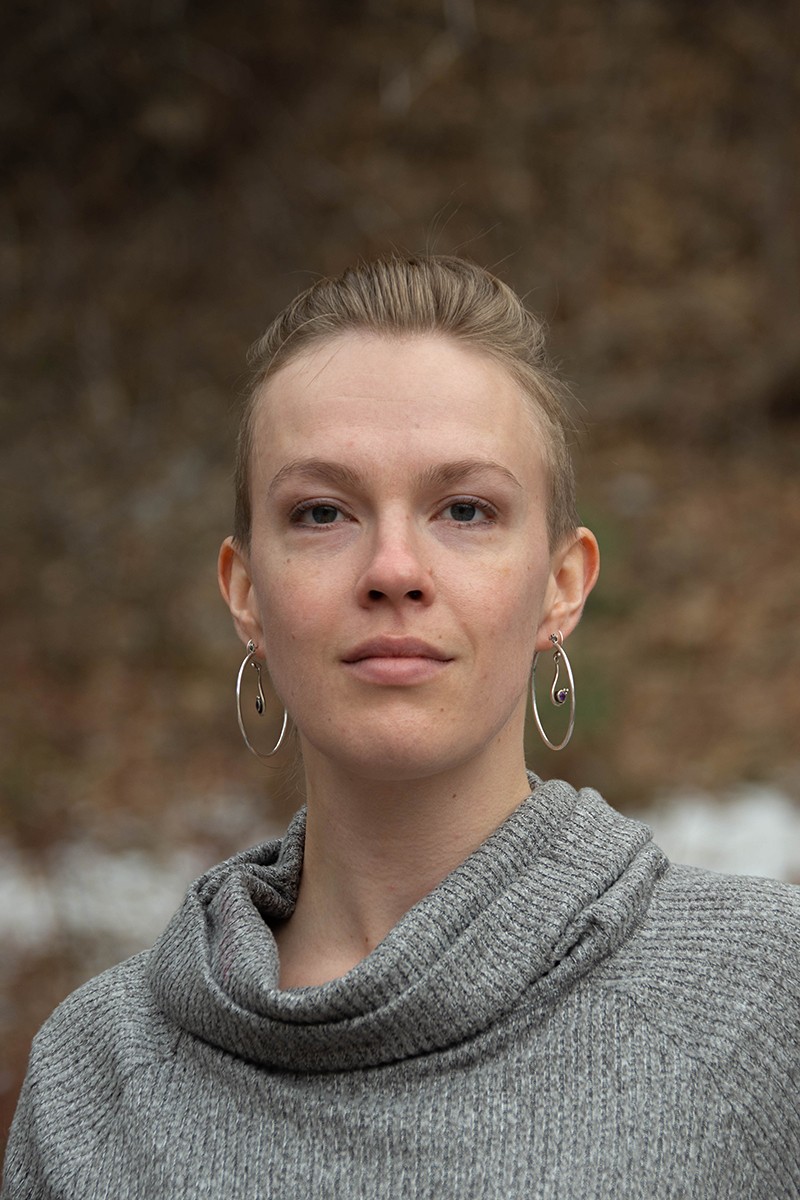

We caught up with the brilliant and insightful Carly Milligan a few weeks ago and have shared our conversation below.
Carly, thanks for taking the time to share your stories with us today We’d love to hear about when you first realized that you wanted to pursue a creative path professionally.
Art ended up being my third career choice late into my college education. No, I was not studying art at the time.
It seems like a lot of the artists I know have the “I always wanted to be an artist” backstory. Mine is a little bit different. Sure I loved to draw as a kid. Don’t most of us though?
I didn’t want to be any one thing. It was early in my teens that I most strongly felt the desire to and be anything and everything that caught my interest. I wanted to be a professional ballerina, I wanted to write and publish novels, I wanted to become an engineer, I wanted to pursue science, I wanted to play the flute in marching band AND also dance in the color guard never mind that that would be physically impossible to do simultaneously.
My first serious career choice was ballet. After I had decided that as much as I loved ballet I didn’t want it to be my job I ended up going back to school to study Biology with the intent of becoming a veterinarian. I’m not squeamish, but I a few events made it clear to me that I would not last emotionally as a vet. I though I could totally still put my degree to use though. Except in an interesting parallel to my dance career I realized that as much as I enjoyed studying science I didn’t want any of the jobs where the science actually gets applied.
It was around this point in time, finishing my bachelors in Zoology with a minor in Chemistry and a technician degree, but no longer certain what I would do with myself afterwards that several events lined themselves up together. First, I got back into drawing just for fun, something I hadn’t done much since high school. My now mother-law got me a set of oil paints for Christmas. And then my favorite illustrator, Dan Dos Santos, was coming to Utah to teach a workshop with another painter, Howard Lyon.
I instantly fell in love with oil paints as a working medium as soon as I tried them. The the workshop was an absolute blast that opened my eyes up to the possibility of art being viable as a career path. Getting paid to read books and then bring them to life with beautiful paintings? Where did I sign up?


Carly, love having you share your insights with us. Before we ask you more questions, maybe you can take a moment to introduce yourself to our readers who might have missed our earlier conversations?
Since that workshop I’ve been developing my skills and craft and am happy to be able to call myself a professional illustrator.
For me there are two important things to the work I do.
First is narrative. My favorite thing about art is that it’s a form of communication, and people communicate with one another through stories. I always want my paintings to feel like they have a story behind them that will suck the viewer in or encourage them to imagine their own stories.
Second is craft. The method and skill with which I execute a project is generally forefront in my mind. I’m always pushing to improve it. I work primarily with traditional media. Oils are still my favorite though I very much enjoy experimenting with a wide variety of materials. Digital is a wonderful tool, but there’s an undeniable mystique and magic to having a hand crafted physical object.
There are many avenues where I can use these two things to both create beautiful art and work in collaboration with others to bring their stories to life. Book covers are my bread and butter. I also enjoy taking private commissions and working with other narrative based industries such as games and film.
In your view, what can society to do to best support artists, creatives and a thriving creative ecosystem?
Oof, this one is a doozy of a topic. I’ll try do my best to wrangle my thoughts on this into something concise and cohesive.
As a society, the best thing we can do for both a thriving creative ecosystem and a healthy successful community is really assess our priorities and focus on long-term benefits instead of sacrificing them for short-term gains. Those short term gains often cost us more in the long run. Those of you who are familiar with Terry Pratchett and his example of the poor man’s shoes know what I’m talking about.
Here in the US success is often measured with a dollar sign. Because that’s what we measure, that’s what we focus on and prioritize as a culture. I believe healthier measurements of our success as a society would instead be things like health and well being. In a society that prioritizes doing things as cheaply as possible in order to make a profit, creativity is the first thing to get belittled and cut down. In a society that prioritizes health and well being, creative endeavors will always hold an incredibly important role.


What’s a lesson you had to unlearn and what’s the backstory?
Like many people I struggle with perfectionism. Something I learned from one of my dance teachers early in life was “It’s just as much work, or more work, to do something wrong as it is to do it right. So just do it right.”
And she’s right! I remember watching someone struggle to get a fire going at a house party. This person kept throwing stuff into a pile and then couldn’t get it to light. He was trying to be lazy about it and cut corners and it was creating more work for himself. I stepped in, slowed down, and took the time and effort to build a proper lodge out of small sticks. It seemed like more work at first, but the fire lit right away and it was more efficient than what the person before me had been trying to do.
However, this ideology has it’s flaws. For me this manifested as internalizing and reinterpreting it as “If I can’t do something right. Don’t do it at all.”
I’ve been working hard on instead accepting the thought that “anything worth doing is worth doing poorly” and “perfect is the enemy of good.” I’m still prone to freezing up, or wanting to scrap a project and go back to square one as soon as something goes wrong. More and more though I’m able to accept that if I push through the mistakes, accept that things won’t be perfect, I can still get fabulous results. To quote Bob Ross, “there are no mistakes, only happy accidents.”
Art and creativity comes from being playful. Play happens when the stakes are low. There is no right, wrong, or perfect when you’re just playing. So, I’ve had to learn to be more gentle with myself, and not take myself or my work so seriously!
Contact Info:
- Website: https://www.carlymilligan.com/
- Instagram: https://www.instagram.com/carlymilligan/
- Facebook: https://www.facebook.com/zombie.ballerina/
- Twitter: https://twitter.com/milligan_carly
- Youtube: https://www.youtube.com/channel/UC4KssKQVDqqZ6FySeaelA7g
- Other: https://www.carlymilligan.com/links