



We were lucky to catch up with Carlos Duran recently and have shared our conversation below.
Carlos, appreciate you joining us today. Being a business owner can be really hard sometimes. It’s rewarding, but most business owners we’ve spoken sometimes think about what it would have been like to have had a regular job instead. Have you ever wondered that yourself? Maybe you can talk to us about a time when you felt this way?
I’ve definitely had that thought more than once. The last time it hit me was late at night, sometime during the week, after a full day of composing that should have felt productive. I had spent hours writing music, which is the part I care about the most, but then I still had this long list of things waiting for me—emails, outreach, social media, trying to get people to actually hear the music I had just made. I remember staring at my screen thinking, “This never really stops.” There wasn’t a clear end to the day, no moment where I could say, “I’m done.”
The last time I really felt that was during a stretch where I wasn’t short on ideas—I was short on energy for everything around the music. I had been spending hours writing, but even more time trying to get people to notice it. Editing videos, posting, following up, trying to stay visible. It felt like the actual composing was a small part of the day, and the rest was noise. I remember sitting at my desk late at night, still thinking about what I hadn’t done yet, and realizing I hadn’t had a real “end” to the day in a while. That’s when I started imagining a more contained life—something “boring”, where work stops at a certain hour and your mind can actually rest.
But I’m aware that I’m probably projecting onto that idea. The reality is that most careers don’t offer the kind of stability we think they do, especially right now. So I don’t stay in that thought for too long. What really gets to me isn’t the creative work—it’s everything around it. Making music is the easy part for me. Getting it out into the world, building momentum, cutting through the noise—that’s the real job. And that part can feel endless.
But even in those moments when I feel overwhelmed, I still choose this path. The work itself is something I can’t replace. When I’m involved in a project, especially in film or media, directors and producers rely on me to shape how a story feels. There’s a level of responsibility there that makes the work meaningful in a way I don’t think I would find somewhere else.
So to answer the question—am I happier as a business owner? It depends on the timeframe. Day to day, there are moments where it’s exhausting and I question it. But if I zoom out, I do feel aligned with what I’m building. Even when it’s difficult, it still feels like the right kind of difficulty for me.


Awesome – so before we get into the rest of our questions, can you briefly introduce yourself to our readers.
I’m a composer, guitarist, and music producer based in Los Angeles, originally from Colombia. I came into this field through performance first—I trained in classical guitar, played across different styles, and over time became more interested in film and media. That shift pulled me into composition, production, and eventually into the world of virtual orchestration and scoring for screen.
Professionally, I’ve worked across film, television, and media projects in different capacities. I’ve contributed music and production work for projects connected to companies like Netflix and Amazon Prime Video, and I’ve also worked behind the scenes in music departments, assisting with orchestration, MIDI programming, and session prep. Alongside that, I teach, mentor, and occasionally design workshops around composition, DAWs, and virtual instruments.
At the core, what I do is help shape how stories sound. For directors and producers, music helps the structure, pacing, and identity of a project. I come in to help define those layers, whether that’s through original scoring, mockups that communicate ideas clearly before recording, or technical work that gets a project ready for sessions and delivery. A big part of my skill set is translating between creative vision and technical execution—making something feel emotionally right while also making sure it actually works in a production pipeline.
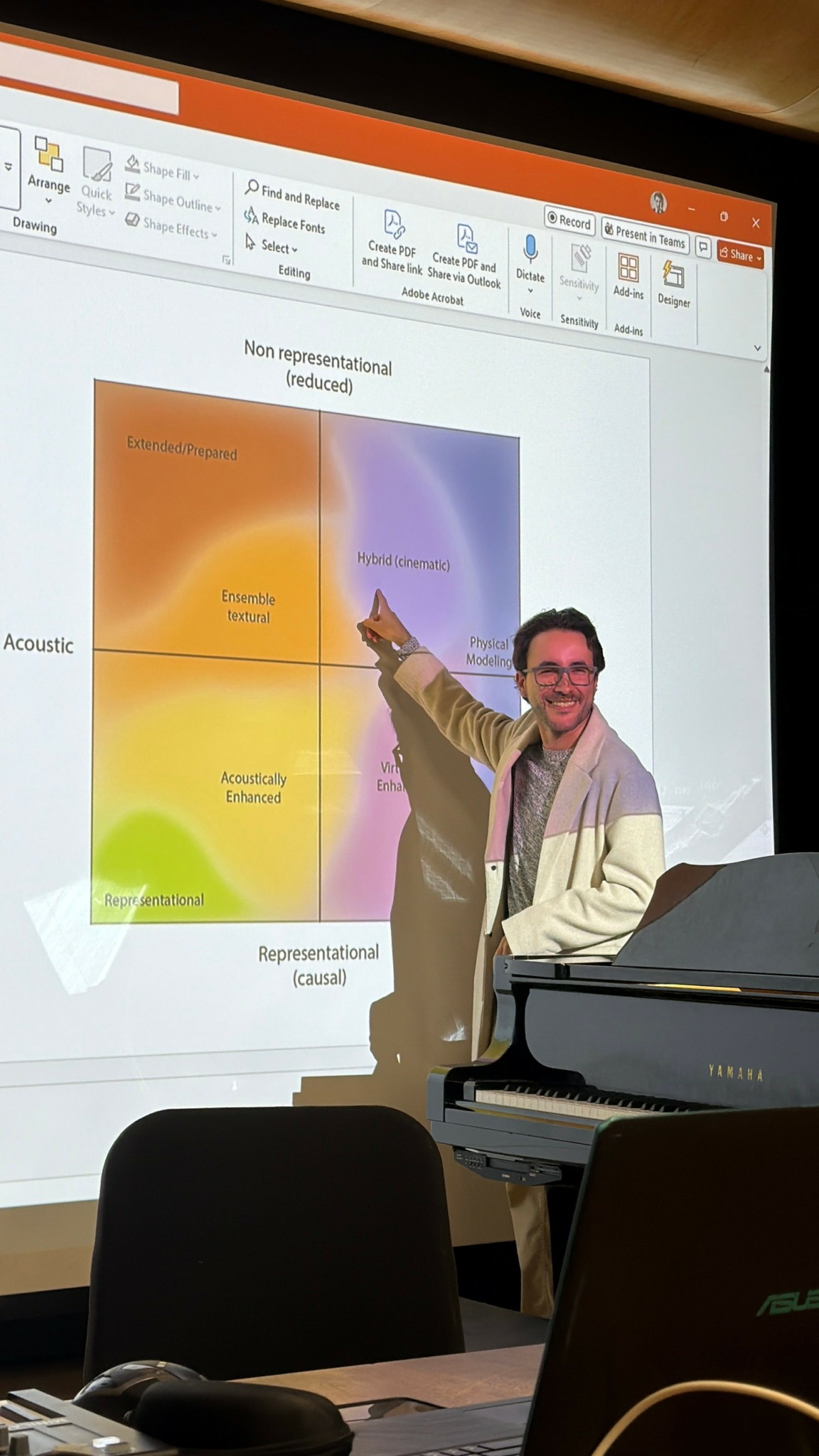
One thing that sets me apart is how comfortable I am working across that full spectrum. I’m as interested in aesthetics and storytelling as I am in the tools that make it happen. I’m currently finishing a PhD where I study how sample libraries and virtual instruments shape the way composers think and work. That research directly feeds into my practice. I’m constantly questioning how technology influences musical decisions, and that awareness helps me stay intentional instead of defaulting to whatever the software suggests.
I also spend a lot of time thinking about collaboration. In media work, music doesn’t exist in isolation, so I approach projects with a strong sense of dialogue. I’m helping directors figure out what their story needs, sometimes before they can fully articulate it themselves. That requires being flexible, fast, and open to iteration, but also being confident enough to offer ideas that move things forward.
What I’m most proud of is the range of environments I’ve been able to work in—from large-scale productions to independent artistic projects, and from industry settings to education. I’ve premiered my own concert works, contributed to commercial media, and helped students and collaborators develop their own voices. I see music as a field that doesn’t need strict boundaries.
For anyone coming across my work, the main thing I’d want them to know is that I take both the creative and the craft sides seriously. I care about the details—how something sounds, how it’s built, and how it functions in a larger system. At the same time, I’m always aiming for something that connects. Whether it’s a score, a collaboration, or a piece of content, the goal is the same: make something that feels intentional and worth paying attention to.


Let’s talk about resilience next – do you have a story you can share with us?
One of the clearest moments of resilience in my life happened during the pandemic, right after finishing my master’s in New York.
I couldn’t return to Colombia because borders were closed, and I didn’t have stable housing. For a couple of weeks, I was living in a theater, trying to figure out what to do next. Eventually, a close friend let me stay with him in Philadelphia for a few months. During that time, it really felt like everything I had been working toward was on hold, and I wasn’t sure how my career would move forward.
When I finally made it back to Colombia, I decided to focus on staying active instead of waiting for the right opportunity. I took on as many projects as I could—TV series, short films—anything that allowed me to keep writing. That period ended up giving me momentum, and it’s what eventually led me to pursue my PhD in Los Angeles.
That experience changed how I think about setbacks. I learned to adapt quickly and keep moving, even when things are uncertain, and that’s something I still rely on in my career today.

We’d love to hear the story of how you built up your social media audience?
My relationship with social media has been a work in progress. I didn’t build an audience overnight, and I’m still figuring it out. What I’ve learned so far is that the content that works best is the content that feels natural to make.
At some point I realized that if content creation feels like a chore, it’s very hard to stay consistent. So I started approaching it from a different angle—what would I actually enjoy making? That shift helped a lot. When it’s fun first, it’s easier to show up regularly, and people can tell when you’re engaged versus when you’re forcing it.
Humor has also been a big part of that. And not just in a superficial way. As a composer and performer, it’s easy to fall into very serious or technical communication, but humor creates an entry point. It makes the work more approachable and helps you connect with people who might not otherwise engage with what you do. That can mean using memes, referencing trends, or just finding lighter ways to present ideas.
That said, there’s a balance. If you lean too much into trends, you risk losing your voice. If you ignore them completely, it’s harder to reach people where they already are. So for me, it’s about filtering those trends through my own perspective—keeping the tone aligned with who I am and what I do.
For anyone starting out, my main advice would be: don’t overthink it at the beginning. Focus on making content you’d actually want to watch, and give yourself room to experiment. Some things will land, others won’t, but over time you start to understand what connects. And once you find that, consistency becomes much easier.
Contact Info:
- Website: https://www.carlosdurancomposer.com/
- Instagram: https://www.instagram.com/duran.zarate/
- Facebook: https://www.facebook.com/duranzarate.composer
- Youtube: https://www.youtube.com/@carlosdurancomposer
- Other: https://www.umamusic.org/


Image Credits
Erica Hou
Merry May Ma
Austin Ali
Valentina Mena Castro