
Alright – so today we’ve got the honor of introducing you to Yuan Tian. We think you’ll enjoy our conversation, we’ve shared it below.
Yuan, thanks for taking the time to share your stories with us today What’s been the most meaningful project you’ve worked on?
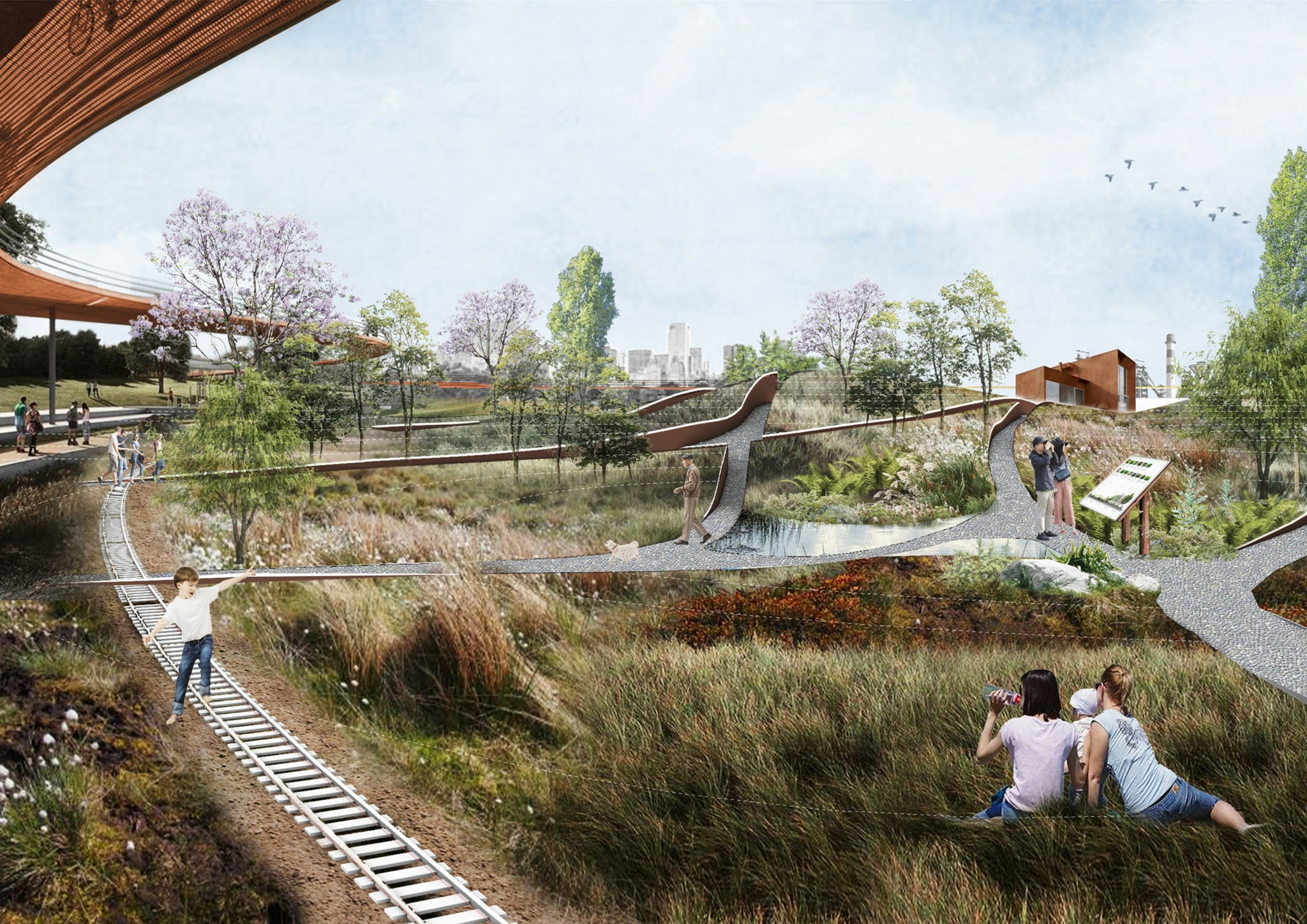
One of the most meaningful projects I have worked on is Back on Rail, a brownfield restoration masterplan in Tianjin, China. This project is particularly significant to me because it reflects my approach to landscape design, not as surface beautification, but as a process of ecological repair, transformation, and long term coexistence between people and the environment.
The site is located in Jinnan District, a former steel production area shaped by decades of industrial activity. Beneath its open ground lies severe soil contamination, a hidden condition that defines both the ecological and social challenges of the site. Rather than treating pollution as something to be erased or concealed, I became interested in how the process of remediation itself could become visible, spatial, and experiential.
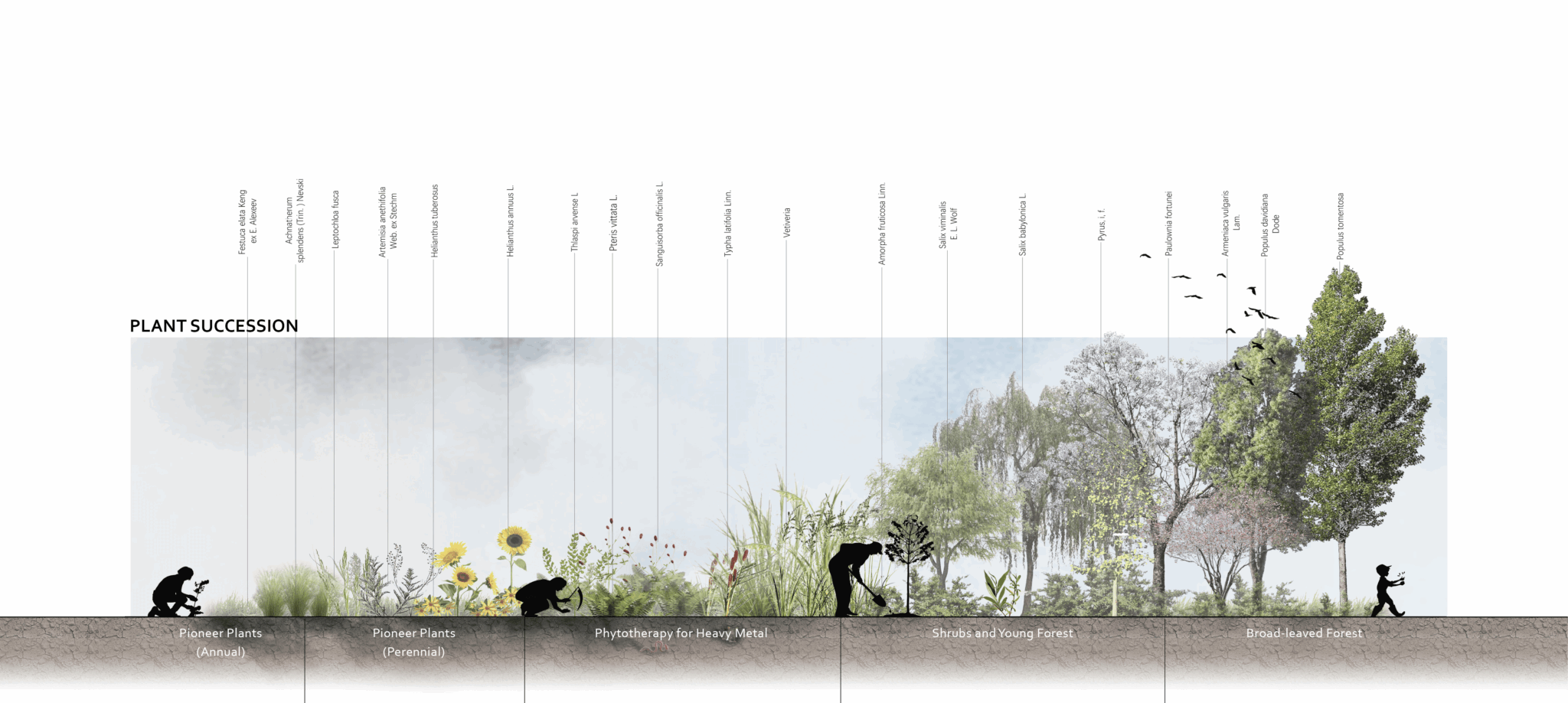
This led to the concept of using the abandoned railway as an ecological spine. Once an infrastructure for extraction and transport, the rail is reimagined as a framework that organizes soil remediation, planting systems, and public engagement over time. Through a phased strategy combining ex situ treatment and in situ phytoremediation, the landscape gradually transforms from contaminated ground to a resilient ecological corridor.
What makes this project meaningful to me is the shift in perspective it represents. Instead of designing a finished landscape, I was designing a process that unfolds over time, where soil, vegetation, and human activity continuously interact. The project also explores how ecological restoration can be made visible and shared, allowing people to witness and participate in the healing of the land.
Back on Rail has received international recognition, including Gold Awards from the IDA Design Awards and French Design Awards, as well as a Silver Award from the MUSE Design Awards. More importantly, it reinforced my belief that landscape design can operate as both environmental infrastructure and cultural narrative, transforming not only physical space, but also how we understand and value ecological processes.
Yuan, love having you share your insights with us. Before we ask you more questions, maybe you can take a moment to introduce yourself to our readers who might have missed our earlier conversations?
About Me
I am a landscape designer currently based in Los Angeles, working at RIOS. I hold a Bachelor of Architecture from Beijing Jiaotong University and a Master of Landscape Architecture from the University of Pennsylvania, with additional studies at the University of California, Berkeley. My background spans both architecture and landscape, which allows me to approach design across multiple scales, from spatial form to ecological systems.
My interest in environmental systems began early in life, influenced by my father’s background in environmental engineering and my childhood exposure to water cycles and ecological observations. This curiosity later evolved into a design approach that combines spatial reasoning with ecological thinking. I see landscape not just as a visual outcome, but as a dynamic system shaped by natural processes, infrastructure, and human use.
In my professional work, I focus on projects that address climate resilience, ecological restoration, and public space design. I have also participated in exhibitions and teaching, and my work has received international recognition, including awards from the IDA Design Awards, MUSE Design Awards, and French Design Awards.
How I Got Into Design
I was drawn to design through a combination of aesthetic curiosity and a deeper interest in how structures and natural systems operate. While my architectural education in China trained me to think about form, proportion, and spatial logic, my graduate studies in landscape architecture shifted my perspective toward systems, processes, and time.
This transition shaped the way I work today. Rather than designing static objects, I am more interested in designing frameworks that can evolve. I value iteration, adaptability, and the ability of a project to respond to both ecological and social conditions over time.
What I Do and What Sets Me Apart
I work at the intersection of landscape, infrastructure, and environmental systems. My projects often deal with complex sites such as post industrial land, urban public spaces, and climate sensitive environments. I focus on translating technical challenges, such as soil contamination, water management, or ecological degradation, into spatial strategies that are both functional and experiential.
What sets my work apart is a systems based approach that connects design with ecological processes. I am interested in making invisible processes visible, whether it is environmental remediation, water flow, or plant succession. My work aims to balance vision with feasibility, creating spaces that are not only conceptually strong but also grounded in real world constraints.
What I Am Most Proud Of
I am most proud of projects that go beyond aesthetics and engage with larger environmental and social questions. For example, my project Back on Rail reimagines a contaminated industrial site as a long term ecological system, where restoration becomes a visible and shared process. Projects like this reflect my belief that design can operate as both infrastructure and narrative.
Beyond individual projects, I am also proud of building a body of work that reflects consistency in thinking, where each project contributes to a broader exploration of how landscape can support resilience, adaptation, and public engagement.
What I Want People to Know About My Work
At its core, my work is about designing with time, systems, and change. I believe landscape architecture has the potential to act as a catalyst for ecological repair, climate adaptation, and social equity.
Good design should not only respond to a site, but also anticipate how it will evolve. It should be accessible, adaptable, and capable of supporting both everyday use and long term transformation. I am particularly interested in creating open and inclusive spaces, as I believe public access is essential to building resilient and engaged communities.
For collaborators and clients, I aim to bring a thoughtful and research driven approach, while remaining flexible and open to iteration. Ultimately, my goal is to create landscapes that are not only functional and beautiful, but also meaningful and enduring.
For you, what’s the most rewarding aspect of being a creative?
For me, the most rewarding aspect of being a creative is the ability to shape how people experience and understand the world around them.
In landscape design, many of the most important processes, like soil healing, water cycles, or ecological succession, are often invisible. What I find meaningful is making these processes perceptible, turning something abstract into something people can see, feel, and engage with.
It is also rewarding to work with time. Unlike many other forms of design, landscape is never finished. It grows, adapts, and evolves. Designing something that continues to change and improve beyond my direct control gives me a sense of humility and long term connection to the work.
Ultimately, what I value most is creating spaces that not only function well, but also shift perception, helping people become more aware of their relationship with the environment and with each other.
Are there any books, videos or other content that you feel have meaningfully impacted your thinking?
One book that has had a lasting impact on me is Gödel, Escher, Bach by Douglas Hofstadter.
I have always been someone who enjoys observing patterns and understanding underlying mechanisms, and this book gave a kind of structure to the way I already think. It explores how complex systems, whether in mathematics, art, or music, can emerge from simple rules and self referential structures.
What resonated with me most is the idea that meaning does not exist in isolated elements, but emerges from the relationships within a system. This perspective strongly influences how I approach design. Instead of focusing only on form, I think about how different layers, ecological, spatial, and social, interact over time to produce a larger system.
At the same time, the book also reminded me that innovation is rarely about creating something entirely new from nothing. It often comes from reinterpreting existing structures and iterating on them in unexpected ways. That idea has stayed with me in my work, especially in projects that involve transforming existing conditions rather than starting from scratch.
In many ways, Gödel, Escher, Bach helped me better understand my own thinking, and gave me a language to articulate why I am drawn to systems, processes, and evolving forms in design.
Contact Info:
- Website: https://www.yuantianstudio.com/
- Instagram: yuan.tian_
- Linkedin: https://www.linkedin.com/in/yuan-tian-95143117b/