

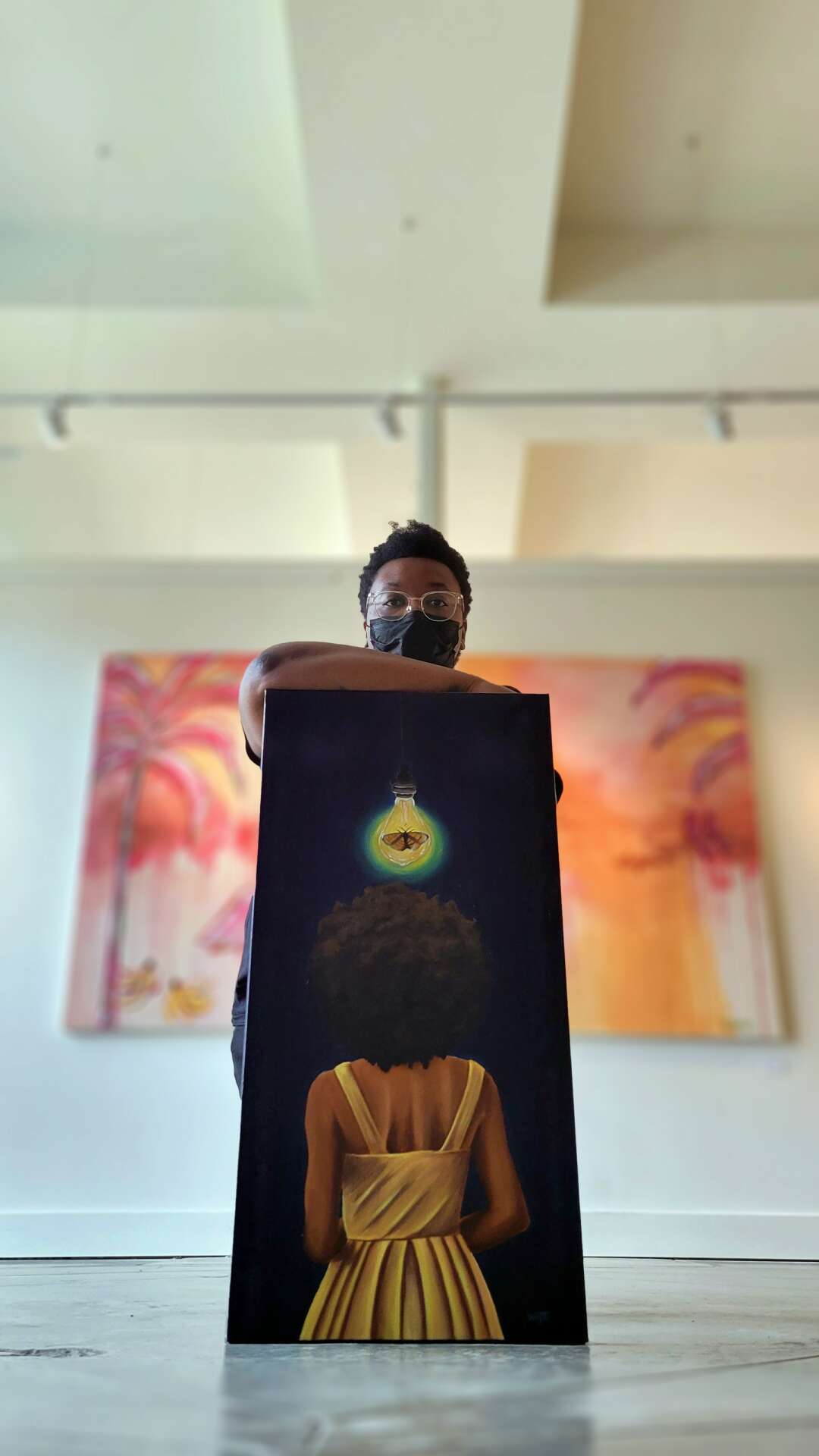

We recently connected with Whitney Tates and have shared our conversation below.
Whitney, thanks for joining us, excited to have you contributing your stories and insights. Did you always know you wanted to pursue a creative or artistic career? When did you first know?
Knowing I wanted to pursue a full-time art career wasn’t an immediate revelation. I’d spent six years working in a corporate environment, each morning more difficult to rise than the last. My work environment was not hospitable or conducive to much creative expression or good mental health. In the beginning, I worked 6 days a week in a large office filled with a sea of cubicles, loud typing, popping gum, personal phone calls, and smelly lunches. The worst part was, there were no windows. So, your average work environment. Only, my job was fast-paced (which I enjoyed), I was coordinating and managing financials and spending for several departments and helped create a smoothly running purchasing process. Still, I was unfulfilled and desperately needed sunshine. I didn’t realize the health detriment working there had caused until I’d had one too many panic attacks, newly diagnosed depression, anxiety, and a myriad of other problems that began while I worked there. Slowly and more frequently, I began to think, “This isn’t what I want.” I’d graduate college with a BA in Studio Art, one of the reasons I’d even gotten the job I was doing in the first place. A freshly polished college graduate, gleaming with joy and naivety. I was underpaid and under challenged, and I somehow lost time to the comfort of a steady paycheck, as insubstantial as it was. However, in 2019, after what could essentially be called a mental health crisis years in the making, I decided it was time to jump. I quit my job and took a risk on myself thinking, “If I’m not making a living working for someone else, I could just as well be struggling while doing what I love.” And that was it. One pandemic later, I’m still at it and I couldn’t be happier, despite the higher levels of stress, insecurity, and responsibilities.


Whitney, love having you share your insights with us. Before we ask you more questions, maybe you can take a moment to introduce yourself to our readers who might have missed our earlier conversations?
I sort of fell into the world of artmaking. Like most kids, I grew up doodling and drawing on any and everything, my parents were proud and of course, my mother kept all of my drawings. But it was just something I did. What I really loved was music. In church, I would pretend to play along with the music on the back of chairs, my fingers dancing wildly as I imagined myself pressing down on the piano keys. I spent my entire school life studying music. Probably too much time, because music theory actually never clicked for me. I’d plateaued and my ability to learn anything new stalled in high school, but chased it never-the-less. I was an aimless teen and didn’t discover my penchant for art-making until I randomly selected the only seemingly feasible choice for college and classes as a 17 year old. It wasn’t until then that I discovered that I could translate my understanding of music into a medium that came more naturally to me. After graduating, I was able to get involved with my arts council and discover artistic opportunities and uncovered a huge art community in Shreveport. I’ve fostered relationships with other artists and collectors which has helped sustain my business and art-making. I am a fine artist with a specialty in portraiture and surrealism. My work is infused with a beauty that calls attention to the darker, less beautiful parts of life. I go beyond the canvas and bring this to public spaces in my murals as well. As terrible as it sounds, my proudest moments are when people cry while experiencing my work. It lets me know that what I’m doing is exactly what I’m meant to be doing. My goal as an artist is to get people to see the parts that they’d rather hide from. To have them confront the difficult things.
How did you build your audience on social media?
I think I’m still on the cusps of learning how to build an audience. I’ve taken many workshops on the do’s and don’ts of social media, and the biggest take away has been quality over quantity. Building a social media presence shouldn’t be driven by numbers. Yes, eyes on your content is important, but if you’re garnering tens of thousands of followers only for them to never see your content, or worse, see it and scroll past, what’s the point? The best outcomes from my social media journey have a result of storytelling. If you strip away all the flashy filters and transitions, what audiences care about the most is a good story and authenticity. Being an honest storyteller is a cherished skill and asset that can do wonders for how your audience responds and engages with you. My audience doesn’t want to see a polished presentation of perfection, so I make sure to share my struggles as equally as my accomplishments. Share the rejections, share the failed experiments, engage your followers, like they were your friends, not a customer.


We’d love to hear your thoughts on NFTs. (Note: this is for education/entertainment purposes only, readers should not construe this as advice)
I can safely say that I’ve reached the age where technology has exceeded my ability to adapt and learn. I still don’t understand NFTs. I just can’t seem to grasp the value of them from a collectors view point. Not in terms of fine art. Perhaps it’s because I reject the idea of artwork as a currency. I’ve always understood NFTs as a modern way for the rich to hide their wealth and avoid taxes by assigning value to invaluable things and trading them as if they meant anything.
Contact Info:
- Website: wetpaintarts.com
- Instagram: @wetpaintarts
- Facebook: facebook.com/wetpaintarts
- Other: https://www.tiktok.com/@maxmarseille