

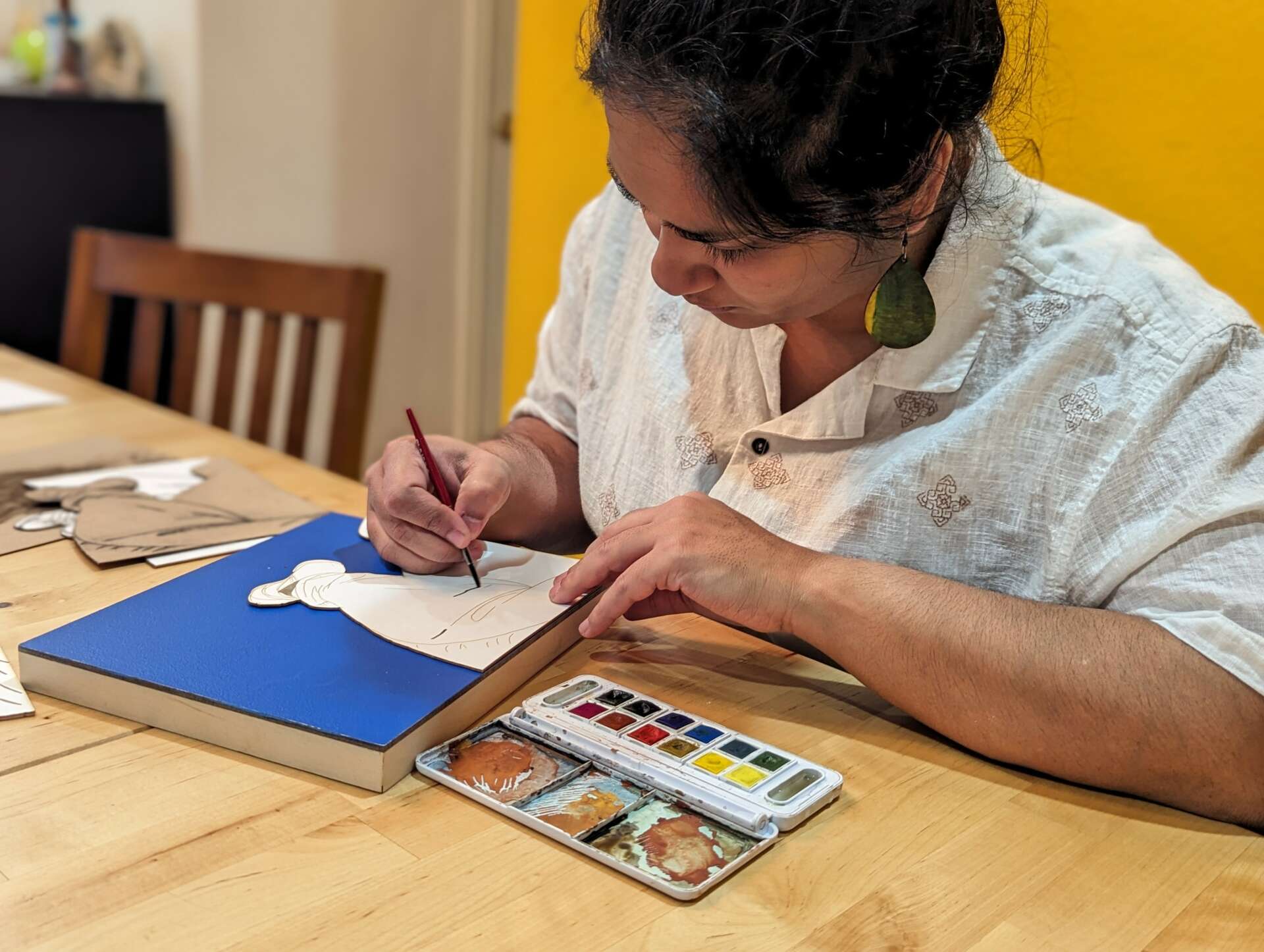

Alright – so today we’ve got the honor of introducing you to Shailee Thakkar. We think you’ll enjoy our conversation, we’ve shared it below.
Shailee , thanks for taking the time to share your stories with us today How did you learn to do what you do? Knowing what you know now, what could you have done to speed up your learning process? What skills do you think were most essential? What obstacles stood in the way of learning more?
The most basic answer is by taking classes. I have been making art since I was young and grew up taking art lessons and watching others make art, but I wouldn’t say those experiences gave me the knowledge about the fundamentals as much as my classes at Austin Community College (ACC) did. I started with the basics of Drawing and Design and then ended up taking a bunch of other classes with a lot of art faculty members at ACC. Besides just different teaching styles, my peers and their experience levels varied, giving me an advantage for receiving unique feedback in each class. I worked with various materials, asked a lot of questions and received a lot of critical feedback. This was also during the pandemic and I was able to maximize the number of studio art courses I took, saving me lots of driving time. I still don’t think I would change anything else to speed up my learning process. The work I am making now is due to my story and my past. All of those events played a crucial role in my artistic development so I wouldn’t change a thing.
Besides the basics of composition, value, and color, the best skills I learned were all behind-the-scenes skills. For example, putting together a frame, using shop tools, creating object lists for works, and listing artwork dimensions as HxW and not LXW as often taught in math classes. These may seem like small things, but they are all skills I have already used numerous times and will continue to use in the future.
The biggest obstacle for me is always time. I would take more classes, work, and make art full time if I had more time. I have a supportive spouse who helped me take some time off to study, but eventually I had to go back to work. I work 2 part-time jobs so I mostly make art at night. Some days, I’m more successful at pushing through my drowsiness and other times, I’m taking a nap in the middle of a classroom during my break. Sleep is always on short-supply but the work never stops.


Awesome – so before we get into the rest of our questions, can you briefly introduce yourself to our readers.
I am an artist based out of Austin, Texas. I make large drawings on paper with dense compositions and repetitive lines. Some of my recent works also include laser engraved paper works. My path to pursuing the arts as a career is not traditional, but that seems pretty common nowadays. I’ve been making art since I was 4 or 5 and I grew up seeing my parents do art projects. My dad made these beautiful, clean drawings that looked printed, while my mom made geometric, embroidered pieces of artwork on paper. I thought about pursuing art for my undergraduate studies, but I wasn’t confident enough to really go for it. I studied Biochemistry and then worked as a High School Science teacher for a few years. In 2020, I took the big leap and left the classroom and enrolled as a student at Austin Community College (ACC). I didn’t take a single non-art class and it was the best! I took Drawing, Painting, Printmaking, and even Ceramics and Sculpture. Working with so many different materials gives me the basic skills for my arsenal in case I choose to make interdisciplinary art in the future. Since the beginning of this year, I have been building my portfolio so I can apply to graduate school. The goal I set for myself was to make at least 24 works for the year, approximately 2 per month. I have completed 17 so far, so I’m a little behind, but I still feel ok about that. The work I’ve made this year has been really personal and it has been the best way to overcome personal challenges for me. I am guessing this is why I have been getting good feedback on my work, because it tells my story. At first, I was really worried about the work I was making, but I had to push past that doubt and just ask for help or guidance. Luckily, I work as a Gallery Assistant at ACC and I’m surrounded by other artists and art historians. They are always up for teaching me new skills and giving me feedback on my art or the direction I should take when I’m feeling stuck or unsure. Additionally, there is a constant influx of art at the galleries and I’m experiencing student, faculty or alumni artworks so that tends to be a constant source of motivation and inspiration as well. The Art professors that I see on a regular basis have also been particularly helpful in the last few months as I finalize documenting my work and learn to practice talking about my work. Each time I talk to a professor, they ask me a different question about my art and it gives me a better idea of what I need to emphasize in my college applications. I also get critical feedback about strengths and weaknesses of certain pieces based on the fundamental principles of art and design. It’s the best type of critique because it is directed towards my work. Overall, it’s been a really good year and I am really proud of all the art I have made this year.


For you, what’s the most rewarding aspect of being a creative?
Surprising myself. For the most part, I don’t know what the end result of my artwork is going to look like. I know the components and I practice drawing them ahead of time, especially if they are based on reference photos. I also experiment with the color palette and/or the paint application techniques ahead of time. Even though I have the ingredients for the work, the end result can still be surprising. It’s tricky because a good artist needs to know when to stop. You don’t want the work to look unfinished and you don’t want to overwork it either. For an indecisive person like myself, it’s always a success when that stopping point comes suddenly. I also love talking about my art. Not why I made it, but what someone else sees or interprets it as. When I talk about my art, some artworks automatically make me smile because they have a personal significance or there is a process involved that I really enjoyed. Pieces like those tend to be extra special for me and I usually want to keep those for myself.


Is there something you think non-creatives will struggle to understand about your journey as a creative?
I have to practice just like everyone else. I am not naturally talented by birth or through my genetics. I don’t get inspired left and right all day everyday, and have to practice my art constantly. Practicing improves my observation skills and muscle memory, enabling me to evolve as an artist. I’ve been working on expanding my color palette, drawing people as frequently as I can to improve proportions for human bodies, and gesture drawing as many things as possible to give up control and let my muscles loose as well. My favorite practice comes from maintaining a sketchbook. At the beginning of 2023, I had two goals for myself: complete at least 2 new artworks per month and keep a sketchbook. At first, it was exciting just to just fill up a sketchbook. After a few months however, the work in the sketchbooks turned into swatches, experiments, notes, ideas, critiques, and tons of to-do lists of sorts. It became my little incubator of ideas. When I finish a piece, if I don’t already have an idea lined up for the next project, I return to the sketchbook and look through my old ideas. Sometimes, it’s all about timing. I’ve had things sit in my sketchbook for months or years before I actually tackle it and that’s ok honestly. So again, practicing is everything.
Another thing someone may not understand is that a finished piece often doesn’t reflect the actual time spent behind it. Not every day is a success and failed attempts are normal. I spend lots of hours taking reference photos, experimenting with different media, and drawing the subject of my work. I often walk away from my work and return with fresh eyes. I ask my professors or peers for their feedback as well when I feel stuck. Ultimately, the final work that I choose to show has many failed sketches and attempts backing it up. It’s all worth it though.

Contact Info:
- Website: www.shaileethakkar.com
- Instagram: _shaileethakkar
- Linkedin: https://www.linkedin.com/in/shailee-thakkar/
Image Credits
Revanth Anireddy, Swati Thakkar, Holland Photo Imaging