

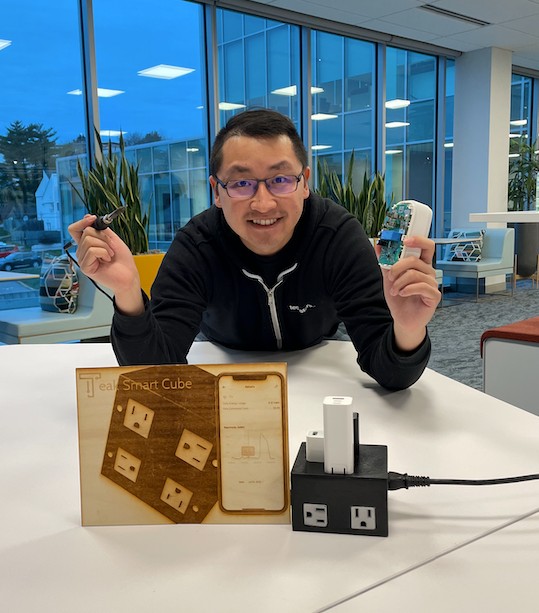

We caught up with the brilliant and insightful Ryan Li a few weeks ago and have shared our conversation below.
Ryan, appreciate you joining us today. How did you come up with the idea for your business?
By accident.
My cofounder and I met at Yale University when we were still students. Passionate in sustainability and technology, we were investigating ways to convert large electric lawn mower batteries into energy storage units to take facilities off-grid. Part of our initial prototype measures power usage of various home appliances and we noticed this constant power draw from devices, even after they are turned off. It turns out, this energy leech (aka “phantom load”) is a well-known, well researched phenomenon for decades. Across the nation, idle electronics suck up $40B+ of electricity and emit 44 million metric tons of CO2 emissions (equivalent to driving 9 million cars on the road) each year. As a concrete example our users identified: a Peloton treadmill costs you $60 per year plugged-in, even if you never ran on it.
What’s mind-boggling is not the problem, but the solution. To this day, the recommendation is to unplug appliances after use or get a smart plug to set your own schedule to cut power off. What we learned from user interviews, however, is that if the onus is placed on the user to unplug or to set schedule, it becomes difficult to follow through consistently. Simply, life is busy and consuming power is far too easy compared to conserving power.
What if the outlet just turns itself off and on, saving energy for users without disrupting lifestyle or business operations? What if it is as easy as plug in electronics and energy saving happens automatically? Thus, we began applying AI to power adapters, combining both user behavior analytics and data from the local utility grid to recommend and implement energy saving schedules.
With energy costs soaring across our nation, we saw homeowners and businesses owners receptive to the level of ease we created to help them identify where energy is leeched, derive savings, and report on impact. These three elements set us far apart from anyone else.


Awesome – so before we get into the rest of our questions, can you briefly introduce yourself to our readers.
With a bachelor’s degree in chemical engineering from Cornell and an MBA from Yale, I’ve been dealing with things that flow: chemicals, liquid fuel, gas, electricity, data, capital, and commerce. I’ve designed green hydrogen production facilities for Shell Oil, drilled horizontal deep-sea injector wells in the Gulf of Mexico, merged energy efficiency companies together as an investment banker, and developed software solutions that integrated Amazon and Alibaba platforms to help millions of SMBs trade in global e-commerce.
All of this is to say I’m a “plumber” with a passion for responsible and sustainable stewardship of resources. My cofounder shares the same passion, though he is much more savvy with hardware, software engineering and manufacturing.
What we are most proud of as a brand is the ability to use technology to help consumers of today become conservers of tomorrow. That’s our mission. You see that in the way our product is built and the impact our customers are creating by simply turning things off.


Can you share a story from your journey that illustrates your resilience?
This was January 2020. We contracted a supplier in China to retrofit their power adapters for our applications. That was how we originally planned to go-to-market, our software plus off-the-shelf hardware. By February, China went into its first lock down and we soon followed. By May, our supplier went from making consumer electronics to making face masks and ventilators. So all of a sudden, we couldn’t make hardware, couldn’t interview customers in person, and couldn’t test our software.
Certain things are just out of your control and there are always blockers to throw you off course. We released our alpha test app without hardware to at least get feedback on UI/UX. It was during this exercise we realized an opportunity to improve not just the software but also the hardware that houses the intelligence. So we started prototyping designs with cereals boxes and getting user feedback on zoom. That was the genesis of the Teak Smart Cube – a really smart power adapter in a modular, cubic form factor that is not only energy efficient but also space efficient, versatile, and sleek looking. And yes, we are getting a utility patent on it too!
Okay – so how did you figure out the manufacturing part? Did you have prior experience?
Yes, we are the factory – literally. Both my cofounder and I worked with a lot of manufacturers in our previous profession. I used to manage Alibaba’s US business and worked with manufacturers around the world. The timing to engage with a manufacturer is critical. Too early, you might put your IP at risk. You might also waste a lot money when you are still in the tinkering mode. Hardware mistakes are incredibly hard to reverse and very very costly. So what worked for us is to source components from different suppliers and 3D print the rest. This allows us to box build the first 10 prototypes ourselves, send them out to early users for feedback, and iterate at a very low cost. We also document how to efficiently assemble our product, so that we can eventually transfer this knowledge to a contract manufacturer. Basically, if you can’t build one yourself, do not expect a manufacturer to somehow cost efficiently build one for you.
The 2nd part is to find the right manufacturer. This is like finding an investor in your business. They are investing significant resources to build your product – what’s in it for them? Where is this manufacturer located and have they built products that have gone through UL and FCC certifications? What happens if the product breaks? What happens if the product breaks and you get sued? These are important considerations beyond just the cost and they can save you a lot of time and heart aches down the road.
We are building this product here in the US! We found our manufacturer through FORGE networks and our accelerator program at Rev Ithaca and Techstars.
Contact Info:
- Website: www.revert-tech.com
- Instagram: @reverter0
- Linkedin: https://www.linkedin.com/company/revert-technologies-inc/