



We were lucky to catch up with Noah Way recently and have shared our conversation below.
Noah, thanks for joining us, excited to have you contributing your stories and insights. Are you happy as a creative professional? Do you sometimes wonder what it would be like to work for someone else?
Yes, incredibly happy. I would be miserable if I was doing anything else with my life. The only times I’ve been truly unhappy is when I was trying to be “regular”, follow the grain, or listen to philistines who had no right to give me advice on my future, under the guise of “guidance”. Yet, of course, being an artist is still extremely challenging, especially in the current landscape of the industry. It’s filled with a lot of rejection, waiting, and a need for determination that’s not for the weak of mind and heart. A teacher teaches every day, a doctor sees patients on the daily, but a filmmaker doesn’t spend every single day on a set making movies, even though that’s their life’s work. Which is partly why I believe an artist is not just a vocation, but a lifestyle. That ideology contributes to my happiness when times get tough.
On occasion, doubt can get the better of any of us. My career choice lends itself to being so gradual in latitude, it’s easy to become disheartened or not see how far I’ve truly come due to being too close to my own path. I think for instance, this past year, a play I wrote spent six months in negotiations to potentially premiere at what is arguably the biggest theater in Chicago. Or like being considered for Apple TV’s Directing program. Neither ended up happening. At first I wanted to beat myself up for not getting those, but when I looked at it objectively, I started to see how even being considered so seriously, for that length of time, I could still call that a win at the end of the day. My name was out there, my work was being discussed and dissected by very prominent auditors, and ultimately, because of that, neither felt like true rejection. Often, this line of work doesn’t always have to do with talent. There are so many other variables and factors that are completely out of an artist’s control. On the days I feel down, I have to remember that to keep me going. Now, I didn’t spend that time idle, just twiddling my thumbs on baited breath, since part of being a successful working artist is having several coals in the fire– never putting all my eggs in one basket; so in the meanwhile, I always find other projects to keep me productive.
However, if others can’t grasp that concept, they think “Why aren’t you working?”. Cruel people say things like “Wow, then this line of work must not be for you,”. And I’m like– “B*tch, I’m trying! You have no idea the hoops I have to jump through just to get into rooms where my project are even considered.”.
Sometimes I see other people my age and they look so blissful. They went to college, got a degree, found a job, clock in and clock out, and now they’re good to go perpetually, seemingly. Locked in for what they’re going to do for the next 40 years of their life. Looking forward to the white picket fence, the annual family vacation to some tropical place. What’s that like? It’s made me say a few times– “I want to be that happy by things like that”. They make the life of box checking look so tantalizing. However, I lack any sort of understanding for it as well. I know a life like that makes many people perfectly content, but it would drive me up a wall after a few days. The inconsistency that comes with my career choice, the cutthroat nature, the never ending ladder, it gives me motivation. Almost, because, essentially– there is no final goal post. There is no end destinations for artists. No gold watch at the end of a 50 year long career at a company. No last box to check off the list to say, “I did it”. The enrichment, culture, flexibility, and enlightenment my artistry brings me is invaluable and insurmountable in comparison to the consistency and safety any “regular” job could bring. As tempting as it has been at times!
Noah, love having you share your insights with us. Before we ask you more questions, maybe you can take a moment to introduce yourself to our readers who might have missed our earlier conversations?
I got into the industry through nepotism. Except I didn’t really. My parents are not blue on Wikipedia. Instead, I started my artistic endeavors by making short narratives in the backyard on my mother’s video camera; stop-motion animations in the basement with a Kodak EasyShare 3.1 MP point-and-shoot starring my most recent LEGO sets; and comedy sketches with friends involving humor that would get us lobotomies if it were the 1950s. Making silly little films as a child and adolescent was one of my only creative outlets. I was just dying to get the swarm of wild ideas out of my head.
Eventually, I began uploading my work to YouTube. To my surprise, the videos gained traction. I was apart of YouTube’s partnership program, which meant I could earn money from advertisements. At 15, I crossed the one million views threshold and also got my first check from Google, I felt such a sense of accomplishment. As I grew older, my vision focused to trying to make more “serious” work. Which really just meant I wanted to be taken seriously. I was in a theater company, taking acting classes, and started upping the production quality of my short films to submit to local festivals– nabbing a few of my first awards in the process!
I started my undergraduate career at 16, due to being schooled at home. At the time, I didn’t have much autonomy, so my options were limited. I went to a local university and double majored in acting and communications with an emphasis in media studies. I didn’t have the resources to know that I could have potentially gone to school for film– but after studying under a couple professors I respected greatly, they helped confirm that being a director was a perfectly viable career path for myself. Upon graduation, I still felt like a “baby” and nowhere near ready to tackle the “real world”. Since I didn’t exactly study my passion, some of my education felt severely underwhelming for what I wanted to do. As it turned out, acting school was one of the best directing schools I could’ve chosen– as it essentially turned me into an acting practitioner instead. However, my other major offered little-to-know upward knowledge in the filmmaking vocation. Their equipment was still in the stone age, using standard definition cameras and technology that was barely relevant at the turn-of-the-century. There was nothing creative to do there, the closest being broadcast journalism– which I did, just to scratch the itch as much as I could– so I still continued to do as much as I could creatively outside of school, sometimes making those projects a bigger priority, much to the chagrin of my communication professors.
When it came to my thesis, I was supposed to write a paper. I ended up writing a 12-page letter to the board, telling them how they failed me as a young, hungry student. The first conversation I ever had with my guidance counselor, years previously, lied to my face. I told him I wanted to do theater and make films. He said the school was “perfect” for me. I believed him, and at the time, it made me feel better about going to a college I didn’t care about. But now that I was in my last semester, and I felt so unprepared for what I wanted to do– I had to call them (and him) out. I’d like to believe my desire to get better at my craft was so strong, it was precocious, not pretentious. So I asked my practicum professors if instead of writing a dumb paper, I could make a short film. They obliged, and I made a short titled “Rooty” for my thesis instead. A 23-minute film about a boy who moves to a new neighborhood and becomes unlikely friends with a talking gorilla. I was the first person in the history of the school to make a short film for their thesis project– and I know for a fact that they now allow future students to have that as an option for their practicum classes as well.
So with those underwhelming feelings still ruminating, I went to graduate school in Los Angeles. This time, for directing and writing. I moved to California, which was one of my biggest goals at the time, and I began working on film and television sets professionally. SAG-AFTRA sanctioned web-shows, projects for Warner Bros, Amblin Entertainment, NBCUniversal, and more. But nobody tells you about what happens when you finally get to where you’ve always wanted to be… it won’t be enough! I don’t mean in an unsatisfied, ungrateful way– but in terms of goals. What I said earlier about artists and that never-ending goal post? I gained some clarity in that regard.
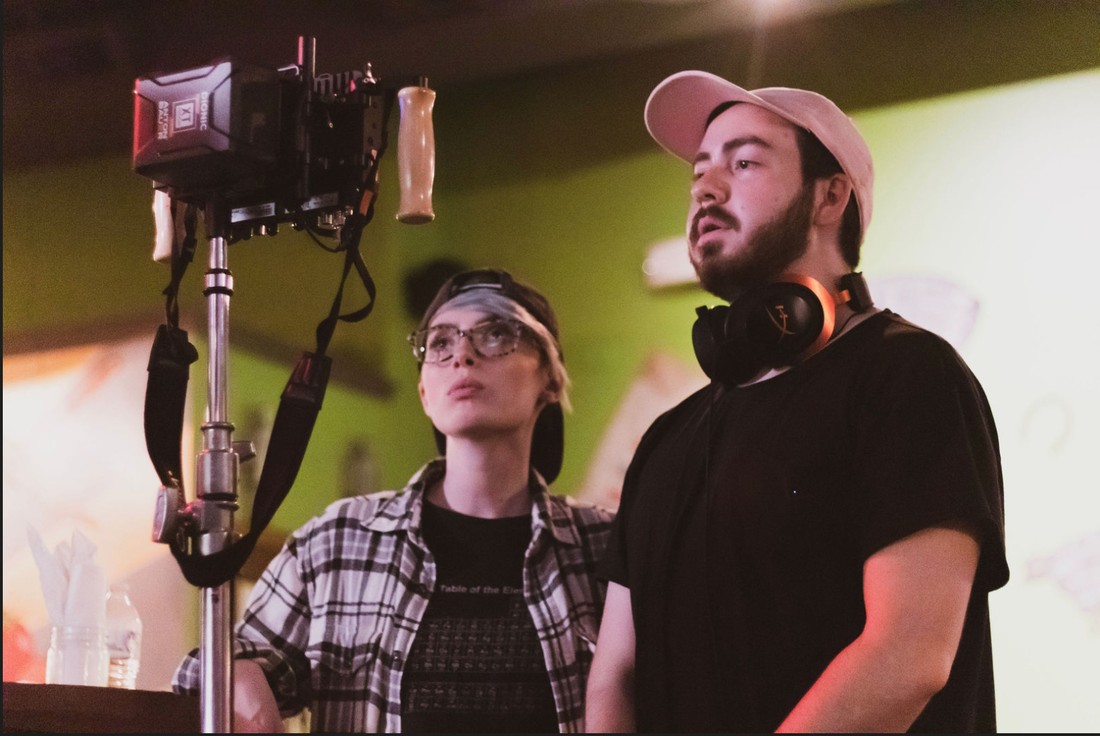
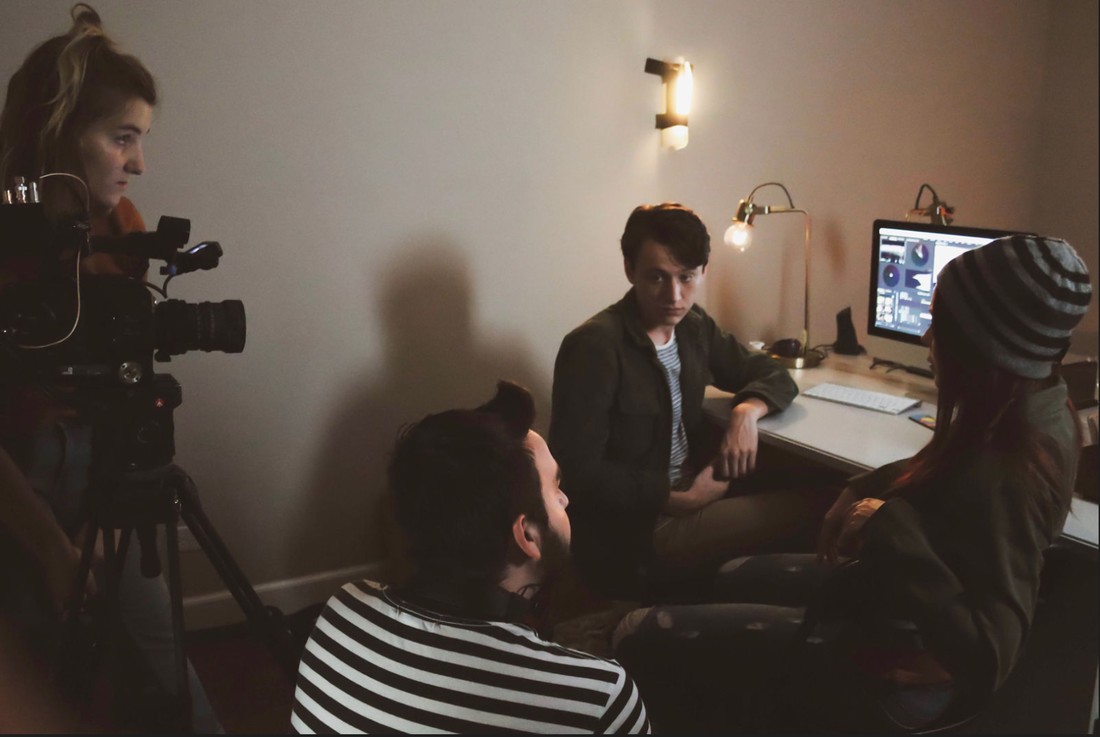
I loved helping make films and television… but it still wasn’t “making” films and television. I thought to myself, if I happened to die tomorrow, what would be the one thing I still regret? Not having made my own film. So I decided I needed to make my first feature film. I wrote a script, called up my oldest mentor, John K. Burke, and asked for his help in producing my biggest project-to-date. By some miracle, despite all odds, it happened. Even though logistically it was practically impossible. Making a movie is one of the hardest things a human can do, in my humble opinion. But I did it. And I was lucky enough to have mine land on Amazon Prime. Which ended up opening more doors for me to make another feature film; one I’m even more proud of. Making a movie was the best film school I could have ever had, even if the end-product never turns out the way you exactly envision it. Going to Los Angeles, studying at one of the best graduate film schools in the country, and making my own content finally had people taking me “seriously”, like I always wanted.
What am I most proud of? I read somewhere that only 10% of filmmakers end up making a feature film. Then, out of those 10%, only 10% of them end up making a second feature. I feel like I’m in a very special, privileged club. I also read that a filmmaker with a “bad” film is better than a filmmaker with no film. So I’ll take a win where I can get it. But I am still very skeptical and cautious to be proud of myself or my work– as I don’t want to muddy the line between pride and complacency. I’m still sometimes worried that saying I’m “proud of myself” will slow the motivation I need to keep going.

What’s the most rewarding aspect of being a creative in your experience?
I think one of the most rewarding things about being an artist is to see the world in gray, versus a black and white polarity. Being in people’s heads and shoes for a living gives room for vast empathy across humanity. It’s one of the best superpowers we have. It unlocks this deep understanding of people and choices that others don’t always have. A villain isn’t always a bad guy; they surely don’t see it that way. So we tend to look beyond and under the surface. An emotionally immature adult or parent makes us instead see a wounded child in need of a hug. Nobody wants to be judged for their actions, so recognizing intentions can help see things in a different light. I was re-hashing this screenplay I wrote a few years back, because there was a potential producer for it– and I came across what is known as Blue-Orange Morality. Both colors being opposite on the color wheel, means they are as far apart as they could possibly be. Sometimes this transcends color theory and directly relates to people. Others lives or choices are so different than what we may know, there’s no purpose in attempting to judge or conclude anything about them at all– it would be like trying to compare the color blue to orange. So instead, we must let it be. Having this frame of mind when navigating the world and dealing with interpersonal conflict over the years has become a major redeeming quality of being a creative person.
What do you think is the goal or mission that drives your creative journey?
I think my biggest M.O. in driving my creative journey is representation and reflecting the human condition known as life. Growing up I didn’t see a lot of people like me depicted in media, or experience anything I had. I wondered why my family didn’t look or act like every sitcom I’d seen in existence. It can be very lonely to feel you are the only person experiencing what you’re going through. I’ve always believed that art is a mirror to society, and that there must be more people like me out there, who are also feeling the same way. My work, since it is highly personal, has been both cathartic and therapeutic in extremely ineffable ways, that is only processed through creation. Art is meant to heal and soothe. At least that’s what it’s done for me; so to create things that humans can watch and feel seen represented, and a little less alone in this world is a prime example for the drive of my existence.
I’ll never forget… when my first feature had a public screening a few months after its initial release. The audience was filled with people consuming my work, a very bizarre feeling. When I introduced the film at the beginning of the evening, I prefixed with letting the audience know I didn’t think I was making the next “Citizen Kane”. But that if for an hour and a half, I could make people forget about their problems– shut off their brains to the horrors of the existence, only for a moment, it was mission accomplished. Following the screening, a young girl, barely in high school found me. She told me that she had cancer– and that it had reeked havoc on her life, understandably so, since her diagnosis. Then, she disclosed, that when she watched my movie, for 100 minutes, she got to laugh and enjoy herself– and for a brief moment in time, forget about her cancer. I was so moved. That interaction has stuck with me permanently. I was like “Oh! That’s why I do this,”.
Contact Info:
- Website: linktr.ee/noahway
- Instagram: instagram.com/itsmenoah
Image Credits
Amy Nelson Photography