

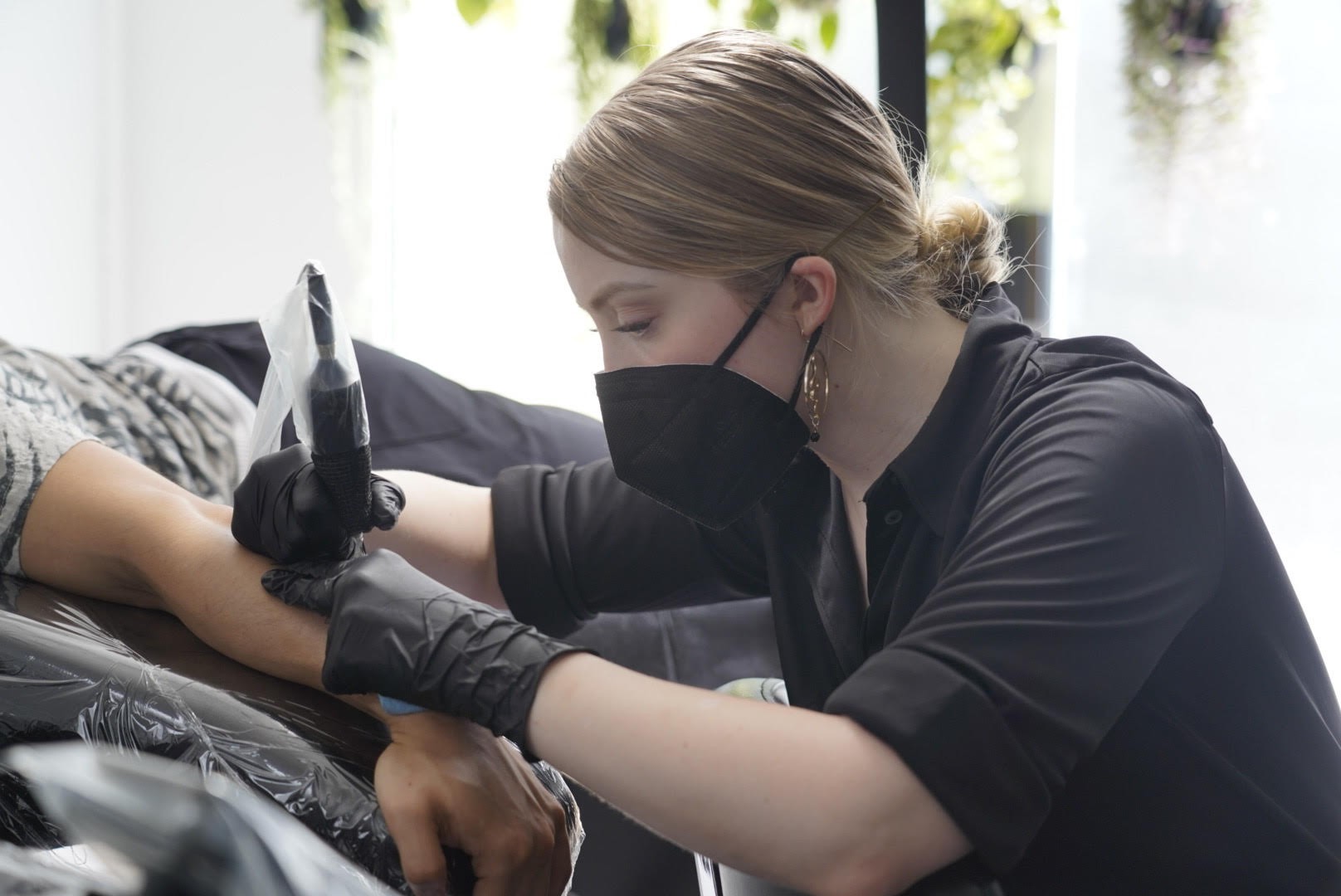

Alright – so today we’ve got the honor of introducing you to Morgan Black. We think you’ll enjoy our conversation, we’ve shared it below.
Morgan, looking forward to hearing all of your stories today. When did you first know you wanted to pursue a creative/artistic path professionally?
This is a complex question that I think has two elements to it–where did my creativity originate from and when did I direct my focus to tattooing?
From childhood to present day I have always been enamored with art in all of its forms. I was about six years old when I entered my first singing competition, eleven when I had my first poetry publication and twelve when I sold my first piece of traditional artwork. I had all the time in the world to create at that age and I became truly obsessed in every sense of the word. When I entered high school, my mom took me down to what I think was the local treasury office in Sacramento where I applied for my business license and seller’s permit. I thought it was just the coolest thing ever, I set up my Etsy shop the same night and applied to be a seller at some local farmer’s markets and conventions.
My first big convention around that time was SacAnime in Autumn of 2010. I rented a booth, dressed up as Maka from Soul Eater, and sold a bunch of handmade jewelry, prints, and clothing. I remember I made around $350 profit from the entire convention which was a lot of money to a thirteen-year-old. I was completely thrilled! I continued working conventions for another five years after that.
As for tattooing, it had always been a passion of mine but it took a backseat to my professional business endeavors for many years. I began drawing on skin consistently around age eleven, gave myself my first hand-poked tattoo at twelve, and made my first tattoo transaction at fourteen. Throughout high school I traded hand-poked tattoos to a few of my friends and classmates in exchange for homework answers (sorry mom–work smarter not harder, right?). I sold my first commissioned tattoo design to my teacher (shoutout to Mrs. Buscher!) when I was sixteen.
So you could say I have always been pursuing a creative path professionally, since grade school. I was a rebellious kid who gave a fat middle finger to anyone who told me that my art could not make me a living and I succeeded in proving them wrong.


Awesome – so before we get into the rest of our questions, can you briefly introduce yourself to our readers.
My friends and fans call me Mochi–I’m a big softy with squishy cheeks and a hardcore love for Japanese culture, which miiiight have something to do with my nickname. I was given this name by my friends within the cosplay/anime community and it has stuck with me since then!
I am a multidisciplinary artist currently specializing in fine-line, black-and-grey tattoos and am most known for my work involving Studio Ghibli.
Getting a tattoo with me may be a different experience than some are used to. I focus heavily on continued consent and bodily autonomy with my clients and pride myself on providing a high-end, peaceful atmosphere in the studio. I work best in a bright and cheerful environment vs. a dark and crowded or loud environment. As a neuro-spicy individual with trauma history, I think it is important to provide a comfortable experience for clients that takes into account this need for absolute safety and peace. Tattoos can be a powerful way to reclaim one’s body and I would love to be the best ally possible for those who feel this!
When I accept a tattoo design, we enter into a collaborative process where your creative input is highly valued. I take special care to inform my clients of technical limitations and aging factors for each design, with the goal of creating tattoos that last a lifetime. I am also realistic about expectations, budgeting, and time frames. I can’t always promise everything you might want, but I can promise a beautiful tattoo that values your creative vision.
I hope to work on more large-scale and detailed composition works in the near future. Thank you for your continued support!
Looking back, are there any resources you wish you knew about earlier in your creative journey?
I wish I knew how common it is to self-teach tattooing before I committed to a traditional apprenticeship.
Traditional apprenticeships can often be an unfair exchange of time/labor in favor of the mentor–my own apprenticeship was no exception. I’ve spoken to dozens of tattoo artists who regretted their apprenticeships, who felt exploited and traumatized by their mentors. Young artists are often subjected to the whim of their mentor’s moods and demands, which leads to an emotionally stressful workplace. A traditional apprenticeship can also lead to artists getting “pidgeonholed” into becoming carbon copies of their mentor, leaving little room for personal style or creative desires.
There are many forward thinking tattoo artists nowadays who share their knowledge freely with colleagues, or via platforms such as Youtube and Patreon. I love the free technical videos from Jono Smith via Youtube and have purchased a few specialized courses via Udemy in the past. The most surprising thing I learned as a newbie was that MOST tattoo artists are very kind and approachable people! As long as you are respectful of their time and effort, it is not hard to befriend other tattoo artists and ask a few questions–just don’t rely on them to explain everything to you. Do your own research, participate in the tattoo community via social media, and make sure you are bringing value to the industry.


Is there something you think non-creatives will struggle to understand about your journey as a creative?
I think that the devaluation of our work is probably the biggest gripe most artists have with non-creatives. People are quick to judge our pricing without understanding the true cost of the profession.
I think an excellent example would be this story about a woman who approached Picasso in a restaurant, asked him to scribble something on a napkin, and said she would be happy to pay whatever he felt it was worth. Picasso complied and then said, “That will be $10,000.”
“But you did that in thirty seconds,” the astonished woman replied.
“No,” Picasso said. “It has taken me forty years to do that.”
For tattoo artists, it is the same. I spent eight months as an unpaid apprentice to become trained in my specialty, where I did hard manual labor roughly twenty hours per week. I also held a day job at the same time to pay for the costs of my equipment. This is on top of the fifteen years of arts experience I had prior to my apprenticeship. Most tattoo artists share a similar story–we have invested our entire lives into being able to do what we do.
Aside from the investment and education it takes to begin tattooing, there are also heavy costs associated with this profession. Tattoo artists bleed money left and right–.the average tattooer is only taking home about 20-30 percent of what they charge. It is also important to consider the hours of unpaid administrative work and design work we do behind the scenes, as well as the physical damage we endure for our art.
Montserrat Andreys, a chiropractic sports physician based in Portland, Oregon, was quoted stating that, “tattoo artists literally put their bodies on the line for your beautification.”
“(Artists) are in a static, singular position that doesn’t move,” Andreys continues, “so nutrients can’t get in, waste product can’t get out. The muscle is basically screaming for blood flow and oxygen — that’s where the pain signals come from.”
In addition to sitting still, holding a heavy, vibrating machine for up to eight hours per session generates adverse effects for tattoo artists. High levels of vibration can damage the nerves, blood vessels, and capillaries in their hands because the oscillations are overstimulating for the body, Andreys says. Some tattooists experience stiff muscle contractions as a result, as well as a syndrome that turns people’s hands and fingers white.
Only one study exists on the prevalence of chronic pain among tattoo artists. Researchers at The Ohio State University found tattoo artists exceed the maximum levels of muscle excretions recommended to avoid injury by up to 25 percent, especially in the neck and upper back. All of this on top of the biohazard risks tattoo artists face every day.
To make a long story short, we (creatives) wish to be valued for our hard work. Understand that creating tattoos may be fun, but it is certainly not easy. It requires major sacrifice and dedication to succeed in the tattoo industry. Artists deserve fair wages, enough to cover our cost of living and still be able to invest in benefits such as quality healthcare and retirement funds.
Contact Info:
- Website: www.blxckmochi.com
- Instagram: www.instagram.com/mochi.tattoos
Image Credits
Katie Mizuno Kento Mizuno