

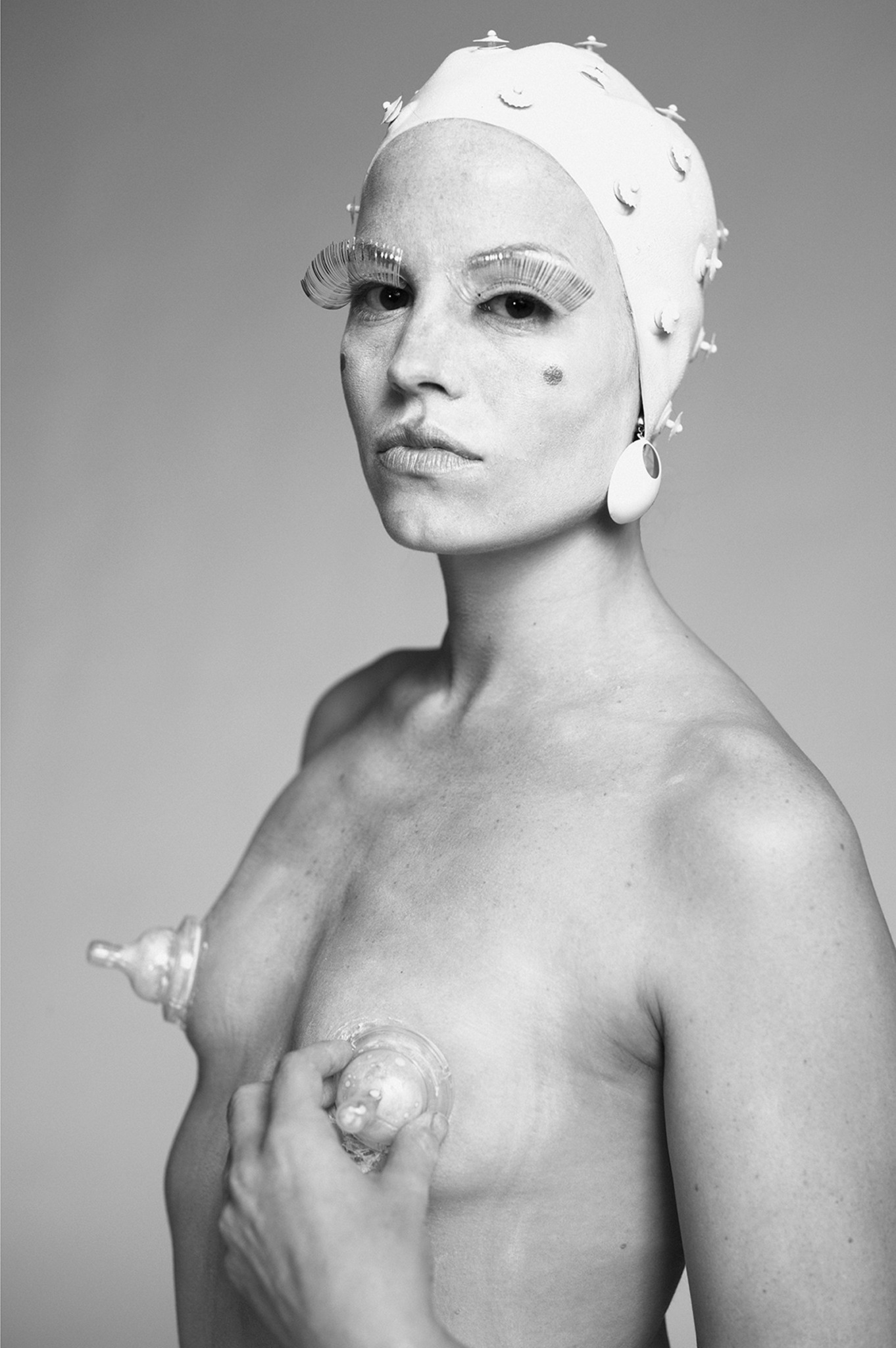

We recently connected with Molly Valentine Dierks and have shared our conversation below.
Molly Valentine, thanks for joining us, excited to have you contributing your stories and insights. Can you talk to us about a project that’s meant a lot to you?
There have been many but one that really sticks out, for me, is ‘I Worried’, a public art project, mounted at Franconia Sculpture Park in Minnesota, which is now a permanent installation. For the project, I worked with lines of favorite poet Mary Oliver’s poem ‘I Worried’ which is about love and loss, anxiety and control, and the process of letting go. I put modified lines of her poem on street signs of all shapes and sizes, meant to direct people on a walk through the park. Initially, the street signs also acted as conductors (speakers) for sound- the sound was created using electrodes attached to local plants and the skin of residents, mixed with nature sounds, and made a sort of meditative song for 5 of the 9 signs. The sound system was solar powered and motion activated and, unfortunately, could not survive the first harsh winter. Now the signs exist as meditative instructions for what it means to grow older, to surrender, to gain a deeper understanding of the nature of self and control.
This was one of my first real experiences with public art, and I loved it. It also allowed me to marry my love of technology with my love of nature, and translate or filter each love through favorite poets and poems. My favorite aspect of this piece is its existence beyond me, for people of all walks and ages and backgrounds. To me this is the most fulfilling aspect of being an artist, when you can step beyond siloed spaces and meet people where they are. I have gotten a lot of positive feedback on this piece and it has a special place in my practice and my heart. The generous support (funding and fabrication) also gave me the space to understand how much help and support each project needs and to no longer be shy in asking for this help- it’s necessary. Being an artist is a job, and an important one. Being able to make a public artwork is one of the most fulfilling experiences a maker can have for its ability to have a life that connects with people beyond a single exhibition.

Great, appreciate you sharing that with us. Before we ask you to share more of your insights, can you take a moment to introduce yourself and how you got to where you are today to our readers.
Sure! I love this question, because I hope it inspires people who are thinking about a creative career but on the fence. Just do it ;)
I went to an Ivy League school, funded by a surprise inheritance from an aunt who had passed away. While I adored school and learning, I really faltered in this environment. The kids were really wealthy, and on track to make LOTS of money in industries like banking, legal professions, etc. There was very little talk of creative work and creativity. I studied psychology, and am grateful to have a college degree, but I think so much of what I learned was what I DIDN’T want for my life, as much as what I did. I discovered art classes my junior year and was hooked but it was not enough time for a double major so I had to sacrifice a lot of what I wanted to do or learn to complete my degree.
Out of school, I tried the office world- HUGE fail, laughing. I was miserable in an office. So, I began a tutoring business, because I have always loved teaching. From there it was really a series of adventures on how to support myself as an adult, study art, and put myself back through school. This led to a post-baccalaureate at the amazing Sculpture and Extended Media program at Virginia Commonwealth University, then as many classes as I could take the following 2 years to learn how to work with every kind of material that drew my curiosity, from rubber, to video, to glass, to plaster, and then a stint in New York to save money, followed by a graduate degree at the University of Michigan in interdisciplinary art and design. There are many things I might do differently if I could go back in time, but all in all, it led me to make some amazing projects, and it showed me how determined I am to live a life that is meaningful to me (and I hope to others, through both projects and teaching).
My work is primarily about the ways that people feel connection, or conversely, disconnection… from self, one another, our world and environment. I am fascinated by this vibrant, fractured landscape of digital extensions, tools, filters, and mediators we have made proliferate, and I wonder at tech’s efficacy for engendering intimate connection, Much of my work factors in my studies in post-modernism (just a term for how our social sense of self has changed over time ), gender studies, and design. But really my practice, through the lens of poetry and fiction, and the languages of nature and technology – deals with my fascination with our desire to connect to one another and how it is successful or how it fails. It is more observational in nature. While I feel what we are doing to our environment is short-sighted and frankly, terrifying- the work considers the entanglement of nature and technology from a light that acts more as a witness, than a keeper of answers. The work is light and dark, sensual and alien at the same time: in many ways, it mimics how we feel about one another, or ourselves in this weird landscape of social connection we have developed. More and more, I filter unresolved stages of life – grief, longing, love, loss- through my work. The work offers no solutions, political stances, or opinions, really. I tried that once or twice, but it felt disingenuous. And more and more, I am drawn to larger-scale funded works that engage the public, or exist in public spaces, beyond the gallery. I love the idea of just going about your day and encountering a work of art that changes your perspective on something, or helps you sit with what is weighing you, allows you to just be for a moment- not do, do, do – but – be. The best art or poetry or writing I have encountered enables you to be comfortable with contradiction, depth, and complexity. To me, that is the true nature of human experience, and our desire to dissect, to preach, to categorize, to divide etc etc. hurts us, I think. I love public art, and all forms of art in general because they are a precious space that allows for contemplation, for open-endedness, the lack of resolution.
Learning and unlearning are both critical parts of growth – can you share a story of a time when you had to unlearn a lesson?
I would say a couple of things. I had a hard time feeling like I had to (or have to, this is ongoing) ‘fit in’. So I will say the first thing to know is that your practice and your work is your own animal, and no one else’s. We live in a society that encourages production as if we are machines. The very point of being an artist is to fight this narrative, to be human. So, therefore, you must allow yourself to be human- you have to live, and be vulnerable, and connect with people. Eat, sleep, and have hobbies. All of this, of life, of being an artist is a process, so find a way to enjoy it as such. Self-care is not much talked about in the world of art, and certainly not in academia. There are ‘heroic’ stories in each sphere of locking oneself away in backbone of white male capitalism (sorry, not sorry). To really create good and meaningful work, you must take breaks, feed yourself, feed your needs and LIVE. I really believe this and fight against the ‘work like a machine’ narrative. Your practice will unfold at its own pace. And every time I have had to push something too hard, it has failed – I have not gotten the grant or show, I have hurt myself etc. etc. There are times of stress and hurry and that is natural. But just don’t make it a lifestyle.
The second, along this line, is embrace who you are as an artist. Your method of working is going to be different to every single other person’s. You may need to lay on your back and stare at clouds for 3 hours before making something, you may need to shut off every device to focus, you may need lots of social time, you may need lots of mess, or conversely an insane level of organization or a favorite rock in your pocket. You will absolutely encounter people who do not understand this and they will make it known for some odd reason. Ignore them or limit contact or sharing.
Community is essential, it is the lifeblood of recovery and inspiration. Surround yourself with weirdos, people on your frequency, and watch your juices rise, it is magic, and it is crucial to your wellbeing and success. The lonely artist narrative toiling away in lauded isolation is just goofy. You may need to be alone to work but you will also want community that supports you.
Listen to yourself but balance this with the practical- hours that correspond (mostly) with daylight, good health practices, meeting obligations (trust is important), mostly paying bills ;) Be responsible while staying truest to who you are. Cut the fat of anything inauthentic, it is a waster of time. It is a balancing act, you will learn.
Finally, be proud and say who you are, but without rancor. If you get too spicy trying to explain who you really are to someone, this is not a person who deserves your time in that way. Love them anyways if they are important to you and you do you, but keep it close to the vest. Your confidence in who you really are is your golden ticket. Follow it relentlessly.
Can you share a story from your journey that illustrates your resilience?
Hmm, well I have moved over 20 times for work. Each time, I have to make new friends. And I have had times where I had so little money, I was literally taking toilet paper from public restrooms.
I love something Alyssa Liu (the Olympic skater) said about struggle, about it making you feel alive. So true! Your life, as a challenge, really comes alive. The colors are richer, the smells and textures more vibrant, you are LIVING, not just staring at a screen in a comfortable apartment. You connect with peiple more deeply, you find your tribe, and you commit to the magic that is living life on your terms. It is honestly so awesome. In the moment, you may want it to end, and it will, but man I would not trade the periods of struggle for anything. You get really comfortable with what you actually need versus what you want, you develop the ability to really live in the moment, the ability to laugh. A life without struggle is like eating oatmeal every day, it’s boring. So yes! embrace the struggle, it is essential for growth. Never get too comfortable. But also enjoy comfort, not everything has to be hard, that is some Puritan nonsense. You can get through struggle and enjoy the sensuality of life too. Both are very important.
Contact Info:
- Website: https://mollyvalentinedierks.com/
- Instagram: @mvdierks
- Facebook: mopollopy dopierks
- Linkedin: no idea :)
- Twitter: no to Elon :)
- Other: that is all – thank you!
Image Credits
4_Day Labor: Shawn Saumell