

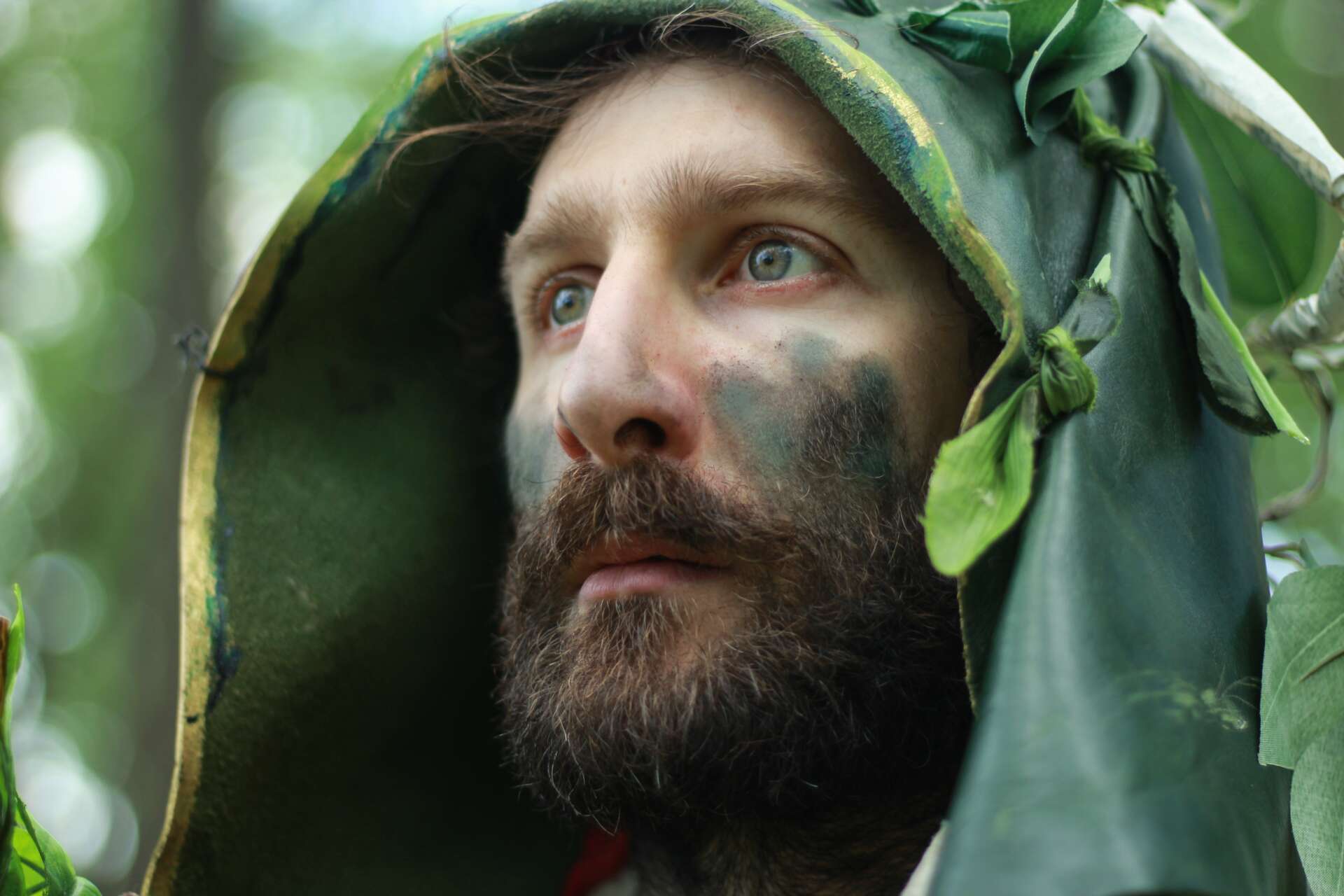

We recently connected with Michael Masurkevitch and have shared our conversation below.
Alright, Michael thanks for taking the time to share your stories and insights with us today. One deeply underappreciated facet of being an entrepreneur or creative is the kind of crazy stuff that happens from time to time. It could be anything from a disgruntled client attacking an employee or waking up to find out a celebrity gave you a shoutout on TikTok – the sudden, unexpected hits (both positive and negative) make the profession both exhilarating and exhausting. Can you share one of your craziest stories?
In the profession of acting, no two days are alike – but I’ve had some days unlike any other. In film, we use audio and visual tricks and cues to craft a new reality of a story for people to watch – and in low budget independant film, we do this by any means neccessary, usually weird practical solutions because “fixing it in post” is actually more expensive.
Probably the most extreme was the feature film “Snow Blinded” because the second half of the movie includes moments of explosive gore and body horror, and a whole lot of my character running around buck-naked in the snowy forests covered in fake blood and sometimes prosthetics. It took three years to film – the first year an actor dropped out because he was too cold (and he wasn’t even naked!) and did some reshoots, the second year we filmed a lot of the deep woods scenes that didn’t have gore while we applied for funding, the third year we got $10K – peanuts for film, but enough for our prosthetic effects and gore to look the part.
The coldest day of filming was the pivotal scene where my character, still fully naked but now covered in prosthetics, had an emotionally moving scene alone in the woods that involved some basic stunts – specifically me holding on to some handles we screwed into a tree to look like I was hanging from it. Now usually, to keep warm between takes, I would be doing karate and yoga to burn energy and manage my temperature, which actually worked better than trying to pull a coat on and off (Especially because the coat would stick to the fake blood and then my makeup would need to be redone.) Picture me, naked in the snowy woods surrounded by camera people and covered in fake blood, for hours, doing karate to stave off hypothermia, wearing only ski boots – that was my life.
But with the heavy prosthetics on for the final scene, I couldn’t do my usual moves – it was too cold for the silicone to stick so I was basically holding on certain layers. I was freezing. Perhaps the coldest I had ever been. The makeup guy, taking pity on me, brought me some of those hand warmers. I placed them on the coldest part of me – the part downstairs. They stuck in the coagulated sticky fake blood, and I forgot about them.
Then, finally, everything was ready for the final shot. I reached up to hold myself on the tree, preparing to ‘turn off my shivers’ when the camera started rolling. The Director called for Finals (last minute touches on makeup) and the prosthetics guy came to pour more of that frigid fake blood on my body. Then he stopped, and looked down… And, very carefully, pulled the hand warmers out of the coagulated blood so they wouldn’t show up in the shot. “First time I’ve ever done that” he said.


Awesome – so before we get into the rest of our questions, can you briefly introduce yourself to our readers.
When I was five years old, my Uncle – a stage actor – pulled some strings at the dinner theatre production of “Treasure Island” to get my family tickets, and have me be one of the kids pulled on to stage to be one of the “Pirate Crew.” I was in heaven. I became obsessed with performance, and attention, dressing in my mother’s clothing to put Elton Jon concerts on for my relatives at dinner parties. That wasn’t really what drew me to acting though. Acting is about living truthfully in a different reality – one that we build in our heads using the “choices” of what is true for the character, and what would need to be true for us to be that character, feel their feelings and let our words and actions come from those feelings, like a temporary consensual hallucination. As a child, my parents didn’t believe in television, so I would go outside and make up imaginary friends to interact with, and we had a rich social life. When my little sister was bored, I made us a fake dog and two cats, who would help us solve mysteries. We also had a couple imaginary friends who sometimes would pull us into their drama.
It has been said that “Michael Masurkevitch has a tenuous hold on reality at best” (by a best friend who was at the time annoyed with my antics) but I believe this to be not only true, but also one of my strengths as a creator.
Acting is about love – the most basic, root-emotion that one could argue, underlays every emotion, even the evil ones. When I analyze my characters, no matter how virtuous or villainous, I take it back to the love at the core of their story, and then build a mental map of how to get there from love. Then I get myself in a place of feeling deep love – not “for someone” (although thinking about my son is a good shortcut) but the simple emotion of love itself. From that place of love, I follow the mental map to the characters’ specific emotions and live in them. Sometimes it’s not fun or pretty – I have played some complete monsters, and a lot of ‘regular guy that descends into madness’ roles. Sometimes I spend hours, meditating or in the shower, letting go of the character’s pain and tortured desperate needs for validation, so I can get back to my life. But when I am approached about a role like that, I rise to the challenge of finding the love that motivates even the darkest of characters.
This is a contrast from light, funny commercials. The technique is the same, the material is just shorter and usually more entertaining.
Meditation is a big part of how I work – it opens myself to my emotions, my angels and demons, so that we can create together.
Writing – screen writing, even children’s books – is approached differently by many people, but for me, it is an extension of the same creativity. In writing, I get to not only find and follow the love of one character, I get to do it for all of them. I’ve had to do a whole lot of learning about story structure too – story structure creates and holds the space in which the characters grow and change. When I write music, it’s a similar process of receiving or allowing emotions and finding ways to use structure – in this case notes and rhythm – to hold space for them to flow.


Learning and unlearning are both critical parts of growth – can you share a story of a time when you had to unlearn a lesson?
The lesson “let go of the results and enjoy the process” has become vital to live by.
When I was young, my self worth issues (which I think we all have a version of) came from a lack of attention, feelings of neglect and unworthiness – that were soothed when I received positive attention for performance or creative efforts. In late-highschool I had a baby, who lives with my parents and I to this day, and felt I needed a real job. When I realised that living with my parents gave me more freedom and went through my Quarter-Life Crisis, I was drawn back to my childhood dream – acting.
It was the ideas of success – fame and attention, validation and money – that drew me there. It was my childhood pathelogical need for attention, that stayed with me throughout my ‘class clown’ life, that kept me going back for more rejection. Then a year in, when I realised these things weren’t coming, I had my first breakdown, questioning my choices and worthiness.
What came out was that I needed to value myself intrinsically and unconditionally, not from external sources. When I did, I came to see that acting and writing inspire and engage and light me up like nothing else, and the search for validation and worth through fame and fortune were just what I needed to bring me there. Now I have a “healthy emotional breakdown” about once a year, discovering truths like how I was self-sabotaging for a subconscious need for control in the audition room (The only way to control the outcome is to ensure failure otherwise its up to casting) but the underlying lesson is always the same:
When I love the process and forget about the results, every role and audition becomes a gift of an opportunity to do what I love, no matter the results, and allow the results to come as they may. Funny story – the results seem to improve significantly when I let go and allow them to do their own thing, and just enjoy the process.


Do you have any stories of times when you almost missed payroll or any other near death experiences for your business?
On big sets – and I’ve been on a few, for Union tv shows or commercials – they have teams devoted to stunts and safety, and stunt-people who have trained to be safe in high-risk and are compensated with danger pay.
On low budget independant sets… That’s not the case.
Hypothermia: twice. The Snow-Blinded prosthetics day was obviously one of them. The other was for a music video I was directing for a song I wrote, which had some underwater scenes of myself trapped in a cage underwater, drowning. We were supposed to film in mid-September but due to life, it was pushed to late October in Lake Huron. I was the one demanding take after take to get it right – my crew was in the rowboat, they were complaining the water was making their hands cold from holding the camera under the surface. When we finally wrapped, I was shaking for several hours.
Fight scenes are a lot of fun, I have a martial arts background (I wanted to be a Ninja Turtle when I grew up, still working on the turtle-part) and love using it for film.
Probably the coolest was a sword-fight for a heavy metal music video. Day one we filmed the story stuff. Day two, at the top of the day, our stunt-guy and villain (amazing martial artist) and I spent hours choreographing the elaborate fight scene that the director wanted to just film through “from soup to nuts” over and over again. It was a long and elaborate display of martial mastery.
By lunch, we were warmed up and in the zone. The cameras started rolling, and we kicked up to full speed, fighting with dull (but still sharp) steel blades.
By the end of the day, we were both exhausted, and one of the swords was getting a bit loose. But the Director needed more angles.
The last few runs of the fight were frankly terrifying. We were too tired, getting sloppy, forgetting moves the other partner was expecting. After a near miss, we finally told the Director – we hope you have enough footage, anything else needs to be in inserts or someone is going to lose atleast a finger.
One time the scene was to get into a fight over a gun with two guys in a car who pulled me in through the window, while the car ran into a tree. I was a bit worried about safety, but the Director was laying on top of the car shooting down through the skylight, so I felt bad saying no when he was doing something even more dangerous. We choreographed the scene beforehand and the speed at which the old beater would be hitting the tree. I still wasn’t expecting being thrown by the impact when we hit.
One time my character got knocked over with a big swing, and then kicked by a group of people while down. The punch connecting was movie magic, but the actors really got into it. The next scene, my character was covered in bruises by our brilliant makeup department, but a few of them were real.
For a thriller where I play a homeless man kidnapped by a sadist offering him a painting job off the street, my character was controlled by a shock collar. The Director did not feel that my reaction to the shock collar was real enough, and asked if he could actually use it for a take to inform my performance. It was not a good feeling. Later, after a long day in one of the pivotal scenes, he wanted to up my performance and asked me if I would be open to him doing it again. I said yes. We didn’t have a safety or stunt person, because they would have noticed that I was wet with water from the water-boarding at the top of the scene, and had my ankles chained with real metal shackles. It was one of the worst sensations I have felt.
Contact Info:
- Website: https://www.imdb.com/name/nm7727960/?ref_=nv_sr_srsg_0_tt_1_nm_7_q_michael%2520masur
- Instagram: https://www.instagram.com/actor.michael/
- Facebook: https://www.facebook.com/michael.masurkevitch.5
- Linkedin: https://ca.linkedin.com/in/michael-masurkevitch-17643424
- Youtube: https://www.youtube.com/channel/UCQOlRJ-vO6q2mGtJl7msc7g
- Other: https://masurkevitch.weebly.com/
Image Credits
Photo Credits: Motorcycle – Luke Stevens Shark Hat – screen grab from Charles’ Whal’s “Oddshark” commercial Druid – Jessica Chin King, Photography “Rec Volton” poster – from Luke Stevens and Director Jack Lesarge Blood Face – still from Brian Lockyer’s “Snow Blinded” Bearded Boatman – still by Brian Lockyer from “Decompress” music video “Jon Loves Movies” poster – Director Brian Lockyer “Beyond the Veil” poster – Pariovita films and director Manish Ragunath “Ian with Whiskey” – still from Jesse Thomas Cook’s “The Hyperborean” “Pirate Mike” Poster – from director Brian Lockyer