

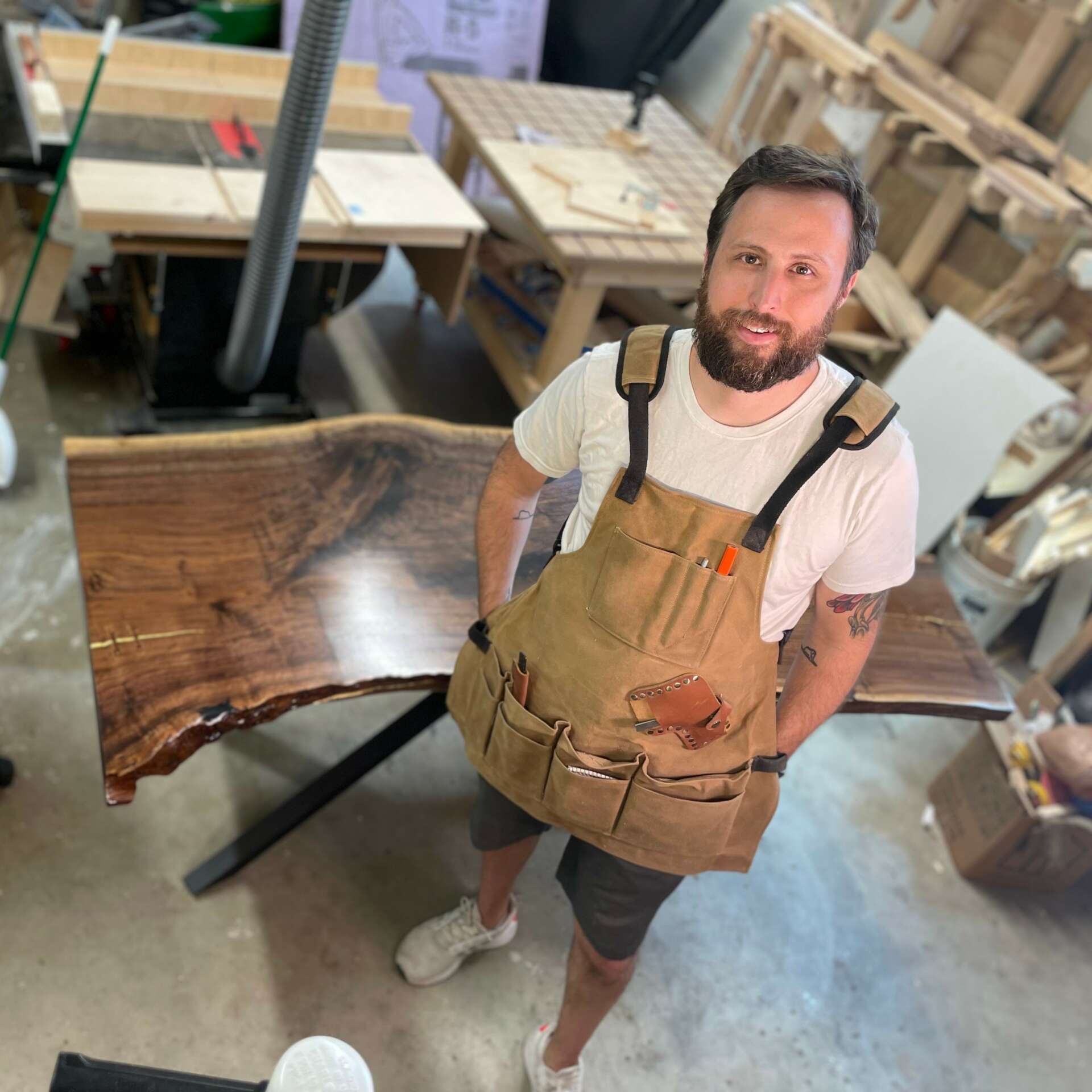

Alright – so today we’ve got the honor of introducing you to Matt Anlyan. We think you’ll enjoy our conversation, we’ve shared it below.
Matt, thanks for joining us, excited to have you contributing your stories and insights. Can you open up about a risk you’ve taken – what it was like taking that risk, why you took the risk and how it turned out?
I guess I take a lot of risks. In 2016, I took a huge risk by leaving a well paying, comfortable job with an international non-profit to open a donut shop with a good friend of mine. I had two young kids at the time so it was a massive gamble to uproot everything and put all of our life savings into a venture that has a notoriously high failure rate. Needless to say, within 5 years, we became so popular that we expanded into a second donut shop. Things were going really, really well. Most people would ride that success for a while. Most people. Well, I decided to take another giant risk by selling both shops to pursue a career in woodworking, art and content creation full time. It was one of those “life’s took short not to do something you love” type of moments. Will I find success again? Time will tell. All I know is I am a much happier and feel a lot more fulfilled.


Awesome – so before we get into the rest of our questions, can you briefly introduce yourself to our readers.
My name is Matt Anlyan and I am a self taught woodworker that has started a woodworking company called Bearded Owl Studio. One day in my early 30s, I became a weekend warrior woodworker and absolutely fell in love with it. Over the last 8 years, I’ve been able to expand my skill set (and tool list!) which has enabled me to make more advanced pieces. Last year, I sold my business and this gave me the time and runway to create a woodworking business. Currently I make custom furniture and smallwares but will be expanding to more commercial applications in the next 6 months–wooden signs, marketing pieces and minimalistic displays particularly for the local maker community (myself included) who sell their goods at pop-ups, craft fairs, etc.
I hail from a family of designers and artists, so I love to push the boundaries of what’s possible. I love taking a risk in the name of art. I also love taking a client’s vision and making it a reality. So, when it comes to commission pieces, I want to do everything in my power to marry their dream to a reality. Even if it means losing money, I want to make sure my clients walk away thrilled with their piece.
Is there a particular goal or mission driving your creative journey?
A life of meaning and happiness is what drives me. There are two words that have inspired me in this venture. The first one is the Japanese word Ikigai. In so many words, it means find a career where these four things intersect: what you love, what you’re good at, what the world needs, and what you can be paid for. The other is a Greek word Meraki. Meraki is ssentially putting a piece of yourself, a piece of your soul into all of your creative work.
My whole life, I feel like I have struggled to find a “career” that is meaningful. I’m now in my late 30s and I feel like I’ve finally found it. I have come to the point in my life where I care so much more about the journey than I do the final destination.


In your view, what can society to do to best support artists, creatives and a thriving creative ecosystem?
Buy small, buy local! The world has become a wasteland for cheap products. Cheap to make, cheap to buy–and they end up in the trash after a short life. I think there is a resurgence of people who want to spend more on quality products that last–things that they can pass down to their kids. People are choosing to spend $1,000 on a hand made, solid wood table that will last a lifetime instead of buying a $300 table made of particle board that will last a few years before it starts to fall apart.
Society needs to understand that artists and makers aren’t mass producing items. They are often making one of a kind, high quality pieces of art. These aren’t going to be as cheap as big box stores. The money is also going to support a family who depends on this money–not to a corporation who’s shareholders will benefit. Sharing posts on social media, liking posts, buying small items–these all go a long way in helping small makers and artists.
Contact Info:
- Website: beardedowlstudio.com
- Instagram: instagram.com/beardedowlstudio
- Youtube: www.youtube.com/@beardedowlstudio
Image Credits
Sarah Harris