


We caught up with the brilliant and insightful Lara Kline a few weeks ago and have shared our conversation below.
Lara, looking forward to hearing all of your stories today. Quality control is a challenge almost every entrepreneur has had to focus on when growing – any advice, stories or insight around how to best ensure quality is maintained as your business scales?
Quality control (QC) is not binary for creative agencies. When our team was smaller, there was a fluidity to proofing, with responsibilities bouncing between individuals with a keen eye for copyediting or quality assurance (QA) testing on a website design. We were physically all in the same place and able to pull in colleagues on an ad hoc basis to be “an extra set of eyes” or “take one last look.”
Our growth and the pandemic concurrently required us to completely reimagine QC. We needed to move from winging it to scaling it. NJI went from being a US-only operation, in one city, to a fully distributed workforce in dozens of states and two international offices in London and Singapore in less than a year. Our staff has grown three-fold and we’ve deepened our capabilities significantly.
Identifying and investing in business operations resources was an important first step to better QC. We tapped talent already in the company excelling at guiding and leading process-oriented efforts. This small and mighty team has been transformational in elevating our QC game, including studio schedule creation; project management tool evaluation and implementation; templatization of tasks, contracts; reporting, and much more. Excellent QC is iterative. We’ll never be done improving and that’s something we have to remind ourselves often.
A few things we’ve figured out along the way include:
1) Create Internal Champions- test, train, and invest in a cross-section of individuals in developing the tools and resources you are looking to implement company-wide. The individuals you select should be patient and thoughtful in how they approach learning and sharing information. This helps share the implementation load, increase adoption, and empower teams to problem-solve challenges together.
2)Feedback Options- recognize that providing input in real-time is difficult for some individuals. Be sure to have asynchronous/written inputs (e.g. Google Doc, Mira Board) and synchronous opportunities (e.g. agenda driven call).
3) Foster Curiosity- Let team members experiment with how they do something or lead a project beyond their established day-to-day. This keeps people intellectually fresh and more readily able to bring focus to their work and QC responsibilities when called upon.
Grinding on team members to achieve “perfection” on a deliverable feeds burnout and resentment. We all remember how to do something better when we learn it through play, even writing tasks and QC. We created a workshop around how to make the best PB&J sandwich. It was really about learning to listen with empathy and curiosity to clients and colleagues. These skills encourage more strategic dialogue with clients and more thoughtful, detailed writing of tasks by account/project teams for designers/developers and richer follow-up conversations. You see details differently when you practice the skills of listening, looking, and understanding differently.

As always, we appreciate you sharing your insights and we’ve got a few more questions for you, but before we get to all of that can you take a minute to introduce yourself and give our readers some of your back background and context?
Art is the rose line of my professional and personal life. I constantly seek ways to blend art and business in my work. Guiding the strategic creative vision for agencies, public and private companies, associations, nonprofits, and many others is tremendously joyful for me. Being the conduit between organizational strategy and creative output is my strength.
Distilling complexity is how I like to talk about the problem our agency solves most readily for clients. The team takes hard-to-understand ideas, issues, products, and even entire industries or technologies and makes them easily accessible and impactful to public affairs and public policy audiences. That can mean influencing people’s perceptions, educating audiences on a topic, or driving people to take a specific action.
I challenge our account and project teams to know what their client business goals and objectives are, not just take orders for a specific deliverable. We need to know the “why” to develop creative ideas that have an impact. I encourage our teams to bring beauty and nuance to campaigns and projects often characterized by the overuse of red, white, and blue or poorly edited stock photography.
I think we are the most effective as partners when creative strategy is not an afterthought for organizations. Business goals and objectives can and should align with measurable creative execution. I believe the time the team invests to become fluent in their respective crafts of graphic design, illustration, code development, video editing, strategy, etc. gives them a deep foundation of both technical skill and creative inspiration to bring to our clients and work.
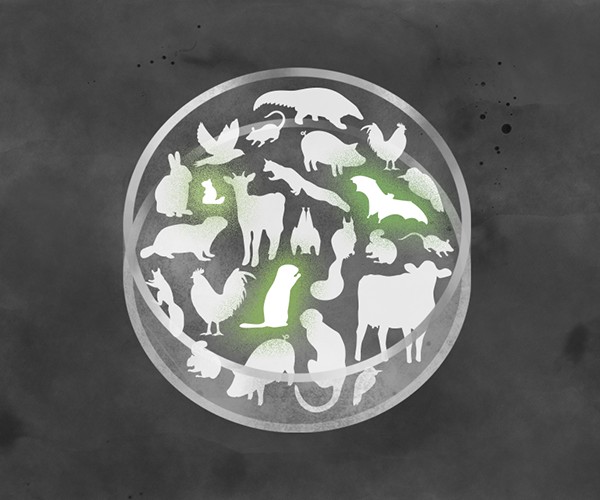
I remember early in the creative process for a project with the World Wildlife Fund trading ideas with our creative team. How could we visually show the relationship between deforestation, population growth, and the outbreak of pandemics in a way that made it accessible to policymakers?
The initial concepts were expected, almost clinical. The conversation that ensued was around how to show the idea of bleeding and seeping into other spaces. That led to a conversation around how watercolors behave on the page, ink, calligraphy, and the tradition of Japanese Suibokuga painting. A shared curiosity in art and design led to an exciting visual direction that showed zoological spillover and the relationship between environments, animals, and people. That is a standout moment for me of the creative process in action.
When I think about why our team is different, it comes down to people showing up for each other. The focus is on the work and a successful outcome. Titles, preconceived notions, and ego all get in the way of good work. We do our best work when we come to the table as equals, all looking for a solution that is creatively ambitious and answers the question we were called to answer. A colleague referred to it as “grit and wit” and that feels right. A good sense of humor goes a long way when you’re in the trenches making things happen on tight deadlines or juggling complex requirements.
Have you ever had to pivot?
Following the 2016 presidential election, I recognized that my work supporting the White House Collection and its historic legacy as part of the White House Historical Association was going to look very different under a new administration. I lept into independent consulting with the sage counsel and support of an extraordinary group of women who stepped up and said, “We’ve got you, you can do this.” Their generosity and selflessness made what was a tremendously scary and unnerving time a transformative experience that taught me to advocate for myself, trust my instincts, and be fearless. The openness and honesty of many people, men and women, made the first few years of building and leading a business an exhilarating experience. It was hard and at times scary as hell, but so necessary in the larger arc of my career, business, and personal life.
Learning and unlearning are both critical parts of growth – can you share a story of a time when you had to unlearn a lesson?
Early in my career, I held the disillusioned belief that I needed to figure it out all on my own. Working at a major agency, I saw that people were rewarded for being entrepreneurs and problem solvers. I sought to emulate this through my own choices and actions.
I was sent to a client’s office as a last-minute request to staff incoming media requests. For the next 48 hours, I lived at that office advising the client and setting the media strategy for how to respond to a life-and-death medical evacuation from a high-risk polar desert. The individual was successfully evacuated and the global media story was positive. However, when I returned to the agency office, proud of leading this tremendously complex media crisis, I was met with shock and dismay by the agency’s senior leadership. Yes, it had gone well, but why had I not asked for help?
I missed the point entirely by not calling in the cavalry our client deserved (and had contracted for). It wasn’t enough that it ended well. It could just as easily have not. My responsibility was to know when it was time to ask for help. It took me a while to understand what I had missed. It’s something I revisit years later as an important lesson.
Luck had a lot to do with the desirable outcome of how the media covered the story. If I had raised my hand and asked for help, there would have been people at the table who knew how to handle preparing for what if the evacuation had gone badly; there may have been missed opportunities to better position the client’s message and the resources and effort behind the evacuation. There would have been other professionals there to shoulder the responsibility of this global media moment. We don’t always have a clear cavalry to call, but when we do, it’s important to understand that asking for help is not a weakness, it’s a strength.
What I failed to realize was the professionals around me already knew when and how to ask for help. It’s not about me missing out on an opportunity to lead. It’s about making sure the best players are at the table to ensure the best outcome possible— always.
Contact Info:
- Website: https://www.njimedia.com/, http://www.femfacti.com/
- Instagram: https://www.instagram.com/njimedia/
- Facebook: https://www.facebook.com/njimedia
- Linkedin: https://www.linkedin.com/in/larakline/
- Twitter: https://twitter.com/njimedia
- Other: https://dribbble.com/njimedia
Image Credits
PR Week, NJI, Elliott O’Donovan, and Dean Alexander.