

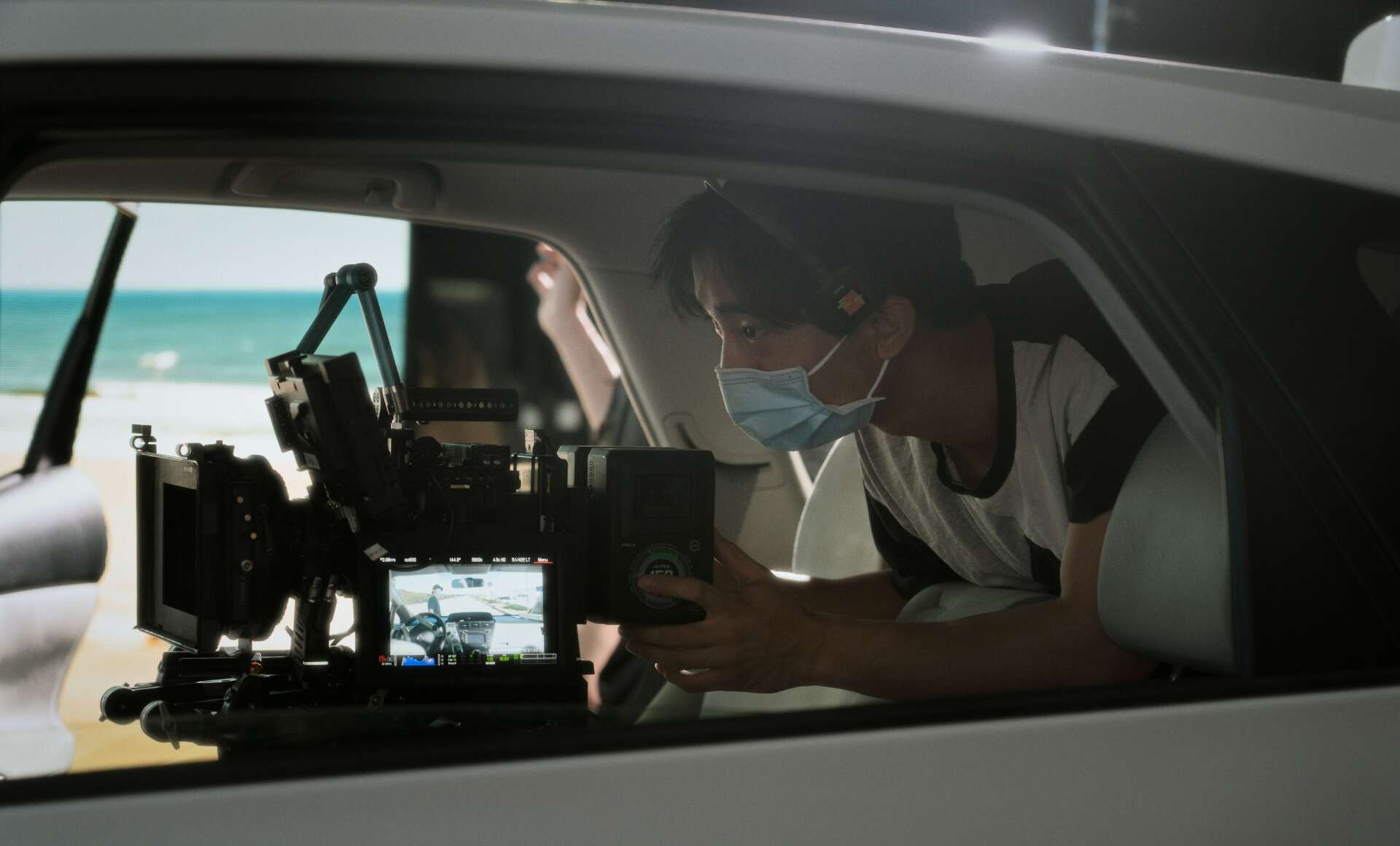

We recently connected with “Lance” Haoyuan Li and have shared our conversation below.
“Lance” Haoyuan, thanks for joining us, excited to have you contributing your stories and insights. Can you talk to us about a project that’s meant a lot to you?
The most meaningful project I’ve worked on is a 22-minute short film called “The Day, at the Beach”. This is my graduate thesis film for my cinematography MFA program at Chapman University. It has been screened in numerous festivals around the US including Oscar Qualifying ones, and is so far my favorite film I worked on as the Director of Photography. The story is about a high school girl from China studying in America confronting a brutal truth she discovered about her visiting father. The core of the film is a girl’s psychological growth, which corresponds to my growth as a maturing cinematographer ready to enter the real complex world out there. Technically this film is one of the most challenging films I ever made at this point of my career. This was the first time I shot car scenes on an LED stage, and also the first time I filmed within a real ocean. During pre-production I did lots of planning and research to make sure every shot in the shotlist can be executed beautifully as well as on time. During the shoot we used four different cameras on set, including an iPhone camera, due to various time and budget concerns; in post-production, I managed to color match all of them seamlessly. Many audiences were surprised that an iPhone is used for filming during Q&A sessions in film festivals. Overall, I think this film is a landmark for my career; it makes a perfect conclusion to my life in film school.

“Lance” Haoyuan, love having you share your insights with us. Before we ask you more questions, maybe you can take a moment to introduce yourself to our readers who might have missed our earlier conversations?
Hi, my name is Haoyuan Li, usually go by “Lance”. I am a freelancing cinematographer based in the Los Angeles area. My interest in cinematography started during my undergrad study at UCSD. Back then I worked in a Chinese student organization named “Chinese Union” in my freshman year and got involved in shooting a welcoming video for their airport pickup service. This promotional video is presented in the form of a narrative short, telling the story of how the senior student from the student council picked up a new student from China at the airport and helped her adapt to the environment. Later, I became more and more involved in the video production aspect of the organization and was the DP for its annual short film in 2016. Back then I was still majoring in Chemistry, but eventually I transferred into Visual Arts-Media major and started to get more serious into the realm of filmmaking. Throughout the course of my career, I also tried directing, editing, visual effects, and even sound design, but ultimately, I think my biggest strength resides within the ability to tell a story visually. When I’m presented with a good story and performance, I can always make sure I capture or construct it in the most impactful way. Because of this, I gradually became one of the most popular DPs in my year, especially within the Chinese community. The positive response made me decide to further pursue this career to become a professional cinematographer.
As in 2023, I have DP ed numerous short films, two feature films and one mini-TV series. I work mostly in narrative films, but I would also like to try commercials and music videos to expand my portfolio, exploring more visual possibilities.


Is there something you think non-creatives will struggle to understand about your journey as a creative?
For people who do not understand how a movie is made, they usually attribute everything on screen to the director and actors. However, filmmaking has always been teamwork since its beginning. Not a single successful film in the history of cinema is made solely by a single person. The director draws the blueprint of the protection and is responsible to the actors’ performance, but he or she also relies on other department heads to complete the details. As a cinematographer, also called director of photography, I’m the one who’s responsible for capturing the director’s vision in the most effective way. A director may decide the shot size, framing, and even movement, but there are much more to consider than those broad brushstrokes. Lighting is one of my most important duties. Since the camera sees the world differently than our eyes, we have to find ways to construct the lighting in front of the camera, so that the final image represents, or even enhances our usual perceptions of the world depending on the story. I also collaborated with the production designer to decide the design and placement of practical lights within the frame, so that my other invisible lights can gain the logical motivation to balance the exposure of the scene. Sometimes I act as a creative visual advisor for the director, using my knowledge of cinematography to suggest unique ways for visual symbolism using specific framing or lighting choice. When a film is completed, sometimes it’s hard to tell which visual choice is made by whom, but again that’s because we worked as a team to contribute the images presented on the screen.


What do you think is the goal or mission that drives your creative journey?
My biggest driving force in my cinematography has always been visual storytelling. I do like to experiment with various visual possibilities, but I’m motivated mostly by the need of the story. If the story requires me to be avantgarde using some crazy optical configurations and lighting choices, I’m all for it, but by default I would like to keep things simple while still tasteful. My cinematography style ranges from 4:3 Japanese low-contrast film to Cyberpunk neon lighting shot on anamorphic lenses. I’m comfortable with all these styles because story is the anchor of my work.


Contact Info:
- Website: lancelhy.com
- Instagram: @lancelhy
- Bilibili: https://space.bilibili.com/4804408
Image Credits
Carol Xie, Zhibin Geng, Hammer Geng