

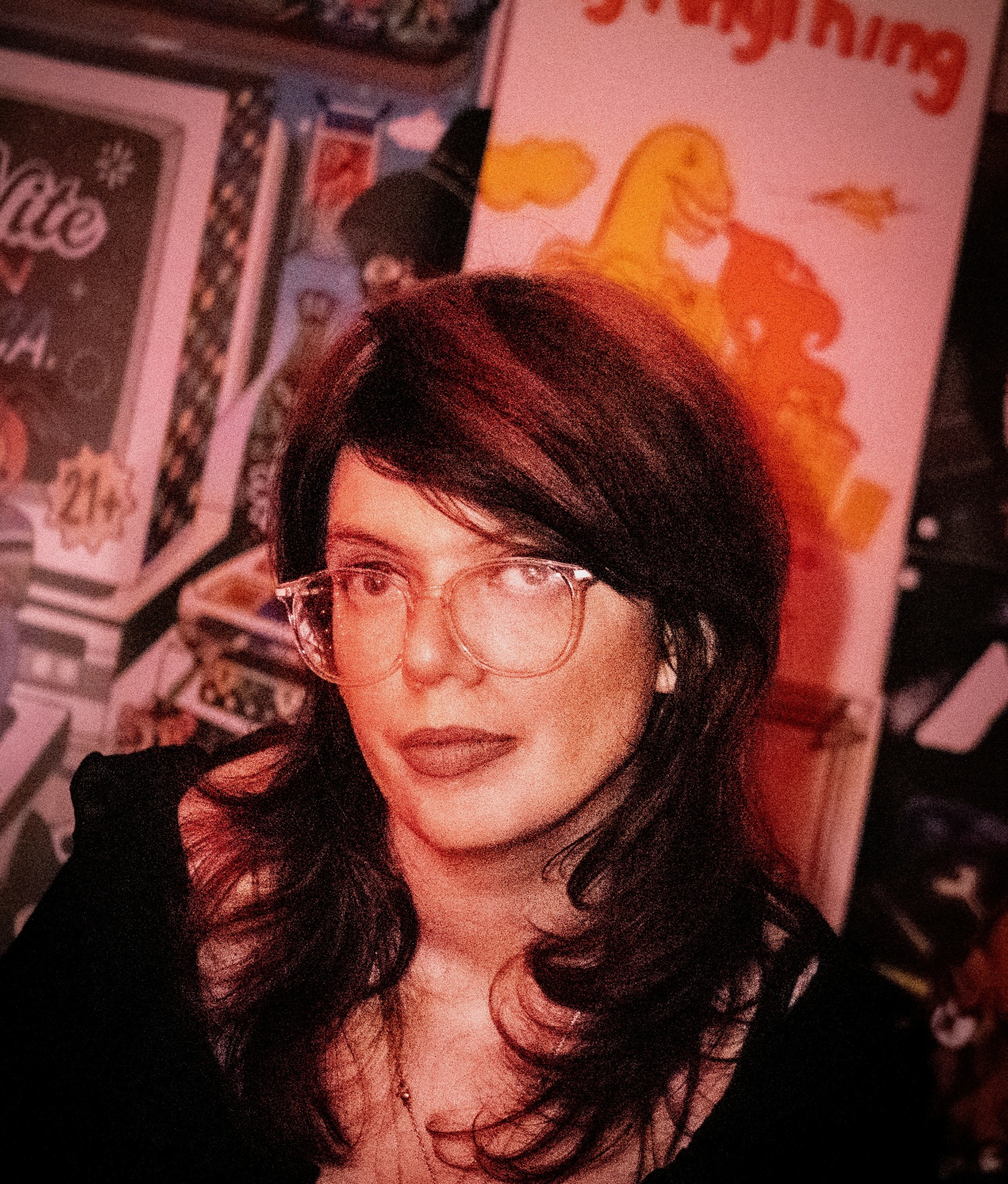

Alright – so today we’ve got the honor of introducing you to Kayla Moreno. We think you’ll enjoy our conversation, we’ve shared it below.
Alright, Kayla thanks for taking the time to share your stories and insights with us today. We’d love to have you retell us the story behind how you came up with the idea for your business, I think our audience would really enjoy hearing the backstory.
I’ve been in music journalism since 2023. At the time, I had been writing copy for websites like startups and independent agencies. This process began feeling soulless; writing was a chore. I realized, even then, that I didn’t need to demonetize writing for it to be meaningful for me. Instead, I simply needed to pivot to a topic that felt natural to me—but I didn’t know what possibilities existed for me.
Music has always been my constant, as I was raised in a very musical household. My parents met through music; my mom was shy, working as a flower seller at bars, when she heard my dad talking to his best friend about having an extra ticket to see Ozzy (RIP). A rare moment of bravery overcame her, and she offered to go with him. One thing led to another, and I was born. So, music is the driving force of my life.
Personally, I’ve been into 2000s “emo” and pop-punk since I was around 8 years old, maybe a bit younger. I have a rather encyclopedic knowledge of the topic. When Fall Out Boy dropped ‘So Much For Stardust,’ I wrote a review for fun. I figured it deserved to have a home somewhere, and Rock Insider Press eventually took it. I contributed there for a while, eventually getting hired by Get Some Magazine as Head Writer, and then again at New Noise Magazine as a regular contributor.
Experience in both print and web was immediately fulfilling. I got to write about something that mattered to me. I had routines, but it never felt stale the way copywriting did. In 2025, I got accepted to UC Berkeley and completed their Journalism Minor Program that summer. We were instructed to create a social media profile that generates a good amount of growth due to consistent mixing with strategic posting, and Nowhere Fast Presents was born.
I was inspired by my time working in both print and digital; both formats served different purposes. For Nowhere Fast, I wanted to combine those strengths—I’d do weekly web content and quarterly print issues. Around the same time, the All-American Rejects were doing the first leg of the House Party Tour. The mutual euphoria between Tyson Ritter and his fans was palpable. I’ve been a fan in those intimate spaces; that’s how I have my current network. A lightbulb moment hit me: I could book those shows. Now, Nowhere Fast Presents operates on a hybrid system. It’s equally a magazine and a booking collective. My dream for it is to have the quarterly cover stars match a show that we put on.
Tyson Ritter, please call us. Let me book the Rejects for a Cal frat party!
Kayla, before we move on to more of these sorts of questions, can you take some time to bring our readers up to speed on you and what you do?
Music journalism found me accidentally. As a fan, I established a platform on Twitter before it became ‘X.’ I still call it Twitter! Very millennial of me. Regardless, organically posting about the bands I love—especially Fall Out Boy—got the attention of not only fellow fans, but the bands themselves. There once was a time when Mr. Wentz was in my notifications tab regularly. The secret? I would ask hyperspecific questions, born out of inherent, neurodivergent curiosity. Truthfully, I was accidentally interviewing these guys in between classes and during lunch in high school.
I wasn’t very popular. When I wasn’t doing this, I was playing Magic: The Gathering at a comic store or at choir practice.
The lack of social popularity benefited me, since I had more time to focus on what really mattered to me. Music was everything. I could go online to escape, or, even better, spend money I didn’t have to see these bands in person. The friendships forged during these years withstood most of those I met due to forced proximity at school.
Now, with ‘Nowhere Fast,’ I aim to destigmatize being a ‘fan.’ The term carries considerable stigma. In many cases, there’s a misogynistic aura surrounding it. It’s impacted every part of my journey; a recent comment on a podcast I was interviewed by insinuated I got here via unsavory methods. However, this doesn’t have to be the case. If people realize that most started off as a fan of something or someone, the stigma fades, like anything else. So, I’m running a series of artist essays where musicians talk about those who inspired them—any artist, any genre. Most of our projects at ‘Nowhere Fast’ bridge that gap, but especially that artist essay series. I hope that everyone eventually sees that we’re not all that different from each other, and any differences that do exist only make our connections all the more interesting.
Can you share a story from your journey that illustrates your resilience?
I came out as bisexual very early—I was only 16 at the time. Though I still resonate with the label, my identity has had to boomerang back to myself a few times in other ways. After I came out to family and friends, I began dating someone I met online. We were both huge fans of Dan and Phil (YouTubers). They were aspirational to us, especially in their connection to each other. The idea of finding a life partner that you stay with forever was alluring, even though we came out long before they did.
However, we were vapidly incompatible. We had different goals, values, and humor. Typically, I find symbiosis unnecessary for most connections; differences between people are extraordinarily educational. Not in romantic relationships, though, where compatibility relies on—at least—a few overlaps, beyond surface-level interests like our favorite YouTubers or some bands. Sadly, I am also extraordinarily stubborn (hello, Capricorn!). So, while we didn’t quite “finish each other’s sandwiches,” I believed time alone could solve some of the issues we faced, and I stayed the course.
We were together about 7 years, give or take, with a brief breakup in between there somewhere. We lived together. We knew each other’s families, but our families didn’t know each other. We were engaged, with shitty Pandora rings proving our devotion. There wasn’t much chemistry; that part felt like a chore, a little like copywriting did for me. Baseline attraction was virtually nonexistent, mutually speaking, but she was the first to admit it. Still, I tried again and again to make it work. I stayed at my Target job, though it made me miserable spending hours behind the cash register. I thought that’s what you were “supposed to do” with a long-term partner, despite both of us being…miserable!
I had my part in it, too; I was irresponsible and had other priorities. She used to say I cared more about the bands than her. Unfortunately, I regret to admit she might have been right, though I’m sorry I didn’t have the guts to admit it then. Money was hard for me always, and it created friction. Eventually, I got better with it, but I couldn’t share this as a resilience story without acknowledging my hand in the breakup. I wasn’t in it for the right reasons, either, if I knew there was no spark but felt obligated to stay due to time spent together.
It caught up to us—hard and fast. I was living with her in Ohio, where brutal winters were novel to me, as a born-and-raised Californian (who doesn’t shut up about it). The cheap rent prices and independence were nice, but I fell on some black ice on my way to work and broke my left leg. The suburbs of Ohio don’t think out-of-towners will require as much salt on the sidewalks, compared to other “real winter” locations. A week prior, I had done a tarot reading on myself, pulling The Tower, The Devil, and Death consecutively. I refused to believe that was for me, since we’d just gotten engaged and my cat was purring next to me…until I was in the hospital. And on heavy painkillers…because my leg snapped in half. I am now a bionic bisexual woman.
Crazy work.
While my leg will never be as functional, my heart returned to baseline after a few years spent reintroducing myself to myself. I haven’t really been in a relationship since; my Player Card has racked up unlimited points. I crawled back home to California and grumpily moved back in with my dad. I got all my stuff back from my ex—except for my poor cat and my acoustic guitar. I stopped contacting her so we could both move on the way I thought we deserved. I began going to shows again, finished my associate’s degree on a very nonlinear path, and the rest is history. Now, I actually have 3 associate’s degrees and am attending my dream school, despite turning 30 this year. It’s never “too late.” Self-discovery is an ongoing process for me, after I learned how resilient people truly are. You are always capable of so much more than you know, even in periods like the one I faced that feel like “rock bottom.” I literally had to crawl myself out and learn how to walk again!
Consequently, Death in tarot resembles not only a painful ending, but a profound rebirth after.
Maybe there’s some truth to that stuff, even if it’s mostly projection.
We’d love to hear the story of how you built up your social media audience?
My audience began forming a very long time ago, suggesting that perhaps consistency is social media’s best marketing tool. I came from a unique vantage point, though, since I started in the fandom space. The network I fostered was not really “followers,” but “online friends,” who shared life updates just as much as shared hobbies. This, I think, generated a more authentic online presence for me as soon as I began posting. When I was still doing YouTube, I didn’t build a character or anything—I just talked.
The platforms where I could “just talk” felt the most natural. It’s probably the ADHD, but regardless of the source, verbal connection is huge for me. Interviewing bands is currently my favorite part of my job. Online, I try to harness this energy, even when one of my colleagues is posting their work. I won’t make their captions sound like me; I’ll make it resonate with their work, whether it’s an album review, quiz, interview, or gallery.
In some niches, curation is fundamental. It’s important to us, too—we have an aesthetic formula that we follow—but resembling real people is far more important to maintaining the audience we built. This method has also, thankfully, allowed us to expand upon our pre-existing audience without friction.
Contact Info:
- Website: https://nowherefastpresents.substack.com/
- Instagram: https://www.instagram.com/punr0ck ; https://www.instagram/com/nowherefastpresents
- Twitter: https://www.x.com/punr0ck_
Image Credits
Logo by Jamers R. (@jamersrdesigner)
Self-portraits by Kayla Moreno