

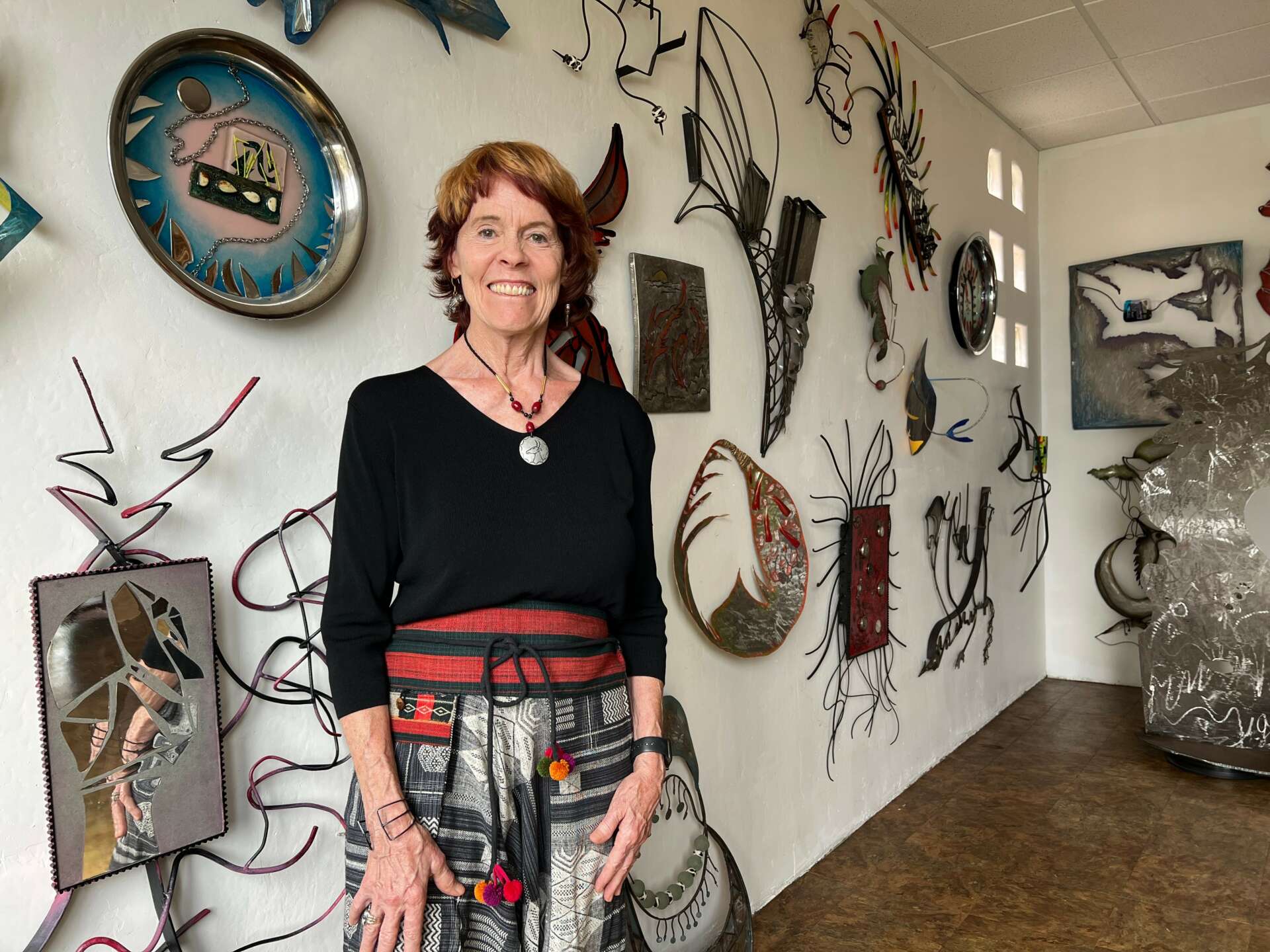

We caught up with the brilliant and insightful Karena Massengill a few weeks ago and have shared our conversation below.
Karena, thanks for taking the time to share your stories with us today Did you always know you wanted to pursue a creative or artistic career? When did you first know?
I grew up in Ukiah, California and when I was very young, I went to the Mendocino Art Center on the ocean in Northern California. While my mother took art classes children had a clay class in the sheep shed, where I made a piggy bank and threw a small vase on the wheel! My mom thought I was a genius! I always have made little assemblages since I was four or five years old and would pick up bits and pieces on the street to create small sculptures and miniature environments. I remember making geometric sculptures with the white, malleable part of my wonder bread sandwiches!
It wasn’t until I was in high school and dropped a physics class to get into a craft class, that I had my epiphany of really wanting to be an artist for my life. I didn’t know how but I just knew it made me happy to create and it was so profound that I passionately felt it would be my destiny.


Karena, before we move on to more of these sorts of questions, can you take some time to bring our readers up to speed on you and what you do?
I went to art school where in addition to the usual academics, I studied jewelry making, sculpture and lots of life drawing. After graduating with my Bachelor of Fine Arts from Tyler School of Art, Temple University in Philadelphia, I immigrated to Toronto, Canada. An ad in the newspaper from the Canadian government offering to pay people to train as welder fitters caught my eye! They needed welders to work on the pipeline, bringing down the crude oil from Alaska through Canada into the US. I knew I loved to weld from my sculpture classes in art school, so I applied and was accepted into the program at George Brown College. It was extremely challenging because I was welding 8 hours a day next to men some of whom had just gotten out of prison. They were very tough and often didn’t respect women. Apparently, they did not know about Rosie the Riveter! I had to be better than them to earn equal treatment. I was able to perfect all four welding positions, flat, vertical, horizontal, and overhead and gained their respect. That is the way I learned my craft.
During this time, I was given a large public art commission, and was looking to find sources that might donate materials for this project. When completed, it was five figures made out of three-quarter plate steel in the front of a public school. I contacted a company that manufactured spray welding materials I had seen demonstrated by a salesman when I was in art school. They were very interested in my training and in addition to donating materials for this public art project they offered me a job! It was for demonstrating and selling welding products. I drove around with my brief case of paperwork, and my other case with torches and alloys! It was difficult!
I asked them how much of the product I could use for myself, explaining that I was a professional artist. They let me have $150 a month for free, which was a lot in 1977! At one point, I actually became ill from brazing in an enclosed area from the cadmium, zinc and lead in the materials. I was literally painting my sculptures with the alloys and a torch!
After this I left the job to travel down to South America on a cargo ship and up the Amazon 1000 miles. I also traveled around Brazil, Peru, and Bolivia by trains and buses while carrying a wooden case filled with stretched canvases, oil and watercolor paints, drawing materials, and a portable easel. I painted landscapes and portraits where ever I went and was received warmly by the locals. My memories of the Amazon in 1978 were of its fecundity, life and death juxtaposed from each other constantly.
It breaks my heart to think of how different it is today with the rape and pillage of the rainforests and Indigenous peoples. Much of my current artwork addresses these concerns. Traveling many years later in Africa through Kenya and Tanzania, seeing people the least responsible for climate change suffering the most has further caused me to address this within my artwork.
If my work can inspire people to see themselves as part of a solution, helping in even small ways to address this life-threatening phenomenon, I feel hopeful. In many of my current works the fractured mirrors are meant to function as a double entendre. As they see their reflections, observers can be inspired in some way to participate in the solution, more than being just a part of the problem. They also represent to me our disappearing glaciers.
Before returning to the US to live, I had exhibitions in Canada and created other public art projects. I worked for Inner City Angels, a non-profit organization which placed me in city schools creating murals, teaching painting, performance, and sculpture projects. Through Ontario Arts Council grants I worked sometimes creating permanent public art projects such as murals working with the students as I taught them about color and rendering. I was working on a two-story indoor cityscape representing Toronto out of plastics and metals with industrial arts classes in one school, and that’s where I met my Australian husband, Graham Robertson, an incredible science teacher.
Though I always continued working as a professional artist having exhibitions and receiving grants to help subsidize them, it was difficult to make a living when the money came sporadically through art sales and freelance work. My not yet husband convinced me to go back to school at the University of Toronto and get my teaching credential where I received my Bachelor of Education in Visual and Industrial Arts.


Can you share a story from your journey that illustrates your resilience?
After having been a professional artist for years, it was challenging to go back to school and study art education. I had my voice as a creative, independent artist, well established, but it was difficult to keep up my art practice, while I was teaching art in high school! After years of this, I decided to go back and get my Master of Fine Arts in Sculpture at California State University Fullerton. Upon my completion in 1993, the college teaching jobs were very far and few between. I was told I could get one in Texas or Tennessee, but I wasn’t willing to consider moving there from California. I continue to create art for public and private spaces. My website shows a history of my work as an artist: karenamassengill.com
I know that I must create to remain happy and healthy so I have an always had a studio where I maintained my art practice, but it did take a degree of resilience to make them all work together.
As an art educator I taught Digital Art and Imaging and 3-Dimensional Art. Without my expertise in digital imaging, though I consider myself primarily an object maker, I would not have made much of my current artwork. It is through the teaching of at-risk youth, both at Harbor College as an adjunct professor and Cabrillo High School, that I have especially realized the value of creating conversations across diverse populations. I believe this holds the keys for healthy communities to co-exist with mutual trust and respect for one another. I’m sure that I was a better art educator for being a professional artist at the same time.
I have been back to my full-time art practice for the last almost 10 years, and I’m very happy about it!


What’s the most rewarding aspect of being a creative in your experience?
I am happiest when I’m in my studio creating something that I’m excited about! The discovery process is truly magical. It’s risk-taking, rewarding, scary, fun, and frustrating all rolled up in one!
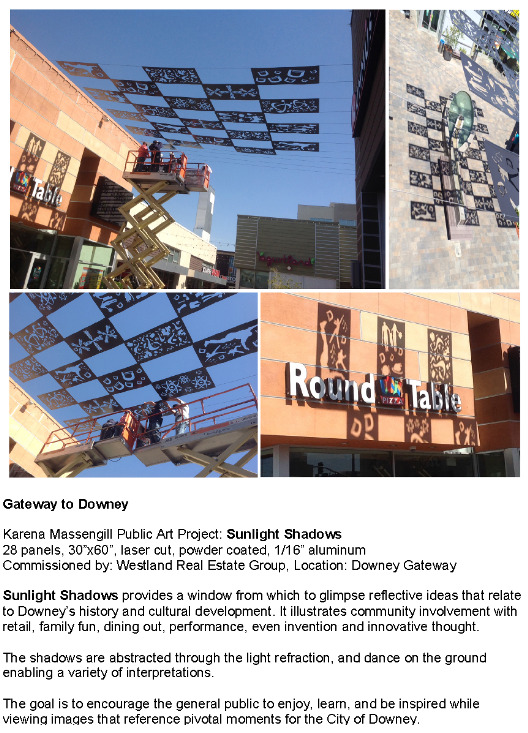
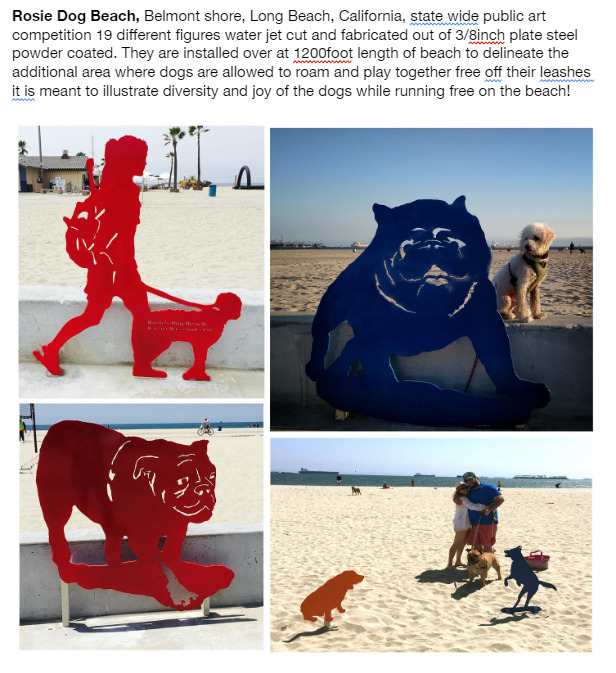
Working on Public Art Projects is also very rewarding though extremely difficult. Navigating through the bureaucracies, working with a budget that accommodates the contractors, installation costs, and satisfies the clients all are challenging! However, with this art form the artist has the opportunity to create conversation with a public that may never have visited a gallery or museum. When at its very best, public art can cause people to introspect about their own lives and place in society.
After a statewide competition seeking an artist to create artwork for Rosy Dog Beach, I was chosen for my ideas of how to delineate the 1200foot expansion. It was fun creating designs from photos I took while visiting the dog beach. And it was rewarding to see it realized in fabricated steel with colored powder coating on the beach along with the many accolades from people visiting the beach!
After this I was rewarded a commission to create “Gateway to Downey” for the City of Downey.
When working in my studio, the bottom line is, I need to do the work for myself. I can’t worry about others because there’s no guaranteeing that they will like it, or have any response at all! But when people are moved by my work to either think or feel something about themselves, the world or both, I find that tremendously gratifying. The responses I get from people can be exhilarating!
It was also very rewarding as an art educator to help people discover their own creative voices. Seeing them blossom, both in their self-confidence, discipline, and self-worth was very satisfying, and I am honored to have been in that position!


Contact Info:
- Website: https://www.karenamassengill.com/
- Instagram: https://www.instagram.com/p/CZu2q9nhESb/
- Facebook: https://www.facebook.com/karena.massengill
- Youtube: https://www.youtube.com/@karena4art/about