


Alright – so today we’ve got the honor of introducing you to Karen Budan. We think you’ll enjoy our conversation, we’ve shared it below.
Karen, thanks for joining us, excited to have you contributing your stories and insights. We’d love to hear about when you first realized that you wanted to pursue a creative path professionally.
I have had a lifelong desire to express myself through art beginning with paint by number kits at a very early age, which quickly moved outside the lines established by others to create my own compositions. At that time I saw art as a very enjoyable hobby. Professionally I had a successful 38 year career in education in roles from classroom teacher, administrator and ultimately to the National Director for Professional Development for an educational software company. However, I always held alive my art interest through adult education classes and workshops at local art centers when time allowed. These opportunities were treats to be savored and an interest I planned to indulge at a deeper level when I retired. Upon retiring, my husband and I relocated to Scottsdale, AZ. A major decision point for choosing Scottsdale was the art opportunities available. I envisioned myself taking the occasional class, joining local art groups and participating in workshops located in exciting parts of the world. I did all of those….however, I am very much a type A personality and it wasn’t long before I was fully engaged in my art as a second career……a professional artist.


Awesome – so before we get into the rest of our questions, can you briefly introduce yourself to our readers.
When I first started taking art classes I tried everything from drawing, acrylics, watercolor and pastel. Pastel became my medium of choice as I loved the bold colors one can achieve. My initial training after retirement was using pastel doing landscapes plein air painting. I worked with Richard McKinley taking every class and workshop I could with him both in the states and in Europe. Richard taught me the basics of good art – composition color harmony; values, edges and so much more. Although my work kept improving I was never really happy with the results of my landscape paintings. Richard is a very loose painter and I so admired his work. I tried so hard to be loose and painterly and get those beautifl soft paintings. But I am a type A personality, very organized and detail oriented. Painting loose was so difficult for me. An activity I initiated while president of the Arizona Pastel Society brought this front and center for me. Each month members could sign up for a challenge. We were given an object and charged with creating a painting with the object in it. Since it was my idea, I volunteered for the first round. The person who took on the project chose a glass goblet as the item for the month. I had no idea what to do…..lay the goblet in the desert sand and paint the scene around it? I decided to do something different. I surrounded the goblet with fruit, turned out the lights and set up a light from the left. The highlights on the goblet defined it and I focused on the fruit. It came out so good I ended up entering it successfully in a International Association of Pastel Societies show. This experience was a turning point for me in art. I realized I needed to stop trying to be a loose painter and go with my personality which is detail oriented. I also realized still life setups allow me complete control of the setup and lighting and I left landscape painting behind. I became the contemporary still life painter that I am today. My final transition was moving from pastel to oil painting. Although I had great success as a pastel painter, I decided to try oils as a result of recommendations from gallery owners. The transition was not as difficult as I envisioned. I paint in the indirect method with multiple layers which I also incorporated with pastels. The result of these experiences is that my painting style is photorealistic…..I thrive on the challenge of transferring the complex subtleties of the color, texture and light patterns of the composition before me onto a two dimensional surface resulting in a painting that looks as real as the setup itself.


What do you find most rewarding about being a creative?
For me, the most rewarding aspect of being an artist is the freedom to express myself. I am very lucky in that I do not have to depend on my art sales to make a living. I am in the wonderful position of being to paint what I want….not what I think will sell. It is just the sheer joy of seeing what I envision come to life on my panel as I add layers and then the final details. Of course, when my effort results in a painting that resonates with others it I truly exciting. It is fulfilling to have someone want to have my work in their home or office.


Is there something you think non-creatives will struggle to understand about your journey as a creative?
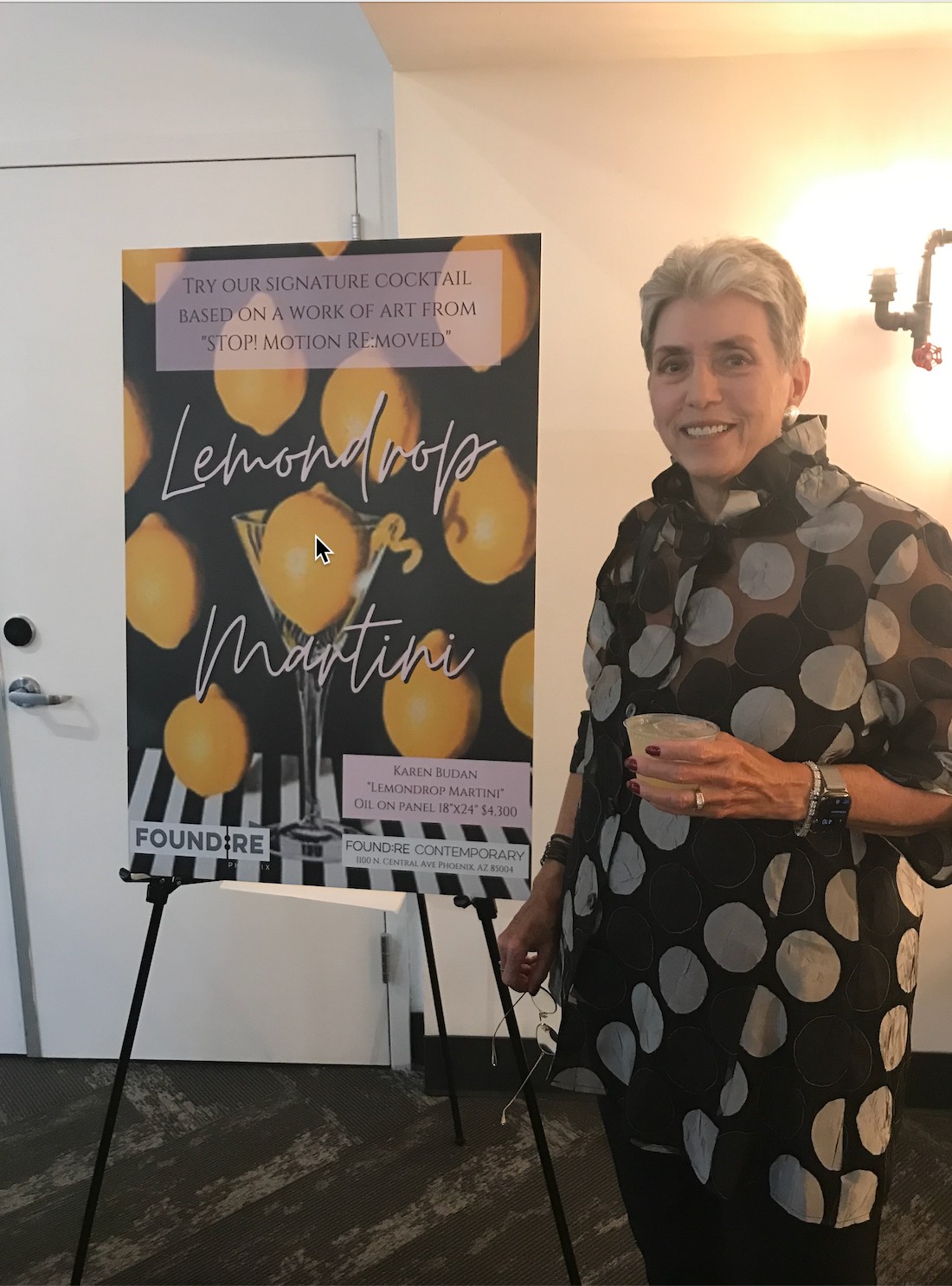
As an artist, I am frequently asked how I come up with my still life compositions. Coming up with my concept and setup is the most difficult part of a painting for me. I am not one of those artists that has a list of paintings they want to paint waiting on the sidelines. I am usually beginning to think about the next painting as I finish the current one. I begin looking around and thinking of what might be fun to paint. And certainly there are things that I love to paint……the reflections and distortions created by light playing on glass, metal and other shiny surfaces, bright colors, stripes and symmetry. I love the grace of a martini glass……and luckily there are many types of martinis resulting in a series of paintings. And I love coming up with titles that are a play on words or are tongue in cheek descriptors of the painting. So in answer to that question……although I can share some commonalities that show up over and over in my paintings, each composition has it’s own path to coming together.


Contact Info:
- Website: www.karenbudan.com
- Instagram: www.instagram.com/kbudan
- Facebook: www.facebook.com/kbudan