



We caught up with the brilliant and insightful Janice Schoultz Mudd a few weeks ago and have shared our conversation below.
Janice Schoultz, thanks for joining us, excited to have you contributing your stories and insights. What’s been the most meaningful project you’ve worked on?
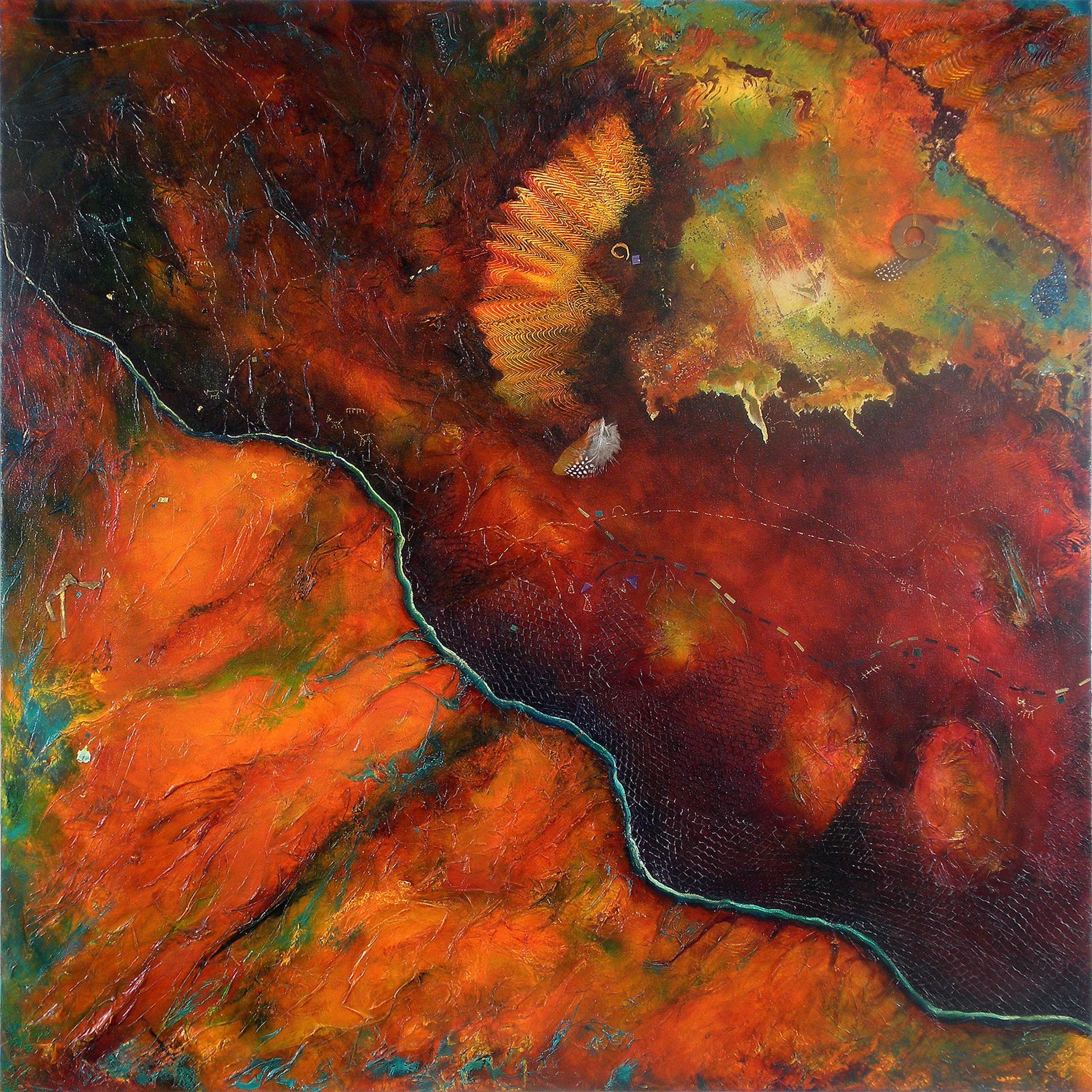
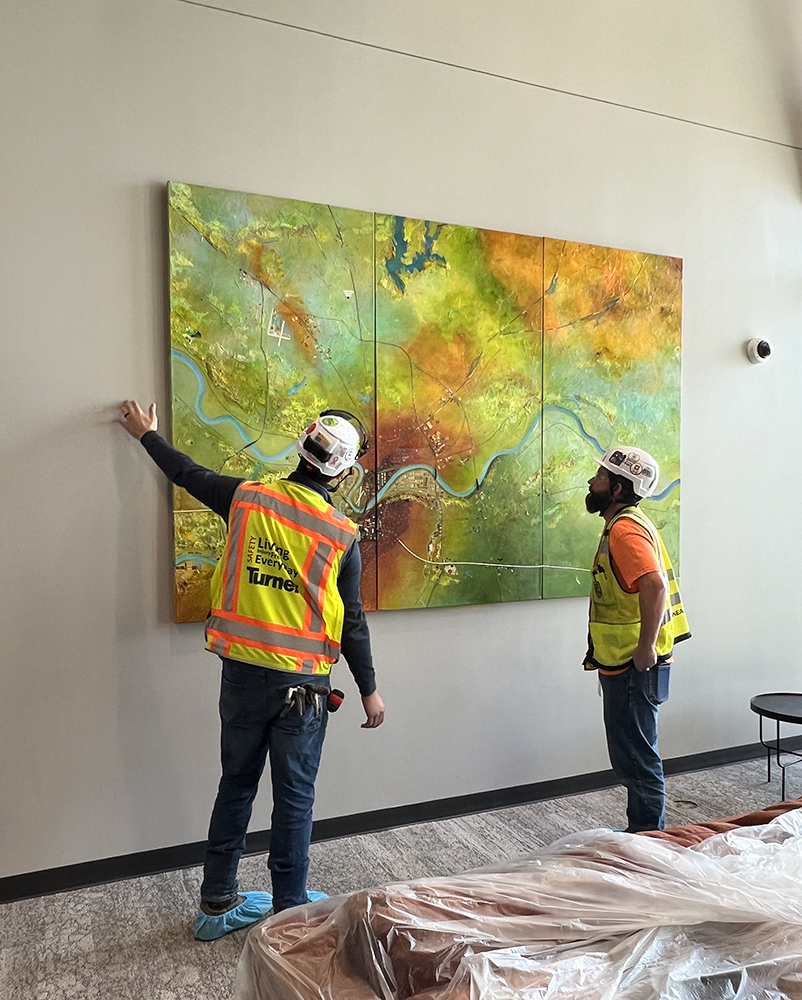
The most meaningful project I have worked on was a commission to document the journey of a refugee family from their homeland to their life in the United States. Mr and Mrs L. had seen a painting of mine hanging in Grafica Gallery, Webster Groves, MO, and asked me to use the primary elements of that work to form a new piece for their home. Those elements were leaves from the ginkgo tree, which is native to East Asia. The leaves were woven into a tapestry of branch elements, using colors that reminded Mrs L. of her girlhood home.
When I first spoke to the couple, I discovered that Mrs L. and her birth family were from South Vietnam. Upon her parents’ release from several years of re-education camp following the Vietnam War, the family of 10 joined an informal group of refugees, who in the 1980’s became known as the “Vietnamese Boat People”. After years of planning and saving, this family bought space on a wooden rowboat and set sail into the South China Sea. The engine failed on the 4th night, and they were stranded with less than a cup of water for all 10. When I learned about their story, I suggested incorporating the leaf imagery into artwork that included map suggestions of their journey and indications of their life today. I soon met Mrs L’s elderly parents, who shared the entire story. I came away dumbstruck. It was a profound lesson about resilience; the ability to overcome extreme hardship and the impact of our choices on our own lives, as well as those around us.
As always, we appreciate you sharing your insights and we’ve got a few more questions for you, but before we get to all of that can you take a minute to introduce yourself and give our readers some of your back background and context?
“Thinking Art” is how one client described the luminous, highly textured, mixed-media paintings I have become known for. My work involves visually abstracting references from landforms, nature, or the skies and adding representational object depictions to the composition. This approach allows me to explore the historical, scientific, cultural, and spiritual context woven into our lives. Why this interest?
I was born in New Vernon, New Jersey, and at the age of four, I met my 87-year-old Finnish grandmother; she had come to live with us. The drastically different life experiences, way of dressing, and outlook of this 19th-century woman provided rich material for my curious childhood mind and big imagination. I used to wonder, “What did the world sound like with no radio, TV, or phonograph?” or “How did sailors travel the oceans before there were maps?”, and…”No one smiles in those old photographs; were they real people?” She told me about the advent of electricity, cars, and telephones, and how they changed daily life. I spent many hours thinking about how people and the land adapt.
At 18, I enrolled at Pratt Institute in Brooklyn, NY, and spent the first year in the required Foundation Arts program which consisted of 2D, and 3D design, drawing, painting, and photography. I continued on to obtain degrees in architecture and interior design, which helped me hone the design and compositional skills I employ in my artwork today.
A concept, a composition, and a color scheme are prerequisites for the start of a painting. This is how a designer begins and it is this skill that makes me comfortable in visualizing a topic and tackling commissions.
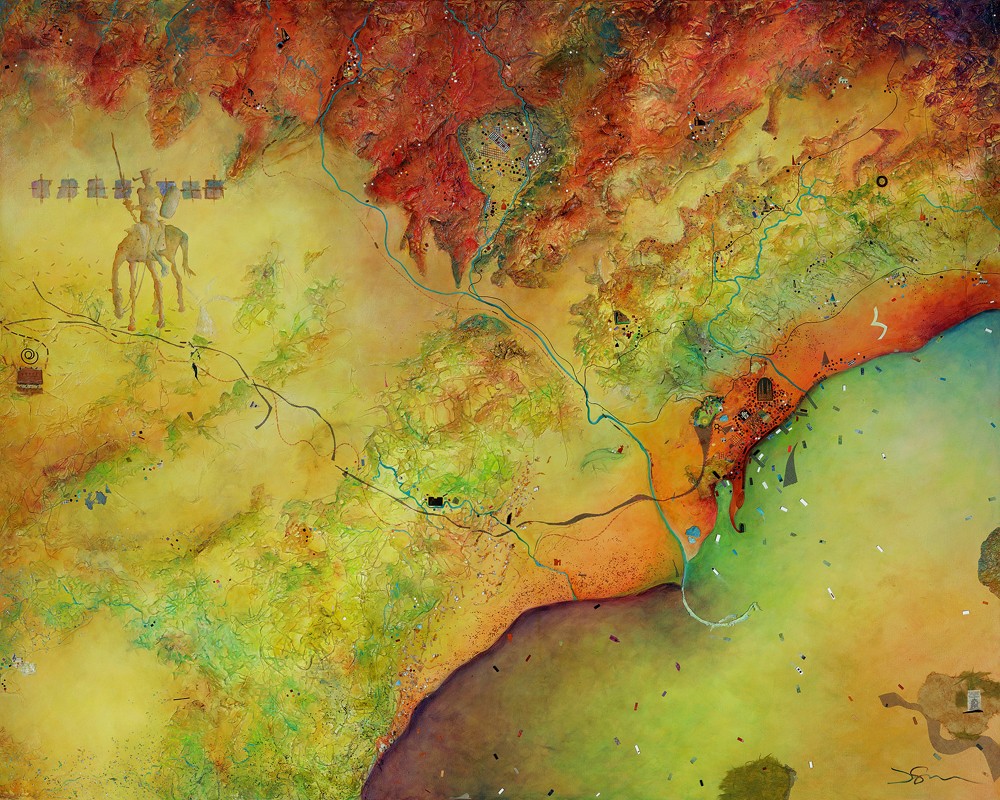
When a potential purchaser contacts me, we talk about what they are looking for and why it is meaningful for them to put this experience, history, or image on canvas. These conversations help me create a well-informed plan that will help me visualize their idea. A client of mine, who was born and raised in Catalonia, Spain, requested a painting that would capture the region’s topography, history, and character, as well as his early influences, and the changes of the twenty-first century. I developed a textured terrain map as the base upon which to build his story. It was a four-by-five-foot work on canvas using acrylic paint, oil pastel, innumerable collaged elements, and a painting of Don Juan. The client expressed great satisfaction at every stage of the process, which included four in-person reviews.

We often hear about learning lessons – but just as important is unlearning lessons. Have you ever had to unlearn a lesson?
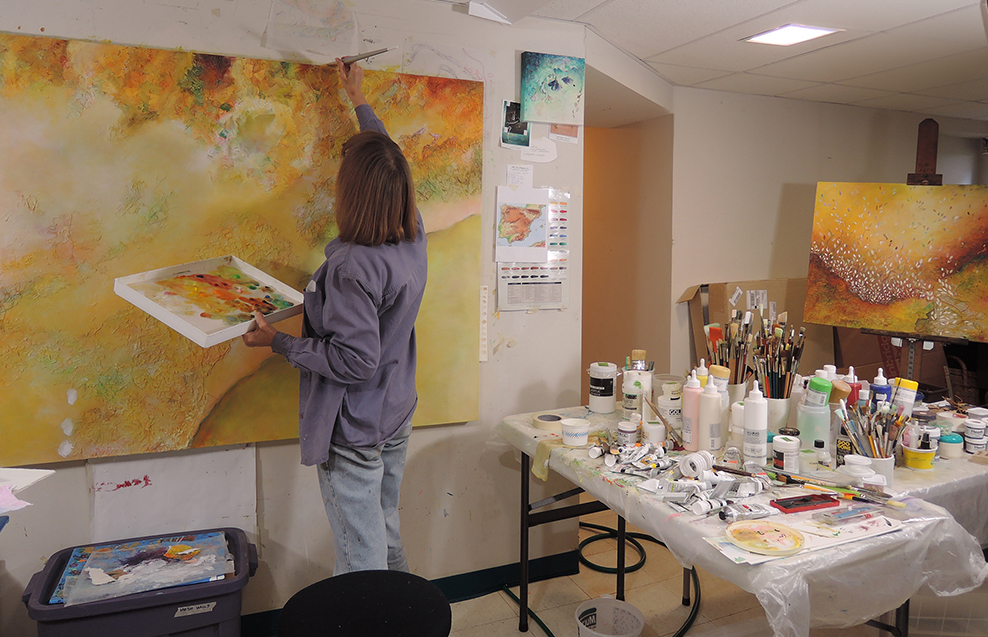
When I began painting in earnest, I was an adult with two small children. I worked in a vacuum trying to learn to paint with watercolors, a medium I had never before used. This was quite unproductive and frustrating. After a year I gave in and signed up for classes. Some instructors were better than others, but I learned a great deal about the medium and its many related techniques. I was soon more than proficient and curious about working with acrylic paints, but after a move halfway across the country I found myself working alone once more. I turned to watercolor overlaid with pastels. I did not know how to use pastels, and this was again, unproductive. YouTube had not yet been invented and I struggled alone. Two years later I signed up for a painting class in St Louis, taught by Ann Croghan. She taught how to use a number of different mediums. I was soon combining watercolor with acrylics, pastels, ink and pencil. It wasn’t long before I added a collage element to my work. I joined a few local art organizations and met artists who exposed me to new ideas and opportunities. I began to flourish, find my artistic voice, and relish in the new friendships of fellow artists. Thanks to all these people outside of the vacuum, I have found my place, and I like it.

What’s the most rewarding aspect of being a creative in your experience?
One of the most rewarding aspects of being an artist is the ability to make something out of nothing. Put a blank canvas, clean brushes, and a few paint tubes on a table and what do we see? What engages us? What is there to seize our attention, to captivate our imagination, to foster joy, nourish ideas or, to engage our senses? For an artist, that blank canvas can be intimidating, as it is the ultimate opportunity to create a masterpiece. It can also be a thrilling challenge. I prefer the latter.
Having a concept and a preliminary composition before I begin is a big help. It consists only of a thumbnail sketch and a bunch of thinking about what I want to express, but that is enough to set me in motion. The first layer of paint is typically a slapdash affair of color intended to remove the idea of a pristine canvas, for now, it can be considered a used object. Layers and layers of paint and textured material follow as I quiz myself as to whether or not I am moving in the right direction as everything shifts. I often mentally paint the canvas as I rest, to work things out, then go back and do it for real. It is an exciting adventure with lots of ups and downs but if I am successful when finished, I feel a great sense of accomplishment and relief, for that image that has taken up so much of my mental energy is now real.
The story does not end there. Seeing people connect with the finished painting—talking about it, staring at it for extended periods, asking questions, and smiling is the single most satisfying part of this process. When the painting sells, there is an additional benefit. They have a certain expression on their faces that tells me they want to live with this artwork because they relate to it so deeply.
Contact Info:
- Website: https://www.janiceschoultzmudd.com/
- Instagram: https://www.instagram.com/janiceschoultzmudd/
- Facebook: https://www.facebook.com/janiceschoultzmudd.mixedmediapainting/
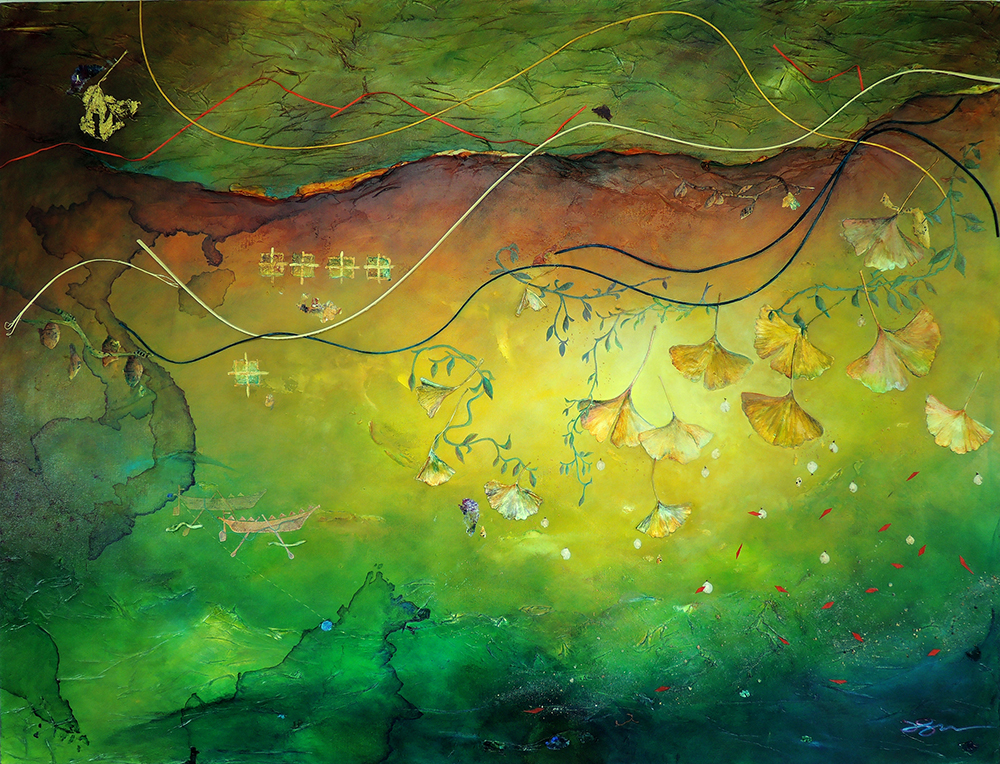
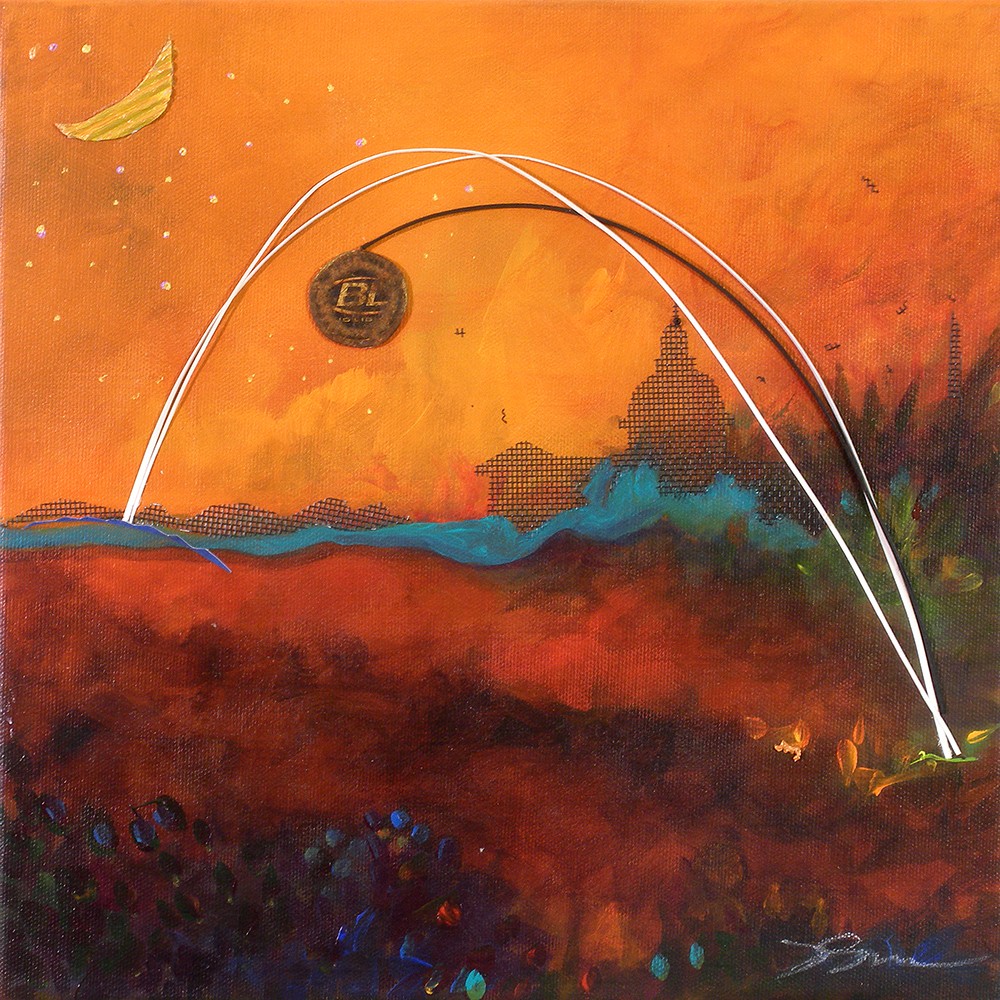
Image Credits
Janice Schoultz Mudd
Arch Design