

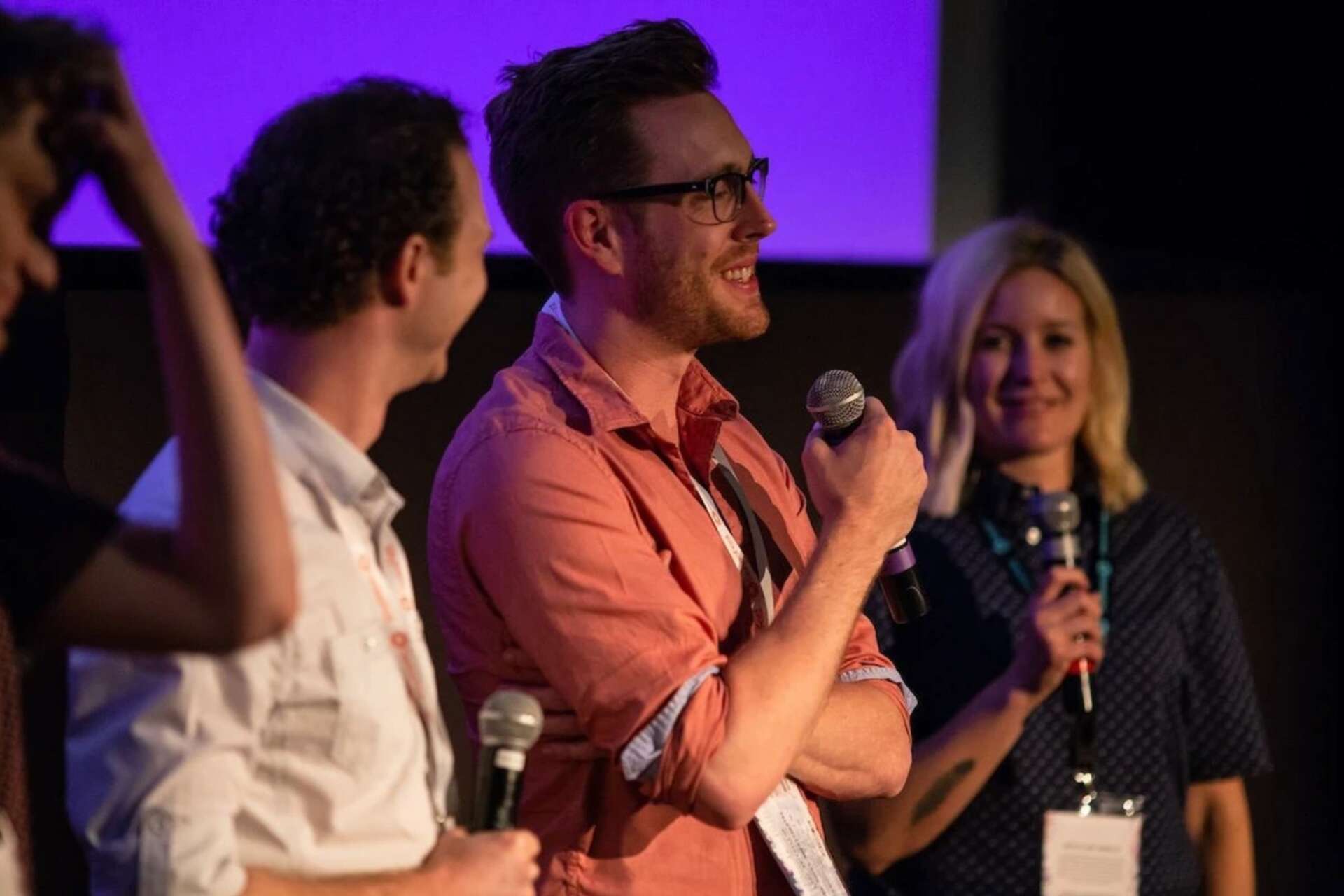

We’re excited to introduce you to the always interesting and insightful Jake D Williamson. We hope you’ll enjoy our conversation with Jake below.
Jake, appreciate you joining us today. How did you learn to do what you do? Knowing what you know now, what could you have done to speed up your learning process? What skills do you think were most essential? What obstacles stood in the way of learning more?
Like a lot of people my knowledge has been a combination of traditional didactic learning and good ol’ hard-won, first-hand experience… just “doing the thing” and making mistakes and trying to do it better next time. I will say, now that I’m older I value the latter much more than I once did when I was first starting out. I like formulas, I like plans, and I really like answers. I think my younger self maybe put a little too much emphasis on “rules”, which, of course, don’t really exist in art. Time-tested guidelines and tools certainly are valuable and should be studied and heeded, but a step-by-step guide to ensuring an artistic endeavor will be successful just doesn’t exist and I desperately wanted that to be the case when I was, say, in my 20’s. Wouldn’t it be great if art was that simple?
To your question about speeding up the learning process… In a sense, I don’t think that’s possible. I studied with a really remarkable acting teacher, Joan Rosenfels, and she would often say that the secret to good art is “time” and I think she was just spot on about that. There’s no quick way to learn it or to make it. Even when a song or scene that I write seems to come out very good and very fast –you know those moments when it feels you’ve just become a conduit for an expression the universe wants willed into existence at that very moment– that song or scene was still a combination of hours and years of living and ruminating and ingesting the world around me combined with, who knows, factors that could be as profound as some shared consciousness that was destined to express at that moment, or simply something I had for breakfast. And yet, to contradict myself (which I’m sure I’ll do a lot here): Pixar storytellers have a maxim I very much believe in and that is “Fail fast”. Basically, don’t spend too much time wondering which creative road is best to go down. Go down one, see if it works, then go back and try another. So, in a sense, if you want a tool that will help put you on some sort of a fast track, I think that’s a good one to adhere to.
Essential skills? Curiosity. …to the extent it is a skill and not just a trait. But, I think we all have it and it can be honed. I credit my voracious curiosity to anything I value in my artistic life. I love learning how things tick. How they work. I have the kind of mind that will become intensely interested in one thing and I’ll research that thing and do it until the next thing that piques my interest presents itself. I did it with music composition/theory and lyric writing for the stage, I did it with acting, I did it with screenwriting… and all of that has given me a really holistic view of storytelling for which I’m very grateful. Following your curiosity is the best way to start, it’s the best way to get back when you’re lost, it’s the best way to remember why you’re doing something in the first place. It’s invaluable.
What stood in my way of learning more? Probably what I said earlier… spending too much time searching for the “answers” instead of just doing the damn thing. I will say, in my defense, it’s the inverse of a problem I see a lot of other artists succumb to.


Jake, love having you share your insights with us. Before we ask you more questions, maybe you can take a moment to introduce yourself to our readers who might have missed our earlier conversations?
I’m a New York-based screenwriter/actor/educator. I grew up in Colorado and performed for years out there in that beautiful, thriving community, but I’ve been here in the city for about 12 years now. It’s funny, I went home a few years ago and my mom, who has always had this ferocious love and support for my sister and I, brought out this big box of things that she had kept of mine since childhood, and it was just filled with poems and drawings and stories and musings of mine. I saw it at a time when the industry wasn’t being too kind to me and it was so validating and firmed my resolve in such a meaningful way. I’ve always been compelled to create things. I’ve always been just so head-over-heels in love with the arts and storytelling. The story goes that when my parents took me to see the first Home Alone in theatres as a very young child, I pointed to Macaulay Culkin and said “I want to do that”. Of course, I was talking about acting, not butchering two grown men who broke into my house… at least, I think I was talking about acting. They did make child vigilantism look so damn fun.
Even though I always identified as an actor, I always wrote. When I was going to college for acting, I wrote a musical called The Messenger with a fellow student. I wrote the music and lyrics and he wrote the libretto. We both broke the story together. It was a riff on the Greek tale Medea, but we told it from the view of a messenger boy who has one line toward the end of the original play. We did a reading of the first act and, to our surprise, the college approached us and offered to produce and stage a fully orchestrated, fully realized version of it. It was exhilarating. So, when I moved to New York and was doing regional theatre, I always kept writing. As an actor, you have so little control. You’re very much at the mercy of dumb luck. One of the pieces of advice you hear a lot is “Create your own work”. I knew that I could write, so I started writing a series called Adventure Capital with a dear friend of mine Britt Chandler Johnson. We were really passionate about it and really driven, so in 2017, we decided to crowdfund about 20k and film the pilot episode which did very well on the festival circuit.
I was bolstered by the successes and decided to walk through the doors that were opening for me which were all related to screenwriting. So I really started taking the art form seriously. I did to screenwriting what I did with musical theatre composition and I just consumed everything I could get my hands on about the craft. You name a book, lecture, teacher, method… I know it and I’ve studied it. Because of that deep study and scholastic obsession with the craft, I started being known as a serious writer who could write and consult on writing with a good understanding of structure and tools. So now, in addition to my own projects, I consult on other’s screenplays, and I also work with a phenomenal film festival called SeriesFest helping writers with their pilots. We had our world premiere there and were so blown away by their reach and respect in the industry. So, I was honored to get my foot in the door there. It’s always a treat when they knock on my door and I get to help independent creators fine-tune their vision.
I also teach Screenwriting to the Master’s students at the School of Visual Arts in Manhattan. You’re catching me at the very beginning of the semester when the students are buzzing and excited about a new year ahead. During their time with me, they’re tasked with writing and shooting their Thesis Films that ideally will be a calling card of sorts in the industry. So, my job is not only to impart the tools and tricks that make great films and stories work, but also assist them with honing in on their thesis idea and making it as effective as possible. I very much believe in beginning from a place that’s organic and instinctual when writing and then imposing more and more guidelines and scrutiny in rewrites, so it’s a great challenge to pressure cook that process in an academic environment. My favorite part of the semester is when their story ideas are formed and I antagonize them to make sure they hold up… for them, it’s not so fun, I imagine. But, we all get very close throughout the year. Seeing them go from literally nothing to a piece of art that they’ve loved into existence is so rewarding for me.
My newest venture is a blog on the act of creativity called Darlings Beware. I think of it as an extension of my teaching. I want it to be a source of inspiration, education, and commiseration for artists of all kinds.


Looking back, are there any resources you wish you knew about earlier in your creative journey?
Yes. Other people. I wish I reached out to other creatives more often when I was younger. It’s still hard for me. Building a network and community of people in your industry that you can go to for advice or an outstretched hand is so important. As the adage goes: “Closed mouths don’t get fed.” and I’ve gone needly hungry before. As a young man, I was too proud or insecure or shy to really ask for advice from people I admired. I saw myself as such an underdog. I was scrappy but I was an island, which wasn’t good or true! When I look at any traction I’ve gotten in this industry, it’s because of other people who were giving me a chance. My gig at SVA, for example: Natasha Soto-Albors, another screenwriting teacher there, and I have been friends for years and she’s the one who introduced me to that program and put a good word in for me. And even then I played it cool and didn’t let on too much that I desperately wanted that job. I’m insufferable. It took meeting my wife who just attracts people in her orbit everywhere she goes to make me understand the value of authentically networking. She’s so good at it and it never feels fake or utilitarian. She’s just remarkable.
To get my students to write from a place that’s authentic and unique to their worldview, I ask them to write 50 stories from their lives and look for common themes or patterns that they seem to enact over and over again. What we’re looking for are core, primal values that resonate with them. One way to find those is to examine the story of your life, another is to notice what themes you keep writing about. And no matter what themes I think I’m digging into in any given project, when I step back and look at my work, it’s always about characters who need to learn to ask for help. So… go figure.

Are there any books, videos or other content that you feel have meaningfully impacted your thinking?
Like I said before, I’ve read a lot of books on storytelling, but when I read The Science of Storytelling by Will Storr, my world was just blown wide open. What he identifies in that book is groundbreaking and many of his central ideas are now where I start from in my own work and teaching. I can’t recommend it enough.

Contact Info:
- Website: Jake.williamson9@gmail.com
- Instagram: @jakedwilliamson
- Linkedin: www.linkedin.com/in/williamsonjaked
- Twitter: @JWilliamsonofa
- Other: My Blog, “Darlings Beware”: https://medium.com/@DarlingsBeware