


We’re excited to introduce you to the always interesting and insightful Francesca Trop. We hope you’ll enjoy our conversation with Francesca below.
Alright, Francesca thanks for taking the time to share your stories and insights with us today. We’d love to hear the story of how you went from this being just an idea to making it into something real.
How did you actually start?
Ever since I can remember, I thought of myself as a painter. I was the kid who drew — always drawing — and I was certain that’s what I would become when I grew up. But somewhere along the way, I made peace with a difficult truth: I didn’t want to depend on my art for financial survival. I needed a foundation beneath me. So I went to law school, became a lawyer, and spent 15 years practicing entertainment law — painting in every spare moment I could find.
Then, on the day I turned 39, I gave myself a birthday gift: I resigned from my job, rented a studio, and started building an art career from the ground up.
But here’s the thing about being an artist that doesn’t fit neatly into the usual “idea to execution” story. For most entrepreneurs, you start with an idea and then figure out how to build it. In art, it works the other way around. Execution comes first. You go deep inside yourself, pour something out, and only afterward — once the work begins to accumulate — do you start to understand what the idea actually is. Great art doesn’t come from figuring out what the public wants. It comes from expressing something intimate and unknown, and then hoping it finds its audience.
So my “launch” wasn’t a business plan. It was a leap, followed by a long process of making work and gradually understanding what I was making and why.
What helped me enormously was the unexpected overlap between painting and law. My years in legal practice taught me to be organized and thorough — skills that translate to any field. But more than that, I recognized a deep structural parallel between the two disciplines. In my legal work, a client would come to me with a mess of a problem — chaos — and my job was to listen carefully and find a path through it to resolution. That’s exactly what I do when I paint. I pour chaos onto the surface, and then I organize it into a coherent whole.
That insight didn’t just help me understand my art — it gave me a way to talk about it, connect it to other people’s experiences, and build a body of work with real intention behind it. I even created a series directly inspired by the legal world, drawing on everything I’d lived through in that first career.
The first, Legal Spirits: Myths and Symbols of the Legal Profession, is a coffee-table book that accompanies my paintings exploring the iconography and hidden symbolism embedded in the legal world — the visual language that lawyers live inside every day without ever quite seeing it.
The second, Les grands procès qui ont changé le monde (published in French by Éditions du Passage), takes a different angle: a short history of human rights told through 24 landmark trials that fundamentally shifted the way society understands justice. Together, these two books reflect what has always driven my work — the belief that law, like painting, is ultimately about what it means to be human.
The launch, in the end, was the work itself.
Great, appreciate you sharing that with us. Before we ask you to share more of your insights, can you take a moment to introduce yourself and how you got to where you are today to our readers.
My name is Francesca Trop and I was born in Montreal to a French-Canadian mother and a Belgian father — a bilingual, bicultural upbringing that planted in me an early instinct for dialogue, for holding two worlds at once and finding what lives between them.
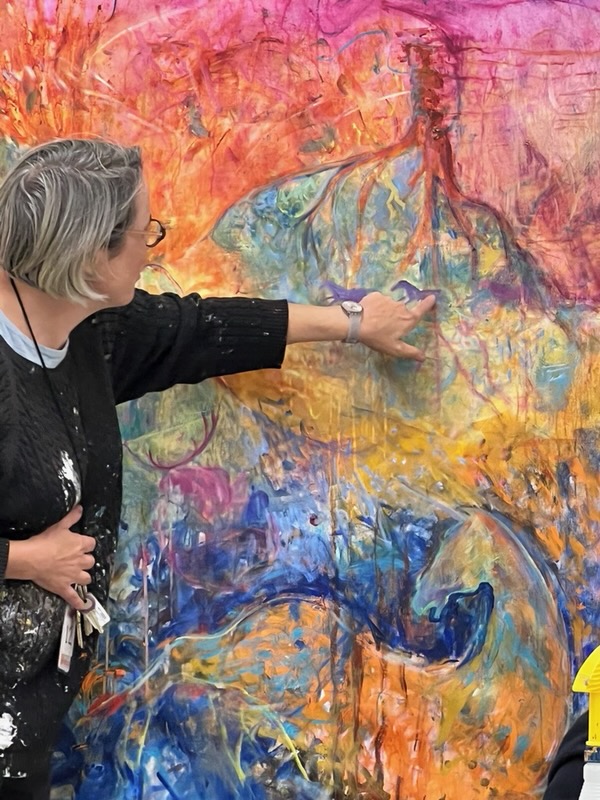
My process is physical and instinctive. I begin by putting colour on the surface and entering into a dialogue with it — each stroke calling for the next. I work with acrylics, collage, printmaking and pure pigments, and my palette shifts constantly because I bore easily and I need the painting to surprise me. I build what I think of as a balanced chaos, staying abstract until something compels me to introduce a figurative element — an animal, a plant, a person — and suddenly a story appears, waiting to be told. Humour and tenderness are never far away. A painting is finished when it has become a safe space for the soul to go and play.
My first collectors came from the legal world — judges, lawyers, and people looking for meaningful gifts for them. But the audience has grown wonderfully wide since then. Young couples hanging their first piece in their first home. Families decorating a cottage. Children — young children — who respond to the work with an immediacy that never stops moving me. Professionals transforming their workspace into something alive. And recently, an elderly woman who walked into her retirement home carrying the very first original artwork she had ever bought for herself. That one stays with me.
What I am most proud of is not any single work or milestone, but the range of people the paintings seem to reach — and the fact that a child and a retired judge can stand in front of the same canvas and both feel something. That, to me, is everything.
What I want people to know is simple: my work is made to be lived with. It is warm, it is layered, it rewards looking, and it was made by someone who spent a lifetime learning that order and chaos are not opposites — they are conversation partners.
Come find your safe space.
www.francescatrop.com
Is there something you think non-creatives will struggle to understand about your journey as a creative? Maybe you can provide some insight – you never know who might benefit from the enlightenment.
What non-creatives might struggle to understand
Choosing the path of a creative means making one fundamental decision, over and over again: to choose curiosity over fear. Every single day.
Non-creatives often assume that artists wait for inspiration — that the work happens when the mood strikes. But the reality is far more disciplined than that. I apply one rule above all others: the more I work, the luckier I get. Showing up is everything. If I don’t go to the studio, the paintings don’t happen. It is that simple, and that unforgiving.
But discipline alone isn’t enough. You also have to believe — truly, unshakeably believe — that what you do matters. That somewhere, someone’s life will be quietly improved because you created a new world for them to step into. That belief is not arrogance. It is a professional requirement. Without it, you cannot sustain the solitude, the uncertainty, or the silence that the creative life demands.
And then there is the part that surprises most people: the artist must also be the ambassador of their own work. Waiting to be discovered is not a strategy. Seizing every opportunity to show, to speak, to connect — that is part of the job too. It was this conviction that led me to write my books in the first place. And what followed still humbles me.
Writing about the intersection of art and law opened doors I could never have anticipated. I received commissions from courthouses. I was invited to present my work to international audiences and to classrooms across the province. The Chief Justice of the Supreme Court of Canada invited me for a private visit to the court. The Chief Justice of the Supreme Court of the United States sent me a handwritten letter of congratulation. The Bar Association of Montreal commissioned me to design a new medal, awarded annually to the most distinguished lawyer. “Last year, I joined Gallery Erga — a milestone that felt, in the best possible way.
This summer, I will be painting several murals — including one on St-Viateur, steps from where I live. And I am developing a new collaborative project with a professional dancer that I am very excited about.
None of this came from waiting. All of it came from showing up, giving generously, and honouring the gift.
It may sound like a naïve philosophy. But I would argue it is the most practical one I know: be generous, do the work, believe it matters — and only then will you find the people who need it. The more you give, the more you receive. That is not a cheap trick. That is the core of the artistic way.
Can you tell us about a time you’ve had to pivot?
On pivoting
The trickiest pivots are not the ones where you are unhappy. They are the ones where you are doing well — respected, established, succeeding by every measure the world around you recognizes — and you still know, quietly and persistently, that you are in the wrong place.
That was me. I didn’t have impostor syndrome. I just felt like a tourist.
I had chosen to specialize in entertainment law deliberately, because I wanted to be close to artists. I spent six years in Paris, working first for a film producer and then for Canal Plus, one of Europe’s largest television networks. When I returned to Montreal, I joined the legal team at the National Film Board of Canada. By any measure, it was a remarkable career in a fascinating field.
And yet. Every time I sat down with a creative to offer legal advice, I felt the same thing: I wanted to turn the tables. I wanted to be on the other side of the room.
The day I finally quit, I was so ready that I didn’t hesitate for a single moment. I had made my decision and I walked straight across the road. I had taken Dolly Parton’s advice to heart — find out who you are, and do it on purpose — and I was done waiting.
But I want to be honest about what came after, because this is the part that rarely gets talked about. Leaving the career was one thing. Claiming the new identity was another. It took me years — many years — to be able to introduce myself as an artist without flinching. In a world where saying “I am a lawyer” earns immediate, automatic respect, saying “I am a painter” can feel like stepping off a cliff. The credentials that had opened every door were gone, and I had to learn to stand on something less legible to the world but far more true to myself.
That slow reclaiming of identity was, in many ways, the real pivot. And it was worth every uncomfortable moment of it.
Contact Info:
- Website: www.francescatrop.com
- Instagram: #tropfrancesca
- Facebook: Francesca Trop
- Linkedin: Francesca Trop


Image Credits
Last 2 professional portraits by Adriana Garcia Cruz