

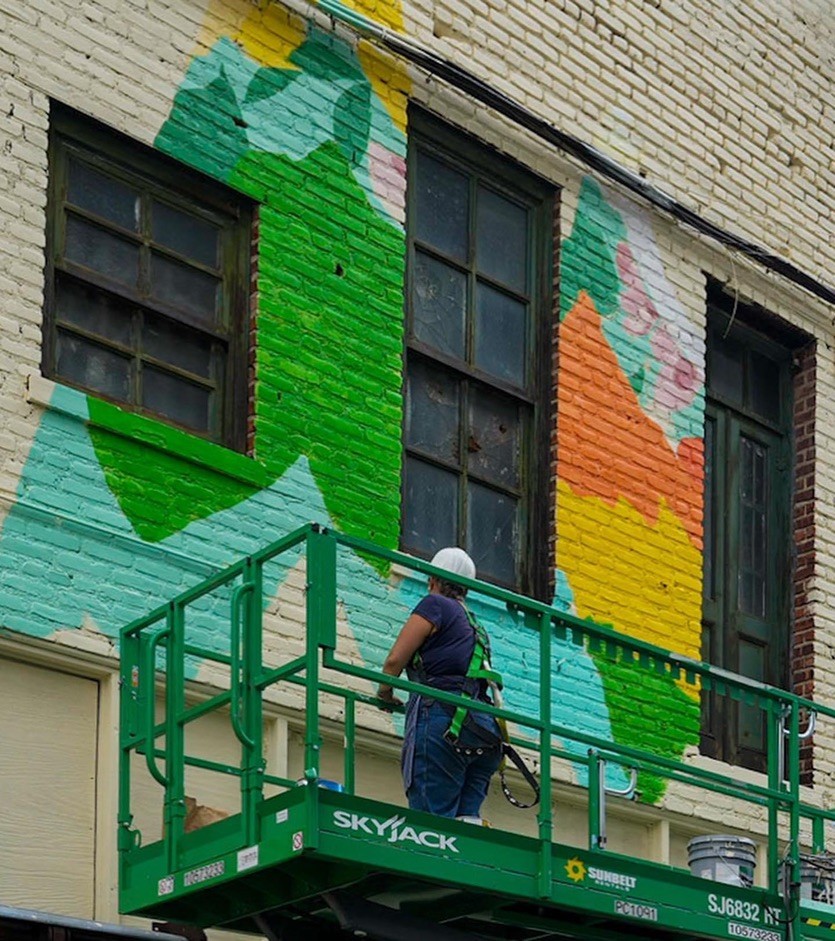

We were lucky to catch up with Eirini Linardaki recently and have shared our conversation below.
Eirini , thanks for joining us, excited to have you contributing your stories and insights. We’d love to hear about the things you feel your parents did right and how those things have impacted your career and life.
My parents both supported me and encouraged me from a very young age to pursue learning arts and always showed me how proud they were every time I made anything as a child. Many people around me were telling me that “artist is not a real job” and that I would have to “keep it as a hobby” on the side, but my parents never believed in that narrative and they showed it to me. They were working class and all but totally supported me. I told them I wanted to travel to France, when I was 16, all the way from Greece, to visit art schools to choose which one I wanted to study in, and visit art museums and travel by train all over Europe, they, again, totally supported me. They never demonstrated any doubts about my ability to achieve my dreams. I know now what an incredible gift that was, now that I meet so many people telling me they were creative as young people but didn’t have their family support to pursue a career in the arts

As always, we appreciate you sharing your insights and we’ve got a few more questions for you, but before we get to all of that can you take a minute to introduce yourself and give our readers some of your back background and context?
As an artist, I am constantly inspired by the world around me and the diverse cultures and communities that I encounter. In my art, I seek to capture and convey the beauty, complexity, and depth of these experiences. One of the ways I do this is through the use of fabrics in my collages. I collect fabrics from everywhere I travel, and each piece holds a unique history and story. By layering and combining these fabrics, I am able to create intricate, textured compositions that speak to the rich tapestry of our shared human experience. In my work, I strive to push the boundaries of traditional collage techniques, experimenting with different materials and techniques to create unexpected and evocative compositions. I am particularly interested in exploring the intersection of art and anthropology, using my collages to delve into themes of identity, memory, and cultural exchange.
Through my art, I hope to foster a sense of connection and understanding between people from different backgrounds and experiences. I believe that art has the power to bring people together and facilitate dialogue, and I am passionate about using my work to promote cross-cultural understanding and appreciation.


Is there a particular goal or mission driving your creative journey?
In my artistic journey, I am continually inspired by the world around me, drawn to the diverse cultures and communities that shape our global tapestry. Through my work, I aim to encapsulate the beauty, complexity, and profound depth of these experiences. Fabrics, for me, are a medium that holds a unique resonance. Each piece, collected from the various corners of my travels, carries with it a distinct history and narrative. Layering and interweaving these fabrics, I construct textured compositions that serve as a visual ode to the intricate weave of our shared human journey. Furthermore, I delve into the realm of digital collage and animation collage, pushing the boundaries of traditional techniques. This digital medium offers me new avenues for exploration, allowing for more intricate and layered compositions. The interplay of physical and digital elements in my work adds a dynamic dimension, inviting viewers to engage with the complexities of our shared human experience.
My artistic exploration extends beyond conventional collage techniques, venturing into territories layered with diverse digital and analog materials and methods. This experimental approach allows me to craft compositions that are at once unexpected and profoundly evocative. I’m particularly captivated by the intersection of art and anthropology, using my collages to probe themes of identity, memory, and the exchange of cultural narratives.
Through my art, I aspire to forge connections and deepen understanding among individuals of varying backgrounds and experiences. I hold a firm belief in the transformative potential of art as a catalyst for dialogue and connection. It is my fervent commitment to employ my work as a means to foster cross-cultural understanding and appreciation, offering a visual language that transcends linguistic boundaries and speaks to our shared human experience.


In your view, what can society to do to best support artists, creatives and a thriving creative ecosystem?
I believe that if any society wants to support the arts and future cultural development, it must start with education from the youngest age. The arts have to be matters that are just as important in school as any other. I can’t see, really cannot, who decided that painting or music are less important than physics or mathematics. Who, really, created these standards? As adults we all know the value of the arts in our lives, yet when it comes to academic accomplishment at school, we tend to follow priorities that haven’t changed for a hundred years. Most schools, like small factories, operate like remnants of the industrial era when schools were used to separate academics from factory workers. Maybe if we change our view of what and who is useful in a society and allow the arts to be accessible to every person who goes to school, we could create a rich creative landscape with artworks that speak to all of us.


Contact Info:
- Website: https://www.linardaki-parisot.com
- Instagram: https://www.instagram.com/linardakiandco/
- Facebook: https://www.facebook.com/eirini.linardaki/
- Linkedin: https://www.linkedin.com/in/eirini-linardaki-73321118/
Image Credits
Image Credits: – Rachel Fawn Alban, Courtesy of Audible, Inc. – Richard Nazario – Eirini Linardaki