

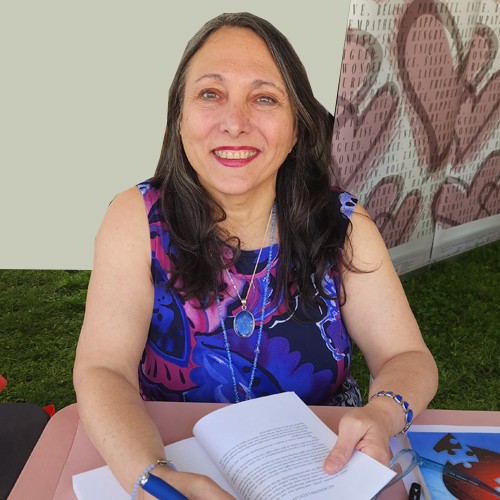

Alright – so today we’ve got the honor of introducing you to Deborah Herman. We think you’ll enjoy our conversation, we’ve shared it below.
Hi Deborah, thanks for joining us today. We’d love for you to start by sharing your thoughts about the pros and cons of family businesses
I come from a long line of business owners and entrepreneurs. My father created his business out of necessity. He had worked in sales and sales management for several companies and built them into tremendous success. But he had heart disease, and during his last employment, while he was recovering from a severe heart attack, the company stripped him of everything. The biggest mistake they made was not having him sign a non-compete. After all, he had done most of the innovation the company had enjoyed. By the following year, he and my brother not only started their own company, but they attended the bankruptcy sale of the previous company, and my father bought his customized desk, which now sits in my brother’s home office. My father, may he rest in peace, taught me the value of resilience, an essential ingredient in any family business.
I have a family partnership with my husband, who is a literary agent. As a married couple, we needed to divide territory right away so we wouldn’t have any ego clashes. It is natural in any situation where you have two people with strong personalities. There also must be a separation between the business life and the personal. I had similar but differing interests from my husband, so I eventually branched out to do my own complementary business. I am an indie publisher and author who consults with writers to bring their work to publishable standards. But we created a hard and fast rule that just because I am working with a writer, I can’t expect him to take them on as a client of the literary agency. Not only could it lead to conflict, it is also unethical. I can help writers improve their work because of my experience curating the titles the agency represents, and my husband, Jeff Herman, has sold over 1,000 titles to major publishers, but I can’t create the expectation that working with me leads them to him. I have a completely separate business. But I can guarantee they will learn what they need to navigate the publishing industry and have a product they could be proud to submit to any publisher. Based on my experience and sensibilities, it also does not guarantee that they will sign with an agent or a publisher. I can only guarantee they will benefit from my thirty years in the industry and my success as an author and publisher.
I have three children who each have been involved with the family business of publishing. My oldest daughter is an artist and she has illustrated one of the children’s books I published. I also help her edit a book she is writing. But what I have done is support her ambitions by opening any doors I can for her to live out her dreams. I also sometimes attend conventions with her to promote her fantasy work and to look for possible projects for my business. But we have an arm’s length relationship because I would not want to stifle her goals. I see my role as one of providing opportunity and mentorship. It fulfils my desire as a mother of a grown child to support her while not confining her to my idea of what her life should look like. It helps us build a strong relationship.
My son, Joshua T. Adams, is more directly involved in the business as he is one of my primary editors. He is a gifted writer and has just completed his first published book. He worked with the founder of the Israel Leadership Institute, Eeki Elner, to bring his story to life in a way that is beneficial to his readers. The book, The Last Year of My Life: Ten Leadership Tools that Transformed a Deadly Diagnosis into a Path of Renewal is part memoir, part prescription, and part spiritual journey. Eeki was given six months to live and told by four doctors to tie up his affairs. A fifth doctor agreed to fight, and over six years later, it shows what miracles can happen. The authors systematized the tools Eeki had been teaching through the ILI as how he not only walked his talk he healed himself. The book is for anyone who wants to reach his or her potential for personal mastery.
Although Joshua is part of the family business, he has his own life and a second career as a therapist. The family business has been helpful in guiding him and providing tools, but he works remotely and ultimately wants to write a novel. While Joshua was writing the book with Eeki, there were times I had to edit the work and give him some difficult feedback. The good news is the communication was such that he was eager to learn and our relationship of mother of son was put aside from our professional relationship. I credit him with the ability to be so open to my feedback because at first, I was thinking like a mother and was afraid to tell him things I would have had no trouble telling a regular client.
My youngest daughter works in the family business on the periphery as more of a support for what we do. We all live in different cities but are creatives. So my youngest daughter’s knowledge of the digital world is a great benefit for all of us. I am very proud of my children and the contributions they make to my work. ‘
I think the key for a successful family business is to maintain boundaries. Personal is personal. Business is business. And when the two overlap with emotions it is important to clear the air right away.

As always, we appreciate you sharing your insights and we’ve got a few more questions for you, but before we get to all of that can you take a minute to introduce yourself and give our readers some of your back background and context?
I decided to become a writer mid-year of law school. I did a dual degree, Juris Doctorate and Master of Journalism, and thought breaking into the publishing field would be easy. Fortunately, my now husband, who was my then-literary agent introduced me to the business end of publishing by having me evaluate and doctor book proposals. We eventually wrote one of the bibles of the industry together, Write the Perfect Book Proposal: Ten Proposals that Worked and Why, now in its third edition. I curated titles for the literary agency and learned what to look for in a project that could be viable and picked up by a publisher.
I got my first book writing break when a publisher turned down a manuscript, and the author faced having to return the advance he received with the publisher canceling the book. I was hired to rewrite the text, which was a medical humor trivia book. I thought it was a big deal. I was paid a flat rate, which seemed enormous at the time, but when I finished the book, and it was accepted, I must have earned pennies per hour. But it got me started as a professional writer. Most writers don’t realize there is a learning curve and a time to pay your dues to succeed.
Since then, I have written thirteen traditionally published books, one being a bestseller, and I have created an indie hybrid publishing company. My time is limited as I typically work on one large writing project above my responsibilities to my clients, so I have developed author services and consulting to guide authors in navigating the industry. Often, I can help them avoid some of the “dues paying” and unscrupulous ways to spend money for little return that is rife in the author services industry. Many claim to have the expertise and have spent little or no time publishing. They see people who dream of publishing a book and promise things they can’t deliver. When I meet with authors, I give them a realistic perspective and examine options. I liken it to my spiritual work called soul-odyssey as I write about it in my book Spiritual Writing from Inspiration to Publication, as I see the path to becoming a published author as similar to the challenges we all face as human beings. One of the lessons I discuss in my book is that of self-protection. Writers who know little or nothing about publishing are vulnerable to promises that cause them disappointment and financial loss and take them off the path to fulfilling their personal writing mission.
I have created a personal one-on-one coaching course, which begins as a four-month process. It combines spiritual teaching of a general nature with practical steps toward writing a book. The course aims to help the writer clarify goals and organize their work while learning about themselves. I use a customized workbook developed over the last twenty years that has been said to be life-changing for the writers who have participated in the course.
My spiritual work is central to my guidance for writers. I have intuitive gifts that I incorporate into my responses to my client’s assignments to help them grow. I can do developmental editing but I prefer to help writers find their Divine inner voice that will inform all of their work. The course is experiential.
Another service we provide for those who have written books is a manuscript assessment. We have created a proprietary approach to diagnosing common issues that derail most projects. We have the professional experience to see where writers are stumbling and provide a blueprint for correction.
If we publish someone, we provide access to editors, designers, and marketing professionals and can set the stage for author branding and marketing. www.micropublishingmedia.com
We have a writer’s social network called writersnetworking.com, and I have a unique online bookstore where we sell the books we publish as well as gently loved titles. It is called debsbookparadise.com


Can you share a story from your journey that illustrates your resilience?
Publishing is a risky business. I am a boutique company and carefully choose projects to put into bookstore distribution that I stand behind and believe in. We have an amazing book coming out this December that was in the works for over two years. The title is The Last Year of My Life: Ten Leadership Tools that Transformed a Deadly Diagnosis into a Path of Renewal. We all worked on the book and carefully edited every page. Finally, it was finished. The author Eeki Elner, is the Founder of the Israel Leadership Institute and with his co-author Joshua T. Adams, they systematized the tools of leadership into the way he healed himself from a diagnosis of six months to live. It is now over six years later. The book is for anyone who wants to learn personal leadership to reach their potential. The book is wonderful.
There was only one problem. We did our first printing of 1,000 books. They looked great. That is until I looked closely and realized the word Israel was misspelled on the cover. It is in small print, but come on!!! The buck stops with me so I spent several hours beating myself up over it reluctant to inform the authors who were already on the edge. Eeki is in Israel now reporting on what is happening and Joshua who is in the US was eagerly awaiting the arrival of his first book.
The printer felt sorry for me so agreed to a second printing at a deep discount. We thought we might need more books so that is a plus. My brother, who was in a type of printing business said can’t they put a sticker over the mistake. I balked and thought the idea absurd until I spoke with my distributor who said we could put a sticker over the mistake. Evidently, there are stickers that don’t show, and I am not the first publisher to run up against this type of thing. Fortunately, the mistake is in very fine print which is probably why no one noticed it.
But this type of thing can derail small business people who become discouraged. I was beating myself up over it until my distributor told me two stories. One was when he was with a major publisher who was printing a second edition of a major cookbook. After printing 100,000, they discovered they used the wrong file and had reprinted the original. He chuckled and said everything was relative.
Then he told me of another publisher whose book came out with the cover right-side up and the interior wrong-side down.
When running a business, it is important to be resilient because things will always happen that will take you by surprise. Then problem solving mode is the best approach.


Is there a particular goal or mission driving your creative journey?
I aim to help writers clarify their goals and pursue their personal missions. Publishing must start with a good book, and I believe the book should be written for the right reasons. That is why I prefer to work with people with a sense of mission. Even a memoir is not about the person writing it. It is a way to use someone’s life experience to create something that will elevate and inform the reader. Writers are messengers and I try to help them do it with a link to the Creative Source.


Contact Info:
- Website: https://www.micropublishingmedia.com or https://www.deborah herman.com
- Instagram: https://www.instagram.com/authordebherman/
- Facebook: https://www.facebook.com/Debsbookparadise
- Linkedin: https://www.linkedin.com/in/bookpublishingexpert/
- Youtube: https://www.youtube.com/@Authordeborahherman
- Other: https://www.debsbookparadise.com https://www.tvclassicspress.com