

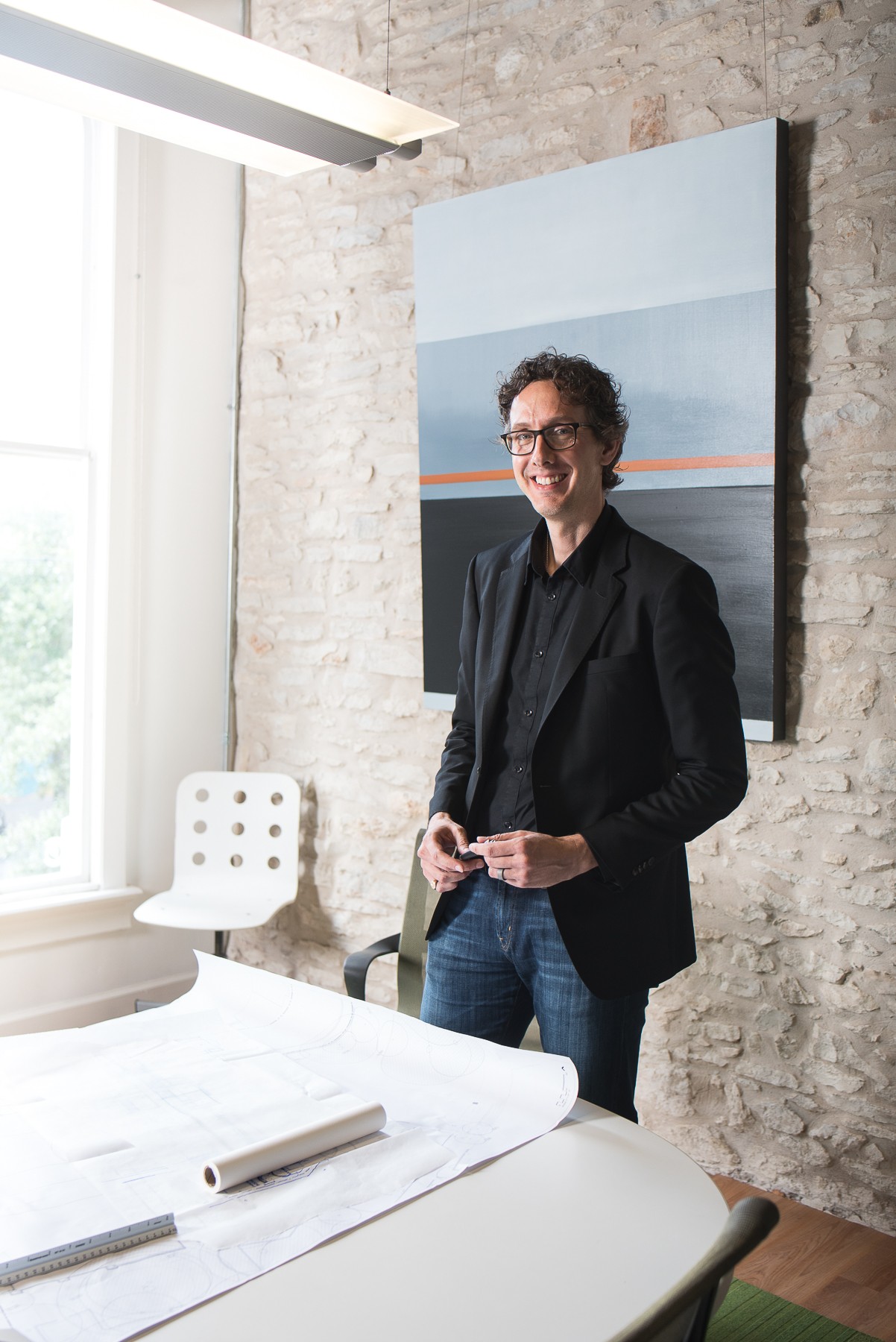

We were lucky to catch up with Daniel Woodroffe recently and have shared our conversation below.
Daniel, thanks for taking the time to share your stories with us today We’d love to hear about a project that you’ve worked on that’s meant a lot to you.
As a Landscape Architect and longtime East Austin resident one project easily rises to the top because of how amazingly transformative it is. Springdale Green, located in East Austin, reimagines the standard convention of an urban office workplace by transforming and healing a 30-acre former petrochemical tank farm into a “gold standard” environmentally conscious office campus — reestablishing native meadows, woodlands, and an urban creek tributary. From inception the collective vision of the landscape was about “toxicity transformed“- taking a contaminated site and cleaning it, healing it, lifting it up and revealing the power of nature to cleanse and restore balance with nature.
One of our earliest ideas that set the tone of the landscape design was an image of the Millennium Falcon landing on forest moon of Yavin 4. The Falcon represented the new buildings — something state-of-the-art, iconic and legendary — a force for good. A new architectural pavilion represents the ancient Jedi temple of Yavin 4, and the restored floodplain, forest and meadows represent the power of [the force] nature to heal.
Abstracts like this and my love of Star Wars aside, the nature of the existing site (particularly the floodplain) presented a unique set of challenges that severely limited the developable area of the project to the northwest corner of the property. While this resulted in a really strong engagement of the urban edge along Springdale Road, the floodplain severely limited the available building area. As a way to offset limitations like this, a series of enhanced environmental requirements and standards were put in place so the buildings could get a little additional height and density approved. These standards included a enhancing and improving the floodplain so that it performs better than before, a landscape restoration and ecological strategy that exceeds minimum requirements, and superior habitat and biodiversity.
Due to the site’s contaminated past the team developed a design thesis / story that amplifies the role and importance of nature and urban ecology – to restore, heal and clean the land naturally while also developing a dynamic and innovative way to engage and experience the site. One of the most fun elements we imagined was an elevated boardwalk that “levitates” over the land (and floodplain) presenting a one-of-a-kind solution to be immersed with the site at a variety of elevations – from just above the meadow all the way up into the canopy of the trees. The boardwalk enabled us to utilize technology, innovation and design excellence to expand the user experience beyond the footprint of the buildings and engages them into the whole site in a really fun and special way.
Today Springdale Green is on track to achieve SITES and LEED Gold, and I believe it would be the first campus in Texas to achieve this level of environmental superiority (For those not familiar, the SITES rating system was founded in Austin and provides a comprehensive framework for designing, developing and managing sustainable and resilient landscapes). With an emphasis around health and wellness through green infrastructure, Springdale Green will create a campus work culture that engages and embraces nature. Through a series of carefully curated spaces with names such as the bird blind, hammock grove and bee meadow, the landscape is choreographed to be a series of dynamic environments that are intended to evoke creativity where users can immerse with nature at their workplace. I believe this emphasis on nature and ecology is not only becoming an industry standard, but given the site’s history, the City of Austin’s climate action goals and the client’s expectation to lead and not follow, this project naturally developed into the exemplification of superiority and excellence. Setting a high bar for others to follow.
Overall, Springdale Green is one of dwg.’s most powerful and impactful projects that I am very proud of, and it goes without saying that none of this would have been possible without a visionary client, Jay Paul Company, an amazing design team led by Gensler, and a fantastic general contractor, Level 10. It’s the true Dream Team!

Great, appreciate you sharing that with us. Before we ask you to share more of your insights, can you take a moment to introduce yourself and how you got to where you are today to our readers.
Having received both my Bachelors and Masters of Landscape Architecture degrees in Edinburgh, Scotland I moved to the United States in 1998 to begin my career as a landscape architect – a profession that engages in the planning, design, management, and nurturing of the built and natural environments. With extensive training and unique skill sets, landscape architects work to improve human and environmental health of the public realm. This can include parks, campuses, streetscapes, plazas and residences, but also includes ecological restoration of former petrochemical tank farms, green roof and other roof top amenities, and the transformation of parking lots into parks.
As founder and president of dwg., my work explores the interrelationship between landscape, architecture, ecology and urbanism, infrastructure, and art to express the importance of creating exceptional designs that are socially and environmentally equitable and resilient. Our work in the urban landscape (or public realm as we like to call it) is incredibly diverse – always toggling between a multitude of scales. From understanding the importance microbes, bugs and critters to the design of custom furniture and lighting, to envisioning entire districts of cities, we do it all. We have a particular passion for projects that have a nuanced focus on adaptive reuse and urban transformations that amplify climate resilience and the creation of engaging, social spaces. We believe design can be incredibly thought provoking to reinvent spaces that are otherwise underutilized. Our work celebrates the stories and layers of the past with visions for the future through an honest use of authentic materials, local crafts and trades. Sometimes this transformation can be as simple as using 80,000 pink survey flags to highlight an urban creek from an unwelcoming place into something magical and memorable. And sometimes our process is infinitely more complex, involving transforming a former petrochemical tank farms into an ecological paradise within the heart of a major city.
I feel so incredibly blessed to have a career where my passion for creating outdoor spaces that inspire and delight can also translate into built projects that promote social and environmental action.


Can you tell us about a time you’ve had to pivot?
Without hesitation, moving to the States in 1998 was a huge personal, social, cultural and professional rollercoaster. You can imagine the cultural nuances, not to mention the very different climate, landscape, and of course the need to re-train my brain from meters to inches! However, my international background and experiences has enabled me to develop an increasingly sophisticated dialogue around the public realm. I passionately believe that landscape architecture in America is having a renaissance. Our profession is coming to the forefront again, much like it did in the Olmsted era. As a profession, landscape architects are leading conversations about how the American city, the public realm and the environment can work in greater harmony and balance. The ability to dive in, to raise my hand, to voice my opinion, and make change happen has been incredibly pivotal in crafting my career path.
However, by far the biggest pivot was the decision to start dwg. in 2010. What started as a leap of faith in a period of economic instability has grown from one single employee to nearly forty wickedly smart teammates across the country that enable us to work on amazing commissions all over the world. Having the faith and trust in myself — and team — to make dwg. become a success was together one of the most liberating and terrifying moments in my business career and life. Looking back, I have to credit so much to the trust and enthusiasm of friends, peers and clients who provided the morale boosts, reassurance and the projects to flourish as much as we have. After 14 years of experiences, lessons and new perspectives I finally feel like dwg. has earned our stripes and are now hitting our stride. In such a short time we are seeking (and being sought out for) new innovative and imaginative commissions that have the capacity to change the world for the better. In fact, our most recent commission is re-imagining 2.7 acres on the northern bank of the Allegheny River in Pittsburgh. Not too shabby for a firm that started with one employee working at my dining room table 14 years ago!


What do you think is the goal or mission that drives your creative journey?
Since dwg.’s founding in 2010, we have constantly sought work that enables us to innovate and advance sustainable design solutions to create tangible change for communities.
Operating at the intersection of nature and culture, art and science, ecology and community, landscape architecture has the power to bring life to a site, create positive change, and encourage engagement. Whether it be an ecological restoration, a public art installation, or a high-rise roof garden, we believe landscapes should be spaces for joy, relief, and the meaningful connection between people and their environment.
Our design solutions are not tethered to convention. We believe that smart and unexpected interventions cultivate unforgettable, meaningful experiences. Regardless of project type, location, or scale, we create something better by disrupting the norm. We’re passionate about what we do and we have fun doing it. Our culture is built upon authentic relationships with our colleagues, clients, and communities, and we are always eager to partner with other creative collaborators.
Much like landscapes themselves, we encourage our thinking to evolve and grow over time. By pursuing projects that present unique challenges, we develop an ever-growing knowledge that allows us to adapt to solve new problems. As a collective of curious and creative people, our combination of resourcefulness and imagination leads to discovery. Influenced by disciplines from horticulture and soil science to industrial design and architecture, we embrace new technology, delve into research, and explore the natural world in support of achieving our project visions.
Onwards and upwards!


Contact Info:
- Website: studiodwg.com
- Instagram: @studiodwg, @danielwoodroffe
- Facebook: @studiodwg
- Linkedin: https://www.linkedin.com/company/dwgaustin/ and https://www.linkedin.com/in/danielwoodroffe/
- Twitter: @studiodwg @danielwoodroffe
Image Credits
dwg.