

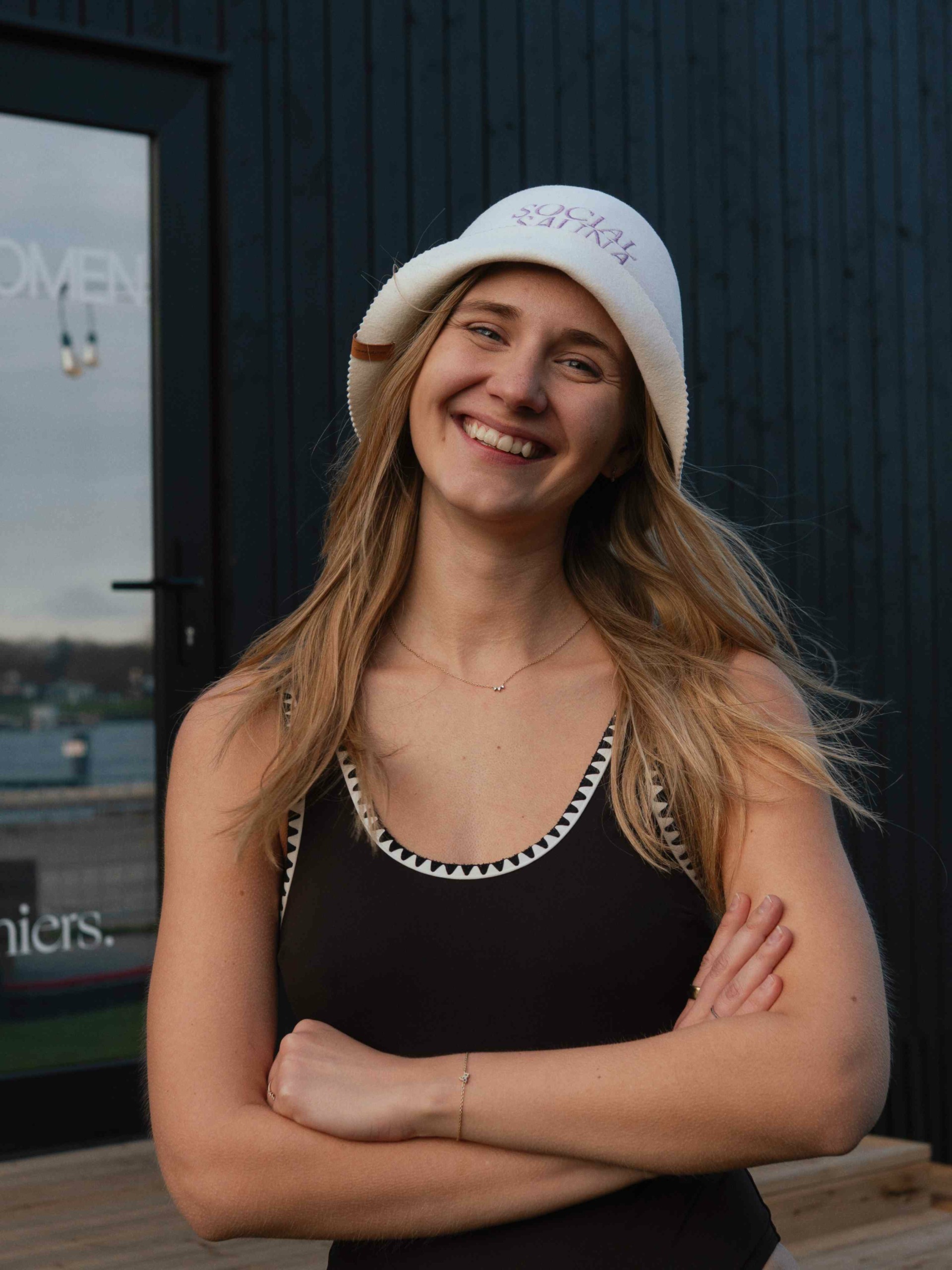

We recently connected with Anzelika and have shared our conversation below.
Awesome – so before we get into the rest of our questions, can you briefly introduce yourself to our readers.
My name is Anželika (pronounced Angelica :) ), and I’m the co-founder of Miers Social Sauna Club in Riga, Latvia. The journey into this industry is deeply personal, and in many ways it starts with Latvian sauna culture itself.
In Latvia, sauna traditions are deeply rooted in our culture and daily lives. I remember going to the sauna as young as four or five years old at my grandmother’s house. From childhood, I was taught that sauna is a place for cleansing, connection, and slowing down. Traditionally here, sauna rituals happen in small, intimate groups, often with family or close friends, outside the city, and over several hours.
Everything changed when I met my partner, Casper, who is also the co-founder of Miers. We spent a lot of time between Latvia and Denmark, and there I discovered a completely different sauna culture emerging. These were large social saunas with guided rituals, music, aromatherapy, towel waving, breathwork, and cold plunges, often shared with 30 or 40 strangers at a time.
I completely fell in love with the concept.
For me, it was such a contrast to the quiet, traditional Latvian sauna experience I grew up with. Suddenly sauna became something energetic, immersive, and communal. Instead of simply sitting in heat, you were being guided through an experience. I often describe it as having a personal trainer, but for sauna. Someone helping you move through the heat, the cold, and the mental challenge of both.
At the same time, this happened during a very personal period of my life. I had spent four and a half years working remotely in online teams while moving between Riga and Copenhagen. Like many people, I felt how digitalized life was becoming. Sauna became a space where I could disconnect to reconnect, away from screens, away from notifications, and fully present with other people.
That combination stayed with us.
For a long time, Casper and I kept asking ourselves: should we bring this concept to Riga? Eventually we realised we had to. Today, Miers Social Sauna Club has been operating for four months, and we are introducing a new kind of sauna culture in Latvia.
There are of course public saunas here already, in gyms, hotels, and wellness centers, but what we wanted to create was something specifically designed for younger, health-conscious people living in the city. We wanted to make sauna more social, more accessible, and more experiential.
In many ways, we are introducing a completely new format to Latvia. That comes with exciting opportunities, but also challenges. Because we are early movers, there is a lot of education involved. Many people already have strong ideas about what sauna “should” be. But what we consistently see is that once people try our sessions, they fall in love with the experience. Around 65% of our guests return after their first visit, which tells us we are building something meaningful.
At Miers, we currently offer three types of guided sauna rituals: Calm, Flow, and High.
The structure is always the same, a 75-minute guided ritual with three sauna rounds, each followed by cold plunges or cooling-off periods. What changes is the music, intensity, aromas, and atmosphere.
“Calm” is our most meditative experience. It’s deeply inspired by Nordic and Latvian sauna traditions, almost like a breathwork or nervous-system reset session.
“Flow” sits somewhere in the middle. Think tribal rhythms, grounding energy, and a feeling of moving into a state of presence and recovery.
Then there is “High,” our techno sauna experience. This is high-energy, immersive, and social. We use electronic music, towel waving, heat rituals, and collective energy to create something that honestly feels like a healthy version of a night out.
One of the reasons this has resonated so strongly is because we’re seeing broader cultural shifts happening everywhere. Young people are drinking less. More people care about health, recovery, and mental wellbeing. Many people still crave social connection and nightlife energy, but they want it in a healthier format.
We often describe our sauna parties as “the party without the hangover.”
What also fascinates me is that there’s real science behind why these experiences feel so powerful. Sauna heat elevates your heart rate, releases endorphins, activates heat shock proteins linked to recovery and longevity, and creates a natural dopamine response, especially when combined with cold plunges.
At the same time, there are studies showing that human happiness is strongly connected to the quality of our social relationships. When people go through intense or meaningful experiences together, whether it’s heat, cold, music, or shared vulnerability, they naturally feel more connected.
That intentionality is at the core of everything we do.
Technically, you could sit alone in a hot sauna and still receive many physical benefits. But what makes guided social sauna experiences unique is the collective aspect. When people breathe together, cool down together, and move through discomfort together, something very human happens.
I also think it’s interesting that social sauna culture is growing globally right now, especially in places like Germany, Scandinavia, the UK, and the US. We’re seeing nightlife evolve. Clubs are struggling in many places, while people increasingly seek healthier, more meaningful social experiences.
For us, sauna sits perfectly at the intersection of wellness, social connection, and culture.
Our tagline is “the easiest entry point to better health,” because genuinely, all you need to do is bring a swimsuit and show up. The ritual itself does the rest. You leave feeling lighter, calmer, more connected, and better physically and mentally.
Even our name reflects that mission. “Miers” means “peace” in Latvian, but in our context it represents inner peace and balance. We also intentionally added a dot at the end, Miers., because to us it symbolizes that final feeling you experience after a session. That deep exhale. That moment when your nervous system settles and you feel completely present again.
More than anything, I want people to know that Miers is not just about sauna. It’s about creating spaces where people can reconnect, with themselves, with others, and with their bodies, in a world that often pulls us away from all three.

We’d love to hear the story of how you built up your social media audience?
I think for us, building an audience on social media has really come down to having a very clear sense of who we are as a brand, but also who we are not. We’re still very early in our journey, only a few months in from soft launching, but we’ve already had several videos perform really well organically, with some reaching hundreds of thousands of views across TikTok and Instagram. And I think the reason for that is not because we tried to appeal to everyone, but actually the opposite.
From the beginning, I felt that especially in the wellness space, there’s a lot of sameness. A lot of brands look and sound very similar, very polished, very aesthetic, very “safe.” And for us, we knew we didn’t want to be just another soft, beige wellness brand. We wanted to be bold, playful, disruptive, social, energetic, almost the opposite of what people expect from traditional wellness culture.
So when we started creating content, we leaned fully into that identity. We posted videos of techno sauna sessions, people dancing, strong energy, humor, community moments, and honestly, not everyone liked it. Some people loved it, some people hated it, and I actually think that’s a good sign. Because if everybody feels neutral about your brand, usually it means you’re not standing for anything memorable.
I think one of the biggest lessons for me has been that building an audience today is less about trying to look perfect and more about creating a strong point of view. Especially now, when AI tools and templates make it easy for everyone to create polished content, what becomes rare is personality and human connection. That’s what people really connect with.
And that’s also why we’ve tried to show the people behind the brand as much as possible. We want people to feel the energy, the community, the humanness behind what we’re building, not just see a logo or a perfectly curated feed. I think audiences today connect much more deeply with brands that feel real and emotionally clear.
So overall, I would say our approach has been: be very intentional about your identity, don’t try to copy what everyone else is doing, and don’t be afraid to create a strong reaction. Because the strongest communities are built when people genuinely feel something about what you’re creating.
And for anyone just starting out and trying to build a social media presence, my biggest advice would honestly be to spend less time trying to make everything perfect and more time understanding what your brand actually stands for. Ask yourself: what makes us different, what do we represent, and what feeling do we want people to associate with us?
I also think people should not be afraid to experiment early on. Especially in the beginning, social media is really about testing and learning. Some videos will fail completely, and others will unexpectedly connect with people. A lot of our strongest-performing content was actually the content that felt the most authentic to us, not necessarily the most polished.
And I would really encourage founders to show themselves and the people behind the brand. I think audiences are craving more realness right now. With so much AI-generated and highly curated content online, human personality has become one of the most valuable things a brand can have. So don’t hide behind overly perfect branding. Let people connect with your energy, your values, your humor, your community, because that’s ultimately what creates loyalty and not just views.

What’s a lesson you had to unlearn and what’s the backstory?
I think the biggest lesson I’ve had to unlearn, and honestly I’m still in the process of unlearning, is the belief that I have to do everything myself.
A lot of that mindset comes from my background. Early in my career, I worked for about four and a half years at a company called Karst Goods. It was a small team, so naturally everyone wore multiple hats. You learned to solve problems independently, move quickly, and take ownership of almost everything yourself.
My studies reinforced that too. I studied Governance, Economics, and Development at Leiden University College in the Netherlands, and the environment there was very self-directed. Nobody handed you the answers upfront, you had to figure things out yourself. And honestly, I think even my upbringing contributed to that mentality.
For a long time, I saw being able to do everything myself as a strength. And in many ways, it was. It helped me become resourceful, adaptable, and very hands-on. But over time, I realized that mindset can also become a limitation.
First, nobody can truly be excellent at everything. There will always be people who are more experienced, more specialized, or simply more efficient in certain areas. And second, when you try to do everything yourself, your attention gets spread too thin, and eventually you become less effective overall.
So one of the biggest things I’m learning now is how to delegate properly and build systems around delegation.
What’s interesting is that delegation isn’t just about handing over tasks. It’s actually a much deeper internal process. You start asking yourself why you feel the need to personally oversee everything in the first place. For me, it’s been about learning how to let go a little while still creating the right structure, communication, and accountability around the work.
I’ve realized that if you build strong systems and empower the right people, you can still maintain a clear overview without needing to control every small detail yourself.
One experience that really accelerated this learning was creating some physical distance from the business. Since we operate physical sauna sites, I used to think I was most effective when I was constantly on-site, involved in everything, and physically present in the day-to-day operations.
But interestingly, spending more time in Denmark, where my partner is from, actually made me a better operator and leader. Once I wasn’t physically there all the time, I simply couldn’t jump in and solve every small issue myself anymore. I had to delegate, create clearer systems, and make sure the business could function well without my constant involvement.
That experience really showed me the importance of building processes and empowering people rather than relying on my own presence to keep things moving.
At the same time, I’ve become much clearer on where I personally bring the most value. I love working on marketing, sales, partnerships, and growth. That’s where my strengths naturally are. But operational fixes, scheduling, accounting processes, or certain administrative tasks are often much better handled by people who specialize in them.
And ultimately, that shift is not only healthier for me personally, it’s also much better for the business.
So I think the lesson I’m still learning is that good leadership is not about doing everything yourself. It’s about building the right systems, empowering the right people, and understanding that sometimes stepping back a little actually creates a stronger outcome overall.

Contact Info:
- Website: https://miers.lv/
- Instagram: https://www.instagram.com/miers.lv/


