

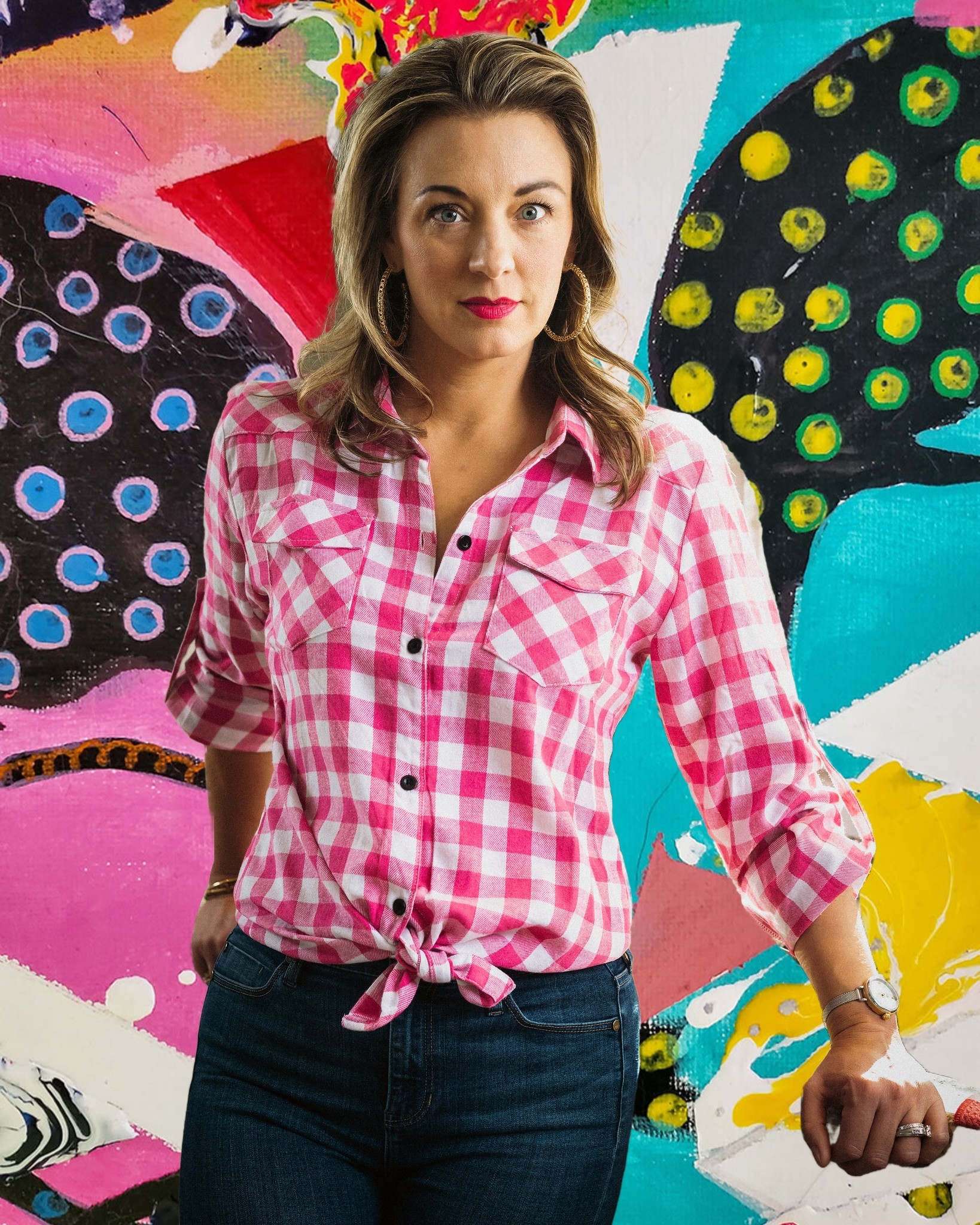

We were lucky to catch up with Alicia Wagner, NTP recently and have shared our conversation below.
Hi Alicia , thanks for joining us today. It’s always helpful to hear about times when someone’s had to take a risk – how did they think through the decision, why did they take the risk, and what ended up happening. We’d love to hear about a risk you’ve taken.
I didn’t set out to take on something controversial. I set out to save my child.
That’s how most of these stories begin, right? Not with ambition, but with desperation. Not with a business plan, but with a moment where you realize the system you trusted isn’t built to catch what your child is falling through.
Years ago, my daughter got sick. Not the kind of sick that resolves with time, but the kind that rearranges your entire life. The kind that turns a vibrant child into someone you barely recognize anymore. We were given labels, reassurances, and a familiar script… “watch and wait”. But waiting didn’t help her at all. And the deeper we went, the more it became clear that we weren’t dealing with a lack of care. We were dealing with a lack of understanding. Most providers are not trained on current childhood epidemics like autism, PANDAS, PANS, POTS, etc…
That was the first risk I took. Walking away from blind trust in a system I once believed had it all figured out. I worked at a pharmaceutical company for seven years, so I knew the system extremely well.
After our providers had few answers, I went back to school for functional wellness. I started asking different questions. I began to look upstream at inflammation, at the gut, at infections, at environmental exposures, at genetics. It wasn’t fast, and it wasn’t easy, but piece by piece we rebuilt my daughter’s health.
She got her life back and in the process, I got mine back too, but not the same version. A new one… one that couldn’t unsee what I had learned.
That’s where The Joss District was born. It started as a way to help other parents navigate what I had to learn the hard way, how to organize testing, find the right providers, and actually connect the dots. It was never meant to disrupt anything. It was meant to support families who were also slipping through the cracks.
But then something else became clear. The families I was working with weren’t looking for more opinions, they were trying to make sense of what was already in front of them and didn’t have the tools to do it. They weren’t asking for more noise, they were asking for clarity. For a way to understand their child’s biology before problems appeared, not after they were already trying to fix them. And right at the center of that need, whether people want to acknowledge it or not, was one of the most complex conversations in pediatric health… vaccines.
That’s where our journey began, my daughter experienced vaccine injury and it wrecked her entire immune system, paving the way for her PANS diagnosis (Pediatric Acute-Onset Neuropsychiatric Syndrome).
Even writing those words, I know the temperature in the room just changed for certain readers. It’s one of the most polarized, politicized conversations in modern healthcare. You’re expected to pick a side. To be “for” or “against” and to stay in your lane.
But what I was seeing, didn’t fit neatly into either category.
I was seeing children with underlying vulnerabilities, issues in detoxification, methylation, and immune regulation who were reacting in ways that weren’t being screened for or acknowledged early enough. I was seeing parents blindsided. Not because they (or their provider) didn’t care, but because they didn’t have access to individualized information for informed consent based on the manufactures’ very own precautions, warnings, and contraindications.
And I couldn’t ignore it anymore.
That was the nuclear risk: choosing to step into a conversation where misunderstanding is almost guaranteed.
I knew what it could cost… credibility, relationships, reputation. I had already built something meaningful with The Joss District. I could have stayed there, helped quietly and kept things safe. But safe doesn’t change systems.
So I took everything I had learned, every late night of research, every case, every pattern, and started curating something bigger. A first-of-its-kind genomics based tool designed to give parents insight into their child’s unique biology from the very beginning. Not to tell them what to do, but to help them make informed decisions in partnership with their providers.
Why? Because parents don’t want louder arguments, they want better tools.
They don’t want to be pushed into corners. They want a seat at the table, included in the conversation, and right now that table is missing a critical piece… individualization.
For decades, research has been accumulating across genetics, immunology, and environmental health. But it hasn’t been translated in a way that empowers families. It hasn’t been integrated into everyday decision making and it certainly hasn’t been made accessible.
So we filled that gap at Sunra Health.
Building Sunra meant stepping fully into the tension between science and silence, between innovation and resistance. It meant accepting that some people would misunderstand the mission entirely and that others would reduce it to headlines or assumptions.
But it also meant something else.
It meant hearing from parents who finally felt seen. Who said, “This is what I’ve been looking for.” Who didn’t want to fight but wanted to understand. We don’t need more division in healthcare. We don’t need red or blue opinions. we need a shade of purple uniting this conversation rooted in safety.
We need a middle ground where curiosity is allowed, where data is explored, and where parents are equipped, not dismissed. A place where prevention is prioritized over reaction. Where we stop pretending one-size-fits-all works in a world that is anything but.
Taking this risk didn’t make life easier, it made it more complex, but it also made it meaningful in new ways. Because when you’ve watched your child almost lose everything and then fight their way back, you stop being afraid of uncomfortable conversations… you start being afraid of what happens if no one has them.
So I took the risk. And I’d take it again, and again, and again.
Because this isn’t just about my child anymore. It’s about an entire generation of kids who deserve better solutions, earlier answers, and a system that sees them for who they are, individuals, not averages in an outdated research paper.
Genomic insights at birth isn’t just about vaccine decisions, it’s about understanding a child’s biology from day one. It reveals how they detoxify, respond to inflammation, and where they may be more vulnerable long before symptoms ever show up. The “test don’t guess” approach changes everything. It gives parents clarity, not just reassurance. A way to align nutrition, environment, and lifestyle to their child’s needs and stay ahead of chronic issues instead of chasing them.
Because guessing isn’t healthcare, precision is. When we give families access to that level of insight early, we’re not just preventing problems, we’re changing the trajectory of pediatric health entirely.
Awesome – so before we get into the rest of our questions, can you briefly introduce yourself to our readers.
I didn’t take a traditional path into this work, it was twists and turns following what felt like a North Star.
My career started inside the pharmaceutical industry, where I learned how medicine is marketed, positioned, and brought to providers. It was an invaluable experience, but it also gave me a front row seat to the limitations of a system that often prioritizes protocols over personalization.
From there, I moved into consulting and eventually stepped into entrepreneurship, opening a farm-to-table restaurant called Fowl & Fodder Downtown. That chapter of my life was rooted in a deep belief that food is foundational to health. Our award winning concept for vegan, vegetarian, gluten free, and dairy free fare focused on clean ingredients, local sourcing, and creating a space that supported wellness from the ground up. It was an amazing concept, but my life shifted when my daughter became critically ill and I had to sell the restaurant. That moment changed everything in an instant.
What started as a mother fighting for her child’s health turned into a complete reinvention of my career. I went back to school for functional health and began studying the root causes of chronic illness in areas like digestion, immune dysfunction, inflammation, environmental exposures, and genetics. I quickly realized there was a massive gap between what families were experiencing and what the system was equipped to address. That’s where The Joss District was born.
After my daughter got better, The Joss District became a place where I helped families organize complex cases; connecting testing, providers, and lifestyle interventions into a clear, actionable plan. I was helping parents make sense of overwhelming information and advocate for their children in a system that often left them without answers or guidance.
At its core, I’m working to address one of the biggest gaps in modern healthcare, the lack of individualization. Kids are not averages. They’re born into a world with unprecedented environmental exposures, some studies have shown newborns are carrying hundreds of detectable chemicals in their bodies at birth and yet we continue to approach their care with one-size-fits-all approaches?
When we treat children like averages, we miss what matters most… their unique biology, their unique vulnerabilities, and their unique potential for wellness. What sets me apart is that this didn’t come from theory, it came from lived experience. I’ve been the parent searching for answers, the one piecing things together when nothing made sense. That perspective shapes everything I have built and continue to build today.
That’s how The Joss District evolved into Sunra Health, because a lot more kids deserve brighter days ahead. They deserve healthcare that addresses upstream prevention, where possible.
Right now, we’re watching an entire generation struggle in ways we can’t ignore. Children are dying at birth at unprecedented rates, facing preventable conditions, battling mental health crises, and living with complex challenges that limit their ability to fully engage in life beyond their homes or classroom.
Autism alone tells part of the story. Nearly half of families navigating autism are facing profound cases, and many of those children will require lifelong support from their parents. The numbers continue to rise, now affecting roughly 1 in 30 children, with even higher rates among boys in states like California (1 in 12).
The ripple effect is significant. Families are often forced to make immediate, life altering decisions, with one parent (most often mothers) stepping out of the workforce to provide full time care. That shift can mean the sudden loss of income, insurance, and stability, all while the cost of care increases. This isn’t just a health issue. It’s a family, workforce, and economic issue as well.
This isn’t the future our children deserve, and yet, for the first time, we have access to tools that can help us change it. Genomic insights give us a window into a child’s biology from the very beginning, offering early signals around detoxification, inflammation, immune response, and more. Not as a prediction of fate, but as a guide. A way to support, nourish, and intervene earlier… before patterns become problems.
We have an opportunity to move from reactive to proactive care. To stop guessing, and start understanding. When that kind of information is available, we have a responsibility to use it, to pave a new path forward for the next generation.
I’ve also always had a heart for community, especially families navigating hardship. I’ve been involved in nonprofit work for years and have been honored with several community awards, but what matters most is showing up where and when it counts for families. In the messy middle of life.
What I’m most proud of at this stage of my life is that my daughter got her life back, and that experience now fuels work that reaches far beyond our own story.
I don’t see this as a business as much as a responsibility: to ask better questions, to build better tools, and to help shift the conversation toward something more individualized and ultimately more human for the next generation of families.
Other than training/knowledge, what do you think is most helpful for succeeding in your field?
Beyond training and knowledge, what’s most essential in this field is the willingness to think independently and sometimes, to stand alone.
If you’re building or challenging anything meaningful in healthcare, especially in areas that haven’t evolved at the pace of science, you’re going to get the head tilts and sideways glances. That’s just part of it. Change can often feel uncomfortable to people who are grounded in systems that haven’t yet caught up.
You have to be willing to hold that tension and listen to feedback, but filter it through discernment. To stay anchored in your values, your data, and, for me personally, my faith. There have been many moments where the path forward didn’t look conventional, or even widely accepted, but it was clear. And clarity (in my opinion) matters more than consensus when you’re trying to create change for the common good.
We have to remember that science is not static, it wasn’t meant to be, it evolves. What we accept as standard today has been wrong before and will be refined again. We’ve seen medications pulled from the market, widespread lawsuits from post marketing data, and growing awareness around medical error as a leading cause of death. These realities don’t undermine medicine, they remind us that it must continuously improve.
And yet, there are areas, especially in pediatrics, where innovation and personalization haven’t kept pace with what we now know. We’re still largely operating within one-size-fits-all frameworks in a population that is currently anything but uniform. At the same time, we’re seeing rising rates of chronic illness, neurodevelopmental conditions, and immune dysfunction in children that are skyrocketing all while people say, “The science is settled.” That gap between what’s happening in real life and how we’re approaching care is where many of us are now focused.
Progress doesn’t come from ignoring those signals, it comes from investigating them. It comes from listening more closely to outcomes, to patterns, and yes, to parents. Especially mothers, who are often the first to notice when something isn’t right. Their observations shouldn’t be dismissed, they should be a much bigger part of the conversation.
At the end of the day, advancing this field requires more than credentials… it requires courage. Where ego can be put aside and allow parents (and providers) to question, explore, and to keep moving forward even when it would be easier to stay within what’s already been accepted. That’s where real change begins and how we protect kids who are falling through the cracks today.
How did you put together the initial capital you needed to start?
Funding Sunra Health didn’t start with a pitch deck. As you’ve heard, it started with a problem I couldn’t ignore any longer.
Like many founders, I didn’t come from a traditional tech background, I came from necessity… “the mother of invention”. I had already walked away from one career, built and sold a business, and then rebuilt my life again after my daughter got sick. So when I started working with families through The Joss District, I wasn’t thinking about raising capital. I was thinking about solving what was right in front of me.
But the more families I worked with, the clearer it became… this wasn’t a one family problem. It was a systems level gap. I took everything I had learned and started building what would become Sunra Health. In the early days of The Joss District, it was scrappy, it was self funded, relationship driven, and built through sheer conviction. I leaned on my network, reinvested my own time and resources, and began pulling together the right people, clinicians, developers, and advisors who understood both the problem and the opportunity at hand.
The real inflection point came when we were accepted into the JumpStart Health Tech Accelerator in fall of 2025. JumpStart didn’t just provide funding, it provided validation. We were awarded a $50,000 grant through the program, which allowed us to move from concept to a true MVP and begin building the infrastructure behind the platform. From there, momentum started to build.
We secured our first investor, committing $100,000 into the pre-seed round (that JumpStart matched), someone who not only believed in the vision, but in the timing and necessity of what we’re building. At the same time, we were proving demand in real time.
– 75 pilot families from The Joss District showing clear patterns and use case alignment
– Over 300+ parent survey responses validating both need and willingness to pay for genomic testing
– Clinical partnerships forming with organizations like Documenting Hope and Docs Genetics
– LOI’s secured for our beta test launch for the platform
– And our MVP officially LIVE, with an audience queue built ahead of launch
We didn’t raise capital on an idea alone, we raised it on traction, on signal, and on a problem families are actively trying to solve. What’s unique about our funding journey is that it wasn’t built in a vacuum. It was built alongside the people we were serving. Every dollar raised, every partnership formed, every milestone hit… it’s all been grounded in real world validation.
And that’s important, especially in healthcare, because investors aren’t just backing a product, they’re backing a shift. A move toward earlier insight, better decision making, and a more individualized approach to care.
We’re now in the process of opening our seed round, with a clear path forward, but the foundation of this company was never just capital. It was conviction, lived experience, and the willingness to build before anyone gave us permission to.
That’s how this started, and it’s still how we operate today, we listen to the moms. They’re coordinating care, researching solutions, and making the majority of health decisions for their families. In fact, women control nearly 80% of household purchasing power in the U.S.
The insight is there, along with the demand. What’s missing is funding and the right people being funded to execute the solutions more moms need.
Female founders only receive about 2% of venture capital, despite data showing they often outperform, delivering returns as high as ~78% compared to ~31% from male led teams in some studies. When women see problems, especially in healthcare and family systems, they build solutions that are grounded in real use, real need, and real outcomes.
So this isn’t just about listening to moms. It’s about funding the women who can build what moms are asking for. Because when you combine lived experience with capital, you don’t just create products, you create solutions that actually work and you create solutions that parents actually need to change the trajectory of pediatric care for generations to come.
Contact Info:
- Website: https://www.sunrahealth.com
- Instagram: https://www.instagram.com/rootcausereporter/
- Facebook: https://www.facebook.com/sunrahealth/
- Linkedin: https://www.linkedin.com/in/alicialwagner/
Image Credits
@ManOverboard