

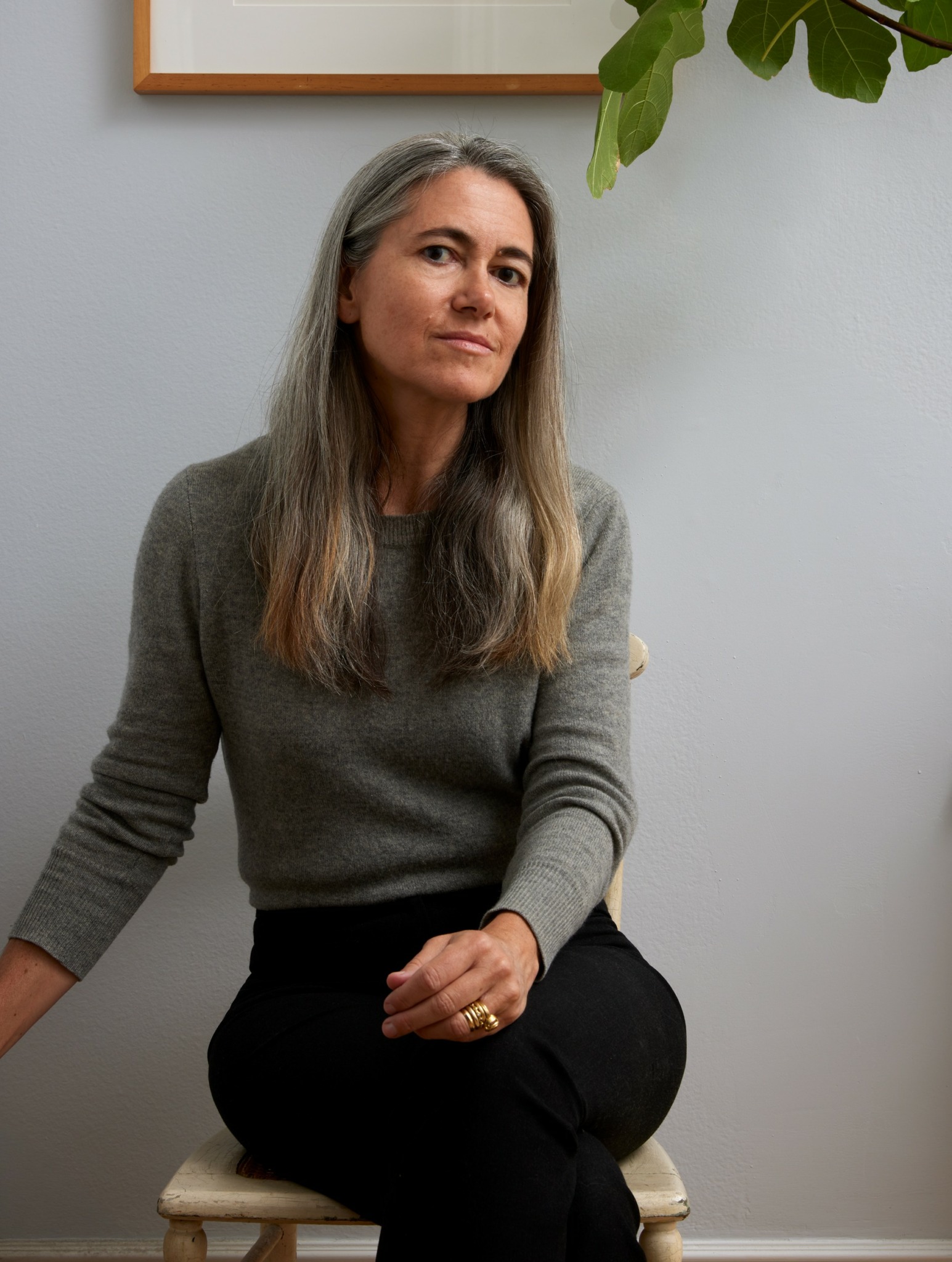

Alright – so today we’ve got the honor of introducing you to Alexandra Rowley. We think you’ll enjoy our conversation, we’ve shared it below.
Alexandra, looking forward to hearing all of your stories today. Did you always know you wanted to pursue a creative or artistic career? When did you first know?
I think I’ve always known, if I’m being honest with myself. Since I was a small child.
There’s actually video evidence. When I was around eight years old, I was interviewed by an NYU clinician who was studying — and I love this — “normal children.” She asks what I want to be when I grow up, and without hesitation I say: “An artist. And maybe a mother as well.” I’m fortunate to be both now. And honestly, they’re more related than people might expect.
Growing up in New York City in the 1970s and ’80s was its own kind of creative education. It wasn’t just the museums and cultural institutions — though those were always present and formative — it was everywhere. The subway graffiti was vivid and alive. There was always music in our home. We had art supplies in the kitchen and our artwork hung on the walls. Making things was my solace and my connection to others simultaneously — a way to sit quietly, to feel, to just be. I’d knit with my godmother, fold origami at the kitchen table, draw on the floor of my room, photograph my friends, lose myself in the darkroom as a teenager. Creativity wasn’t a hobby or an aspiration. It was simply how I lived.
I remember going out to lunch with my parents when I was quite young — our neighborhood spot — and Andy Warhol was sitting at a nearby table. He was wearing overalls in a restaurant where every other man had on a jacket and tie. I looked at him and thought: I want to do what that guy does. Of course, I wasn’t thinking about Pop Art or Factory superstars or cultural disruption. I was thinking about permission. About the particular freedom of someone who had decided, completely and without apology, to be exactly himself in a room full of people who hadn’t. That’s what I recognized. That’s what I wanted.
Of course there have been moments of fear and doubt along the way — that’s normal and human — but I always return to myself as my own creative home. It’s less a career I chose than a self I kept coming back to.


As always, we appreciate you sharing your insights and we’ve got a few more questions for you, but before we get to all of that can you take a minute to introduce yourself and give our readers some of your background and context?
I’m a visual artist and photographer, though I’d resist any single label; my practice has always stretched across fine art, commercial work, poetry, ceramics, sound installation, assemblage, handmade books, and curation. But if I’m honest about where it all began, it starts with language and visual art — and with making things with my hands.
I always drew and painted and made things at home and at school. I learned photography from my father and from my art teachers. I welded in college. In later years I delved deeper into ceramics and assemblage, sound installation and flirted with glassblowing. For me, the practice of visual art and creative writing did something deeper than develop skills — it helped me feel at home within myself, at home in the world, and at home in connection with others. That’s what making has always been: not a career path so much as a way of being.
I was raised by a Catholic mother and a Protestant father, though my mother also taught me to meditate when I was a teenager — and now I’m Unitarian Universalist, if I’m anything at all. I think that background, that particular blend of the formal and the contemplative, shaped something central in how I see. Throughout the history of art there has always been a tension between art and craft as reverential practice and as everyday necessity — between the sacred object and the useful one, the cathedral and the kitchen table. I’m drawn to that tension. To the spaces that are somehow both. To the tiny moments of reverence hiding inside the ordinary. It’s there in a worn doorway. In the sole of a shoe. In the ground beneath our feet. That’s what I’m always photographing, really — regardless of what the subject appears to be.
I was a poet before I was anything else professionally. The first money I ever received from creative work was a check for forty dollars — for a poem published in Hanging Loose Press when I was fifteen or sixteen. It floored me. Not the amount, obviously, but the fact of it: that something made entirely from my own inner life could travel out into the world and mean something to someone else. That the work could cross over from private experience into a shared realm of human connection. A few years later, at around nineteen, I had a photograph — an abstract self-portrait — published in a photography journal in Paris, and that same recognition hit me again, in a different medium but with the same force.
Poetry and photography developed in me in parallel, and I don’t think that’s a coincidence. Both are about compression. Both are about choosing what to leave out as much as what to include. Both require you to find the precise image — literal or figurative — that carries weight beyond its surface. My love of language shaped how I learned to see, and how I learned to see deepened how I use language. They have never been separate practices in my mind; they’re different instruments playing the same music.
I started making art and writing as a necessity. To process feelings and thoughts, to tend to my mental health — though I would never have used that language as a child. It was instinct. Survival, even. For a long time the work was oblique autobiography: long-form series that circled stability, memory, loss, transcendence and connection — always approaching the subject sideways, through objects and surfaces and ground rather than faces. Never direct. Always, I hope, true.
My path has distinct through lines even as it crosses many boundaries. Process. Lyricism. Typologies. Emotionally resonant minimalism. These things underpin my work regardless of subject matter or medium — and people are often surprised to learn that much of what I make is photographic at all. I don’t limit myself to photography; I’m enthralled by its history and its possibilities, but the concept always leads the medium. Depending on the project, I might work with a large format view camera and sheet film, an SX-70 Polaroid, handmade photograms in the darkroom, or composite digital images. I’m fortunate that my technical foundation is strong enough to give me real facility — the skills are there so that curiosity can lead. I’m always growing, always extending my technique in service of the idea.
I came to photography formally as a teenager, at a wonderful K-12 school in New York City where the arts were taken seriously and curiosity was genuinely encouraged. I went on to Kenyon College, ostensibly for poetry — though I pivoted, perhaps inevitably, to Art History and Studio Art. And I was fortunate to also study at Speos École de la Photographie in Paris, where I fell even more deeply in love with both the history of the medium and its technical rigor.
Before establishing my own practice, I worked at Robert Miller Gallery on East 57th Street — a legendary space in New York’s art world — and those years were among the most formative of my life. Every month we mounted exhibitions, and each one was a creative act in itself: collaboration, curation, connection, celebration. It felt like a living thread stretched between the artists — or their estates — and the broader community. I was surrounded daily by works by Berenice Abbott, Walker Evans, Louise Bourgeois, Joan Mitchell, Lee Krasner, Eva Hesse, and Roberto Juarez, among others. I worked closely with the estates of Diane Arbus and Robert Mapplethorpe, and with living artists Adam Fuss and Robert Polidori. The gallery championed the work of marginalized artists long before doing so was considered commercially smart or culturally fashionable, and that commitment to substance over trend left a permanent mark on me.
Someone noticed that I liked to write, and I was invited to work with one of the directors on exhibition catalogues. That’s where I learned about book design and pacing — and about how negative space could allow work to breathe rather than just be seen. It was, in retrospect, another form of the same lesson poetry had taught me: that what you leave out is as important as what you put in.
After three years at the gallery I worked briefly as a blue-chip art consultant and curator before jumping headlong into making my own work. That entire arc — the gallery, the catalogues, the consulting — shaped how I think about images: not as isolated objects, but as participants in a larger visual and cultural conversation. It gave me a fluency with how art functions in the world, in institutions and collections and communities, that I bring to everything I make and every client I work with now.
Today my work lives in two distinct but deeply connected worlds. On the fine art side, I exhibit with Otras Formas, an art and design gallery in New York City, and with Mitrani Art in Miami, formerly Dina Mitrani Gallery. My commercial work is represented by Ray Brown Pro in New York and London. I cross boundaries — between fine art and commerce, between photography and other media, between the intimate and the monumental — and I’ve come to see that boundary-crossing not as a tension to manage but as the thing that keeps the work alive. The commercial projects are wonderful in their own way: the boundaries are defined — the team, the budget, the timeframe, the objective — and I get to problem-solve and improvise within that container. The fine art practice is where I set my own boundaries, or dissolve them entirely.


What’s a lesson you had to unlearn and what’s the backstory?
This is such a great question, because I’m a deep believer in the idea that you learn as much about your own truth by discovering what you don’t want — how you don’t want to work, how you don’t want to treat people, who you don’t want to become. I’ve been shown more than once how not to be, and it was invaluable every time.
I was fortunate to be raised by people who encouraged my creativity and helped me understand that success means reaching your own self-defined goals. That’s a genuine privilege, and I don’t take it lightly. But alongside that gift came something more complicated: I was also raised to work hard, gather credentials, seek external approval, and become accomplished in ways the world could recognize and measure. The degrees. The awards. The grants and fellowships. The signifiers. And I want to be clear — those things have real value. I don’t dismiss them.
But I always sensed there was something deeper I was after. Something undefinable and unquantifiable. A feeling I couldn’t put on a résumé. I understood this most clearly when someone came up to me at an exhibition of my work in Miami and told me that my photographs had moved him to tears. I was so touched — because I know exactly how that feels, to be undone by a work of art. That level of connection is what I’m actually seeking. It’s what I’ve always been seeking.
The lesson snapped into focus for me around the time I was twenty-seven or twenty-eight, over lunch with an artist I deeply admired — someone I’d known from my gallery days, a profoundly spiritual person who also happened to be very funny and completely crass at times. I told him I was thinking about going to graduate school to get an MFA. I was chasing that external validation I’d been quietly taught to crave.
He looked at me for a moment and then said something I will never forget — and I’ll clean it up just slightly, though honestly his raw version was infinitely better: going to graduate school would be like fantasizing about someone you actually want to be with. Just go be with them.
Do the work. Don’t rehearse doing the work. Don’t perform the preparation for doing the work. Just do it.
That advice has served me every single day since. The lesson I had to unlearn was that accomplishment and external validation are the destination. They’re not. The work is the destination. The connection it creates — with yourself, with a stranger standing in front of your photograph in Miami — that’s the destination. Everything else is external, not intrinsic and not as deeply connected, even if those externals help us move forward within the structures of the world.


Is there a particular goal or mission driving your creative journey?
There is absolutely a goal, though I’d say it has shifted profoundly over the years. My practice and the work is moving from the Me story toward the We story.
I find myself asking different questions: How can this work serve this person? How do my images help another human being connect, regulate, ground themselves, deepen their understanding, expand their experience? I’m seeking more and more commissioned work — not as a departure from my practice but as an extension of it. Taking what I have always done instinctively for myself and asking how it can resonate just as deeply for someone else. I see it as an exchange of energy. Sometimes it becomes a kind of collaboration.
In my series ELEMENTAL — abstract images of ground, grass, dirt, snow, sand, rock, water, stripped of scale and utterly boundless — I worked through my own relationship with stability. Those images helped me understand that none of us are truly stable, that the rug can be pulled from under anyone at any moment, and that stability held from the inside is the only kind that’s real. A recent commission brought this full circle: a collector in transition needed grounding, and he chose a piece from ELEMENTAL for above his bed. I love that he will begin and end every day with that image — and that something I made to find my own footing is now helping someone else find theirs.
He also chose a piece from my series ACCESS, which documents the service entrances and side doors of major cultural institutions. We made a monumental print of the Metropolitan Opera’s stage door for his living room. It’s architecturally gorgeous, but it’s also worn and beautifully weathered — you can see plywood crates that probably hold scenery, plastic bins used by caterers stuffed into back windows where no one is supposed to look. He understood immediately what it was about: the unseen labor behind the beautiful thing. The authenticity behind the artifice. And I think that’s exactly what he needed — to be reminded of the invisible work that goes into creating something magnificent, as he himself is building the next scene of his own life.
In PORTRAIT, I tried to understand who my father had been — as a specific person and as an archetype — entirely through his possessions. Things he had touched again and again. His handkerchiefs. His shoe soles. His checkbook ledgers. The lining of his jackets. His last note to me. It was an attempt to understand the transfer of energy through an image — whether love and presence could survive in objects after a person was gone. That work has resonated deeply with anyone who has navigated grief, which is to say, nearly everyone.
In HOME, I went into our family apartment with my large format camera after the movers had cleared thirty-four years of life from its walls, and photographed what remained: the cracks, the stains, the scars. The wabi-sabi of a life fully lived in a space. I’ve been told that work moves people to tears — and I know exactly how that feels, to stand in front of an image and be undone. That level of connection is what I’m always reaching for.
Another commission I’m currently working on is for a woman who has a beloved object she is entrusting me to photograph abstractly, as a composite artwork. It’s something she cherishes but rarely encounters in her daily life. Soon it will be on her bedroom wall, present with her every morning, reminding her of what is most sacred to her.
This is how the work gets to transcend me. I become the channel. The conduit. And for that I am genuinely, immensely grateful.
Contact Info:
- Website: alexandrarowley.art / alexandrarowley.com
- Instagram: @alexandrarowleyart. / @alexandrarowley


Image Credits
All images are courtesy of Alexandra Rowley.