Today we’d like to introduce you to Sonja Harrison
Hi Sonja, thanks for sharing your story with us. To start, maybe you can tell our readers some of your backstory.
As I think about it, I am an amalgam of women who exemplified some form of felt beauty that touched me in such a way that intentionally or unintentionally, I chose to make that part of them a part of me. So, like a collage, my story is comprised of many pieces. I am a composite of many beautiful women. And, like a piece of art, I’m uniquely me.
My story speaks to the connectedness of humanity, of seeing yourself in another, and our power to create our lives.
As a child, there was no roadmap to becoming who I am today. There was not a north star to serve as my guidepost. In terms of a professional self, I didn’t see or experience this version of myself in others – a psychotherapist entrepreneur who is fulfilled in and excitedly passionate about her work.
Fortunately, I had glimpses of it and that kept me hopeful that I would one day find my niche. For instance, the Black women news anchors who were transported into my home every evening greeted me with a smile, imbued a sense of pride in my family members, and appeared to be happy. With a child’s mind, I decided I was going to be a news anchor because they were happy and made others feel good. My dream was dashed years later, after a revered local news anchor spoke to my first semester freshman class about the realities of the job. When it came time to declare a major, I chose Public Communications and Sociology over Broadcast Journalism.
After college, I worked in local government, non-profits and industry before landing at an education association where I worked for over 20 years. At the age of 40, I returned to school with an idea of becoming a psychotherapist to Black women. In the fall of 2018, that idea became reality when I started my private practice.
A quote by Audre Lorde captures a big part of how I work with my clients and this kind of imprint dynamic that existed as I saw or engaged with women over the years who represented something that spoke to me.
The quote goes –
I am who I am, doing what I came to do, acting upon you like a drug or a chisel to remind you of your me-ness, as I discover you in myself.
I am very aware of the oneness of humanity and how that shows up in my work with clients. I don’t know if the women who impacted me are aware of their “me-ness” in me. I can resolutely say that some absolutely are not because they have no idea. For example, the woman I saw walking across the parking lot in Rockville, Maryland going towards Loehmann’s clothing store when I was in my early 20s. I was captivated by her style which I’d describe as professional chic. She represented how I wanted to look in professional clothes. Years later, I bought a pair of pants from Loehmann’s that reminded me of her style. I still have them.
My paternal grandmother, Theodosia Garland, was my first vision of beauty. She was uber kind. I remember my grandfather pronouncing that “she is kind to a fault”. I still disagree with that characterization. She showed and taught me kindness and grace. I don’t believe she saw her “me-ness” in me. A Black woman born in 1926, we did not have the same opportunities. However, she is in me. When I feel myself smiling at the simple beauty of humanity – a person walking down the street, a bird perched on the windowsill when I open the shutters – I remember my grandmother. As a child, I noticed but didn’t understand the delight she took in the simple things. I cherish and appreciate the parts of her that are me.
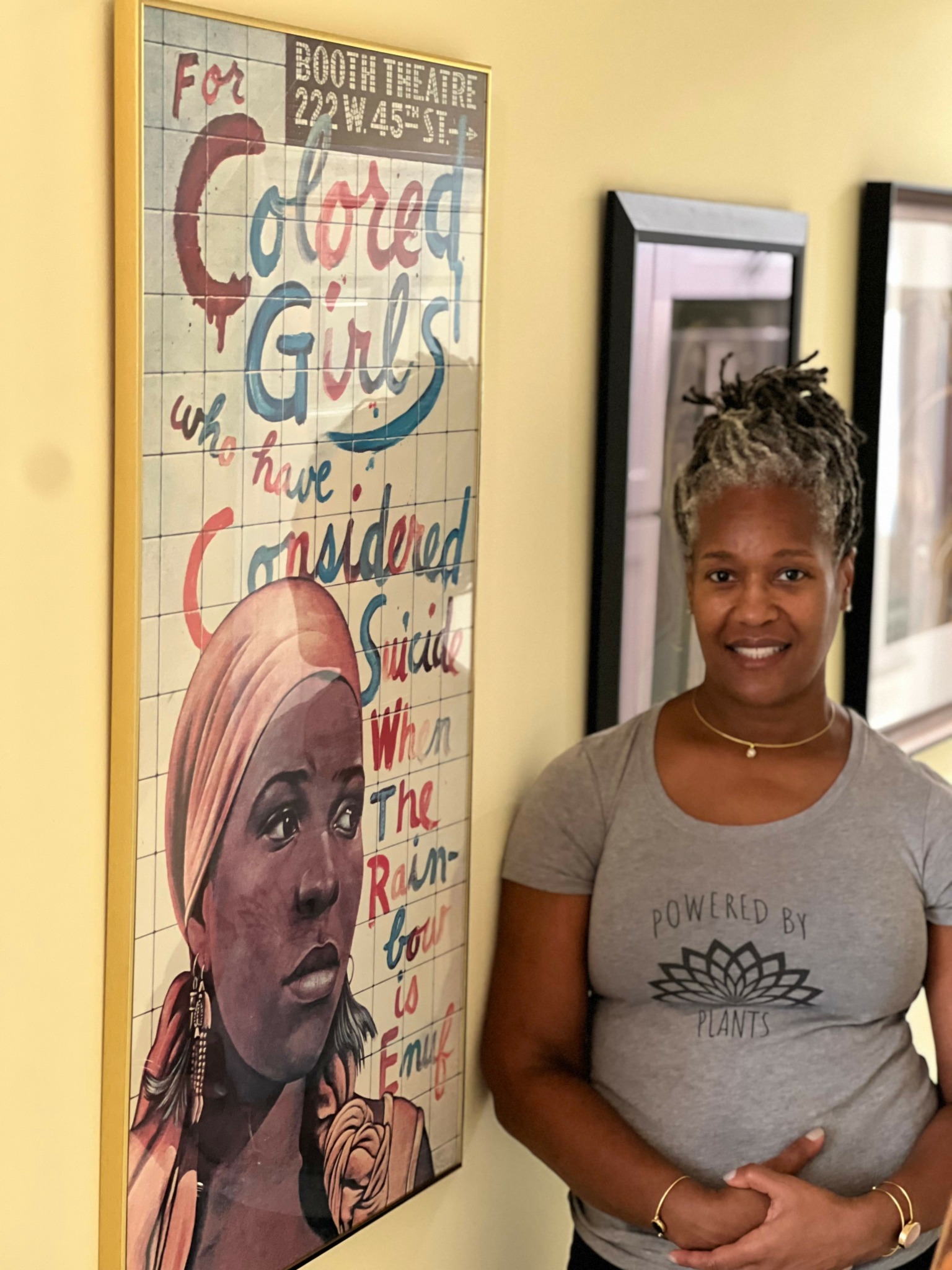
I’ll share one more example, my high school teacher, Joyce Coffey. She introduced me to so much. As part of a DC History class lesson, she led us on a walking tour of LeDroit Park and shared the rich history of the neighborhood. LeDroit Park is the backdrop to Howard University. Paul Laurence Dunbar, whom my high school is named after, once had a home in LeDroit Park, as did many Black luminaries. The fact that I now live in this beautiful community, can be attributed to seeds planted many years ago. Joyce also introduced me to Black art. My first purchase was a poster that I first saw in her home.
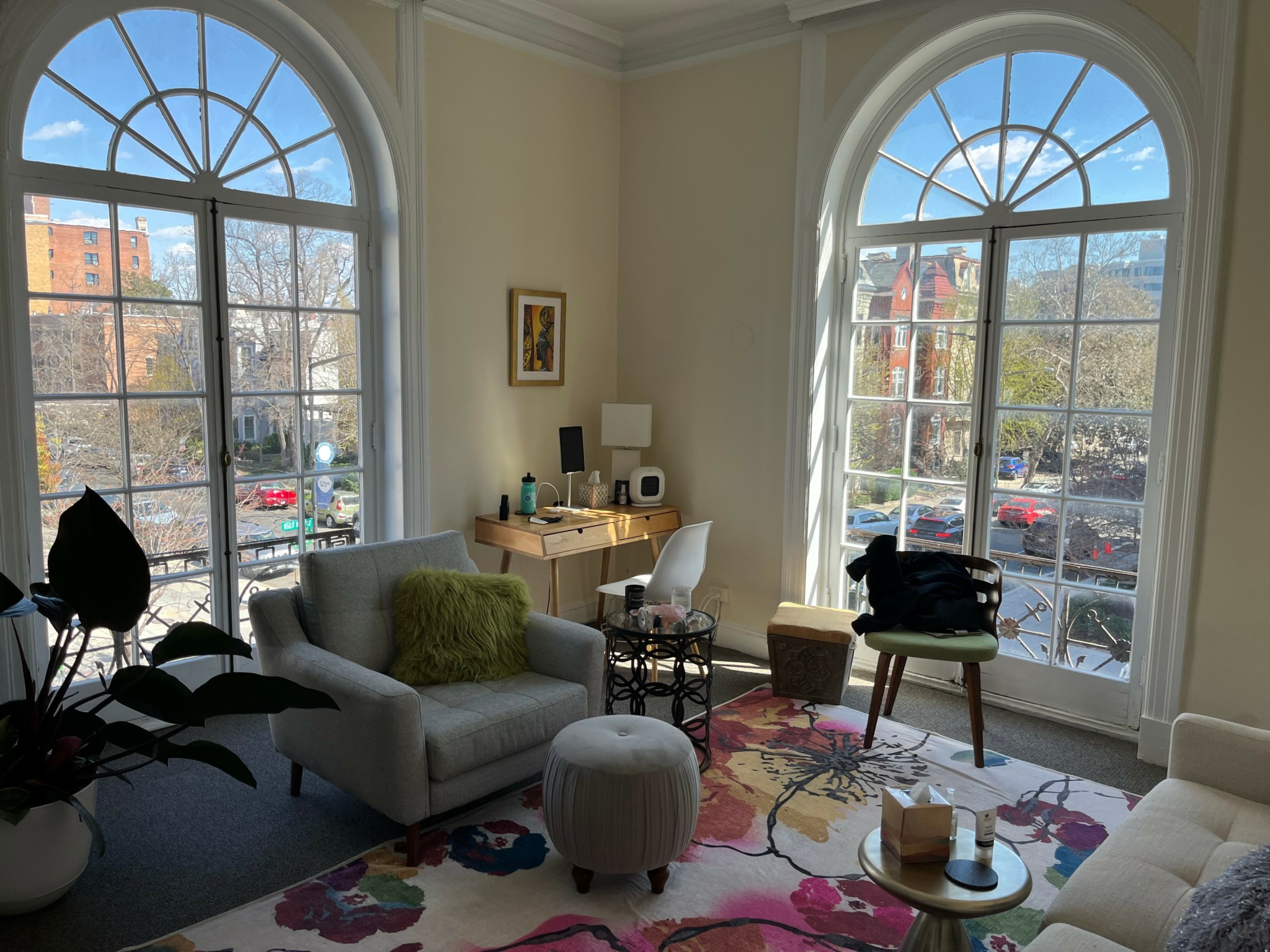
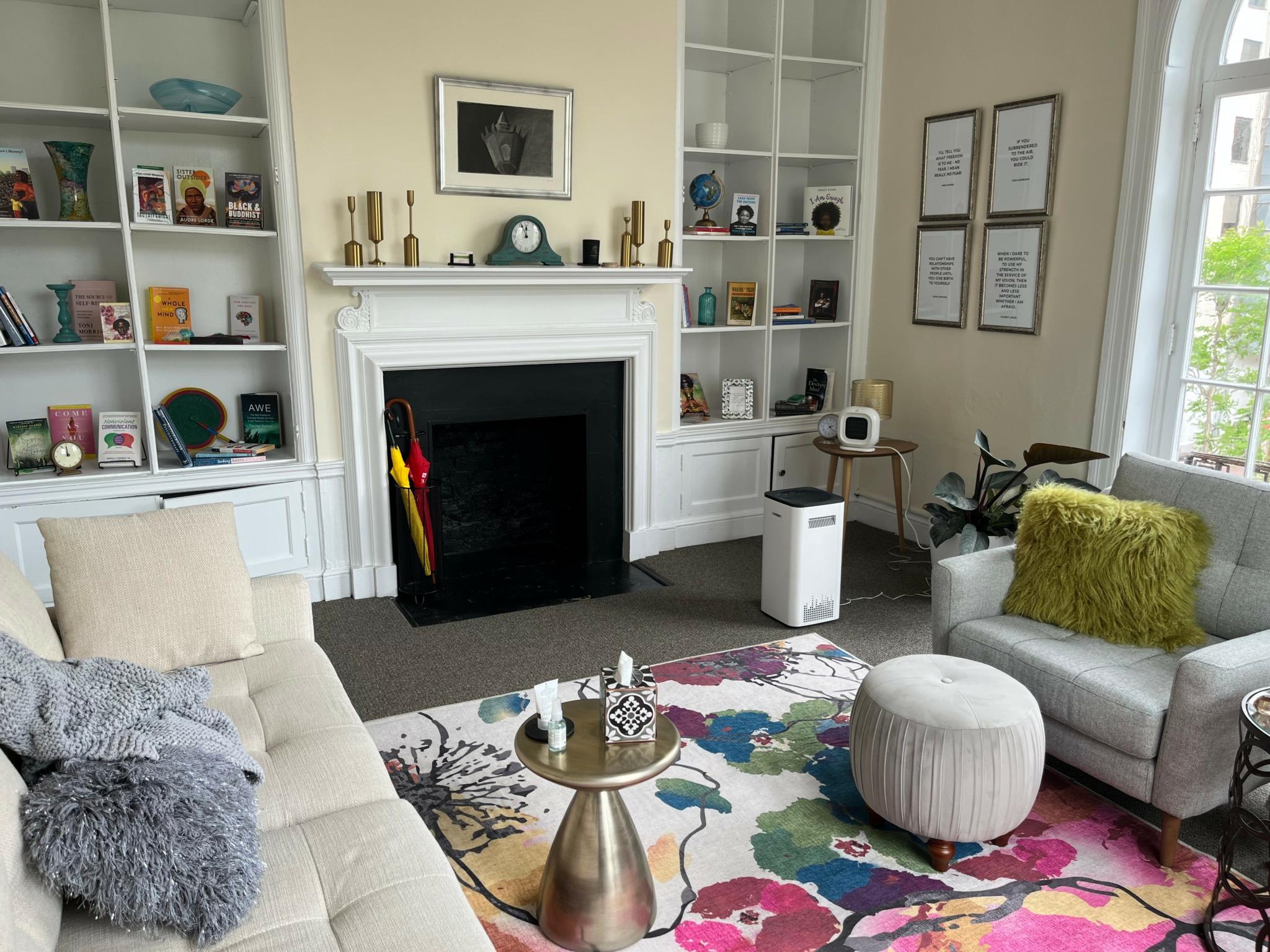
Parts of them are evident in me. When my clients enter my office, they comment on how warm and aesthetically pleasing is it. That’s how I felt when I entered my grandmother’s and Joyce’s home.
As a psychotherapist, I see and experience the beauty and height of possibility in my clients even when they are struggling to see it themselves.
I imagine that’s how it was for my grandmother and favorite teacher – they saw things in me before I realized them.
Would you say it’s been a smooth road, and if not what are some of the biggest challenges you’ve faced along the way?
I would say, my biggest obstacles and challenges were related to fear; specifically, the fear of not knowing, the fear of charting my own path without a detailed roadmap. It’s scary. In the beginning when I was trying to figure out – what do I want to do with my life when my children are no longer the priority? – it was like searching in the dark. I knew working in Diversity, Equity, and Inclusion wasn’t my passion and therefore wasn’t going to sustain me. Once I determined that my passion was helping Black women locate their innate beauty and power other questions came – can and how do I make a living doing this?
My grandmother used to say, “Sonja, if you take one step, God will take two.”
She was right. I’ve found that when I begin searching in earnest for answers to my questions, the universe places people in my path to help me along the way.
Great, so let’s talk business. Can you tell our readers more about what you do and what you think sets you apart from others?
I am a psychotherapist in private practice in Washington, DC. I’m also licensed to practice in Maryland, Virginia, Pennsylvania, Georgia, Texas, and California. I currently have clients in all seven states. Well, DC isn’t a state. For clients in DC, Maryland and Virginia, I offer in person and virtual therapy. Others I see virtually only. One of my clients from Texas was visiting DC, and we met in the office.. That was a treat! Seeing her in person.
I love what I do! I am trained in Sensorimotor Psychotherapy, a holistic mind-body approach to healing trauma. Trauma is fear that’s stuck in the body. My therapeutic focus is the unique experiences of Black women. I guide my clients in mind-body practices to heal while providing extensive psychoeducation to help them understand how trauma/unresolved fear impacts their thoughts, behaviors, and emotions.
Networking and finding a mentor can have such a positive impact on one’s life and career. Any advice?
Mentors have been integral to my success, and I’ve identified people throughout my career to help me and offer guidance. The three managers I had during my 20+ years working in DEI were all mentors. They were experts in the field and consummate professionals. Coincidentally, I’ve had three mentors as I was working towards becoming a psychotherapist and since being licensed.
My mentors each had one or both of two characteristics I admire – they used their gifts and talents to help others and they were committed to continually growing their knowledge base.
I learned to be a great mentee by being proactive and making my needs known. I welcomed their guidance and was open to and appreciated their constructive feedback. I am thankful to them. They are all amazing women.
Contact Info:
- Website: https://sonjaharrison.com
- Other: https://www.psychologytoday.com/us/therapists/sonja-harrison-washington-dc/428797