

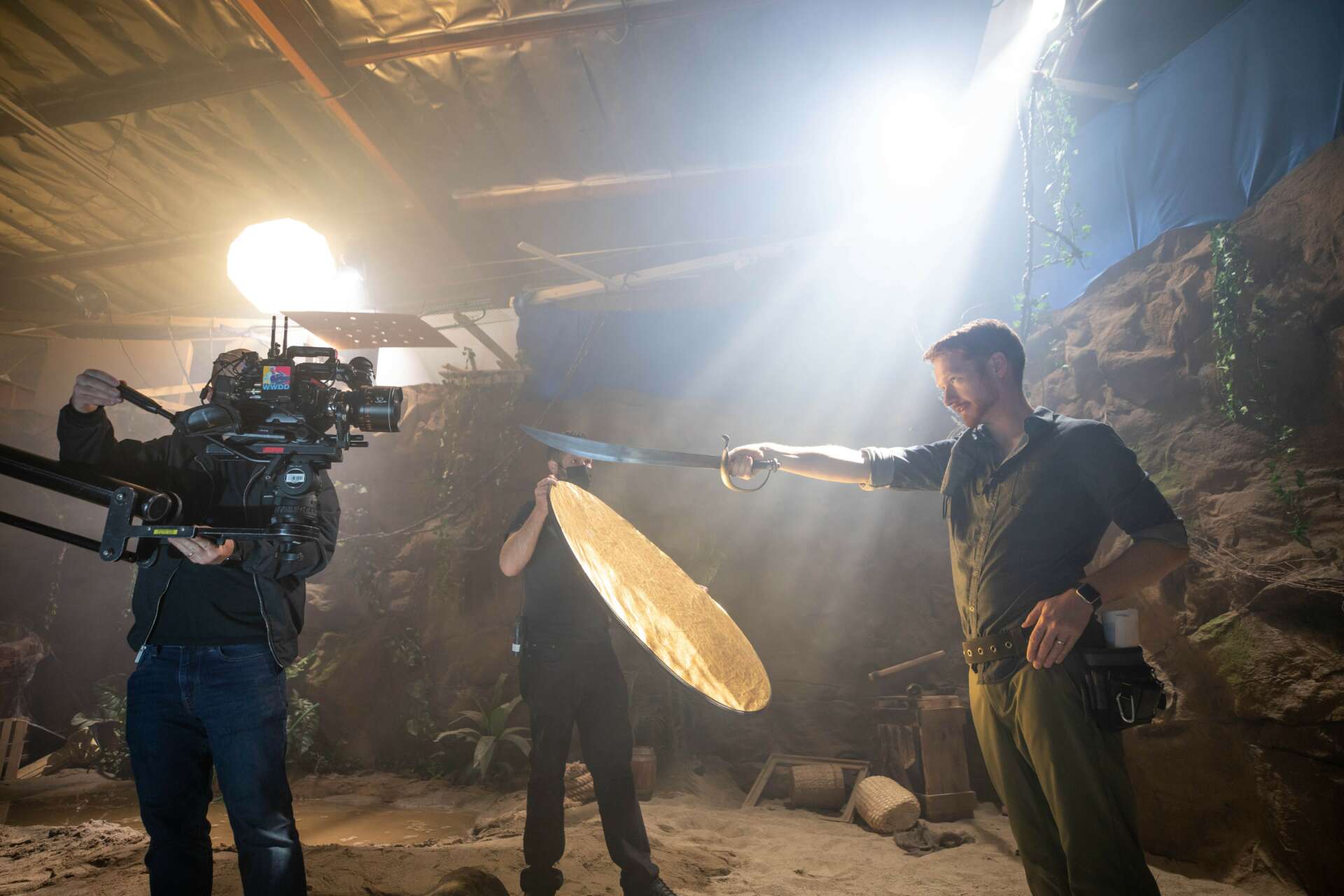

We were lucky to catch up with Brian Ulrich recently and have shared our conversation below.
Hi Brian, thanks for joining us today. Can you talk to us about how you learned to do what you do?
Learning is a lifelong journey, and the moment you feel you’ve arrived, someone younger and more eager will surpass you.
My filmmaking journey began when LEGO released their Steven Speilberg movie maker set, and my brother and I realized even kids can make movies. Later, when “The Fellowship of the Ring” hit theaters, I spent countless hours watching the 12+ hours of behind-the-scenes footage for the Lord of the Rings trilogy, essentially serving as my first film school.
I had saved up to purchase my Hi-8 Camcorder and began teaching myself storytelling, experimenting with editing software and basic VFX using Pinnacle Studios 8’s title creator window. This was in a pre-YouTube, pre-tutorial era, where I did my best to emulate real filmmakers with extremely limited tools.
When my older brother Kevin enrolled at Biola University for film school, I started learning secondhand through him. I gained access to Final Cut Express, the Final Draft Demo (allowing up to 15 pages of writing), and was introduced to lighting techniques.
Upon following Kevin to Biola University, I not only gained access to professional filmmaking tools (including a RED One camera), but also joined a diverse community of like-minded individuals with varying skill sets. I received both theoretical and technical education in class, applying my knowledge on actual sets.
I knew I wanted to be a director, but as a freshman, I couldn’t secure meaningful directing opportunities. Instead, I worked as the sound guy, closely observing other directors, learning from their successes and failures in real time. Learning from other people’s mistakes gives you the advantage of not having to make them yourself.
My senior thesis project put me at the helm of a 35min action adventure fantasy film, that shot on location with a cast and crew of 25, over 13 days. My homage to the film that got me into filmmaking, “The Fellowship of the Ring.” This was truly the culmination of my film school experience, and I graduated with an impressive short film that had everyone wondering what I would do next.
What came next? After graduation, I found myself at the lowest rung of the industry ladder once again. Following Kevin, I became an assistant editor at a production company. While it paid the bills, I felt my directing career stagnating. However, I learned not only about production company operations and streamlining post-production workflows but I also got to learn from the decisions of other directors once again, this time watching them play out in post production. I learned about shooting for the edit, and how to make sure you have whta you need for a finished film.
One valuable lesson from that time was when we transitioned from Final Cut to Premiere as our post-production software. Initially resistant to change, I witnessed the company’s 75-year-old DP, George Adams, adapt overnight. His 50+ years in the industry, starting with physical film editing, showcased the necessity of constant adaptation..
That was when I realized that I would never stop adapting, changing, and learning to keep up in this fast paced industry.
At this point, I’d been to film school, I’d climbed the ladder from assistant editor to Director of Post Production, and I’d pulled together the resources to make 5 short films post film school.
My wife and producing partner, Julianna, and I started asking, “what’s next?”
Quinten Tarantino said “Trying to make a feature film yourself with no money is the best film school you can do.”
So that’s what we did. Starting with nothing, we pulled together a story, locations, actors and crew who believed in the story, and enough money to fund our first feature film. We knew how to do production, but every single day of the 21 day shoot was learning something new, and by the end, I was 10 times the Director I was on day 1.
In post production I got to put what I learned spending 6 years in post into action. That was the easiest part.
Then we had meetings with sales agents, and distributors and pr firms and QC companies, and foreign distributors, and learned a whole other side of the film industry we’d had no experience with. The feature ended up number 1 on Apple Trailers two weeks running, and streaming placement on MGM+, Amazon Prime, and Paramout +, and was released internationally in over 40 countries, and earned fresh rating from critics on Rotten Tomatoes.
With everything we’d learned over the year, Julianna and I launched our own production company where we create everything from narrative short films to commercials.
I try to bring something new to every commercial I do. Whether it’s experimenting with weather and adding a rain scene to the script or adding lighting changes, or complex camera moves, like the vertigo effect, we try to always find a way to bring something new to our filmmaking tool belt.
To stay sharp, I read books, attend workshops, and as well as teaching at Biola University, where I was invited to come back as an adjunct professor. There are few ways to solidify what you’ve learned than to teach it to others. Teaching Intermediate Directing forced me to grow beyond instinct and out words to why I do what I do.


Brian, before we move on to more of these sorts of questions, can you take some time to bring our readers up to speed on you and what you do?
I am a film director that specializes in narrative storytelling, and co-owner, writer, and producer at Brotherhood Studios Inc.
We’ve done everything from producing a globally released action thriller feature film, produce action adventure short films, including one with Terry Crews and Zach King, or make narrative commercial content for clients all over the world.
One of our primary goals for our clients is to create high quality entertaining content to engage their target audience.
Within our own company, our goal is to create creatively fulfilling content while encouraging a work life balance. In a fast paced demanding industry, we want to help families thrive and help our employees and collaborators avoid burnout. We believe that when people are at their best, they do their best.


We often hear about learning lessons – but just as important is unlearning lessons. Have you ever had to unlearn a lesson?
All the way back to my senior thesis film in film school, people constantly told me “you can’t do that.” Like other filmmakers before me, I was determined to prove those people wrong, innovate, and overcome. On that film, I did just that. I proved people wrong, and impressed professors and classmates.
I thought that through determination, creativity, and hard work, I could solve anything.
A few years later, this blinded me to obvious problems that simply could not be overcome by sheer willpower. I once again had taken on a project that seemed impossible, and fellow collaborators began warning me there was no way I could do it. I saw this as a challenge to once again prove them all wrong. While the film did happen, and we did shoot the entire thing, it was at only a fraction of the quality we had set out to achieve. What we had hoped would be a proof of concept to get us our first big feature deal turned into a mediocre YouTube short that did nothing for career except serve as a warning that my own creative powers weren’t enough to overcome the simple logistics of time and money.
A few years later, when I began pre production on our feature film, we once again were faced with the claims that we simply couldn’t do it, but this time, rather than counting on my own willpower to push us through, I surrounded myself with collaborators who could help make my vision a reality and safeguard against the same naive mistakes I had made the last time.


What do you find most rewarding about being a creative?
In a world that is so competitive and divided, I love the teamwork and collaboration that comes with making films.
Denis Viilinue said “Surround yourself with people who love Cinema, not with people who love themselves.”
And it’s true. When you take people’s egos out of the equation, and everyone is just bringing their A game because they simply love making movies, you end you with a synergy and comradely unlike anything else I’ve experienced, where you’re a unified team, fighting the clock, the budget, and the elements to tell a story you all believe in.
At the end of post production, when the film is done, and you’re sitting down to watch it with your team who fought so hard to make your vision a reality, and you’re all watching it together for the first time, there’s nothing else like it. The gratitude you feel for your crew is humbling, and you’re all left with the feeling of, “we did that! Together! Wow… let’s do it again.”

Contact Info:
- Website: http://brotherhoodstudiosproductions.com/
- Instagram: https://www.instagram.com/bhstudiospro/
- Facebook: https://m.facebook.com/profile.php/?id=100063628356398&name=xhp_nt__fb__action__open_user
- Linkedin: Brian Ulrich – Writer/Director – Brotherhood Studios | LinkedIn https://www.linkedin.com/in/brian-ulrich-83b2a083
- Youtube: https://youtube.com/@BrotherhoodStudiosPro?si=IKPJZxU1eGt6LCMN
Image Credits
Photo Credit: 1. Tanner Myatt 2. Rachel Beck 3-5. David Hebert 6. Julianna Ulrich