

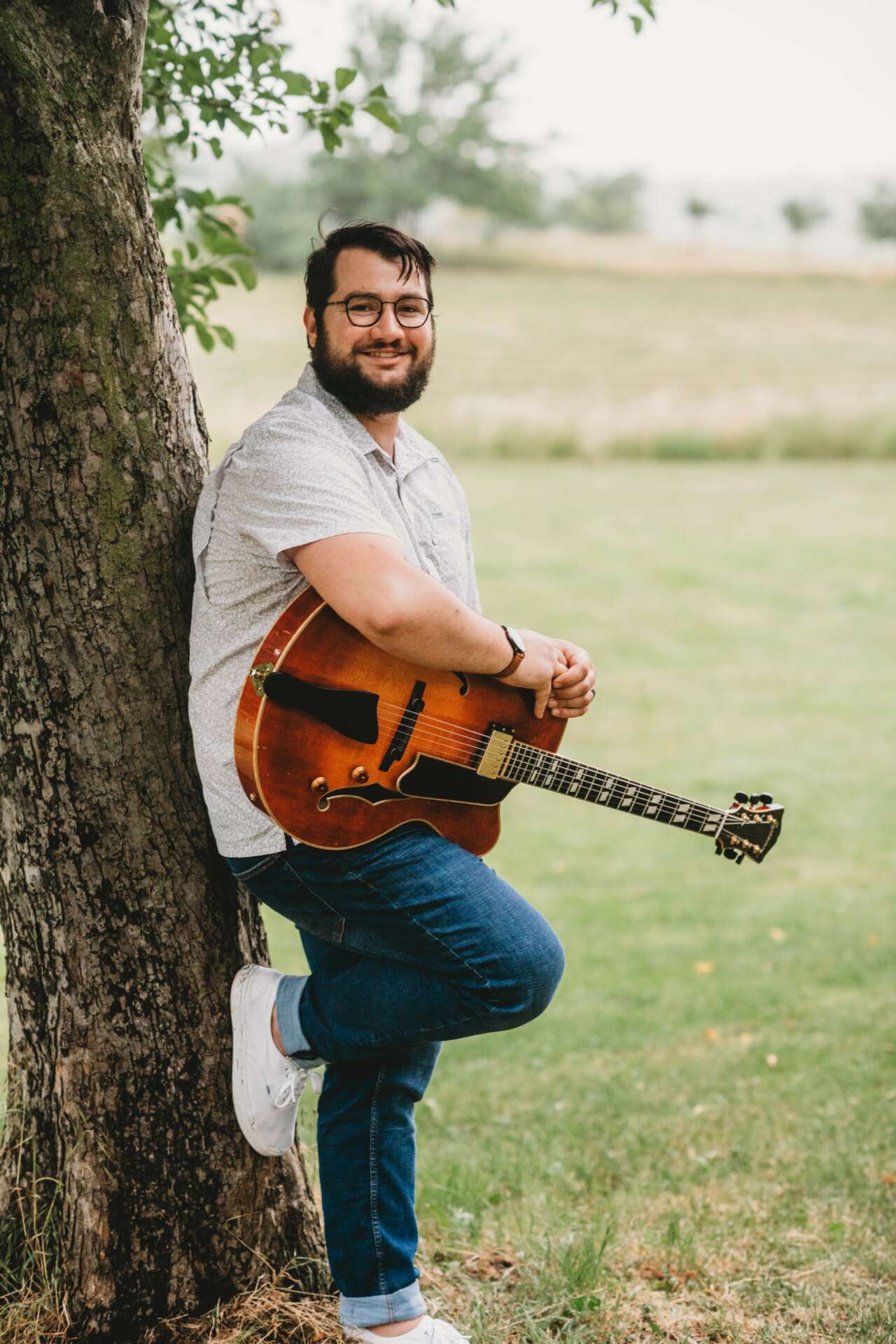

We caught up with the brilliant and insightful Denin Slage-Koch a few weeks ago and have shared our conversation below.
Alright, Denin thanks for taking the time to share your stories and insights with us today. Did you always know you wanted to pursue a creative or artistic career? When did you first know?
I can’t speak for everyone, but I and many of my friends who are also in the creative industry can point to a finite moment in time when we knew that we needed to do “this,” whatever “this” is for us. For me, it was as a fifth-grader at Sunset View Elementary School playing in the school’s African marimba ensemble. We were invited to perform at the National Music Educators Association conference in Boston that year, and for some reason that night, the band was ridiculously tight in a way that I really haven’t experienced very many more times since then. We had a wonderful enthusiastic crowd who elevated the energy to another level as well. I remember the feeling in my body being so captivating, and feeling so alive in that moment. Even as a fifth-grader at the time, I knew that something special was happening that I was going to spend the rest of my life chasing.

Awesome – so before we get into the rest of our questions, can you briefly introduce yourself to our readers.
I bring peace, happiness, community, reflection, and purpose to the lives of others through music performance, composition, and education. I am a guitarist, composer, arranger, teacher, and mentor in my professional life. I teach guitar and jazz classes as a full-time faculty member at the University of Tennessee Knoxville and I maintain a consistent schedule of performing, recording, composing, and teaching regionally and around the country. I find purpose not in these activities exclusively, but by the ways in which I can improve the lives of others through them. My recent creative activity includes three albums as a leader, the most recent of which is called “It Comes in Waves” and releases on October 13 with two tracks live on streaming services now. That work is a reflection on the human experience – how times in our lives, fortunes, happiness, etc. – ebb and flow and our only control over external events is our ability to help and love others. I was fortunate to work with several wonderful collaborators on that album, including trombonist Ryan Keberle (who has also collaborated with David Bowie, Sufjan Stevens, Maria Schneider, and Alicia Keys, among others) and trumpeter Shane Endsley (who is internationally-known and is a member of the Grammy-nominated band Kneebody). My other albums include “Temporary Songs,” an avant-garde freely-improvised album with drummer Bobby Wiens, and “re: manhattan project,” a jazz suite reflecting on the history and complicated legacy of the Manhattan Project. I have also worked as a side-person on several other projects, some of which are coming soon (look for new music from Carmen Bradford and Zach Rich!) As a composer, I write music for myself and for other artists in both small and large ensemble settings and I’m fortunate to have arranged music that has been performed or recorded by artists like Carmen Bradford, Melissa Aldana, the Colorado Jazz Repertory Orchestra, and more.
In a field like music where legacy and lineage are so important, I also believe that I have made an impact with regards to championing musicians from the past who should be celebrated and cherished for as long as people are listening to music. My dissertation is a biography of the life and music of the great late Emily Remler, a jazz guitarist from the 1980s whose career was cut short but is utterly deserving of the highest level of respect in our field. I am currently in the process of revising my dissertation into a book for publication, and will be presenting in my research on her to the greater jazz community at the national Jazz Education Network conference in January. There are also other very exciting things regarding Remler in the works! I have also published a book on the great Kurt Rosenwinkel through Mel Bay Publishing focused on his masterpiece album “Star of Jupiter.”
I got into music by surrounding myself with people I look up to and trying to learn as much as I can from them for as long as I can. While this looks different for everybody, for me it involved attending collegiate jazz programs where I found inspiring people. I hold a Bachelor’s degree from Whitworth University, a Master’s degree from the Eastman School of Music, and a doctorate from the University of Northern Colorado. I want to take just a second to thank all of the teachers and mentors I had at those places – you have changed my life for the better!
There are many, many, many extremely talented and hard-working people working in my field, and I consider myself fortunate to be among them. I believe that I am unique because of, like all of us, my own personal background and musical interests. I work primarily in what people would call “jazz,” but I love Led Zeppelin as much as I love John Coltrane, Radiohead as much as I love Wes Montgomery, Igor Stravinsky as much as I love Charlie Parker, and Death Cab for Cutie as much as I love Emily Remler. when I perform or compose, those influences find their way into my music whether or not I’m aware of it. I think the beautiful thing about art is that nobody has the exact same “recipe,” meaning that everyone arrives at their own unique expression. The other thing about it is that you never arrive at the destination (a truth I wrestled with for many years and still wrestle with today). We are all on an artistic journey, and none of us will ever get to where we are “going,” but that’s alright because the journey IS the destination. Learning to love the process of improving and changing is the key to sustaining creativity for a lifetime.
What can society do to ensure an environment that’s helpful to artists and creatives?
I believe that one touchstone of a healthy society is the ability of the general public and of the economic drivers to recognize and measure the value of things beyond their monetary worth. As creatives, we all recognize that our creations have value, and this value can’t always be measured monetarily (especially considering the current state of the industry and the reigning distribution models that govern it). In my field, great music that improves lives and inspires others might not generate the revenue to “match” its humanistic value. I think that it is important that institutions and agencies that have the resources to support the arts do so, even if it doesn’t necessarily reward their investment financially. The arts are expressions of humanity that bring purpose and meaning to our lives, making them indisputably worthy of support. I think failing to nurture artistry and artistic craftsmanship within our societies jeopardizes our culture, our way of life, our fulfillment and our happiness – not just for artists, but for society at large.


Is there something you think non-creatives will struggle to understand about your journey as a creative? Maybe you can provide some insight – you never know who might benefit from the enlightenment.
A disclaimer: I don’t believe that anyone can REALLY understand the experiences, joys, and struggles in any activity without actually doing that activity themselves, so don’t interpret what I say as any sort of judgement or assumption about any other career path! That said, it’s my perception that creatives pour themselves into their work in a way that makes it more difficult for us to separate criticism of our work from criticism of ourselves. A friend of mine who is a vocalist once pointed out that hearing even constructive criticism of their vocal performance always feels like somewhat of a personal attack – after all, they don’t have the luxury of having an instrument to hide behind because their body IS their instrument. While most examples aren’t that extreme, I think that most creatives resonate with that to a certain extent. In a way, all art is at least a tiny bit autobiographical – no two people can produce the exact same painting, for example. Because of that, I think creatives have an especially difficult time managing our emotions, self-worth, and confidence when faced with harsh criticism – even when that criticism comes from ourselves. I know I’m still working on taking criticism of my work as well as I can, and I will probably still be working on it forty years from now!


Contact Info:
- Website: www.deninkochmusic.com
- Instagram: @denin_koch_music
- Facebook: https://www.facebook.com/profile.php?id=100006988029706
- Linkedin: https://www.linkedin.com/in/denin-slage-koch-b73309181/
Image Credits
Josh Gagnon