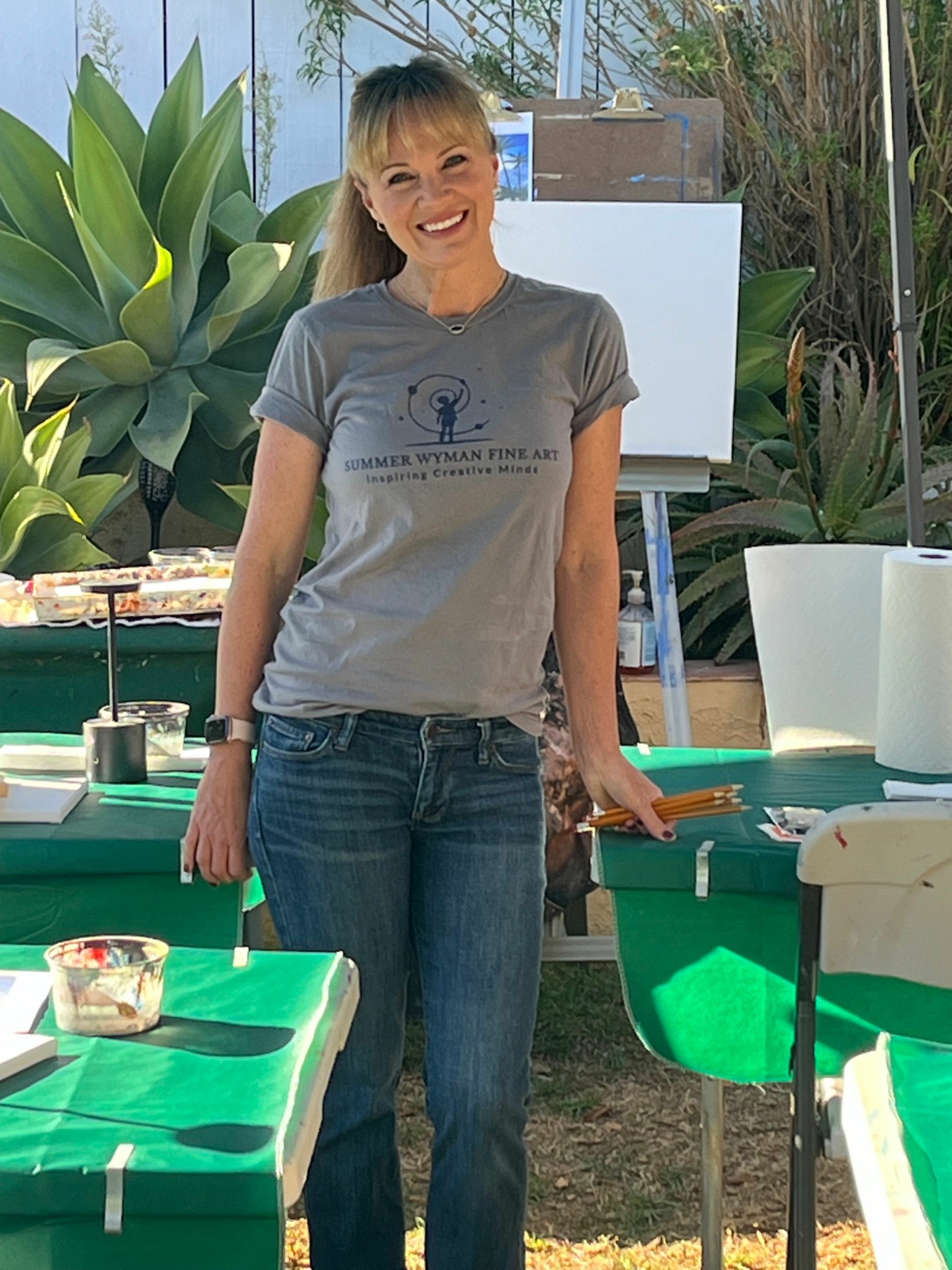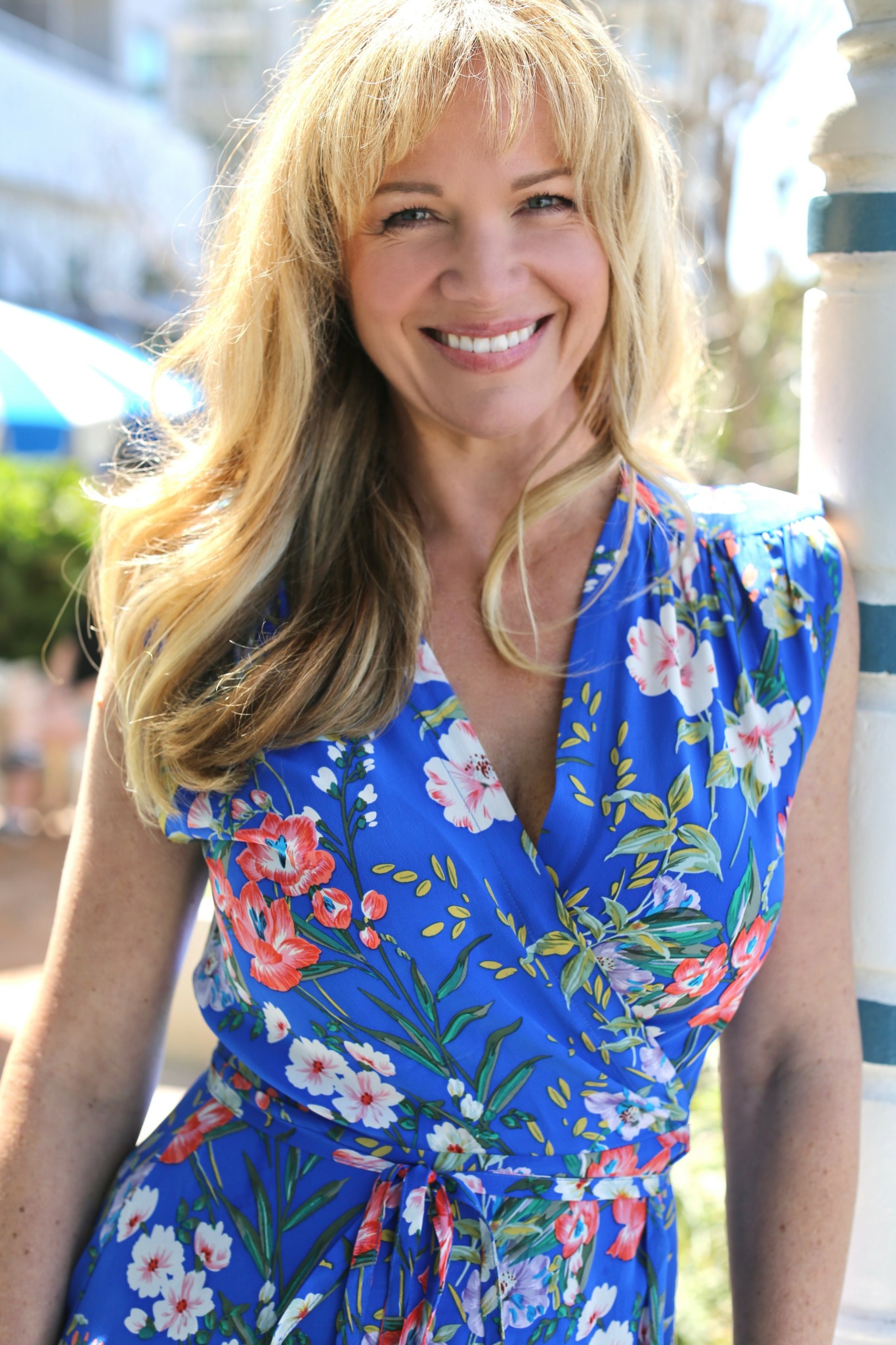

We recently connected with Summer Wyman and have shared our conversation below.
Summer, looking forward to hearing all of your stories today. Can you talk to us about how you learned to do what you do?
How did you learn to do what you do?
I grew up in a family of accomplished artists, so I was surrounded by creative talent from a very young age. I eventually went on to study at the Art Center College of Design in Pasadena to formalize my training. However, much of what I do now was learned through the necessity of a career pivot during the pandemic. After my contract as a school district art specialist ended, I had to learn how to translate my skills as a teacher and artist into a business owner. I learned by doing—setting up a backyard studio, navigating the logistics of a private school, and finding a way to return to my own painting after a ten-year hiatus.
Knowing what you know now, what could you have done to speed up your learning process?
Instead of the iPhone to kill time, I could have used my time more effectively by picking up a sketch pad and sketching in a cafe, or waiting room. Grabbing those small moments would have helped me to continue to improve my skills, especially during my 10-year painting hiatus while I had small children and while I was getting my Masters in Education..
What skills do you think were most essential?
The most essential skill has been the ability to manage my time and energy between very different roles. I have to be a business owner and a teacher, but I also have to be a fine artist who can meet the high expectations of a client.
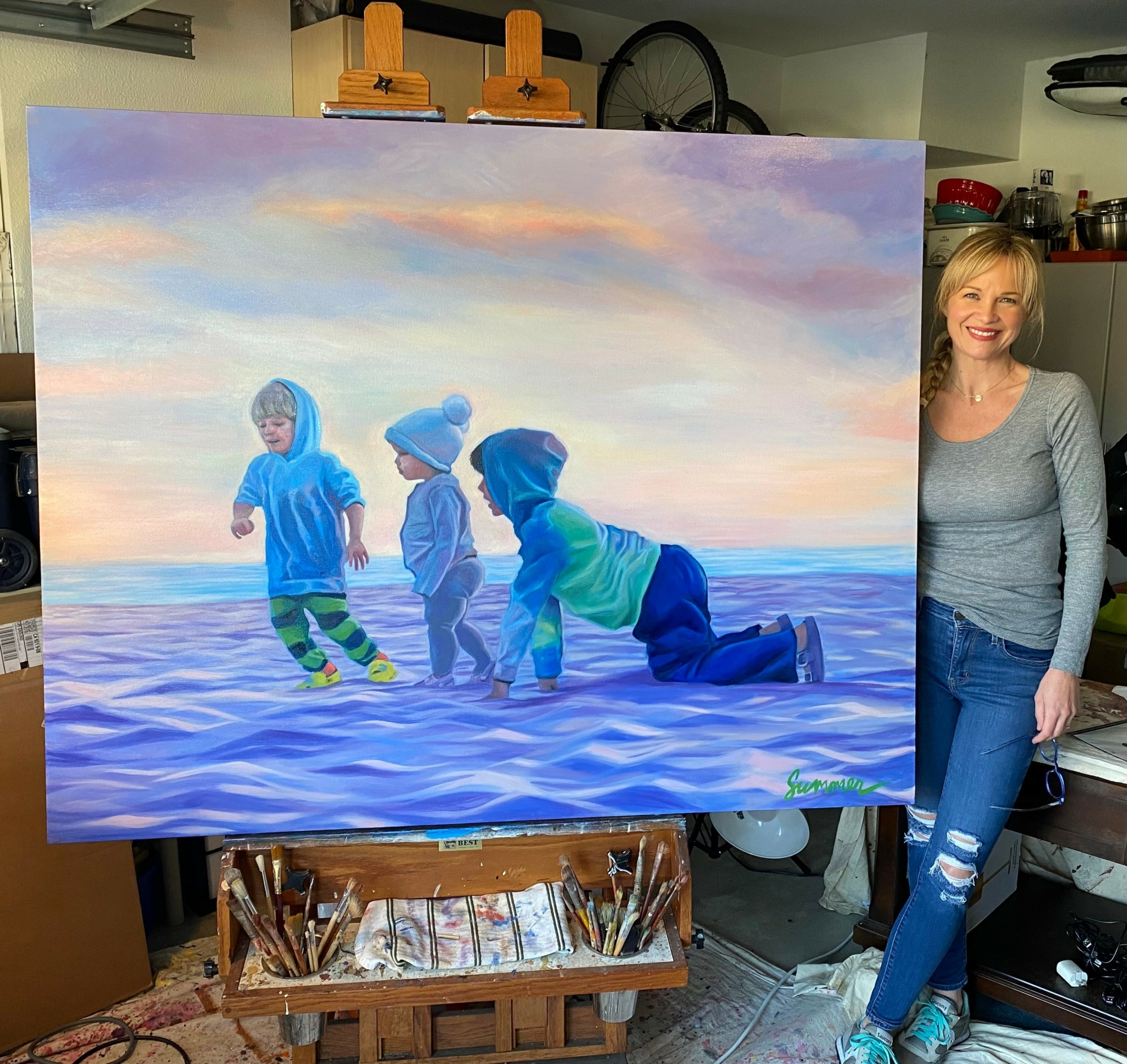
On the technical side, the ability to interpret a client’s photo is vital. I have to look at a photograph and decide how to add or subtract elements—sometimes even adding figures that weren’t there—to make it work as a painting. On the personal side, the most essential skill has been the ability to handle the pressure that comes with commissions. I have very high standards for my work, and learning how to use that pressure to produce something a client will treasure is a skill in itself.
What obstacles stood in the way of learning more?
The main obstacles have always been the practical limitations of time, work, and family responsibilities. For a long time, I simply didn’t have the hours in the day to sit down and paint. However, those limitations actually ended up inspiring me. Because my time is so limited, I have a deeper appreciation for it when I finally get to pick up a brush. I know that my time at the easel is valuable, and that makes me more focused.
Another obstacle is the difference between my private work and my paid commissions. When I am painting for myself, I am free to experiment and take risks. When I am painting for a client, I feel more reserved because I want them to be thrilled with the final result. While that pressure can cause some anxiety, I’ve found that I grow by doing both. The experimentation I do on my own eventually helps me become a better artist for my clients.
As always, we appreciate you sharing your insights and we’ve got a few more questions for you, but before we get to all of that can you take a minute to introduce yourself and give our readers some of your background and context?
Art is in my blood. It’s always been in my blood. My father, mother, grandmother are all artists. I was encouraged from a young age to follow in their footsteps. I love nature and I am curious about the natural world. So as a freshman at UC Santa Barbara, I was a Marine Biology major. At the same time that I was taking my science classes, I was taking art. It was obvious to me after my first semester that my path was to be an artist. I can also explore the natural world as an artist.
I come from a long line of artists, including my father and brother who are both Emmy award-winning computer graphic designers. Growing up in that environment gave me the confidence to pursue fine art, eventually leading me to attend the Art Center College of Design in Pasadena. For a long time, however, my own artistic aspirations were secondary to raising my children and my career as a STEAM+ Art Specialist in the public school system.
The shift into my current business happened out of necessity in 2020. When my teaching contract wasn’t renewed due to pandemic-related school closures, my husband Jason and I decided it was time for me to pursue my dream of owning a private art school. We started with a single ad on social media for backyard garden art classes, and the response was overwhelming. We transformed our backyard into an outdoor school, and since then, we have grown from six students to nearly 100 weekly students.
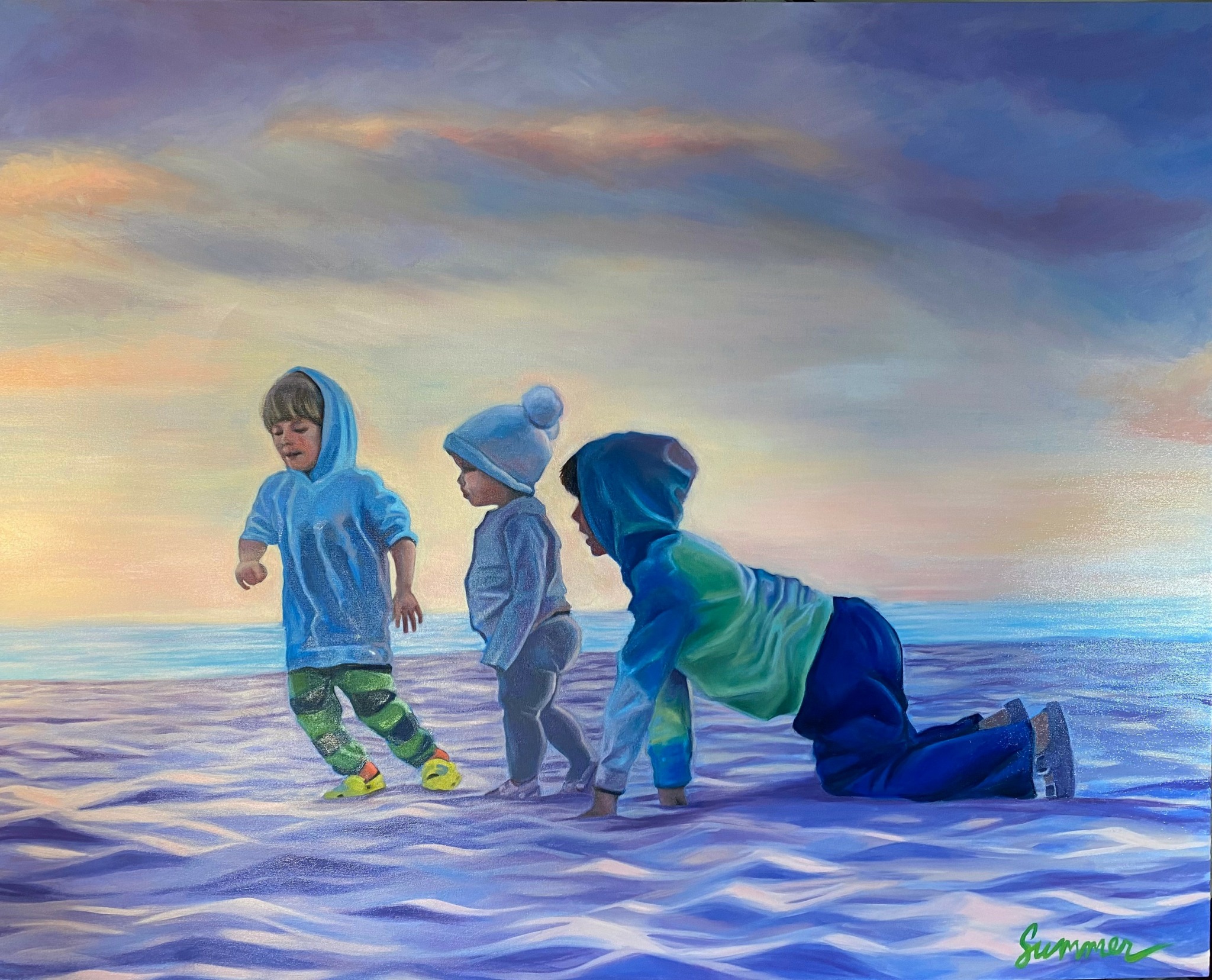
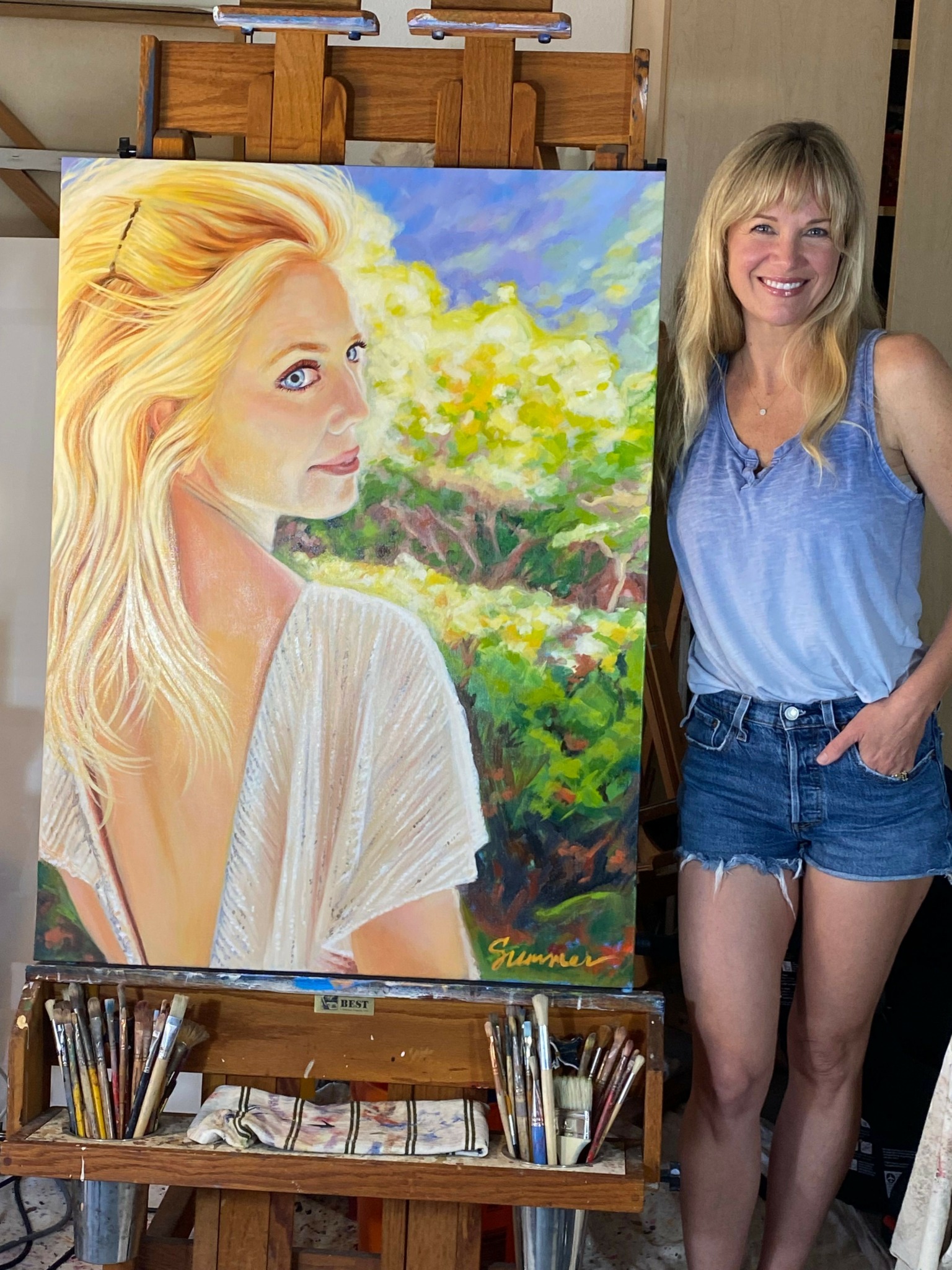
Today, I provide two primary services: fine art instruction and commissioned oil portraits and landscapes. My art school serves students from age three through high school, as well as adults. We focus on a multimedia approach, encouraging students to combine different materials to create bold, expressive work. My private commissions are more classical. I specialize in realistic oil portraiture, which is a painstaking and time-consuming process that few artists devote themselves to today.
I believe what sets my work apart is the personal nature of the environment and the communication. Our school is located in a peaceful garden setting, visited by wild bunnies and songbirds, which creates a social and creative atmosphere that you just can’t find in a commercial building. For my commission clients, I provide a bridge between a flat photograph and a meaningful piece of fine art. I don’t use computers to alter images; I use my own mental filter to interpret colors and compositions, adding or subtracting elements to capture the true spirit of the subject.
I am most proud of the community we have built and the fact that I can provide a good income for my staff of teachers and assistants. It is incredibly rewarding to see the happy faces of my students and to witness the emotional response from a client when they see a finished portrait.
I want potential clients and followers to know that my work is driven by a deep respect for the craft and a genuine love for teaching. Whether I am helping a young child find their creative voice or spending weeks on a detailed oil painting, my goal is always to exceed expectations. My business is small and local by design, allowing me to maintain a level of personal attention and quality that is rare in today’s world.
What’s the most rewarding aspect of being a creative in your experience?
The most rewarding part of being an artist is the ability to communicate beyond words. Artists interpret the world through their work. My work tells a story and shares emotion by tapping into an a collective unconscious. Each brushstroke conveys movement or stillness. A small tonal shift or compositional choice can evoke a range of emotions. There is a moment of physicality that is captured on canvas. There is something about the human experience that is shared when paint is placed on canvas by a human hand. A skilled artist can speak across time from the first cave paintings through the modern age. There is a shared human experience there.
When I get a photo for a commission, it is important that I get to know the subject. Before I can capture their spirit, I need to get a feeling of who they are. I can communicate that feeling in part from the underpainting when I tone the canvas. I don’t think it’s anything supernatural, but it is like an aura that I get from the individual. That underpainting evokes a certain emotion associated with the individual. That’s one of many choices that I make as an artist that captures the ineffable qualities of my subjects.
When I teach someone the craft to be able to feel emotions in their soul and translate their feelings into a physical form, it is extremely gratifying. That ability is something they’ll have the rest of their lives. They are then able to share that ability with others. It’s a never ending virtuous cycle that has gone on for millennia and I’m grateful to be a part of that chain of artists through time.
Do you think there is something that non-creatives might struggle to understand about your journey as a creative? Maybe you can shed some light?
When you come to art, you should understand that one lesson won’t make you an artist. It takes practice and patience. Many people have a hard time sitting quietly with themselves and listening to their inner feelings and thoughts. Art, like therapy, takes time to get better, become vulnerable, and to allow ourselves to open up and give in to the creative process.
The most important thing is to come with an open mind. Everyone loves color. The most beautiful part of starting out as an artist is mixing new colors and applying them to canvas. It can be very cathartic to just sit and explore the color palette.
We all have art in us. It is part of the human experience to be creative—whether that may be through music, speech, or painting. All of those expressions tap into an innate human ability: to observe and communicate nuance and emotion.
Contact Info:
- Website: https://www.summerwymanfineart.com
- Instagram: SWFA_classes
- Facebook: summerwymanfineartclasses