

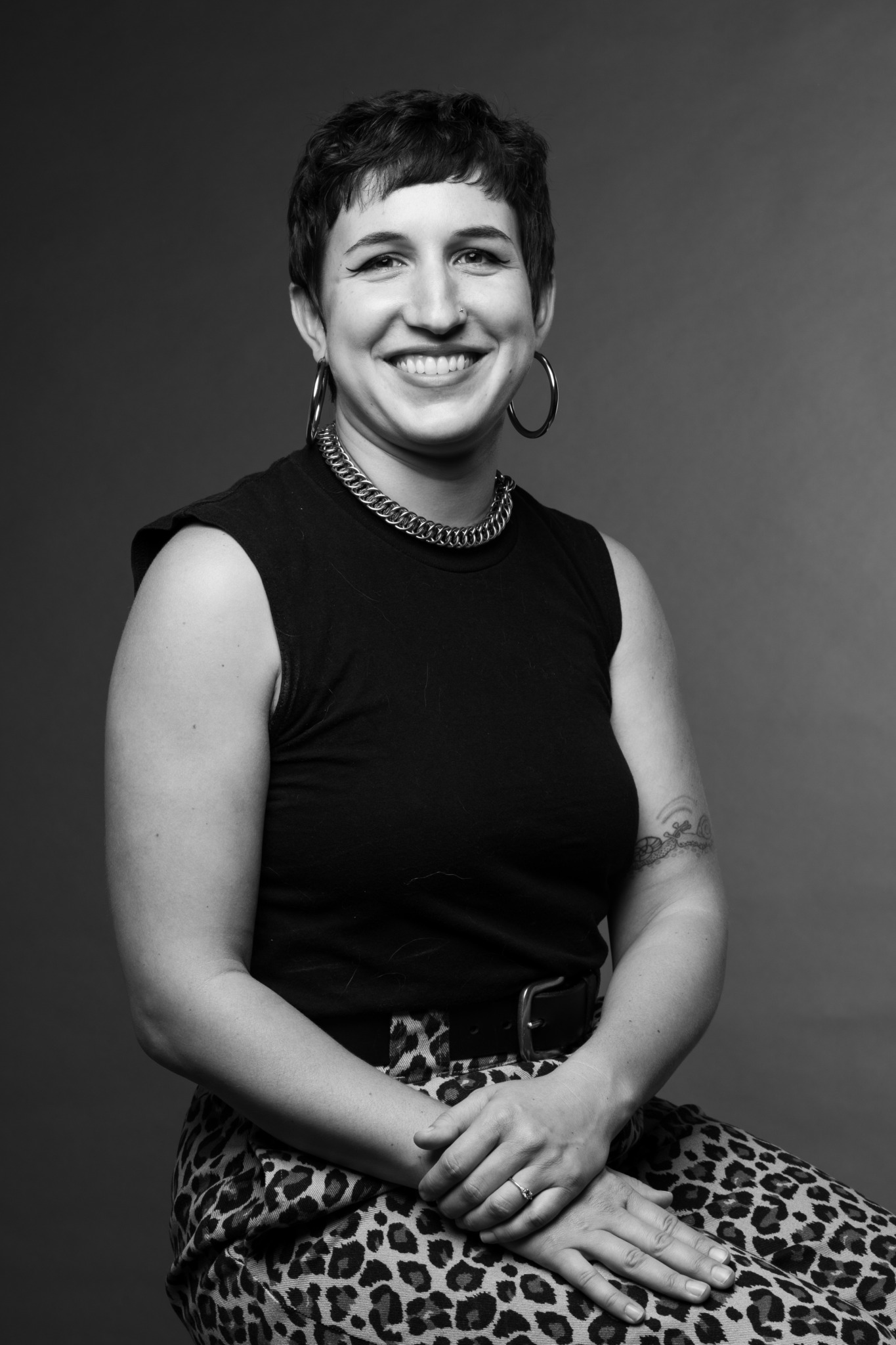

We’re excited to introduce you to the always interesting and insightful Rachel Curry. We hope you’ll enjoy our conversation with Rachel below.
Rachel, thanks for joining us, excited to have you contributing your stories and insights. Let’s start with education – we’d love to hear your thoughts about how we can better prepare students for a more fulfilling life and career.
As someone who struggled in school and is now and educator myself, I have a lot of thoughts and feelings surrounding the school system. If I could change something about the educational system I would change the way schools are underfunded and the value systems that are placed on certain subjects over others. If this country invested more resources into education and less into carceral systems such as police and military, I think we would create a country where people have more opportunity and support overall.
Personally, I prepare my students for a more fulfilling life and career by focusing on their humanity, and attempting to deconstruct harmful narratives they may have about themselves or others through a social justice pedagogy rooted in liberation through creative expression and community building.


As always, we appreciate you sharing your insights and we’ve got a few more questions for you, but before we get to all of that can you take a minute to introduce yourself and give our readers some of your back background and context?
How I got into my industry:
Art has always been a big part of my life. I feel fortunate to have grown up in a family full of multi-generational artists, my dad was an artist, both of his parents were artists, my uncle and cousins were artists as well and my mom always did art with me and my brother growing up. Art is in my blood! When I was a kid my dad had his own graphic design company, so I grew up with paper samples and all kinds of that stuff around the house. I always had a love for paper, for graphic arts, and for text.
When I graduated high school, I initially went to college for advertising because I thought that was the way, but it wasn’t the way for me but it turns out I’m an anti-capitalist and didn’t want to do that at all, so I ended up dropping out.
I did become aware of letterpress and book arts during my time at the School of Visual Arts though, and I continued to explore that medium through internships and self education and it has become a huge part of my practice. Book Arts and Letterpress are very communal. To be a part of that practice, you need to be around equipment, and you need to learn from people. I interned at a lot of different letterpress and book arts places, and learned from several different people doing this craft in different shops.
I eventually came home to Los Angeles and that’s when I started teaching. One day I walked into Jen Hitchcock’s book store in Highland park, Book Show. I sold her some of my zines and hand made books and she asked if I ever taught workshops. I said I had not, but I certainly could! She was very encouraging and open with her space, and I started teaching bookbinding workshops there, and we also started a community collage night called Collage and Cry.
I started teaching after school art programs, and I kept doing more workshops and I realized I really loved teaching, and I was really good at it. The more teaching opportunities that I had, the more experience that I got, the more that I also learned about my own art practice. Eventually I started teaching at museums like the Hunting Library and Craft Contemporary and at libraries, galleries, community centers and schools. That’s how I became a teaching artist.
A teaching artist is the term for someone who is a working artist who also teaches. Typically, you teach with nonprofits instead of working within the school system. For me, my work as a teaching artist is intertwined with my practice as an artist, and being a teaching artist has taught me so much about myself, my students and my community because I get to teach in so many different settings.
There are so many special connections that happen at my art workshops. At one of my intergenerational workshops at the Huntington, a boy came with his abuela and they both did the project, creating books with printed leaves inspired by the Herbarium collection. At the end of the workshop, the grandmother came up to me and told me she hadn’t done art in 60 years. She thanked me and said “you have a lot of art in your hands” and I thought of my own grandma and the art that runs in my family.
Last year I had the opportunity to work with One Institute at their Circa Queer History festival, where I developed and hosted a workshop for people to make their own hanky inspired by the hanky code. I wanted to do something hands-on with the prompt of queer histories, so we hand dyed our own hankies, and people included symbols that represented their identities. Everyone got a chance to talk about their experiences with queer public space; there was a cool moment where a woman who came told us all about lesbian meetups in Griffith Park in the 1970s that we’d never heard of. It was a fun community moment, and a cool way to build community and bridge history and the now through art.
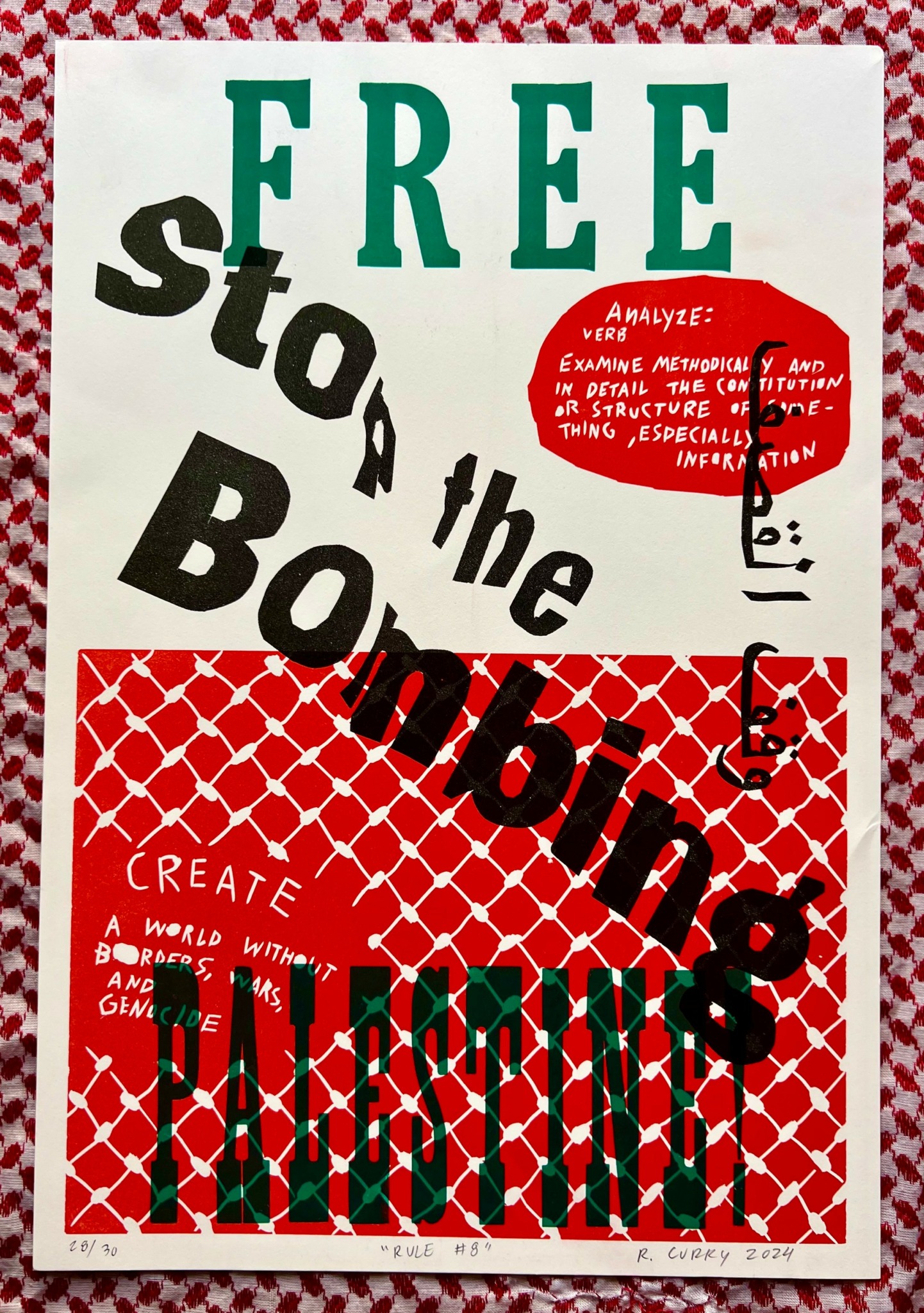
I love to do art projects with a purpose. Earlier this year Austyn de Lugo-Liston and I collaborated on a Posters for Palestine event at the Armory Center for the Arts where we are both teaching artists. We made large collaged and printed posters in support of Palestinian Liberation, that we encouraged participants to either take home or to take to a march. We talked about images and symbols that have historically been used for Palestinian Liberation, and brought in art examples from Arab artists like Etel Adnan and other artists who have made work about the struggles against the occupation. Austin read a children’s book, and it was a free all-day family friendly event that brought people together to create and to learn and heal and to meet each other. It was packed the whole day, and amazing that the Armory helped us create an environment to hold space in this way.
I also had the opportunity to do an artist residency at the Altadena Library last year. That was a really cool project because I really got to blend my work as a community driven educator and an independent artist. I used the library’s makerspace, the Fab Lab, to create work and I taught free workshops for patrons throughout my time there. The residency culminated with an installation piece that I created using donated fabric from the library that also housed work my students had produced during my residency there. That was really special.
For me, being a teaching artist is about community building, and I’ve seen the ways that I can facilitate that for so many different age groups and in different environments who really need it. I’ve taught adults, I’ve taught seniors, I’ve taught young kids, and high school kids. I’ve taught in museums and art centers and continuation high schools and juvenile detention centers. The through line for me is that I try to create a safe space, whatever that means for each learning environment, and I try to do healing work through being gentle and affirming and just by being who I am in the classroom.
There’s a lot of trauma done within the US education system; there are a lot of mythologies that people internalize about their own value and what is valued more or less in society. I think school is the main place where we’re socialized and conditioned to have these value systems about ourselves and about the world. Students are taught that if you don’t read the same way as everybody else, you’re less valuable. Or if you don’t take a test in a certain amount of time, you’re not achieving at the level that you should be. So you internalize value systems about yourself and about the world, and they’re all socially constructed. And I think what I try to do is just deconstruct those value systems, provide an alternative, and create a gentle space where people can explore openly and try to try to dismantle these harmful narratives through being allowed to play and try new things and work together and teach and learn from each other; to not just see teachers as, the sole proprietor of information, but to, form a space where we all feel safe and free and valued and heard.
About my Work:
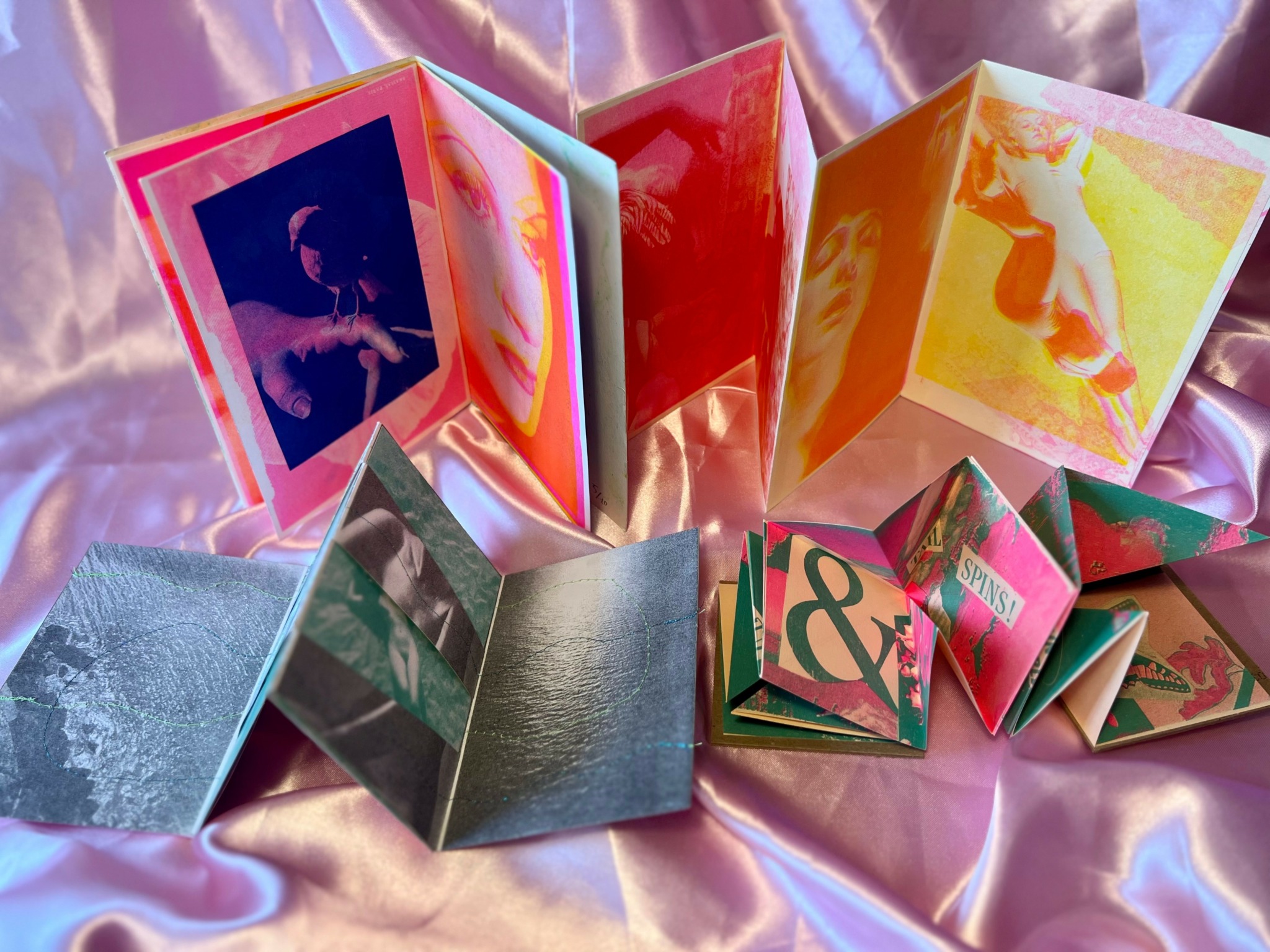
I work in multiple different mediums, but I’m most known for printmaking and bookbinding and lately I have been making some work I am really proud of exploring fiber art and installation. Most of my art revolves around themes of queer liberation, domesticity, and nostalgia.
My biggest inspiration for my fiber art is my sitto (the Lebanese term for grandma). My mom and my sitto both taught me how to sew when I was young. Fiber arts and sewing were central to Sitto’s practice. It was really important to her, and she saw the value in it. She also came from a generation where craft wasn’t viewed on the same level as other art forms, and being a woman and a mom, and first generation Lebanese American, she didn’t have opportunities that others may have had.
I am really inspired by this generation of women in the 1970s and 1980s that did a lot of handicraft and may or may not have seen it as art, but they created their own communities. They did craft fairs, and that was a big part of how my grandmother showed her work to the public, just like how I go to zine fests, she made a lot of her friends that way. She had artist friends who also did crochet and quilting, they made dolls and made jewelry and all kinds of different things. This was a big community building thing, craft fairs were a big deal at that time, because crafting was a big deal, but it was also a very gendered thing, very similar to the the handicraft trends in the Victorian era where women of a middle and upper class economic status kept the home and did handicraft.
My Sitto is central to my experience with what we now call fiber arts. I had zoomed in hard into letterpress and book binding, but there was something that was really drawing me toward exploring fabric and sewing as part of my art practice too that I have been really interested in for the past couple years.
It’s funny to think how two things that are most central to my art practice come from my family history: fiber arts and letter press, which is a form of graphic design and commercial art. My dad, grandpa, and uncle Victor, all did commercial art and advertising. My mom and Sitto did fiber art, working with fabric and craft, and I do both of those things.
Some things I’m proud of:
I’m so proud of my 2022 installation And You Were There Too, which was a new kind of show for me that brought together printmaking, fabric art, video art, and some conceptual things for a limited run at Cal State Long Beach. I am hoping to expand on it and show it in a gallery here in LA in the near future. It’s a mixed media installation piece that talked about my connection to my sitto, the Wizard of Oz, world building, and queer history. It was about texture and feeling, and I sewed everything on the same vintage sewing machine that my sitto taught me to sew on, and thread I inherited from her to weave the projects together. It really felt like a dialogue with my sitto, as well as with my chosen family too.
The thing I like most about printmaking is that you can make multiples, and that’s rooted in the history of printmaking as an accessible and democratic art form for that reason. Throughout my career as a printmaker, I’ve tried to honor that history and that process by using prints for good, because you can make a lot of prints and raise money for things through print sales, whereas with a painting, you only have one, and you spend a lot of time on it. You can make a lot of prints, and the nature of letterpress is that you have letters, and letters are conducive to words, which are conducive to messaging. For me, there’s no way to get around political messaging within letterpress printing.
I’ve made posters to take to marches and to hand out to people to have visually impactful messages. I made extra Free Palestine posters to take to protests this and last year, for example. In the past, I made women’s march posters. I made a poster about trans rights that was in an art show, and during 2019 when the city of Los Angeles started harassing the unhoused community in Echo Park, I made a “housing as a human right” poster, which I took to marches and actions. After those actions, I made another edition of and sold to raise funds for the Uhuru dream house: a housing project for BIPOC artists in New Orleans founded by Uhuru Moor. My partner and I did some postcards on my home press for some of the things happening during the 2020 the BLM Movement and sent postcards to elected officials. You can make a lot of things on letterpress. You have letters, and it just feels natural to just do that kind of stuff, like poster projects, postcards. You can put things up on the street. You can sell things. You can mail things.
Another thing I’m really proud of is the growth and connections I have witnessed in my classes and workshops. Again, because I try to create a safe space, I think people are able to heal and build community on that foundation. I have witnessed students get inspired and find hidden talents in themselves, I have seen adults who internalized the message that they are not artists unlearn that and begin their own creative practice, I have seen friendships and relationships form. Its just beautiful what happens when people get together to make things, its less about what we are making and more about the process of making it together. I feel proud to help make these connections.
I’m teaching letter press this fall at The Armory Center for the Arts in Pasadena and also at Otis College, and I do pop-up workshops throughout the year for all ages. These classes are open to the public and I am always happy to see who shows up!

Is there a particular goal or mission driving your creative journey?
My goal as an artist and educator is to make myself and those around me feel more human. If I can brighten someone’s day who has come to my class, workshop, or art show, then my goal is accomplished. I think thats we all need in what can often feel like a hopeless world. In the face of ever worsening climate and humanitarian crises, I strive to make work and foster spaces that are rooted in the type of love that acknowledges injustices while seeking to inspire hope as part of the effort to create a better world.

What do you find most rewarding about being a creative?
I view being an artist as a blessing. Wether I am actively making art or not, I am always thinking like an artist. I feel strongly, I notice and appreciate all the fine details that make up my world, I think of unexpected possibilities, I create. Thats whats most important to me as an artist and an art teacher, critical and creative thinking. This is a vital skill that anyone can learn, but people often put these barriers up. I hear a lot from my adult students that they are not creative or they can not do art at all. This is simply not true, but if we tell ourselves these stories, we prevent creativity from happening. anyone can and should make art, it’s good for the mind, the soul, and the earth.
Contact Info:
- Website: https://currybookarts.com/
- Instagram: https://www.instagram.com/currycheeks/
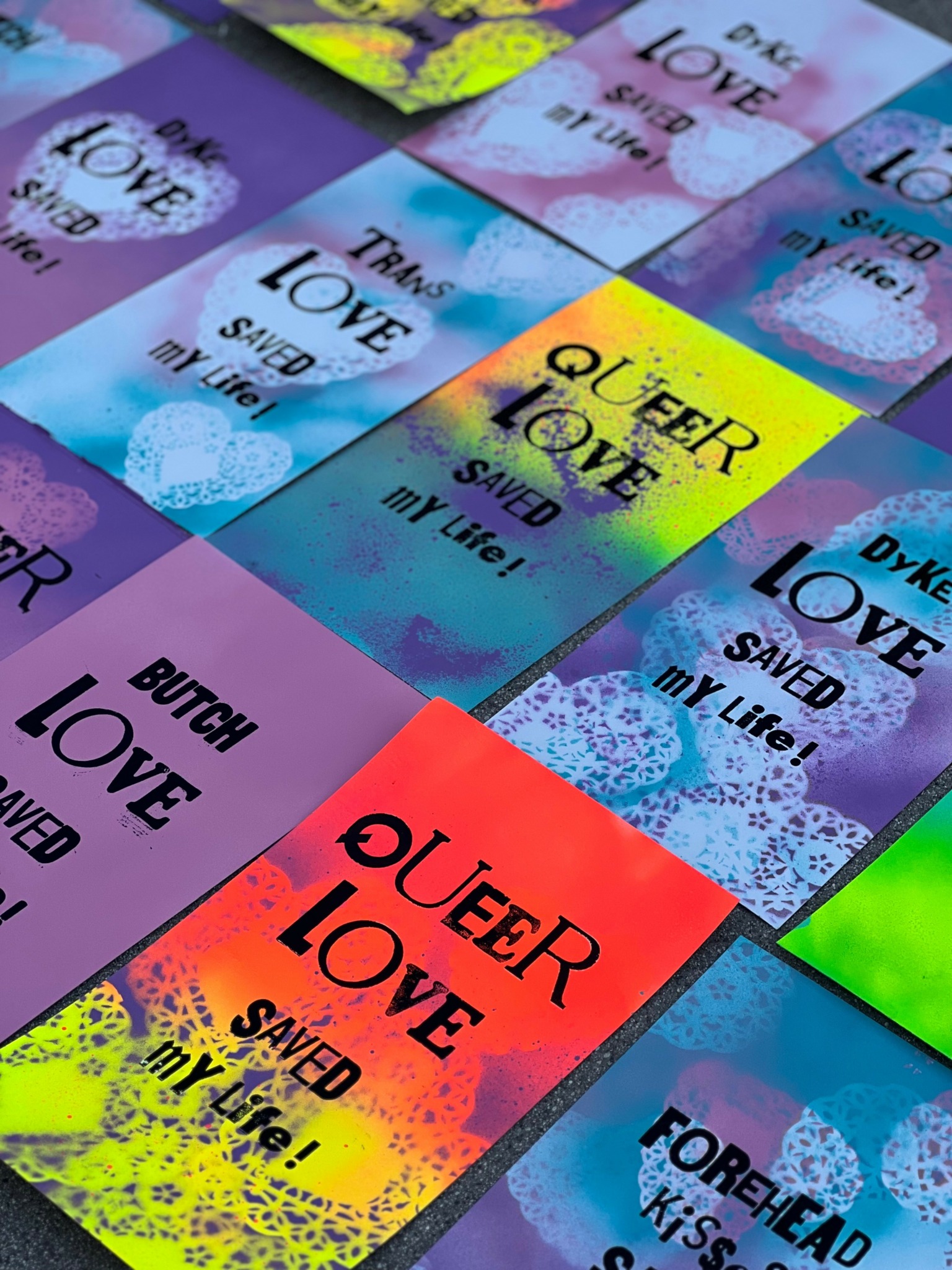
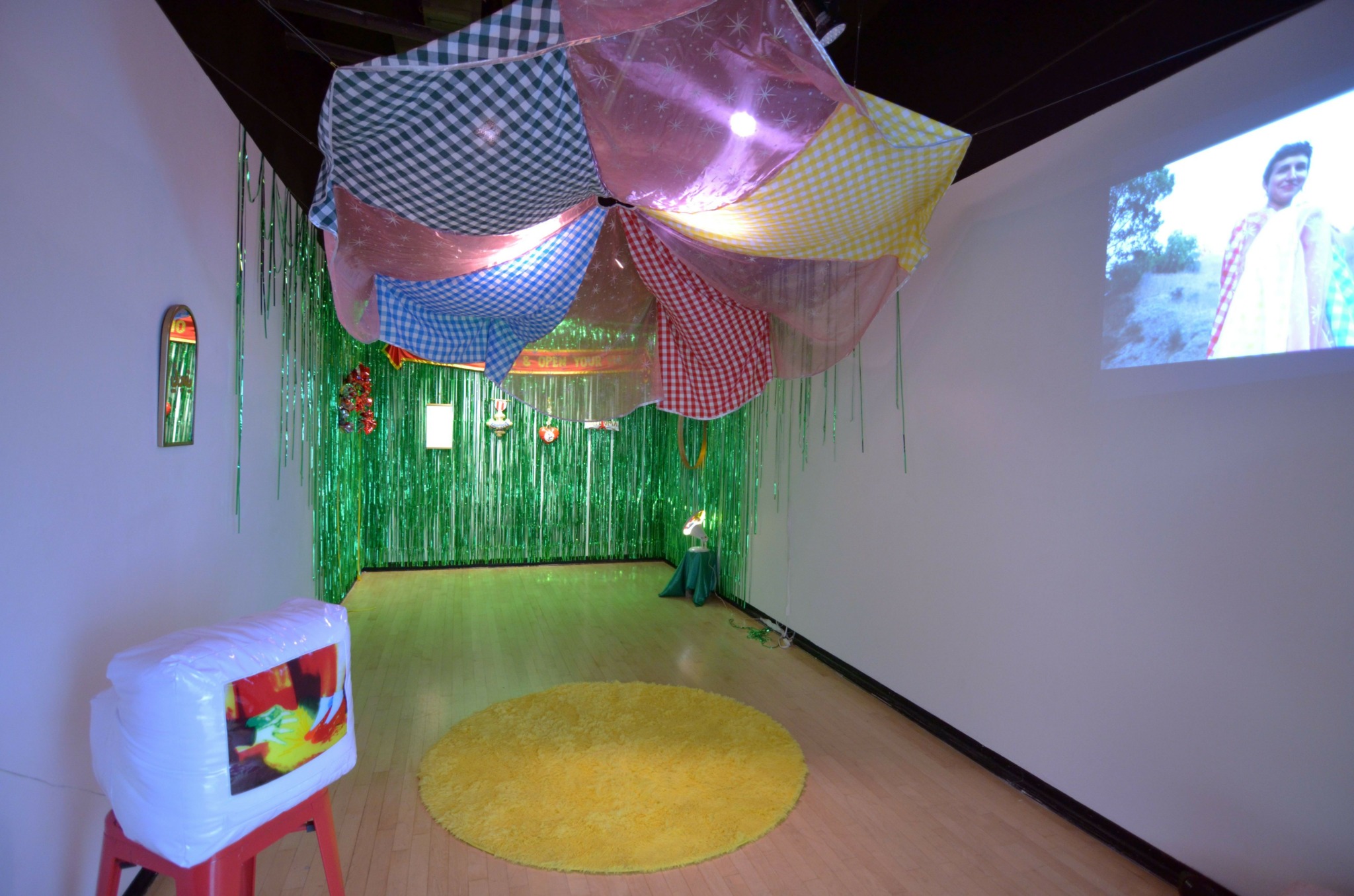
Image Credits
Portrait of me by Johnny Pérez. Photos of artwork by me