


Alright – so today we’ve got the honor of introducing you to Lisa Klug. We think you’ll enjoy our conversation, we’ve shared it below.
Alright, Lisa thanks for taking the time to share your stories and insights with us today. We’d love to hear about a project that you’ve worked on that’s meant a lot to you.
I’ve had an issue staying at a healthy weight since the age of five. I’m five feet, two inches tall and have weighed everything from 115 pounds up to 350 pounds as an adult.
I’m sixty-two years old now, and I feel encouraged as a creative to share my experience through the years with this misunderstood condition.
My upcoming graphic novel “Fat Monster” is part fantasy, part reality. I am going to share real life events related to my weight, but in a world where everyone’s inner flaws can manifest on their body and temporarily make them a monster, but only overweight people are outwardly monsters all the time.
There are so many other things to deal with as an overweight person besides health. There’s a tremendous amount of psychological stress, even now in 2023. I want to be part of a generation of people who encourage young people with weight issues to seek the best in themselves, even when things get rough.
I also hope to warn young adults in an entertaining way of the pitfalls out there for people who have low self-esteem.
This project is meaningful to me not only because I’m basically telling my life story (as a “Fat Monster”), but helping people to understand how very difficult a weight problem is, and how we all need to grow and change to survive.
I have been in the development stage of the novel for a few years now, but I consider it to be the most important art project I’ve ever worked on. I have no intention of stopping work until the project is done. If I can help just one person see themselves in a better light, it will be worth all the effort.


Lisa, before we move on to more of these sorts of questions, can you take some time to bring our readers up to speed on you and what you do?
I’m from a family of artists. My mother was an artist, she worked mainly in acrylics. My sister became a professional artist. She and her husband designed graphics and products for the toy industry.
As for me, I’ve rarely had a clear path through life. I consider myself a late bloomer, an over-sixty woman with the heart of a fourteen year old. I love reading all kinds of fiction and non-fiction, also love drawing, painting, sculpting, and trying to make every day as creative as I can.
One of my main creative influences is animation and cartoons in any form. I’ve been a part of the Sequential Artists Workshop, a comic book school, for going on eight years now. I think ‘zines and comics are the best, most inexpensive way for a visual artist to tell a story.
At the moment, I’m working on a coloring book to help awareness of Florida springs. After that, I plan to publish my graphic novel. During all this I also work in stained glass, acrylic painting on board, and various other crafts.
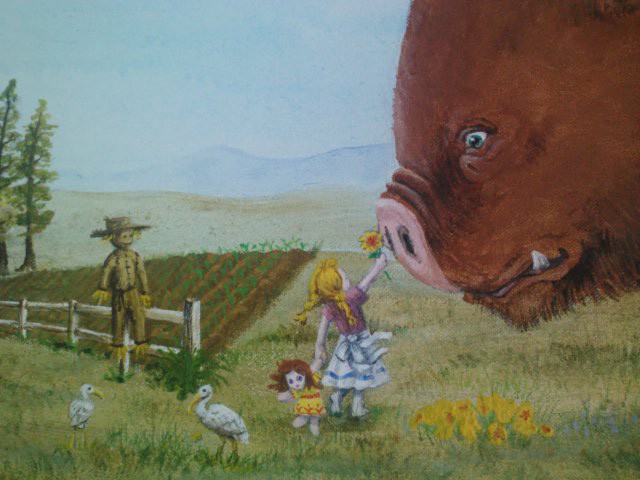
I don’t do commissioned work anymore, but I have sold paintings. I’m a surrealist who likes to paint in acrylic and add items on top such as Jewelry or other embellishments.
I want, ultimately, to be inspirational as an artist. I’d like people to see my work and think about things differently. I want my followers to be taken, if only for a moment, into another type of world where the rules are slightly different.


Is there something you think non-creatives will struggle to understand about your journey as a creative?
I think it’s difficult sometimes for a non-creative to understand why creatives have to… create.
I remember a conversation I had with an older woman decades ago. I had dropped out of art school, and was working at a clerical job. At that time, I’d given up on being a professional artist, and had decided to make the “practical” decision of a secretarial job. However, I had a nagging feeling in the back of my mind it would never work to walk away from my creative urge.
One of the other secretaries asked me if art school was expensive. I answered “Yes”.
“But then”, she replied, “Why did you drop out? Weren’t your parents upset?”
I hung my head, and answered “Yes, but I still do artwork”.
“Do you ever make lots of money?” She asked. I replied I didn’t.
“Is it easy for you to do?” She asked. I replied “No, it’s pretty hard.”
“Then why do it?” She was a little irritated.
I actually never realized until she said that, that I was simply a creative. The same way my hair and eyes were brown, it was just as much a part of me as any part of my body. It wasn’t a matter of “choosing” to create. I just had to do that, or feel deprived.
If you ignore your health, you get sick. If you ignore a creative side, your soul gets sick.
I’ve seen other people wither both inside and out when they ignored their creative side. I withered and became diminished when I did the same. Only when I resolved to express myself to the best of my ability did I really blossom inside and let that heal many other wounds in my heart.
So many times, I’ll hear a parent of a prospective artist say, “But I have to talk my kid into something PRACTICAL, like nursing!”
I did jobs which were not creative for years. They were soul crushing. Then, I went back to school, got a graphics degree, and got a job laying out mailers and flyers.
You’d think because I hadn’t gotten into a more creative, dignified artistic profession I would be upset. No, I was wistful at not pursuing my earlier artistic goals more stridently as a younger woman, but the fact that I could look myself in the mirror and say “I’m a graphic designer, dammit!” meant the world to me.
Let the artist you know find out what kind of creative work they can do for a living. If that’s not feasible for whatever reason, do what you can to assist them in making a creative space. Give them tools and support, and never, ever think this part of some people’s makeup is unimportant.
Telling a creative to be uncreative for whatever reason is the equivalent of punishing someone for being left-handed or blue eyed. It won’t change anything, and you are denying their very essence.


What can society do to ensure an environment that’s helpful to artists and creatives?
I wish there were more communes of artists to interact, share ideas, and help each other financially.
It seems like any artist talking about their craft is then usually in a conversation about how to make the maximum amount of money with that skill. Making a living is a part of the art world, but it’s just as important to do work which has nothing to do with clients.
If there were art communities, we’d be a much more interesting, expressive nation.
We should also have more art classes for elementary school students, and perhaps a standard art appreciation class or two for high school students.
Education on and financial support for artists is essential for our society to grow and progress.
Contact Info:
- Website: https://www.lkgraphics.org/
Image Credits
Lisa Klug