

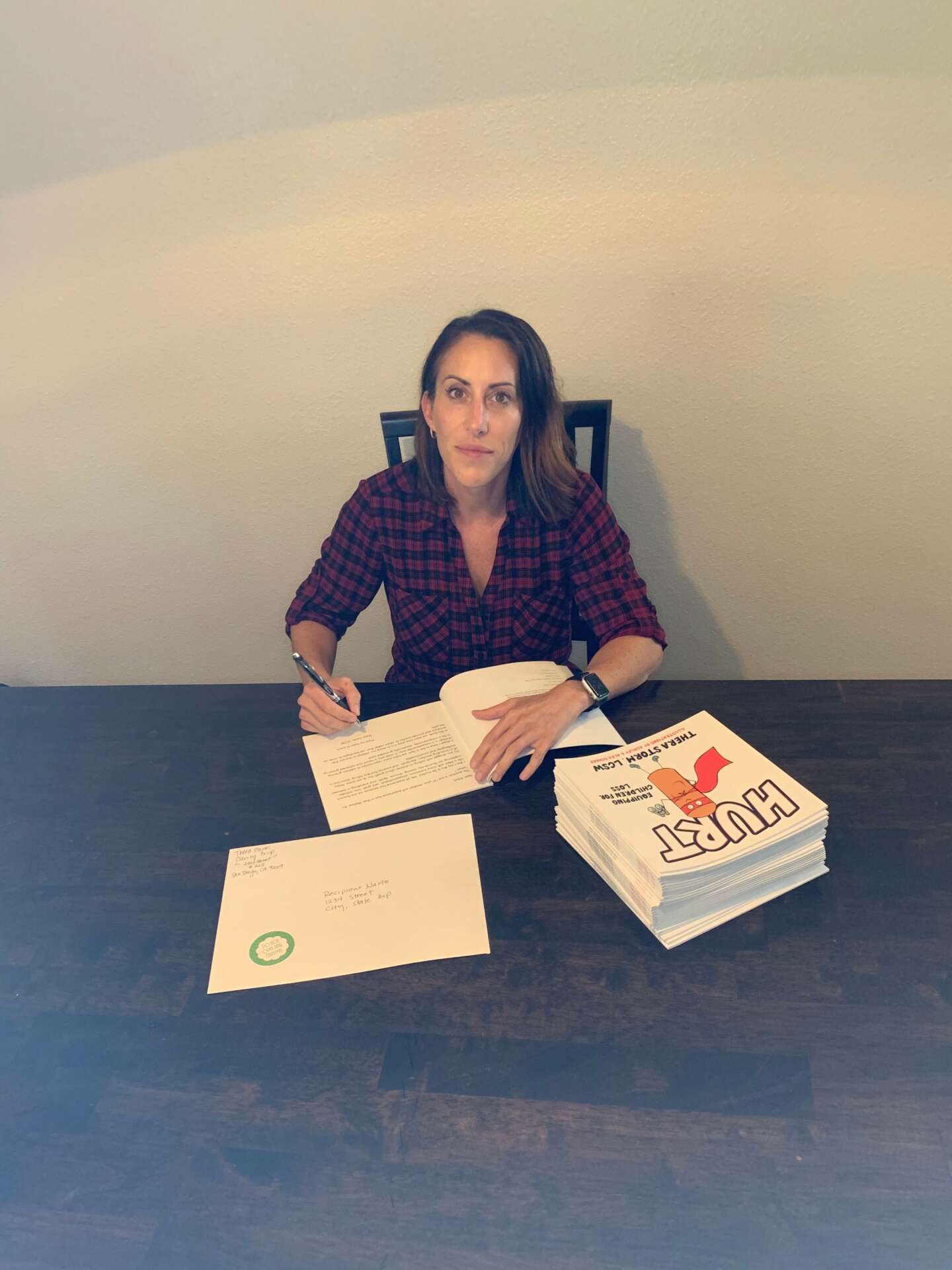

We caught up with the brilliant and insightful Thera Storm a few weeks ago and have shared our conversation below.
Thera, thanks for joining us, excited to have you contributing your stories and insights. What was your school or training experience like? Share an anecdote or two that you feel illustrate important aspects or the overall nature of your schooling/training experience.
In 2002 I received an undergraduate degree in Communications. Although I found some success working in marketing and advertising, everything changed in 2004 when my twin sister was almost killed during her combat deployment. Through the experience as a caregiver and interfacing with the military system, I knew I wanted to be a social worker one day. I was able to earn my masters degree in social work (much later) in 2013.
After becoming a licensed clinician and providing therapy in a military setting, I realized that grief and loss was a common theme. I felt ill-equipped in supporting these issues. In my social work masters program we were given a very limited introduction to “grief.” In fact, we were taught the “5 Stages of Grief” developed by Elizabeth Kubler-Ross. When I became a Certified Grief Recovery Method Specialist in 2018, I learned that there are no stages of grief, that theory is very limiting and grief is not a linear process.
I am grateful that I invested in the grief certification, as it expanded my education and ability to really help my grieving clients in a customized way that allows them to resolve unresolved grief (it is unresolved grief that limits our ability to move on/find meaning in life again after a loss).


Great, appreciate you sharing that with us. Before we ask you to share more of your insights, can you take a moment to introduce yourself and how you got to where you are today to our readers
I decided to become a social worker focused on serving the military when my twin sister was almost killed during her combat deployment in 2004. At that time, I quit my marketing job and moved into the Fisher House in San Antonio, TX to be near where she was receiving medical treatment for severe burn wounds (she was about 10 feet away from a suicide bomber). She had an incredibly long journey for both physical and mental recovery. At that time, there were very little supportive resources, especially for female veterans. I remember after long days at the hospital, I would spend my evenings doing research on trauma, symptoms, mood, career impact, and organizations that could provide support. I felt so powerless and ill-equipped. I WISH I knew what I know now… my sister was grieving.
She was grieving her body. She was grieving her health. She was grieving her career. She was grieving her relationship. She was grieving the expectation of what she thought life would look like as a young 24 year old female.
I understand this now. Because grief is the conflicting emotions caused by a loss of any kind. I did not know this then. I wish I did, because I would have been more supportive. I would not have said the platitudinal statement that we tell grievers – ultimately resulting in their isolation and numbing behaviors because they feel so misunderstood.
In 2005 I married a Marine helicopter pilot. While stationed in Quantico, VA, I was able to enroll in George Mason University’s master of social work program. As a military spouse I further gained a perspective on the need for resources and support for active duty military and their families. That is when my “grief lens” emerged… in providing outpatient therapy for active duty military, I started connected that most of my patients were similar to my sister – they were experiencing a loss of some type. Loss of relationship, stability, health, career, finances, trust, infertility, expectations… all losses and GRIEF. Almost every client was grieving!
I sought out the Grief Recovery Method for grief-specific education and training. I knew I needed this so that I could truly help my clients. The training was intense, but I am so grateful I invested in this certification.
Fast forward to today. I am an Advanced Grief Recovery Method Specialist providing the Grief Recovery Method for clients here in Pacific Beach and all around the world (virtually). Being a licensed clinical social worker and grief specialist has become the most fulfilling educational mix to help and support grievers.
Any stories or insights that might help us understand how you’ve built such a strong reputation?
Because this is my own practice, I get to do things the way I would want them as a consumer.
I do not stare at the clock. Most of my sessions are 1.5 hours long.
I provide free resources for grievers who are not quite ready to commit to one-on-one sessions or the Grief Recovery Method 8-session program. I have downloadable games for families, a podcast, videos, social media content, a PDF e-book, etc. that are available to anyone who finds my website.
I only see about 3 clients a day. In-between sessions I will go for a walk or eat a snack, etc. I make sure that I am fully fulfilled before each client so that they get 100% of my focus. I refuse to see 7 clients back-to-back each day. I could make more money, but that would be a recipe for burnout and my clients would not get fully focused attention and customized treatment.
I want clients to feel safe to be emotionally honest. Honesty is the foundation of grief work. This foundation is important so consulting with a new client prior to working together is very similar to a therapeutic, educational session. I have never experienced this level of interaction with a medical professional, and I am grateful that I get to do this my way with each new person I have the honor in working with.
In addition to working with clients, I provide educational workshops and briefings for organizations, companies, etc. all over the country. Providing grief support as a speaker/presenter has been a wonderful way to educate leaders on best practices and even simple tools for communicating with a griever.
Clients trust me with their broken and beautiful hearts. I am humbled by this every day. I have so much gratitude for the structure of my business model and how it has allowed me to help others and educate folks on the mistakes I made with my twin sister. I get to advocate for grievers and give them a voice. We get to take grief out of the shadows so that society becomes enlightened and clear on the needs of grievers.


Other than training/knowledge, what do you think is most helpful for succeeding in your field?
Honestly, being fully HUMAN has been better for helping and connecting with clients than any book or fancy collegiate lecture or seminar.
Contact Info:
- Website: www.claritycorp.us
- Instagram: @griefrecoverygirl
- Youtube: https://youtube.com/channel/UCoTmNxK1w_W2FSq1GUjo4ig
- Other: Podcast: Portraits of Grief Amazon: https://www.amazon.com/Hurt-Equipping-Thera-Storm-LCSW/dp/109831364X/ref=sr_1_3?crid=SQE0EWKXQOVS&keywords=hurt+thera+storm&qid=1652930706&sprefix=hurt+thera+storm%2Caps%2C108&sr=8-3
Image Credits
Headshot is from Kristina Attwood photography