
We’re excited to introduce you to the always interesting and insightful Stephen Bienko. We hope you’ll enjoy our conversation with Stephen below.
Alright, Stephen thanks for taking the time to share your stories and insights with us today. Alright, so you had your idea and then what happened? Can you walk us through the story of how you went from just an idea to executing on the idea
People often assume businesses start with a great idea. Looking back, I think 42U started with a pattern I didn’t recognize.
For more than twenty years, every business I built somehow focused on helping young people between the ages of eighteen and twenty-five grow, develop confidence, and unlock their potential. Whether it was athletic performance, sports marketing, entrepreneurship, or athlete representation, the common thread was always there. I just wasn’t aware enough to see it.
The turning point came when NIL began transforming college athletics. Everyone was talking about money, endorsements, and branding, but I felt like something important was missing. Nobody was talking about identity.
As a former Division I athlete, I understood how easy it is to become what you do instead of understanding who you are. So I started talking with coaches, athletic directors, sports psychologists, administrators, and athletes themselves. The more conversations I had, the clearer the gap became. Universities were doing a great job developing athletes physically and academically, but very little existed to help them understand themselves, develop leadership skills, build authentic brands, and prepare for life after sport.
That became the foundation for 42U.
From there, it was months of learning, refining ideas, building partnerships, creating programming, and earning trust. There was no perfect roadmap. It was one conversation, one presentation, and one relationship at a time.
Today, 42U helps student athletes understand themselves before the world tells them who they should be. Looking back, the company feels less like a business idea and more like the culmination of a question I’ve been pursuing my entire life: How do we help people discover who they really are and become the best version of themselves?
Stephen, love having you share your insights with us. Before we ask you more questions, maybe you can take a moment to introduce yourself to our readers who might have missed our earlier conversations?
I grew up in a small farm town in northwest New Jersey and was fortunate to have sports play a major role in my life. Athletics opened doors for me, eventually leading me to compete as a Division I athlete. Like many athletes, I spent years identifying myself by what I did rather than who I was. That realization became one of the most important lessons of my life and would later shape both my personal journey and my life’s work.
Today, I live in Morristown, New Jersey, with my wife Jan and am the proud father of four children. While sports and business have been important parts of my life, fatherhood has probably taught me more about identity, leadership, patience, and personal growth than anything else. It has reinforced my belief that our greatest value is found in who we are, not simply in what we achieve.
Professionally, I have spent more than two decades building businesses in athletic performance, sports marketing, entrepreneurship, and athlete development. My career has included founding athletic performance organizations, working in sports marketing and athlete representation, serving as a New Jersey State Trooper, and building businesses focused on leadership and human development. Along the way, I began noticing a pattern. Every venture I was involved with centered around helping young people discover their potential, build confidence, and navigate important transitions in life.
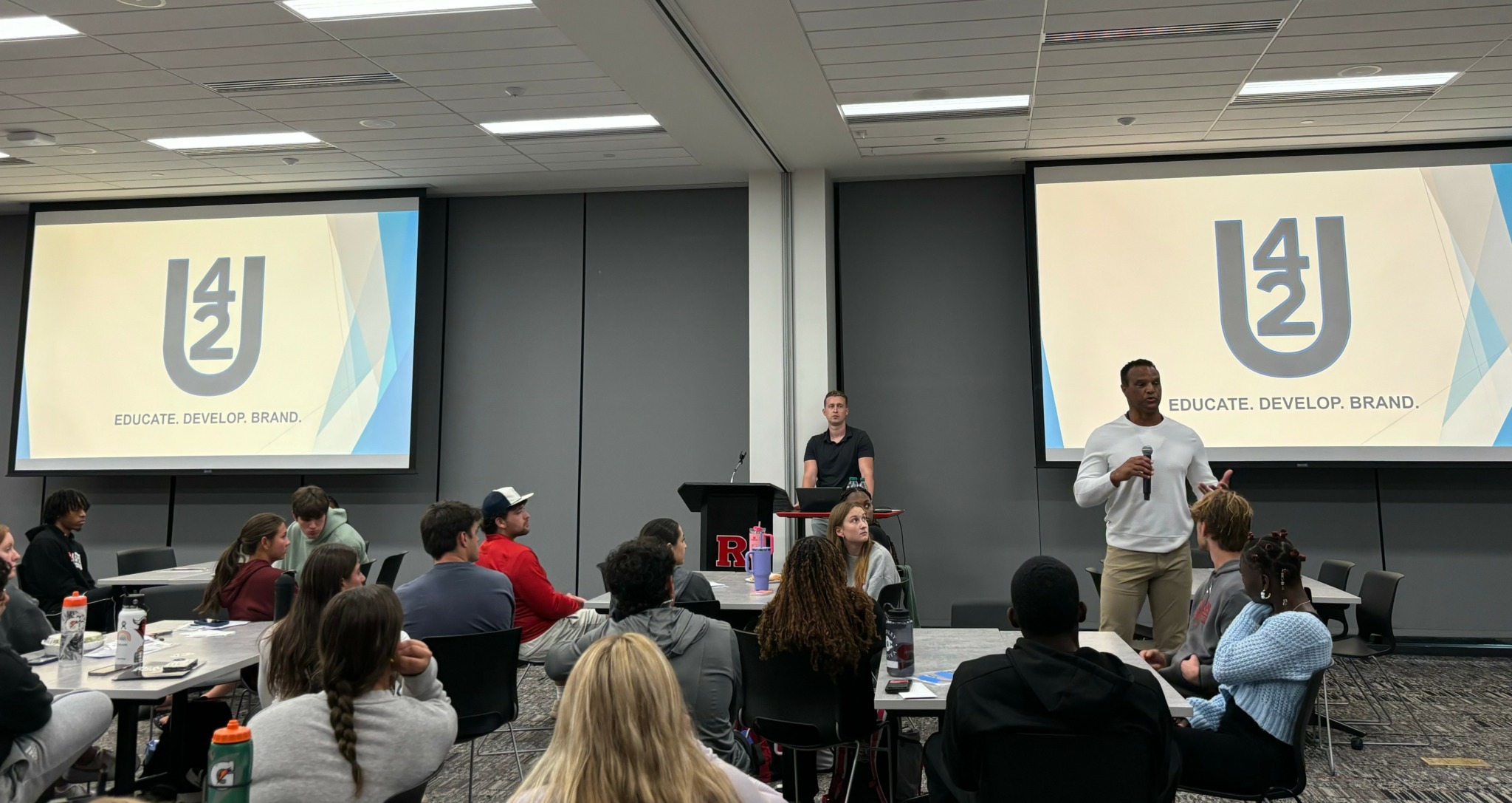
Today, I am the Founder and CEO of 42U, an athlete development company that works with colleges and universities to help student athletes better understand themselves, develop leadership skills, build authentic personal brands, improve performance under pressure, and prepare for life after sport.
What makes 42U different is that we start with identity. In a world obsessed with followers, endorsements, recruiting rankings, and NIL dollars, we believe the most important question is still, “Who are you?” Before an athlete can build a brand, lead a team, make good decisions, or maximize opportunities, they need a deeper understanding of themselves.
Our work sits at the intersection of athlete development, psychology, leadership, branding, and career readiness. We help athletes navigate one of the most transformative periods of their lives while also helping universities better support the people behind the jersey.
What I am most proud of is not a contract, partnership, or business milestone. It is seeing young people gain clarity and confidence in who they are. The greatest moments are when an athlete realizes their value extends far beyond their sport and begins building a life with intention rather than reacting to circumstances.
If there is one thing I want people to know about me and about 42U, it is that we are not in the branding business. We are in the human development business. Branding is simply the external expression of understanding who you are internally. Our mission is to help athletes develop into confident leaders, professionals, entrepreneurs, and people long after the final whistle blows.
Can you open up about a time when you had a really close call with the business?
Absolutely.
One of the most stressful periods of my entrepreneurial career came while building a College Hunks Hauling Junk and Moving franchise. We experienced explosive growth, going from two trucks to more than fifteen trucks and reaching nearly $2 million in annual revenue in less than eight months.
From the outside, it looked like an incredible success story. On the inside, it was controlled chaos.
The challenge wasn’t generating revenue. The challenge was scaling fast enough to support the growth. Every week seemed to require more trucks, more employees, more insurance, more equipment, and more cash. I was learning about commercial vehicle financing, lines of credit, insurance requirements, and cash flow management in real time. Many of those lessons came the hard way.
I remember one period where we had significant revenue booked, but the timing of receivables and expenses created a cash crunch. Payroll was approaching, and despite having work lined up, there wasn’t enough cash in the account at that moment to comfortably cover everyone.
Like many entrepreneurs, I had one of those sleepless nights where you stare at the ceiling wondering how you’re going to make it work.
I ended up calling a friend and asking for a short term loan to bridge payroll until a large job was completed and paid. It was humbling, stressful, and frankly a little embarrassing at the time. But payroll was met, the jobs were completed, and the business continued growing.
Looking back, I wouldn’t change any of it.
Those experiences taught me lessons I could never have learned from a book. They taught me about cash flow, risk management, humility, leadership, and the responsibility that comes with having employees depending on you and their families depending on them.
Most importantly, they taught me not to fear growth simply because I didn’t have all the answers. Some entrepreneurs wait until they know everything before they move. I’ve always been willing to move, learn, make mistakes, and adjust along the way.
I certainly have scars from those years, but I also gained wisdom that continues to serve me today. Entrepreneurship is rarely a straight line. The moments that feel the most uncomfortable are often the moments that teach you the lessons you’ll rely on for the rest of your career.
We often hear about learning lessons – but just as important is unlearning lessons. Have you ever had to unlearn a lesson?
One of the biggest lessons I had to unlearn was the belief that more work always equals better results.
That mindset came from sports. As an athlete, you are taught to push harder, stay longer, do one more rep, fight through pain, and prove your commitment through effort. That mentality helped me in many areas of my life. It gave me toughness, discipline, competitiveness, and the ability to keep going when things were difficult.
But over time, that same strength became a weakness.
I carried the athlete mentality into business, leadership, and life. If something was hard, I worked harder. If I was tired, I pushed through. If something was not working, I assumed the answer was more effort, more hours, more intensity, and more sacrifice.
Eventually, I paid for it.
I got older. I got worn down. I got sick. I got beat up physically, mentally, and emotionally. At some point, I had to be honest with myself and realize that I was not always being disciplined. Sometimes I was just proving something to myself. Sometimes I was using work as an identity.
That was a hard truth to face.
What I had to unlearn was that exhaustion is not the same as excellence. Working harder is not always the answer. Sometimes the higher level skill is awareness, patience, strategy, recovery, delegation, and clarity.
I still believe in hard work. I always will. But I no longer believe that destroying yourself is a badge of honor. The goal is not to grind until there is nothing left. The goal is to build something meaningful while becoming more whole, not less.
That lesson has shaped how I lead today and how I think about the athletes we serve through 42U. Many athletes are taught to attach their worth to effort, output, performance, and pain tolerance. But life after sport requires a different kind of strength. It requires identity, self-awareness, emotional honesty, and the ability to know when force is no longer wisdom.
For me, unlearning the just work harder mentality was really about learning that who I am matters more than how much I can endure.
Contact Info:
- Website: https://www.the42u.com
- Instagram: @bienkostephen
- Linkedin: https://www.linkedin.com/in/stephenbienko/
- Twitter: @stephenbienko