

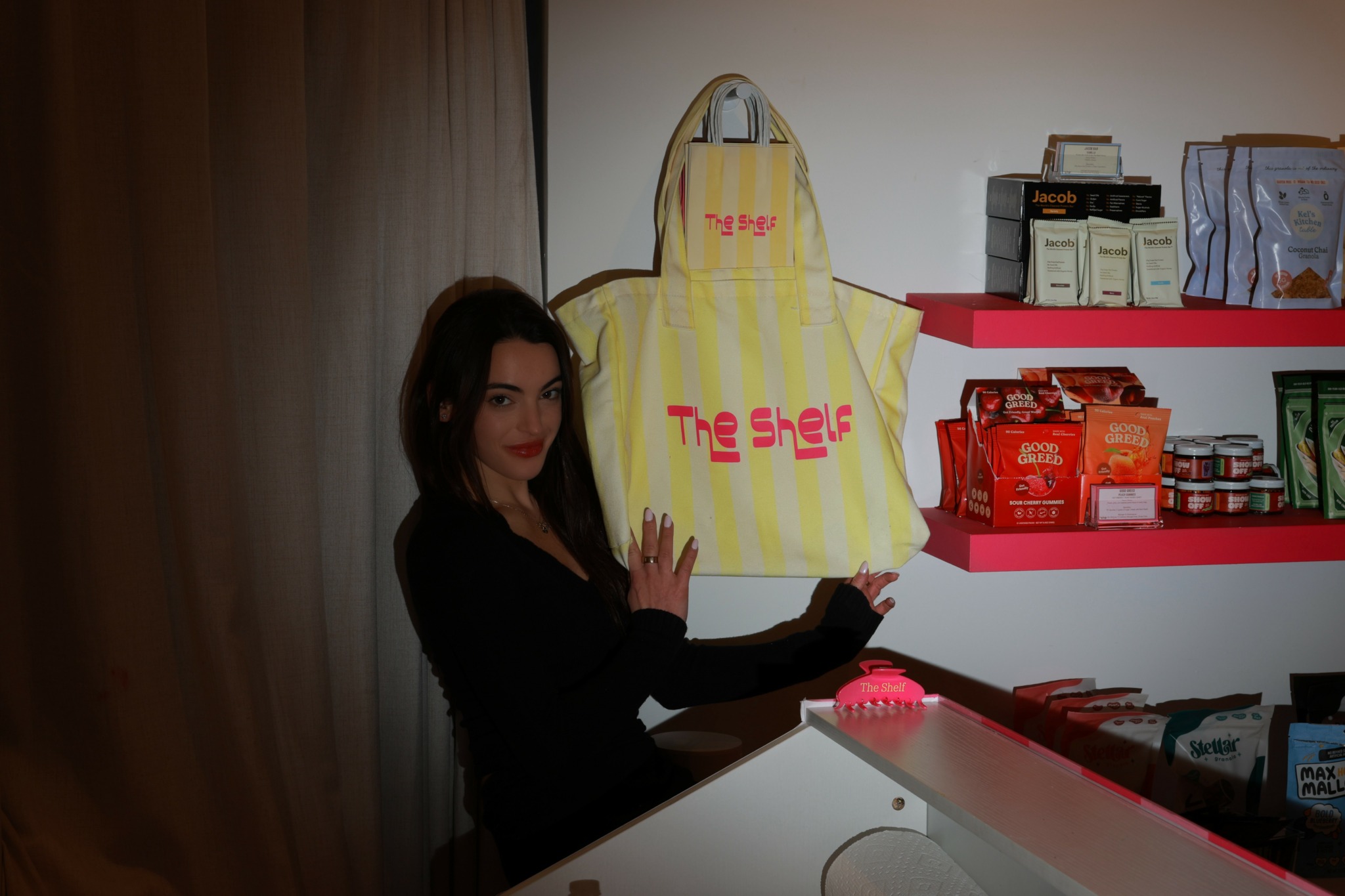

We’re excited to introduce you to the always interesting and insightful Sloane Kraftsow. We hope you’ll enjoy our conversation with Sloane below.
Sloane, appreciate you joining us today. What’s the backstory behind how you came up with the idea for your business?
The idea for The Shelf didn’t come from a single “aha” moment. It came from who I’ve always been.
I grew up in Miami, where snacks were basically a love language. There was always something new to taste, share, and talk about. Trying something new felt fun, not strategic.
When I was younger, I was constantly ordering snacks online, lining them up, and adding new finds to the yellow legal pad on the kitchen counter for my stepmom Tammy to track down at Whole Foods and Fresh Market. The problem was, half the brands I wanted weren’t there yet. Tammy would drive around all day looking for something I’d already lost interest in by the time she found it.
Eventually she gave up and gave me my own shelf in our pantry. Everyone in the house started calling it Sloane’s Shelf — the place you went when you wanted something new, something you hadn’t seen before, something that felt like a little discovery. I didn’t realize it then, but that shelf was the blueprint. It’s also, very literally, where the name came from.
The moment I knew it was a business came years later. I was between apartments, temporarily living at my dad’s, and I tried to order a 7-pack of bagels from a brand doing a goodbye sale before shutting down. Seventy-two bagels showed up at the door. You should’ve seen my dad’s face. I didn’t want 72 bagels — I just wanted to try the different flavors.
That was it. Discovery shouldn’t require a 12-pack, a subscription, or 72 bagels. The Shelf is the version of retail I always wanted: one where you can actually try things, the way I used to in my pantry and the one where curiosity can take the drivers seat.

Awesome – so before we get into the rest of our questions, can you briefly introduce yourself to our readers.
I’m Sloane Kraftsow, founder of The Shelf — a discovery-driven part lifestyle part pantry store for emerging food, beverage, beauty, wellness, pet, and lifestyle brands. Our permanent store opens July 9 at 58 W 8th Street in Greenwich Village, and it’s the fourth retail concept I’ve opened in under a year.
I grew up in Miami, where food felt emotional and social — something tied to identity, curiosity, and connection. I’ve always loved discovering new products, weird snacks, niche brands, and the kinds of things you’d text your friends about after finding them. But over time, I noticed there wasn’t really a physical place built for discovery anymore. Grocery shopping became routine, while emerging brands struggled to break into retail unless they already had scale, funding, data,
or massive wholesale capabilities.
I started The Shelf to become that missing layer.
The Shelf is a rotating discovery store built for emerging brands that are too early for traditional retail, but too physical for DTC alone. Brands get real shelf space, real customer interaction, and real-world visibility without needing massive wholesale orders or traditional retail infrastructure.
At the same time, I built an internal data and retail operating system for The Shelf that tracks what customers are actually interacting with in real life — from sales velocity and repeat purchases to sampling performance, customer feedback, social traction, and in-store discovery behavior. All the data connects to my Dropbox filled with content that each brand can use because so many founders struggle with only having content inside their apartments. A huge problem for emerging brands is that traditional retail can feel like a black box. I wanted to build something that gives brands clearer visibility into what’s working before they scale. The Shelf’s data platform provides a the closest thing to a live stream into our store.
In under a year, The Shelf has operated multiple NYC storefronts and worked with hundreds of emerging brands. Brands that have rotated through The Shelf have gone on to expand into retailers like Erewhon, Happier Grocery, Gelson’s, Butterfield Market, Fairway, and Meadow Lane.
What makes The Shelf different is that we’re built around discovery first. Most stores are optimized for routine shopping. The Shelf is designed for curiosity. The assortment rotates constantly, the categories intentionally mix together, and the experience is meant to feel closer to discovering your next obsession than running an errand.
The Shelf isn’t trying to be a traditional grocery store but we hope to grow into a full grocery store one day with The Shelf spin on it.
It’s a launchpad for the next generation of consumer brands — and a place where discovery and curiosity feels fun again.
Opening July 9
58 W 8th Street, New York City

How did you build your audience on social media?
The first video I ever posted was for La Grocere — which is what The Shelf was called before I changed the name. I was so terrified to hit post that when the video got 1000 views, I threw my phone across the room. And these were people I’d literally grown up with or knew socially.
That tells you everything about how scary it actually felt at the beginning. Here’s the thing about the La Grocere name — it didn’t make sense to anyone outside my closest friends. The whole concept was a cart, not a grocery store, and the name created confusion every time I introduced it to someone new. I changed it early because I knew if I didn’t, I’d be explaining it for the entire life of the brand. That actually became a thesis I now apply to The Shelf itself — emerging brands should use the feedback they get at our store from real consumers to fix their positioning before they invest heavily in inventory and co-manufacturing. The early stage is when changes are cheap. Most founders wait too long because they’re too attached to what they’ve already built.
My favorite marketing moment is from my first pop-up in NYC. TikTok had just been temporarily shut down, there was a huge storm, and I needed to drive traffic to the store. So I made a full Hinge profile for The Shelf on my personal account. People screenshotted it, sent it to friends, came to the pop-up specifically because of it. That’s the kind of marketing most founders are too scared to try because it sounds cringe. It was cringe. That’s why it worked.
The other thing that built my audience was building publicly before anything looked polished. I posted inventory chaos. Construction footage. Moving boxes at 5 a.m. Random founder thoughts at midnight. The mess of becoming a real business. People connected to the honesty of watching something turn into something real in real time. That’s the part you can’t fake later — you only get one chance to document the messy version, and that’s the version people actually remember.
If I had to give advice to someone just starting to build their social media presence, it would be this: act on the things you consistently think about doing. If you keep telling yourself you should make that video, just make it. The gap between people who build something and people who don’t is mostly about whether they let the fear of looking cringe stop them. Throw the phone if you have to. Then pick it up and post the next one.
The other piece of advice is to build for the version of your audience that doesn’t exist yet, not the people who already follow you. The instinct is to make content for the people watching. That’s a trap. Make content for the strangers you want to find you. That’s how you grow past your immediate circle.
The Shelf opens this July at 58 W 8th Street. The whole thing started with one terrifying video and the willingness to keep posting because I believe in emerging brands so much.
How did you put together the initial capital you needed to start your business?
I started very small with a cart in Miami doing farmers markets, wellness events like Reserve Padel, Art Basel, Pilates studios, and pop-ups, so the initial investment was honestly only a few thousand dollars. I funded that through savings while still working full time.
As the cart started gaining traction and I scaled this outside of Miami by traveling to Ann Arbor and creating experiences in Austin, Nashville, and Palm Beach. I reinvested the profits into what was originally supposed to be a one-week NYC pop-up. By the time we opened the doors, the total cost was around $25,000.
I only had to put down a relatively small deposit upfront, and then I basically worked nonstop to get brands onboarded and cover the rest of the expenses in real time.
Then something unexpected happened — the tenant scheduled after us canceled and forfeited their deposit, which allowed us to stay in the space for an additional five weeks at a lower rate. I reinvested some of my five days profit back into the store again because it truly felt like a sign.
After those six weeks, we moved into another NYC pop-up location for another six weeks until that space was no longer available. Then we did a two week collaboration with Juice Press in the West Village.
During that time and a lot of boxes and fridges moving around the city, I secured a permanent storefront in Greenwich Village, which is currently under renovation.
That’s definitely been the biggest financial leap so far. I’m funding it through savings, reinvesting revenue back into the business, and honestly a lot of friends-and-family support through services and relationships instead of traditional funding.
One of my best friends since middle school, Isabel, is actually designing the store and helping select all the finishes and interiors.
Contact Info:
- Website: https://theshelfnyc.com
- Instagram: @theshelfnyc
- Linkedin: sloane-kraftsow


Image Credits
@godshootsprime dave friedman