

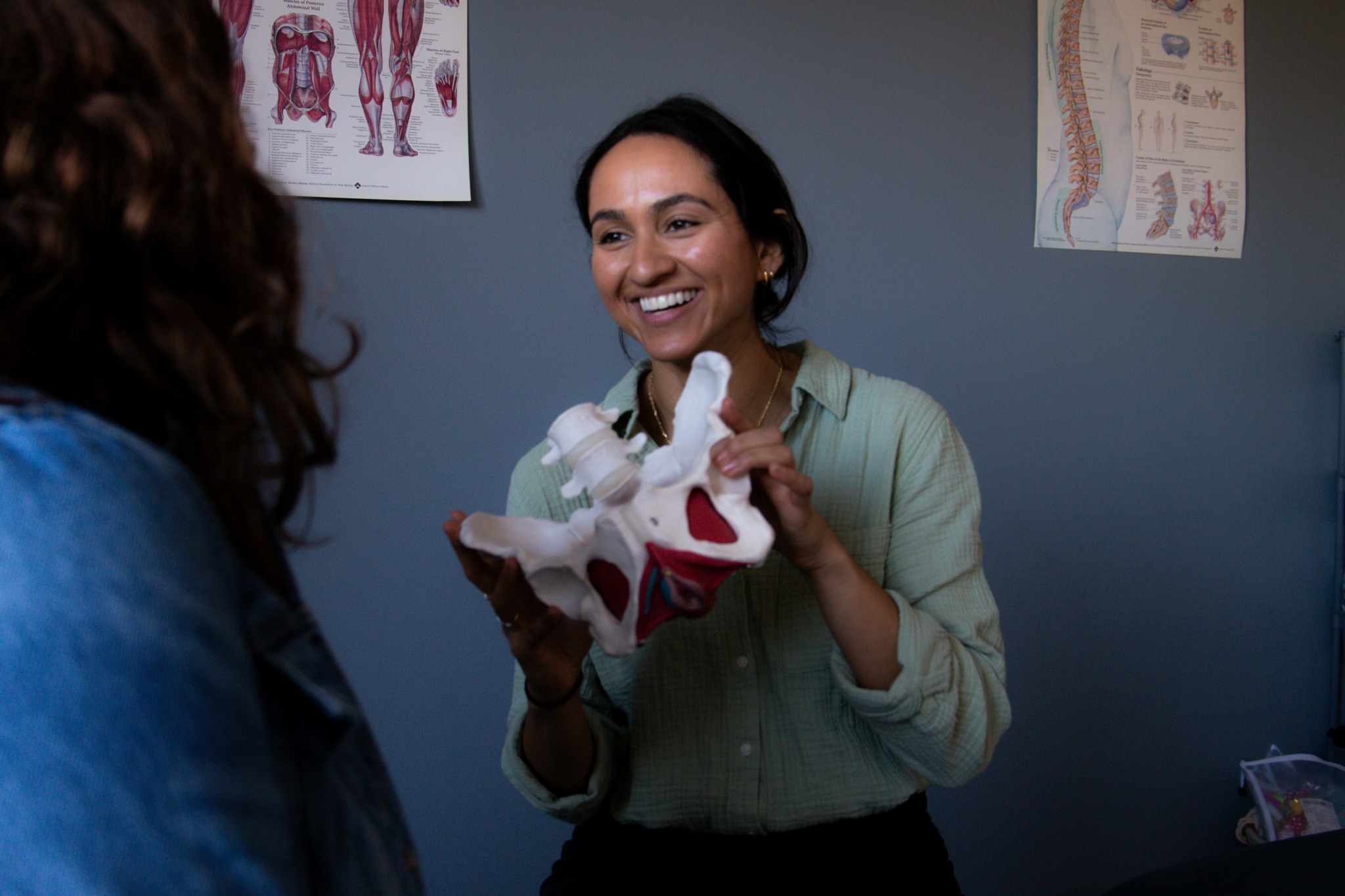

We’re excited to introduce you to the always interesting and insightful Sarina Karwande. We hope you’ll enjoy our conversation with Sarina below.
Sarina, looking forward to hearing all of your stories today. Was there a defining moment in your professional career? A moment that changed the trajectory of your career?
When I began my career as a physical therapist, I was trained—like many others—not to bring personal stories into the treatment room. In clinical rotations, you quickly learn that patients are there to be heard. They’re often in pain, frustrated, vulnerable. They don’t want to hear that you have back pain too; that can feel dismissive, even if it’s meant to be relatable. So, I kept quiet. I focused on listening. On validating. On helping.
But everything changed when I found pelvic health.
Roughly a decade ago, pelvic health was and actually is still very much a taboo subject. People whispered—if they spoke at all—about issues like pain with intercourse, incontinence, or constipation. If you said “pelvic floor dysfunction” in casual conversation, you’d get a blank stare or an awkward laugh. Yet, I felt a pull toward this specialty that I couldn’t explain at first—until I realized it was personal.
I had my own history of pelvic pain—something I never talked about, not even with close friends. Not even my dad knew. The only two people who were aware were my mom and sister. When I was 16, I remember one morning vividly: I sat on the toilet before school, and I couldn’t pee. My muscles had seized. I was stuck, frozen. It was uncomfortable, distressing, and totally confusing. Naturally, doctors assumed it was a urinary tract infection—except it kept happening, and there was never any bacteria.
As the years passed, my symptoms worsened. Burning bladder pain would appear out of nowhere—during clinical rotations, standing at work, or even just watching TV. I saw specialists. I tried supplements. I endured invasive tests that, looking back, were both unnecessary and retraumatizing. Nothing worked—until I finally saw a pelvic floor physical therapist who explained that my pelvic muscles were overly tense. Through targeted treatment, I learned how to relax. Not just during exercise, but while sitting, standing, breathing, even talking. That was the beginning of real healing.
That experience—both the suffering and the relief—was my defining moment. It was when I realized that in pelvic health, sharing your story can actually be part of the healing. Unlike other areas of PT, where personal anecdotes might distract or diminish a patient’s experience, in pelvic health, it helps people feel seen. Less alone. More hopeful.
Once I started telling my story to patients—carefully and with intention—I saw their shoulders relax. Their eyes light up. “Wait, you went through this too?” they’d ask. That shared humanity opened the door for deeper trust, more effective treatment, and often, faster progress.
That moment—when I began to share, when I saw the impact of my vulnerability—is what inspired me to fully specialize in pelvic health. Today, as a business owner and practitioner, my mission is to create a space where people can talk about what’s been unspeakable for far too long. Pain with intimacy. Incontinence. Fear. Shame. The things we carry in silence.
I’m especially passionate about working with teens—because I was one when my symptoms started, and I remember how confusing and isolating it was. My goal is to help young people understand their bodies early, to give them language, tools, and guidance—so they don’t have to go through years of not knowing what’s wrong or where to turn. They deserve answers. They deserve to feel in control of their health and their body.
Pelvic health is personal. And through sharing my story, I’ve found purpose, connection, and a powerful way to help others find relief—not just physically, but emotionally too. That’s the lesson I carry forward every day in my work: sometimes the most effective treatment starts with simply saying, “I understand. I’ve been there.”

Sarina, love having you share your insights with us. Before we ask you more questions, maybe you can take a moment to introduce yourself to our readers who might have missed our earlier conversations?
I’m Dr. Sarina Karwande, PT, DPT—licensed physical therapist and founder of PelviWell Physical Therapy Pediatric and Women’s Health, based in Thousand Oaks, California. My practice is built on something both deeply personal and professionally essential: the belief that pelvic health should be accessible, compassionate, and normalized at every age and stage of life.
My journey into this specialty wasn’t just clinical—it was lived. Like many of the patients I now help, I once struggled silently with pelvic pain that disrupted my daily life and left me feeling confused, dismissed, and unsure of where to turn. After years of misdiagnoses and invasive testing, I finally found healing through pelvic floor physical therapy—and that experience completely reshaped my career. It inspired me to not only specialize in this field but to build a practice that would support others through what can often be a misunderstood or stigmatized journey.
At PelviWell, we provide specialized pelvic floor physical therapy for children, teens, and women, treating a wide range of conditions—everything from bedwetting and constipation in kids, to painful periods and pelvic pain in teens, to postpartum recovery, bladder dysfunction, and chronic pain in adult women. What sets our practice apart is our lifespan approach: we treat patients as early as potty-training age all the way through menopause and beyond. We also create a supportive environment for parents, offering them a haven of education, empathy, and resources—because healing a child or teen often involves the whole family.
Before founding PelviWell, I worked at Shriners for Children, where I gained extensive experience treating complex pediatric cases, including rare genetic and musculoskeletal conditions. That foundation allowed me to develop the clinical sensitivity, adaptability, and insight required to care for young patients with both common and rare pelvic floor concerns. Today, I remain the only pelvic floor physical therapist in the Ventura county area with a dedicated focus on pediatrics, making PelviWell uniquely positioned to support families navigating conditions that are often overlooked or misunderstood.
What I’m most proud of is the safe, shame-free space created at PelviWell—where people can talk openly about what’s often been kept quiet for too long: pain with intimacy, constipation, incontinence, or pelvic floor dysfunction that started in adolescence or even childhood. Every visit is rooted in education, empowerment, and whole-person care. Whether someone is newly postpartum or a teen struggling to understand what’s happening in their body, my goal is always to listen first, educate gently, and guide each person toward feeling confident and in control of their health.
For anyone considering pelvic floor physical therapy—whether for yourself or your child—I want you to know: you are not alone. You deserve answers. You deserve to feel heard. And you deserve a provider who sees the full picture—not just the diagnosis. At PelviWell, healing begins with understanding—and that’s the heart of everything we do.

Training and knowledge matter of course, but beyond that what do you think matters most in terms of succeeding in your field?
It’s the mindset that things don’t have to be perfect in order to begin.
In physical therapy—especially when you’re starting your own practice—it’s easy to get caught up in the idea that you need the ideal space, the full setup, or every detail figured out before you can truly start. But the truth is, you can begin making an impact long before everything looks polished. The most important piece is having a clear purpose and a desire to serve.
Workshops in gyms, yoga studios, preschools, hospital resource centers—these are incredible opportunities to connect with your community, educate people, and share tools that can change lives. You don’t always need four walls and a formal setting to start helping people in meaningful ways.
In pelvic health especially, being visible, approachable, and willing to meet people where they are—literally and figuratively—goes a long way. Success isn’t just about your credentials or your clinic; it’s about your ability to listen, educate, and adapt. Don’t wait for things to be perfect. Start with what you have, share what you know, and let your passion do the rest.

Putting training and knowledge aside, what else do you think really matters in terms of succeeding in your field?
Curiosity—and the willingness to learn from others.
One of the most valuable things I’ve done in my career is ask to shadow other practitioners—from specialists and physicians to fellow therapists. Observing how others work, how they interact with patients, and how they approach treatment has given me a deeper understanding of the entire care landscape. It’s not just about refining your own skills; it’s about knowing how to better guide your patients through a system that can often be confusing or overwhelming.
As a pelvic health therapist, my goal is to be a point person for my patients—a trusted guide who can help them navigate their care, know what to expect, and understand who else might need to be part of their healing journey. That level of support only comes when you take the time to step into other providers’ spaces, learn how they operate, and build those relationships.
There’s so much value in seeing other practitioners in their element. It broadens your perspective, improves collaboration, and ultimately helps you become a more confident and connected clinician.
Contact Info:
- Website: https://www.pelviwell.com
- Instagram: pelviwellpt

