

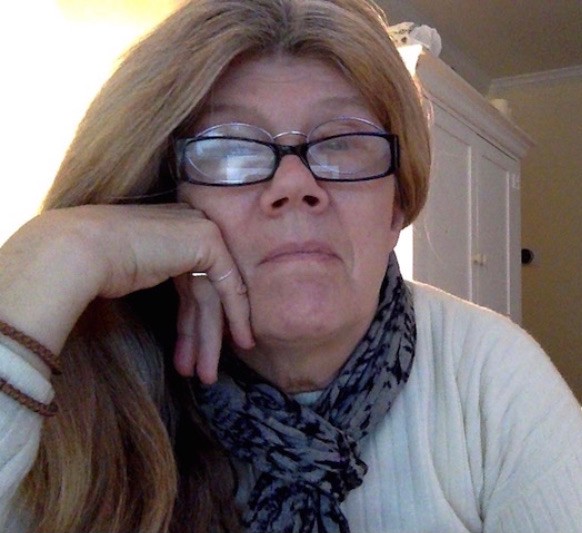

Alright – so today we’ve got the honor of introducing you to Sarah Hatch. We think you’ll enjoy our conversation, we’ve shared it below.
Sarah, thanks for joining us, excited to have you contributing your stories and insights. We’d love to hear about a project that you’ve worked on that’s meant a lot to you.
Many years ago, I was invited to participate in two gallery shows similar in premise. For me, both shows are intertwined: artists painting in the gallery throughout the month long shows. In “On the Spot”, curated by Freddie Styles at City Hall East, we 23 artists met and chose our wall space and mediums. I was given a 104″ X 43″ piece of beautiful heavy art paper to pin to the wall. The next morning I began. After priming the paper, I painted and printed random patterns with acrylic paint. This is how find my images, by staring at the paterns and shapes. In this painting, I saw a very large cloud that reminded me of a belief I had when I was a child. The clouds were where people’s ghosts and spirits go when they die. At the same time, it felt like a book I’d read by Robert Bly, The Very Long Bag We Drag Behind Us. And that was it! The cloud is as if it were the very long bag that holds the childhood beliefs and adult shadows of our lives. I painted in the gallery day and night, mostly night, working on “Random Belief Systems”. During the day people wandered through the gallery. I wore earbuds most of the time, listening to the soundtrack of Chess over and over while I painted. All the artists came and went as our schedules allowed. Later in 2007, VSA, Arts of Georgia invited me to be lead project artist for their show, “Make Your Mark”, modeled after the previous show at C.H.E. In this show, 8 artists (including myself), chose our wall space and brought in our own materials, canvas, paper, etc. Pinned to the wall, I worked on three paintings, one large and two small pieces. I began painting in the same way described in the previous paragraph. Painted patterns, finding imagery. It’s interesting how certain visual scenes in a painting come out in the different gallery settings. In the ”Make Your Mark” show’s painting, I saw a lady standing in front of a lake. She’s bending back, a little alarmed, yet not unhappy, and finds a bird flying towards her face. And, in this piece, there is something purposefully left unfinished. An unfinished disc: a sun? a moon? I do like to create spaces in my work. In this case, you can see the lake in the background, the lake can also be seen through the woman’s body. There are curious animals and birds surrounding her. “Lady By the Lake” is painted on paper, in acrylic, 48″ X 48″. The two smaller paintings are narrow portraits, each painted in the same fashion. Close up faces in front of a landscape. In this show, I was partly responsible for looking after the other artists, making sure they had everything they needed. Perhaps the influence was people and spaces. Both inside my paintings and inside the gallery.
I learned something from both shows. I love working like this. Having the space and freedom to paint. Seeing what comes through me, influencing me when I paint in different environments. I put in my earbuds when I need to be absorbed in the work and take them out when I want to pay more attention to my surroundings and talk with gallery patrons for a moment.
There is a social and community feeling working this way, and, walking around when we need a break, seeing other great artists at work.


Sarah, before we move on to more of these sorts of questions, can you take some time to bring our readers up to speed on you and what you do?
My art career was always a passion for me. When I was little, I used to trace my brothers homework/writing. Then I traced cartoons. Then drawing freeform. I drew stick figures in a way that any kid would. Nothing special, I just wanted to do it all the time. Years later, favourite art teacher, Rita King said, when I would be frustrated by always drawing or painting the same thing over and over, that I should keep doing it, it will change by itself. At the time I was going to the Atlanta School of Art, taking classes in drawing and painting. Rita took me under her wing and encouraged me to not always follow academic rules in art. From her, I gained confidence in the use of shape and colour. I learned to form fragmented shapes into landscapes and figures, composing the scene from individual shapes. To value the differences in my work and style. Teaching me that my style is unique to me.
For many years I showed my work in outdoor art festivals, cafes, wherever I could exhibit. I had approximately eight or ten exhibits happening per month. In 1976, I hitchhiked around Europe. I painted and sold my work in street fairs and sidewalk set-ups. I returned to the U.S. in late 1977, looked for a job, found places to exhibit and sell my work. For many years, I loved doing outdoor festivals and showing in cafes. Years later, I would tell my students that showing in cafes is one of the best ways to get an honest critique of their work. By listening to honest critique, an artist can also decide what is true or not. Either way, it’s a great way to gain experience.
At present, to be honest, the struggle is to make a living, an artist. Early on, I had family support. When that relative died, that support came to an end. I was so fortunate to have that. Now, I must work much more to make money. I have a job I love as a petsitter, yet it takes me away, far too often from my true calling as an original fine artist.
Is there something you think non-creatives will struggle to understand about your journey as a creative?
The challenge of the original fine artist is how hard it is to maintain a living as a creative person. I do know artists who have made a decent living. I have witnessed a kind of charisma some, but not every artist, has and needs in order to sell their own work. That is what galleries are for. To sell works of art so the artist doesn’t have to. Although I have been in galleries over the years, my most productive and lucrative time was when I had my own gallery, selling my own work. I’m definitely not the sales person type, but did connect and make friends with many of my patrons. If I could turn the art world around, I would create a system where artists are paid to be artists. Give them a stipend and a studio. Most people don’t see that being an artist is hard work. We are producing a product, if one wants to look at it that way. I generally don’t, but it’s the best way I know how to explain it for this premise. Most of the time, an artist is not paid for their work.
There is a program similar to what I just spoke of, I believe in the UK. If anyone knows of one in the US, let me know. I wish we had a foundation to protect artists as necessary workers. It’s a cultural thing. And, a save the arts and artists thing. Part of my job as an artist is to also be an educator. I believed this long before I taught in a classroom. I taught Impressionist painting, an Art History class that I formulated to include painting in the styles of various art movements From Impressionism to the Present, and an Imaginative painting course that uses techniques I developed in my own work.
Another important subject is the subject of money. A question I’ve been asked quite a lot over the years is, why is art so expensive? I smile at this question.
An old friend said his work should cost more, enough to cover the $57,000. that it took him to go to art school!
I, however, explain it this way, choose a job and ask how much does that person make per week or month or year for the work they do. And if I create a painting that takes a week, month or year. At the very least, shouldn’t I be fairly compensated. It’s interesting, the term non-creative, I think most people are creative, in one way or another. Art is a beginning, a be all. For me it is healing. I want to carry the viewer in to a world they have never seen before.


Can you tell us about a time you’ve had to pivot?
Over the years, I have had a variety of challenges. The first time I had a shift in my life’s direction came in 1976, when I was in my first relationship as an adult, an abusive relationship. It happened while traveling in Europe. I felt stuck, yet I continued to create my work. I freed myself from that situation and in a few years, I developed a disability which was later diagnosed as Dystonia. I opened a gallery called Alias Gallery in 1985. I was in several auto accidents. In 2016’s accident, I was rear ended and pushed into full traffic. I dodged cars, pulled over and had a panic attack. After this incident, my drive to create, which had always been with me since childhood, was gone. With each accident or incident, years of healing work was undone and I would start the process over again. I was drawing and painting my way through the pain. Art helped me heal, over and over again. I began to focus on selling my older work, I developed a tremor in my right hand which did not help matters, but I continued to work to see what the next phase would be. My creative drive did come back, it just feels different. For a several years, I have been looking to find new ways to work and accept the work that is now passing through me. It’s an ongoing process, I have always loved experimenting, and am in the middle of a new chapter. I am drawing, drawing, drawing and occasionally painting, looking forward to seeing what happens next.
Contact Info:
- Website: www.sarahhatchart.com
- Instagram: SarahHatchArt
- Facebook: Sarah Hatch Art
- Twitter: AliasArtist1
Image Credits
Sarah Hatch