
We’re excited to introduce you to the always interesting and insightful Sara Murray. We hope you’ll enjoy our conversation with Sara below.
Sara, thanks for joining us, excited to have you contributing your stories and insights. Was there a moment in your career that meaningfully altered your trajectory? If so, we’d love to hear the backstory.
I have worked with children for over 30 years – my entire career, my entire adult life. As a little girl, I loved babies and little kids. I volunteered in the nursery at church so I could hold babies, and I babysat as a teenager.
I got my degree in Elementary and Special Education, and I got my Master’s in Reading Education. I worked in a few different public schools in upstate NY, where I’m from, and in the suburbs of Boston. I loved the children I worked with, but the job felt really hard, and not in a way that felt like a good challenge. There seemed to be a lot of things out of my control that I was responsible for, and I didn’t know how to help the students in my class.
I decided to “leave teaching,” and I worked as a nanny for a few different families in the Boston area. One family I worked with was sending their daughter to a Montessori school.
Despite my Bachelor’s AND my masters in various types of education, I really hadn’t heard much about the Montessori philosophy. I took this little girl to and from school each day. The more I learned about the Montessori philosophy, the more I loved it. Children were trusted, honored, and respected, and I loved the idea of teaching “the whole child” and not just academics. I volunteered in the classroom at her school, and I loved being around people who looked at children and childhood this way.
Around this same time, I met my (now) husband. He was a teacher at a small independent school, and he loved his job. He talked about how teaching in a small school were different, and maybe I would like that better than the big schools where I didn’t feel equipped to help my students in the ways they needed help.
I was so happy at Montessori school that I volunteered in, but I didn’t know what the training was to be a Montessori teacher, and I was afraid “that ship had sailed” (I wasn’t even 30 btw).
I was happy as a nanny, and my husband and I got married. My son Daniel was born, and I started thinking about the kind of school experience I wanted him to have. I wanted him to go to a Montessori school, but knew we wouldn’t be able afford it.
This was the early 2000s and the sexual abuse scandal in the Catholic church was being exposed. Several local churches and schools were closing. I read a newspaper (!!) article about a primary school that was being closed. The teachers had no warning, and the teacher in the article was talking about little “honey pot” decorated flower pots that her students had made for their end-of-year ceremony.
When this teacher met with the families outside the school to grieve the abrupt closing, her students were sad and confused. They didn’t know about the complicated politics behind the decision to close the school, they just wanted to have their honey pot decorations and end-of-year party like they expected. The teacher said the children said to her, “Miss Paulsen, what about our honey pots?”
There was something about the innocence of the children in that moment that tugged at my heart. I love the simple, uncomplicated nature of young children, and I realized I missed having that experience in my life. That feeling combined with the love in my heart for my infant son in my arms, and thinking about what kind of educational opportunities I wanted him to have, made me realize that it might actually be worth looking the training to become a Montessori teacher.
Though I spent just five years teaching in Montessori schools, the knowledge and experiences I gained during that time have become integral to who I am as a person, mother, teacher, and behavior coach. They continue to shape how I view and engage with children and families every day.
Sara, love having you share your insights with us. Before we ask you more questions, maybe you can take a moment to introduce yourself to our readers who might have missed our earlier conversations?
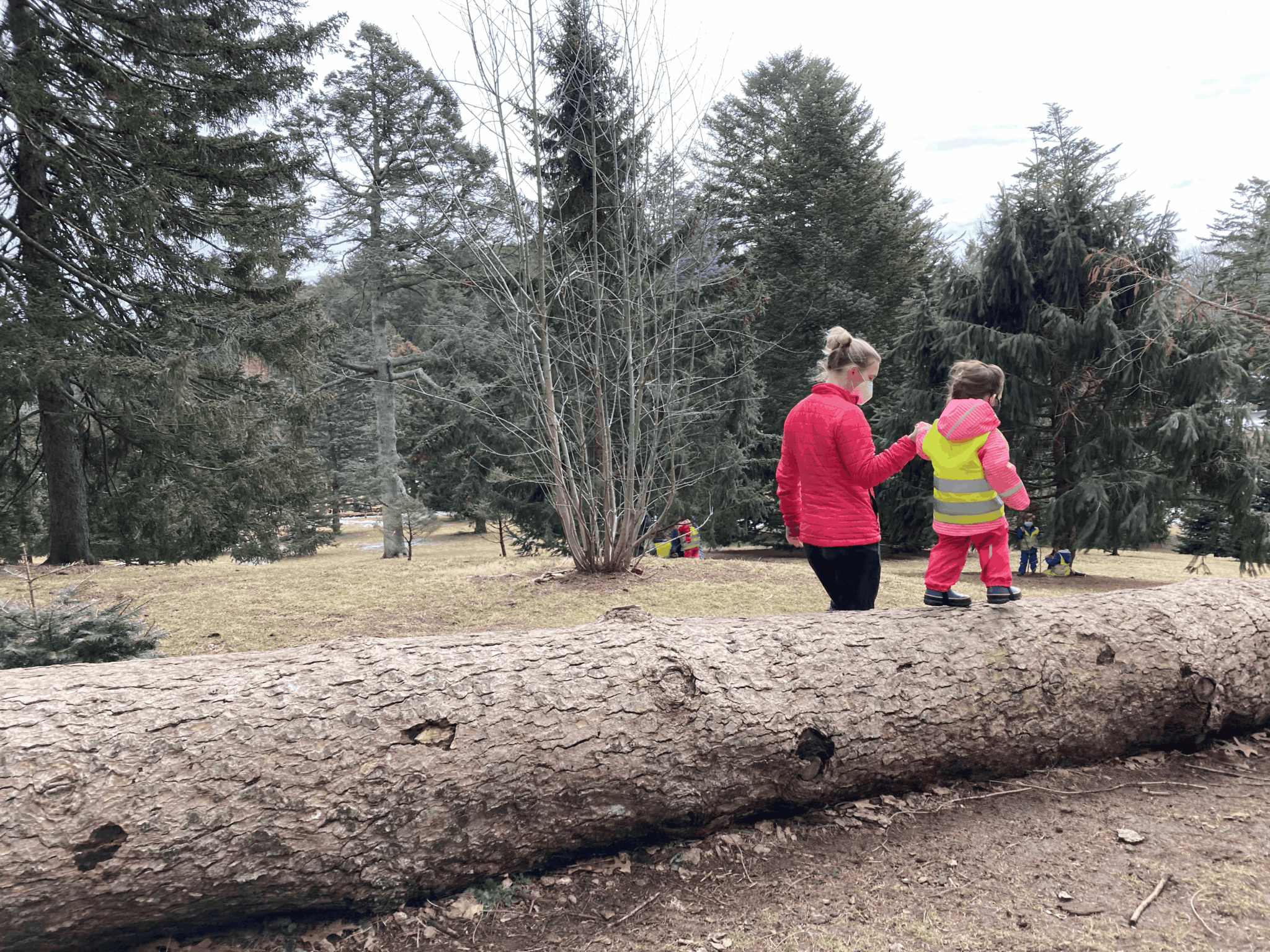
I am an early childhood behavior specialist for parents, caregivers, and educators. I am also a cofounder, Toddler Connections leader, and teacher coach at Boston Outdoor Preschool Network (BOPN).
I like to show people that the right kind of “peaceful parenting” actually works. I help the grown-ups of young children implement Montessori-inspired, connection-based strategies so they can raise kind, cooperative, respectful, responsible, happy, and helpful children.
For my entire career (almost 30 years!), I have worked with young children in a variety of settings. After earning my Bachelor’s and Master’s degrees in Education, I worked in public elementary schools for five years. I loved the children I taught but never felt completely settled. A few years later I was introduced to the Montessori Philosophy. I fell in love and never looked back. I earned my Montessori certification and taught 3-6 year olds for fiver years at Montessori schools in the Boston area.
My son was a toddler as I began my Montessori training and was the perfect age for me to see theory in action at home as well as in school. Maria Montessori’s explanation of a young child’s key developmental stages and behavioral motivations CLICKED – in my heart and in my brain – and allowed me to see my child and his actions in a whole new light. The Montessori approach has a deep respect for children and childhood, and there are high expectations for children and the adults who guide them. Incorporating the best parts of the Montessori philosophy into my parenting changed my life.
A few years later, I taught 1st Grade at a small independent school. I loved my job, and I discovered that many of the best parts of the Montessori philosophy transferred extremely well to a “traditional” school setting. The anchoring beliefs and behavior guidance strategies helped create a peaceful, loving, and fun environment where children thrived.
While teaching 1st grade, I read an article about Forest Kindergartens – an idea popular in parts of Europe and just starting to gain steam in the US – where children spent ALL or MOST of their school day outside. I devoured books, articles, lectures, and workshops on the topic and soon realized this type of education this was the right path for me. I loved my job, but the more I learned about nature education, the more I felt the pull to make a change.
In 2019, together with co-founders Sarah Besse and Shela Sinelien, we launched Boston Outdoor Preschool Network (BOPN) to connect Boston area children with meaningful opportunities for learning, play, and connection in nature.
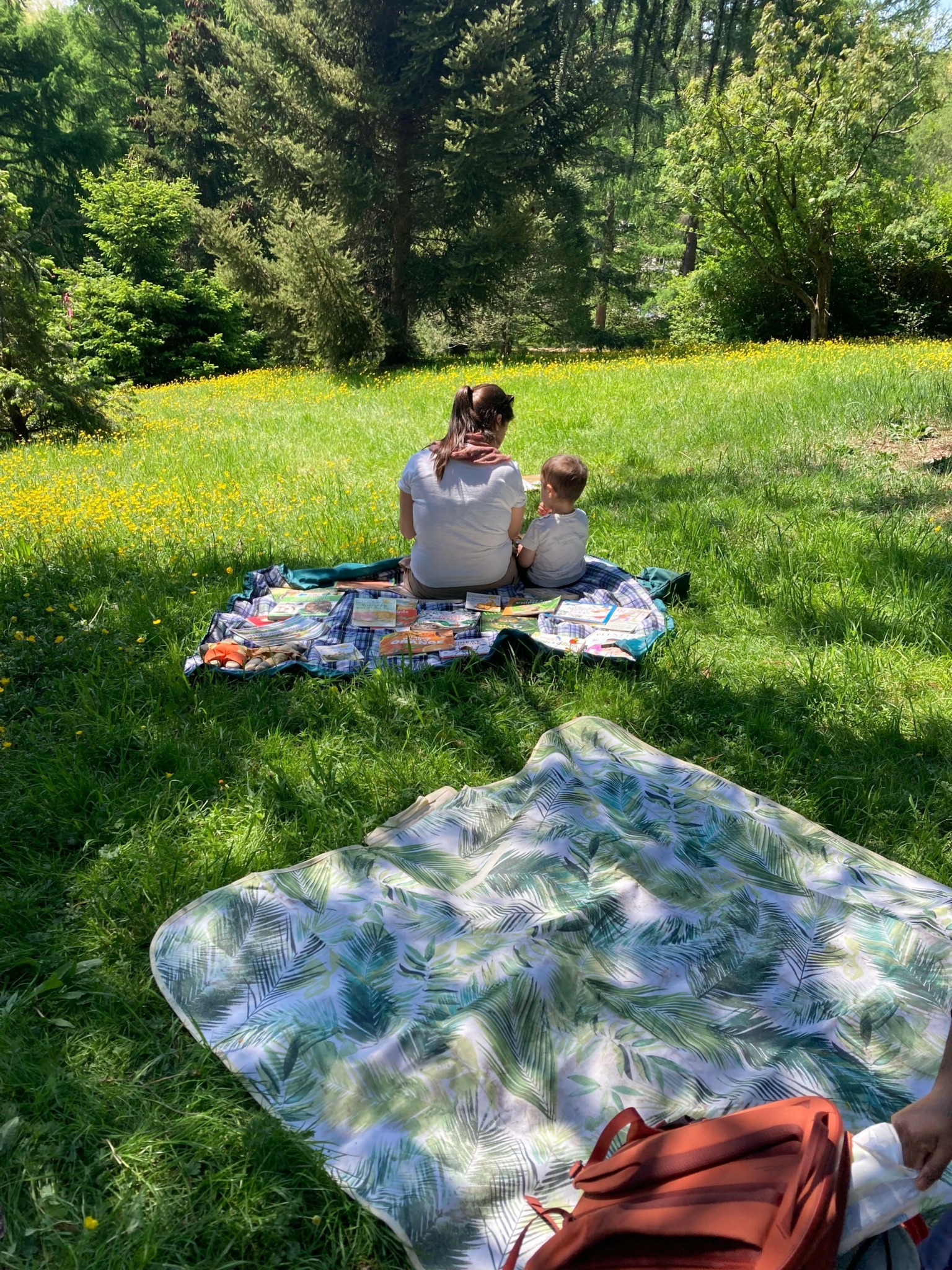
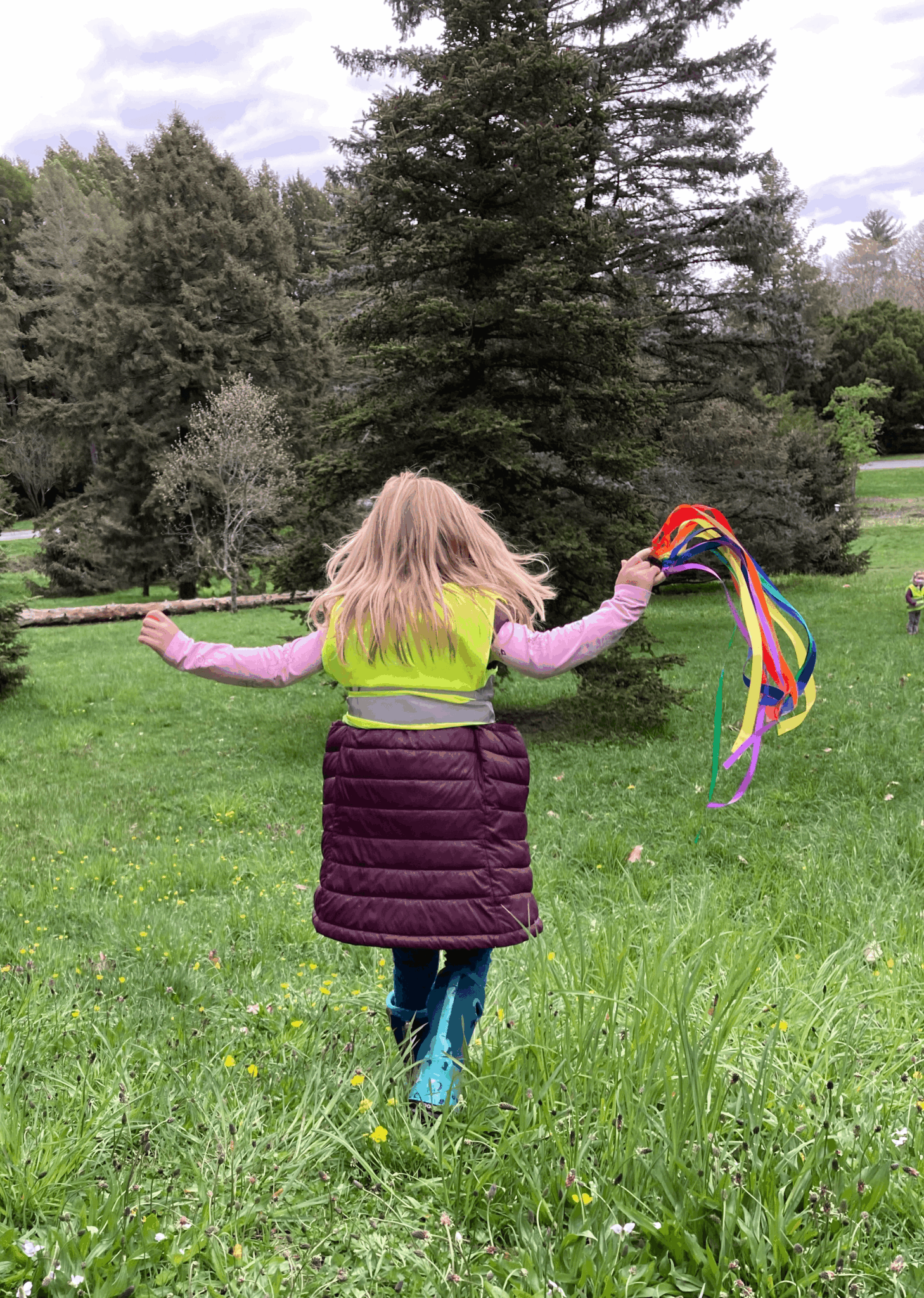
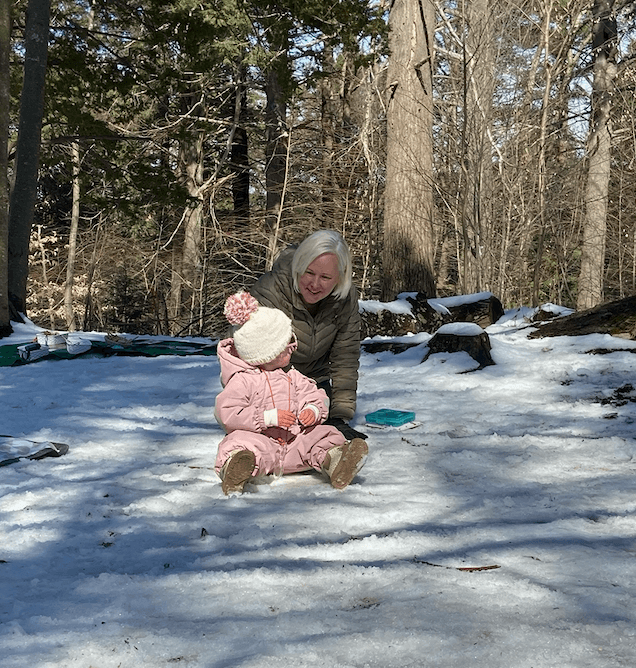
When we first started BOPN, I taught the half day preschool class with my colleague, Sarah. I loved spending the morning in nature with our mixed age 3-6 year old preschool class. Our half day program is outside for the whole 3 hour morning – yes, even in winter! I loved teaching that first BOPN class and still have many, many fond memories from our earliest BOPN days.
Sarah also had a Montessori background, so we had a kind of shorthand to describe behavior and communication about the children. So many of the elements from the Montessori philosophy worked well in our outdoor setting.
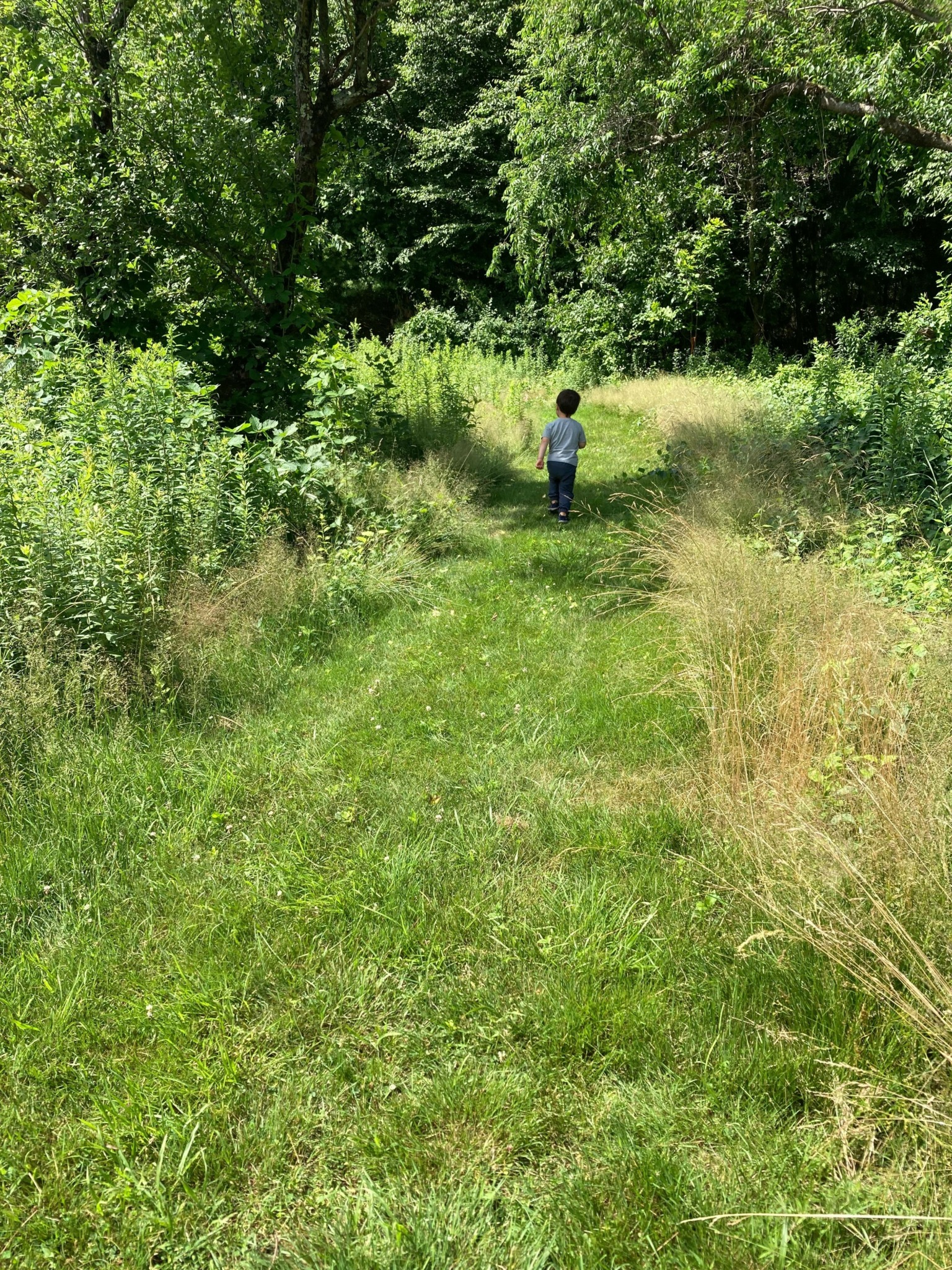
A few years ago, we decided to add a weekly caregiver-and-child class for toddlers. Toddler Connections is a chance for children aged 16 months – 2.9 to spend time playing and exploring in nature with their grown-up.
I was asked to teach the Toddler Connections class, and while it was hard for me to stop teaching preschool, I love what we have created for the youngest members of our BOPN community.
Almost three years in, we have an excellent routine and rhythm for our mornings together. We gather for short, simple, and predictable circle times at the beginning and at the end of our time together, and the majority of class time is a chance for toddlers, supported by their parent or caregiver, to play, explore, and connect with nature.
The rhythm to our morning is inspired by the Montessori idea of the “prepared environment”. This is the idea that the environment is set up for the children who then have the freedom and autonomy to choose their own learning and experiences within the safety of the guidelines set by the adults.
Throughout my time at BOPN, I have had many meaningful discussions with teachers and parents about behavior guidance and child development through a Montessori lens. I visit BOPN classes, talk with parents during Toddler Connections, host virtual webinars, and I have presented workshops at nature conferences.
About a year ago, I decided to open my own coaching business, Balanced Beginnings Behavior Guidance, to more formally share my Montessori-inspired behavior guidance approach. I chose the name Balanced Beginnings, because I think too often people feel like you have to be one or the other. People often confuse “gentle” parenting with permissive parenting, and I love to talk about all of the ways you can have it all. You can raise kind, cooperative, respectful, responsible, happy, helpful children using connection-based, not control or fear-based, strategies.
I offer 1:1 virtual coaching, in-person or virtual workshops for your organization, and I am putting the finishing touches on the Balanced Beginnings Parenting Plan. This self-paced, online course draws from my experience blending the best aspects of the Montessori philosophy with the benefits of child-directed play in nature. The Parenting Plan is packed with connection-based strategies that make peaceful parenting not just possible, but truly effective.
A great place to start is my “Four Fabulous Phrases” freebie. If you visit my website at saraQmurray.com you can access a pdf of the phrases and join my mailing list. I share Montessori-inspired behavior strategies and updates on when the Balanced Beginnings Parenting Plan will be ready to launch. Or follow me on Instagram at Balanced_BeginningsBG.
Learning and unlearning are both critical parts of growth – can you share a story of a time when you had to unlearn a lesson?
I once heard the expression, “It’s nobody’s business what other people think of you.” As a lifelong people-pleaser, this statement initially confused, unsettled, and even angered me a bit. But as I’ve grown older, I’ve come to understand—and even agree with—the sentiment behind it, at least to some extent.
When I first started my business, I was scattered, trying to please everyone. I kept telling myself, “I can do this, I can do that, I can help EVERYONE.” But gradually, the advice to “niche down” and identify my target audience began to resonate. Now, when faced with any (so far, imaginary) criticism of my approach, I simply think, “Well, I guess they’re not my ideal client then.”
While it’s crucial to take feedback and suggestions seriously to grow as a professional, it’s equally important to focus on what people are actually saying, rather than what you imagine they might be thinking or feeling.
II had an experience many years ago that still helps me recenter whenever I start to jump to conclusions or make assumptions about others.
Years ago, after I had “left teaching” and before I had discovered Montessori, I considered becoming a Unitarian Universalist minister. There is actually a lot of overlap with Unitarian Universalism and the Montessori philosophy – Things like the focus on the whole person or child, the interconnectedness of all beings, and emphasis on personal responsibility for learning and growth.
Despite not being raised in the UU tradition, once introduced, I felt an immediate connection –much like I did when I was introduced to the Montessori Philosophy. I decided to take a class at a local theology school as a tentative first step towards becoming a minster.
At orientation weekend, I was there with many other new students from a variety of faiths. Like many new converts, I was brimming with enthusiasm at times, over the top exuberance. Throughout the weekend I was confidently outspoken about my beliefs, and at least once or twice I was in lively discussions and debates. I don’t think everyone necessarily appreciated my confident outspokenness, and there was one man in particular who seemed to bristle when I spoke.
The orientation weekend was profound and meaningful for me. At one point there was a chance for us to walk a labyrinth in silent reflection. I had walked a few turf mazes during my semester abroad in England, but I don’t think I had ever walked a labyrinth. Unlike the intricate twists of a maze, a labyrinth offers a single path, symbolizing the concept of a singular true path in the religious sense. All of the weaving in and out and around suddenly leads you to the center. I walked along in silence, making my way along the bends and curves. When I arrived at the center, I was unexpectedly overcome with emotion. I don’t actually know what made me so overwhelmed, but I fell to my knees and sobbed into my hands. A few people nearby came came closer and stood by me and one or two women put their hand on my shoulder. Rule followers we all were, nobody spoke. After a few moments, I got up and wiped off my face. As I started traveling back out of the labyrinth I saw Mr. Bristle-y. I felt self conscious and judged when I saw him looking at me.
The rest of the weekend passed without any more emotional outbursts on my part. During one of the closing exercises people were invited to share meaningful moments from the weekend. Mr. Bristly raised his hand, and as he was about speak, he looked in my direction. I froze, my stomach flip-flopped, and I started to feel defensive about whatever I imagined he was going to say about me and my outspokenness.
What he actually said was how moved he was by my reaction at the center of the labyrinth. He said watching me have that experience was one of the most meaningful moments of the weekend for him. I. Was. Floored. I had NO idea that was how he felt. I was sure he didn’t like me very much. But that just wasn’t true. If he hadn’t shared that story at the end of the weekend, I would have left the orientation feeling negatively judged by him, and I would have been so wrong.
I remind myself of this story whenever I feel nervous or self-conscious about someone’s (perceived) opinion of me or my work. I remind myself that not everyone will love what I do, and that’s okay. And it’s important not to jump to conclusions or make assumptions based solely on my observations and perspective.


We’d love to hear about how you met your business partner.
I loved my job teaching first grade, but the more I learned about forest kindergartens and nature preschools, the more I felt I needed to make a change. I had spent a summer working at a nature-based summer camp in the area, and I had started a “Forest Explorers” after school program at my school. Several years ago, nature-based education was just gaining steam in the United States, and there weren’t many programs in my area. But I knew I needed to close this first grade chapter to allow space for the new nature-based adventure I was hoping to have.
I quit my job without a new job lined up. I’d done this once before and knew I could fall back on nannying again if needed. Luckily I had the emotional support and health insurance of my husband, and I appreciate how fortunate I was to have both.
It was a busy spring and end of school year time. Portfolio exhibitions, closing ceremonies, report cards, etc filled my time, and I knew that job searching would have to wait for now. I had done a few online searches, but nothing had been advertised. I did have a summer job lined up at at local farm’s summer camp, and I was excited to jump into the nature-based school experience again, even if it was just for the summer.
The school year ended on a Friday, and we had a busy weekend ahead of us. My dear friend had had a baby, and we were zipping down to Maryland to meet the baby. It was my niece’s birthday, and we were traveling from baby-visiting in Maryland to upstate New York for a family visit and her party. We had also said goodbye to two of our beloved old kitties that spring and were eager to add new kittens to the family. My sister knew someone with 8 weeks old kittens ready for their new home. We were scooping up the kittens on that same trip, all in time for us all to be back at work and camp that Monday.
In the whirlwind of the weekend, a family member mentioned my casual approach to job hunting. They said, “You don’t seem to be freaking out that you don’t have a job. We’re all freaking out that you don’t have a job, but you don’t seem to be.” Ok, well, I was now!!
On that Monday afternoon we got back from our weekend of babies, kittens, and birthdays, I did another online search for nature preschool jobs in my area. This time, one popped up!! An ad for a founding preschool teacher in Waldorf Today (online) magazine seemed like a great fit. I answered the ad, sent in my resume and cover letter and later that day got a response. We arranged to meet the next day, and by the end of the week I had a job.
I had met my cofounders Sarah and Shela, and we launched Boston Outdoor Preschool Network (BOPN) that September.
Contact Info:
- Website: https://saraqmurray.com
- Instagram: balanced_beginningsbg
- Facebook: https://www.facebook.com/profile.php?id=100095373350810
- Linkedin: https://www.linkedin.com/company/balanced-beginnings-behavior-guidance