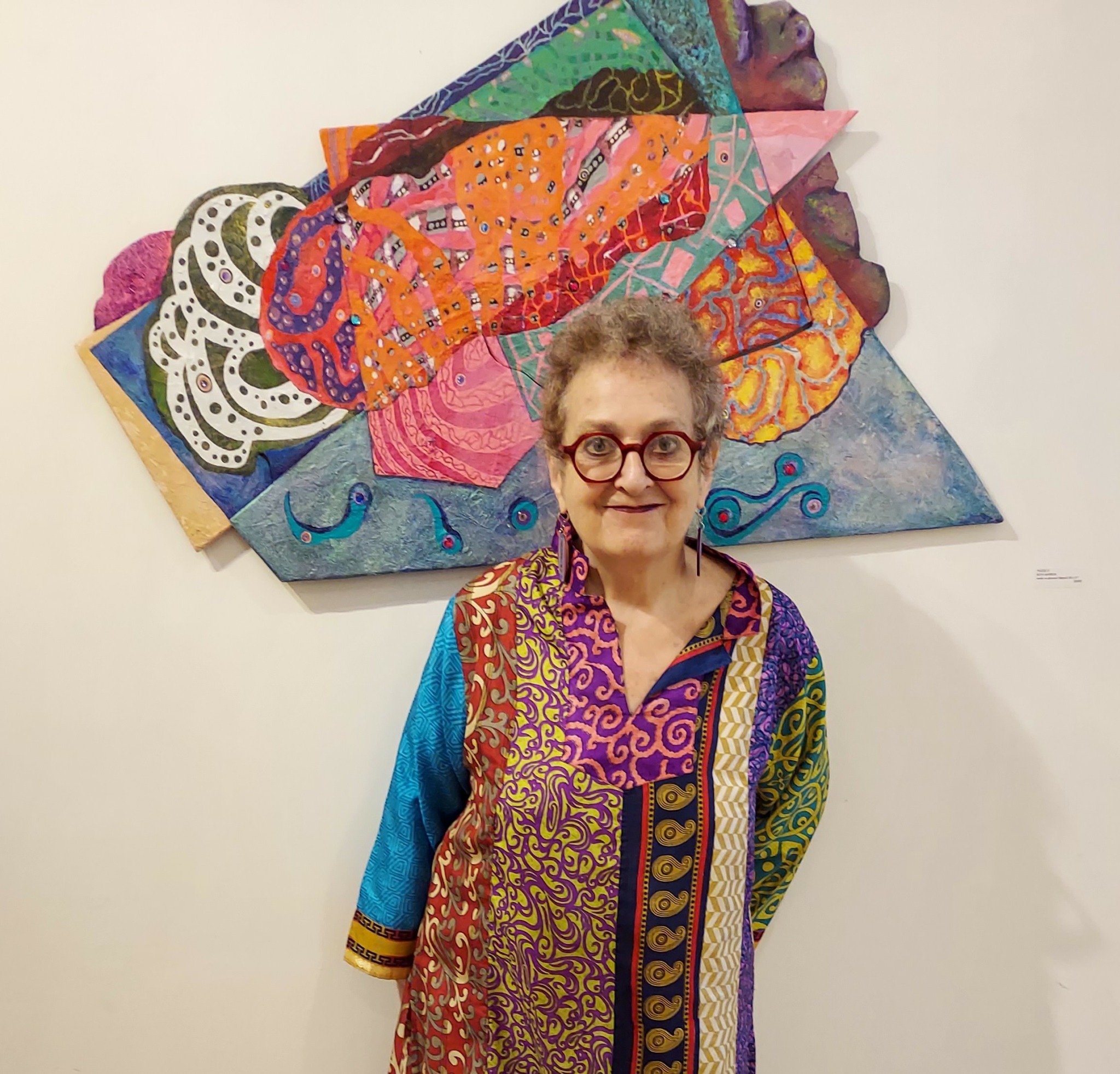

We caught up with the brilliant and insightful Ruth Antrich a few weeks ago and have shared our conversation below.
Alright, Ruth thanks for taking the time to share your stories and insights with us today. If you could go back in time do you wish you had started your creative career sooner or later?
The environment I grew up in strongly affected the trajectory of my life as an artist. Although I had some rebel in me (a quality essential to be an artist) I was mostly rather shy and somewhat ignorant of any possibilities other than becoming a nurse or a hairdresser. It wasn’t until I was in my late 20s – I am now 76 – that I broke my own mold. As far as pursuing a career as an artist and how it evolved. It is not realistic to dwell for long on the what-ifs, because there is no way to change the past. But if this interview helps someone make the choice to pursue a life of making art/music, then it is good to reflect upon my own origins and rationale and reminisce a bit. Growing up in 1950s England, girls were expected to become homemakers – at least in my circle. Although creativity was encouraged, it was for self-entertainment or as a hobby, whether it was drawing, painting or playing the piano. My older brother and I were sent to museums almost every weekend as kids. I think I almost overdosed on art, and it nearly killed all my interest in it. I was in New York almost ten years before I could bear to go into a museum of any kind. In addition, it was only comparatively recently that I learned that women were very much involved in electronic music engineering and composition.
I was very uncomfortable in secondary school (US equivalent of high school) – my mind kept wandering and I was failing academically as well as socially. I took the first opportunity to leave – at the age of 16. I began working in an office, where they taught me secretarial skills and gave me experience, and eventually I was a hotshot secretary. I loved being good at it, and the money I earned. Most of my contemporaries were in school, so I was way ahead of them economically.
My only other motivation in life was to explore the world – or rather, I desperately wanted to get as far away from London as I possibly could, and in 1974 I came to the USA as a tourist.
After travelling around the USA for a year and a half, I settled in NYC having managed to get a secretarial job at the United Nations. I found a large apartment on the Upper West Side of Manhattan which I occupy to this day.
At first, I didn’t want to hang anything on my apartment walls except original artwork. Since I could not afford to purchase any, I had the brainwave to create some! But then, I realized I had no idea how to create the kind of art I would want on my walls so the walls remained blank for years!
Meanwhile, I managed to get sponsored for a Green Card and left the UN in 1978. After a while, I left the company that sponsored me as they were going out of business, and I began working as a temp. I thoroughly enjoyed the freedom to work as much or as little as I wanted. Capitalizing on my British accent to the fullest, and with my super strong admin skills these abilities stood me in good stead.
I had never wanted to go to college until the idea was presented to me — I’ll talk about how that happened, later. I was a bit intimidated about the academic aspect of higher education, but this all changed when I decided to go to art school. Eventually, I wanted to know how to make the objects I had been seeing around me at museums and galleries during my early life in the UK. I wanted to understand it, get inside it. And at the age of 32, I was fortunate enough to be accepted at Parsons School of Design (The New School). I had to begin as a freshman, along with high-school leavers. However, life-experience bolstered my time as a full-time student.
I did have notions of what an artwork was supposed to look like, and I decided to give up those notions. It was a battle. Gradually, I found my “voice”, my marks became my own, and the ideas came flowing and have not stopped. The most important lesson was the one I taught myself – that self-criticism can be a killer of the artistic spirit, unless you use it to propel you forward.
In so many ways, I am stoic about how things turned out for me. Life presented itself the way it did, and I made all the choices to have the best possible life given my understanding as life came at me.
Things could have turned out a million different ways, and one could imagine any scenario. However, taking one step at a time, I built an extraordinary life — now I create, exhibit, and sell my work on a steady basis.
I studied classical piano as a child, and in the 1980s I acquired an Apple Mac and midi capable Casio keyboard. I composed music some of which was presented on video soundtracks. I continue to compose music and have performed live. Writing music for animation is particularly enjoyable and I am currently collaborating with animators on several projects
Although I didn’t have much confidence in myself or my creativity early on, I am now unstoppable! This is a great mindset to be in, especially because this is where I am right now.
As always, we appreciate you sharing your insights and we’ve got a few more questions for you, but before we get to all of that can you take a minute to introduce yourself and give our readers some of your back background and context?
What I do now is shaped by what I used to do. As children, my older brother and I grew up in a musical home. My parents had met each other singing Gilbert & Sullivan opera. We learned piano and we were both very musical. We had a good ear for harmony, frequently breaking out into four part harmony at the drop of a hat. I thought music might be my future, however I was very stubborn about not learning to read music. Academics were very difficult, and I had no desire to challenge myself. I had found it easy to earn a very good living with top level secretarial skills. However, I was a big dreamer. I wanted to work at the BBC – but I never made any inquiries about doing so. I wanted to be a recording engineer, or foley artist, but never took any steps to find out how to become any of those things. I truly thought that dreams were supposed to be just dreams. I never imagined that one could make dreams come true. All I needed was to ask questions and take some action. It wasn’t until I arrived in the USA in 1974 that I began to believe that here, anything is possible. The constraints of the British mindset (that I was exposed to at the time) could be put aside. I found myself volunteering at the WBAI radio station, writing promotional announcements and learning recording engineering and tape editing. I did not have a work visa at the time – having secured a job at the United Nations, so I did not pursue any other employment options. And then, while volunteering somewhere else, a manager offered me a job as a secretary in his company and ultimately they sponsored me for a Green Card. It all worked out and I was able to leave the UN.
About a year later, I commissioned an artist acquaintance to paint my portrait – it was going to be a gift for my father. My visits to this artist’s studio were exhilarating – the mess, the freedom of expression, and it inspired me to consider taking up painting; to finally maybe put art on my own walls where no prints or photos had been allowed. I had no idea where to start, and the kind artist encouraged me to make an attempt at painting on canvas. It was very intimidating, and somewhat confusing. However, the challenge made me realize that I really wanted to know how to paint. My artist friend personally introduced me to the Chairman of Parsons School of Design who suggested I take a summer life drawing class; come up with the prescribed entry portfolio and the school fees, and apply. I did these tasks in quick succession and I sailed through the application procedure, and began as a full-time student at Parsons along with the “children” who had just graduated high school! I had more in common with the professors than the students, but the struggle was mostly to continue to come up with the fees and get to class on time. I often worked nights and weekends and my sleep suffered a lot.
I managed to get through two full years and then got totally sidetracked by falling in love with another artist whom I met while travelling, Ultimately I married him. My husband was quite well established as a book artist (he made one-of-a-kind books) which had an influence on my work. Some of the large “room divider pieces” were a development of the book art ideas I had explored at one time.
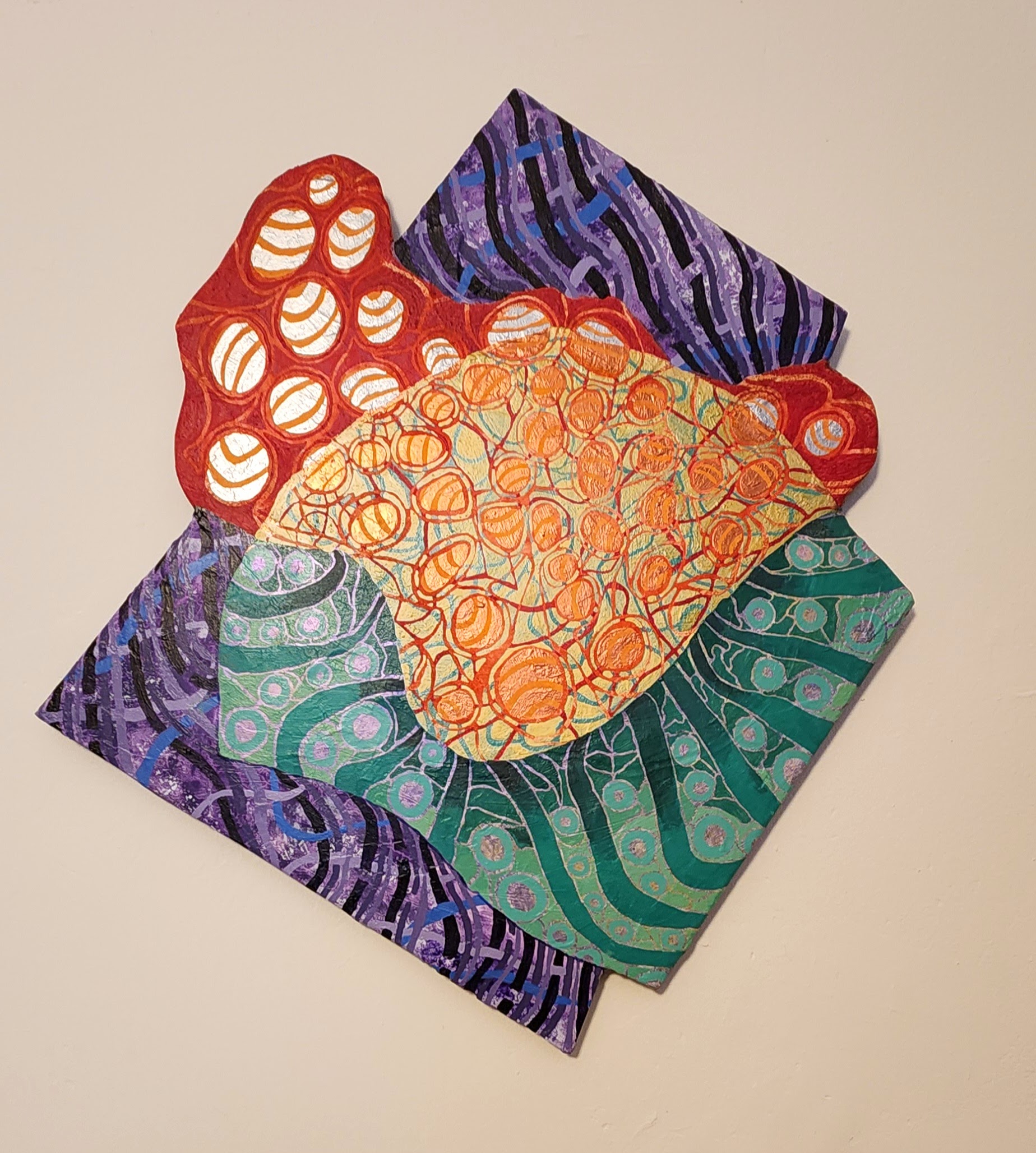
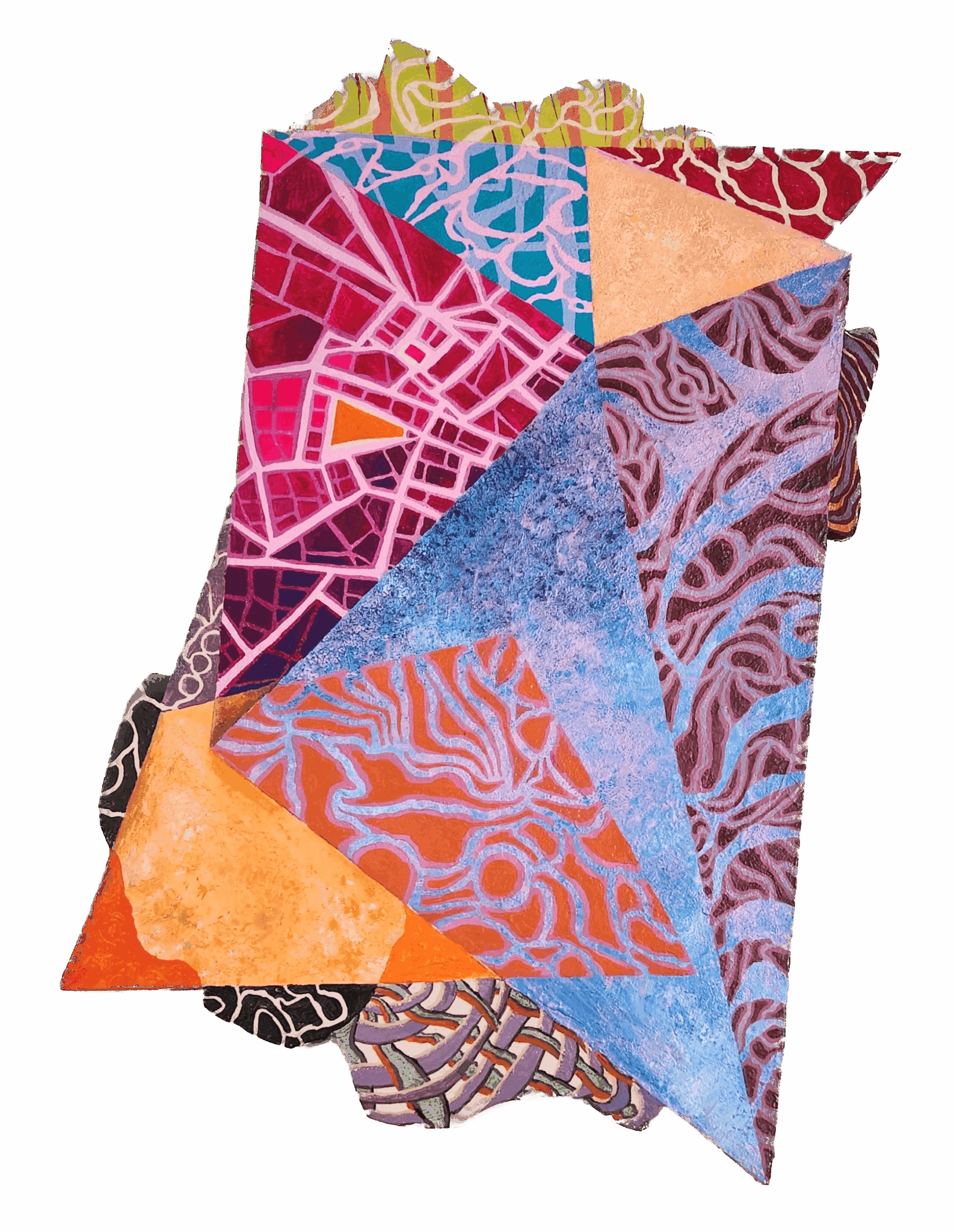
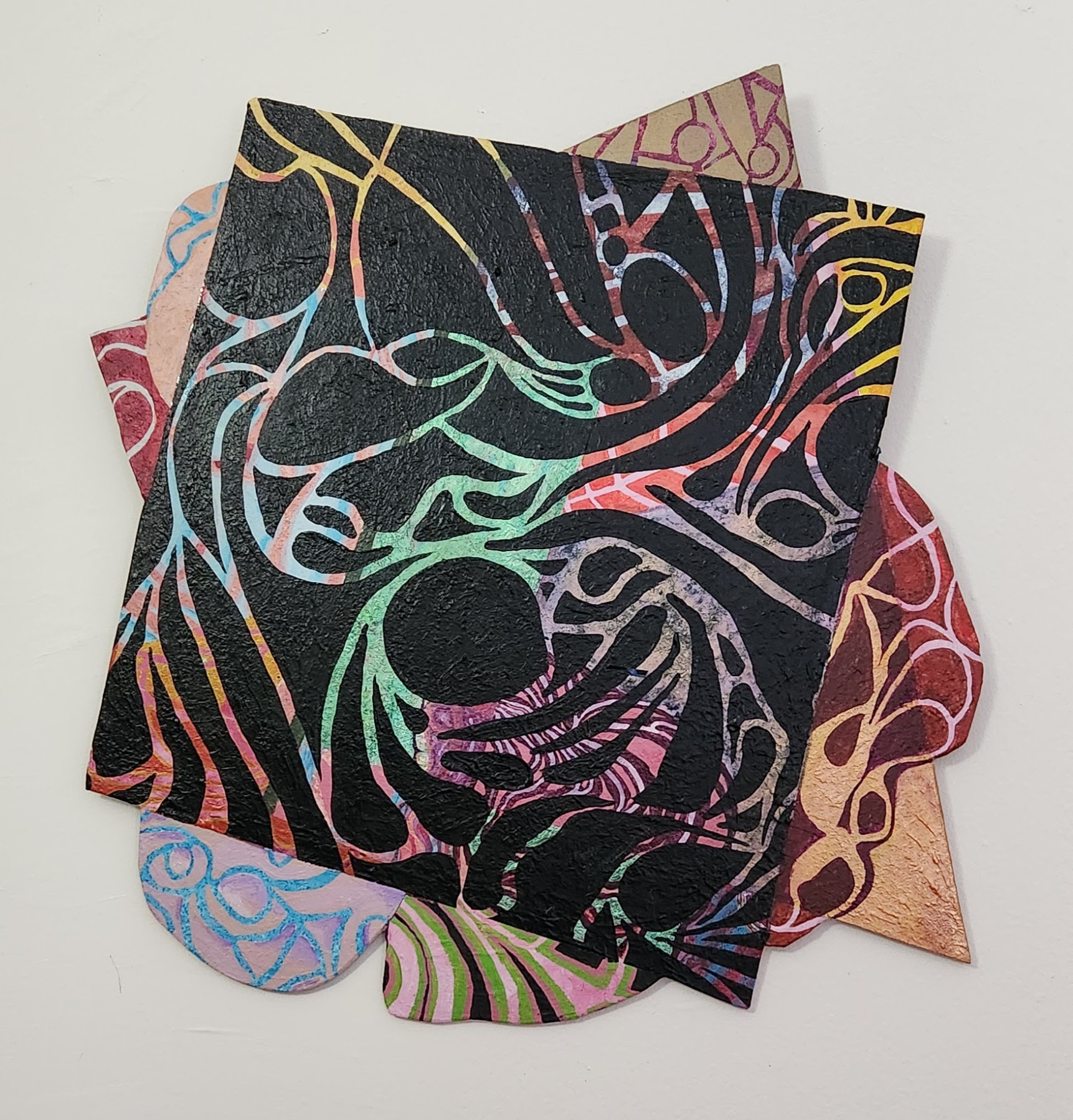
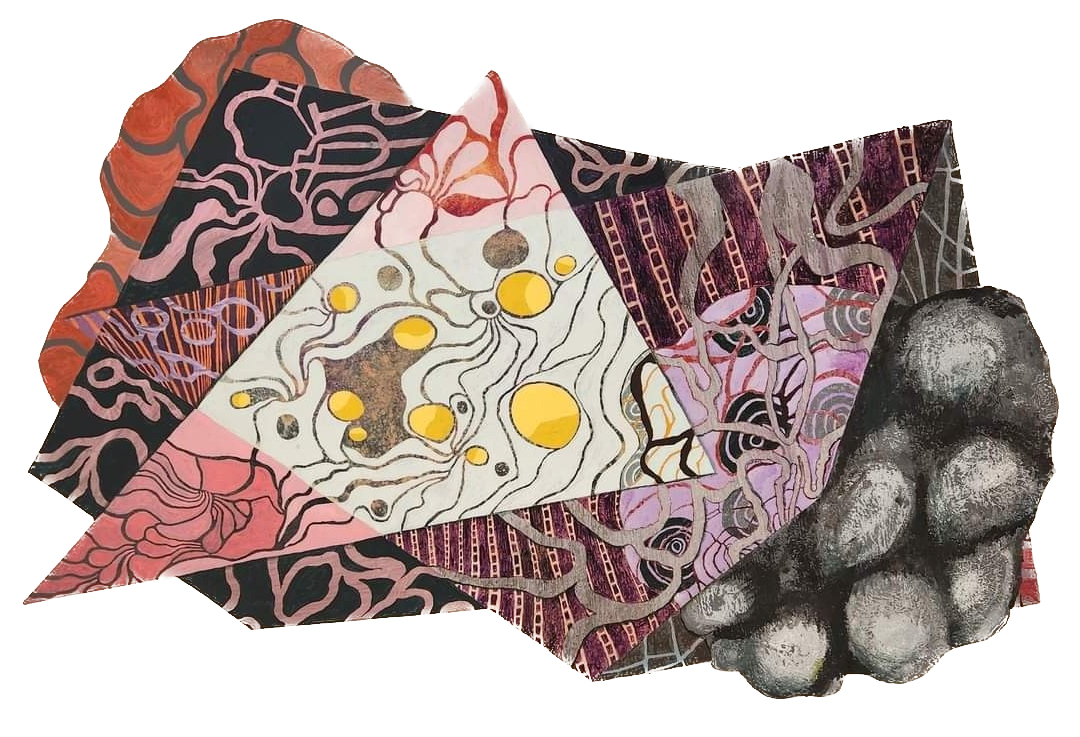
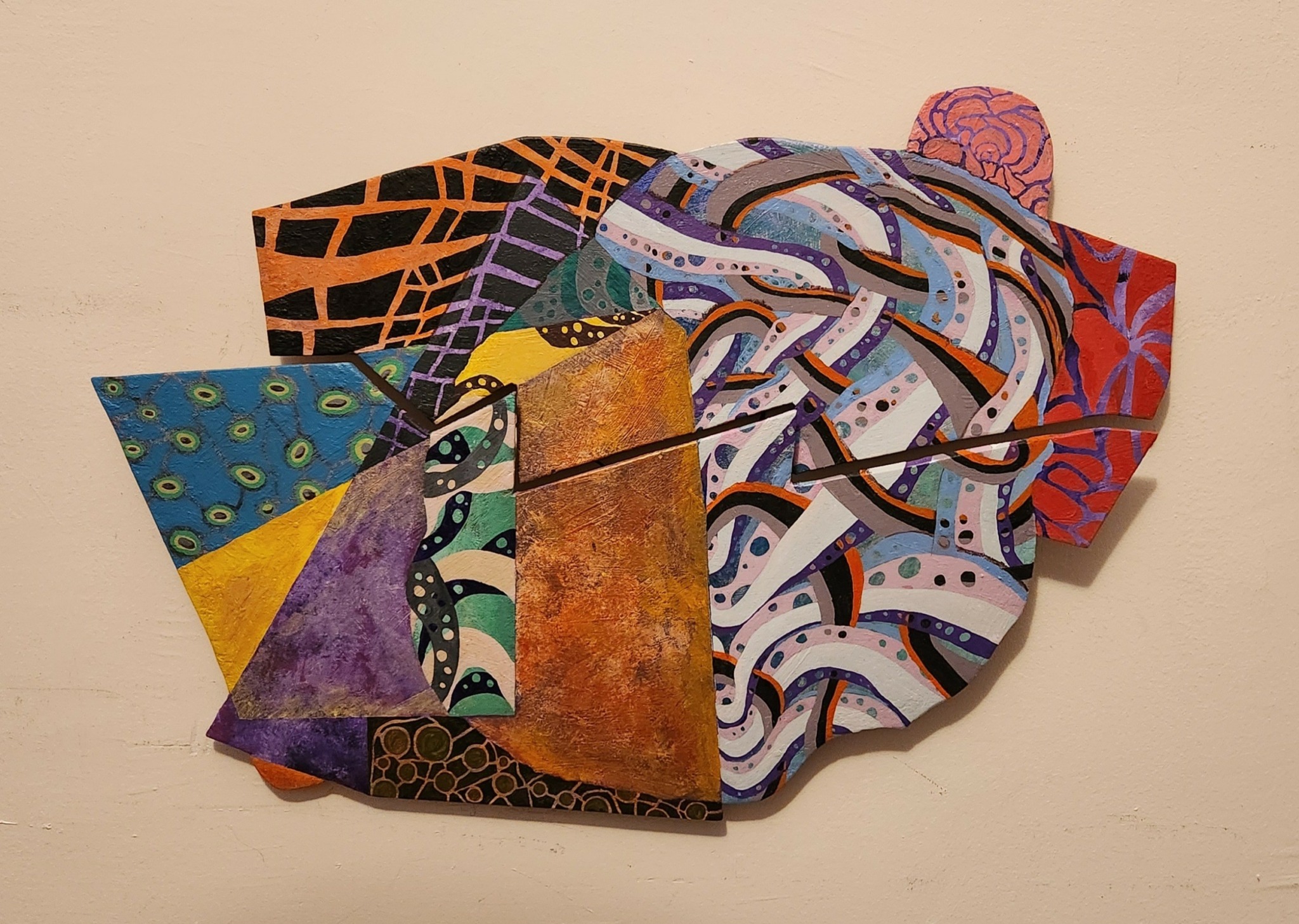
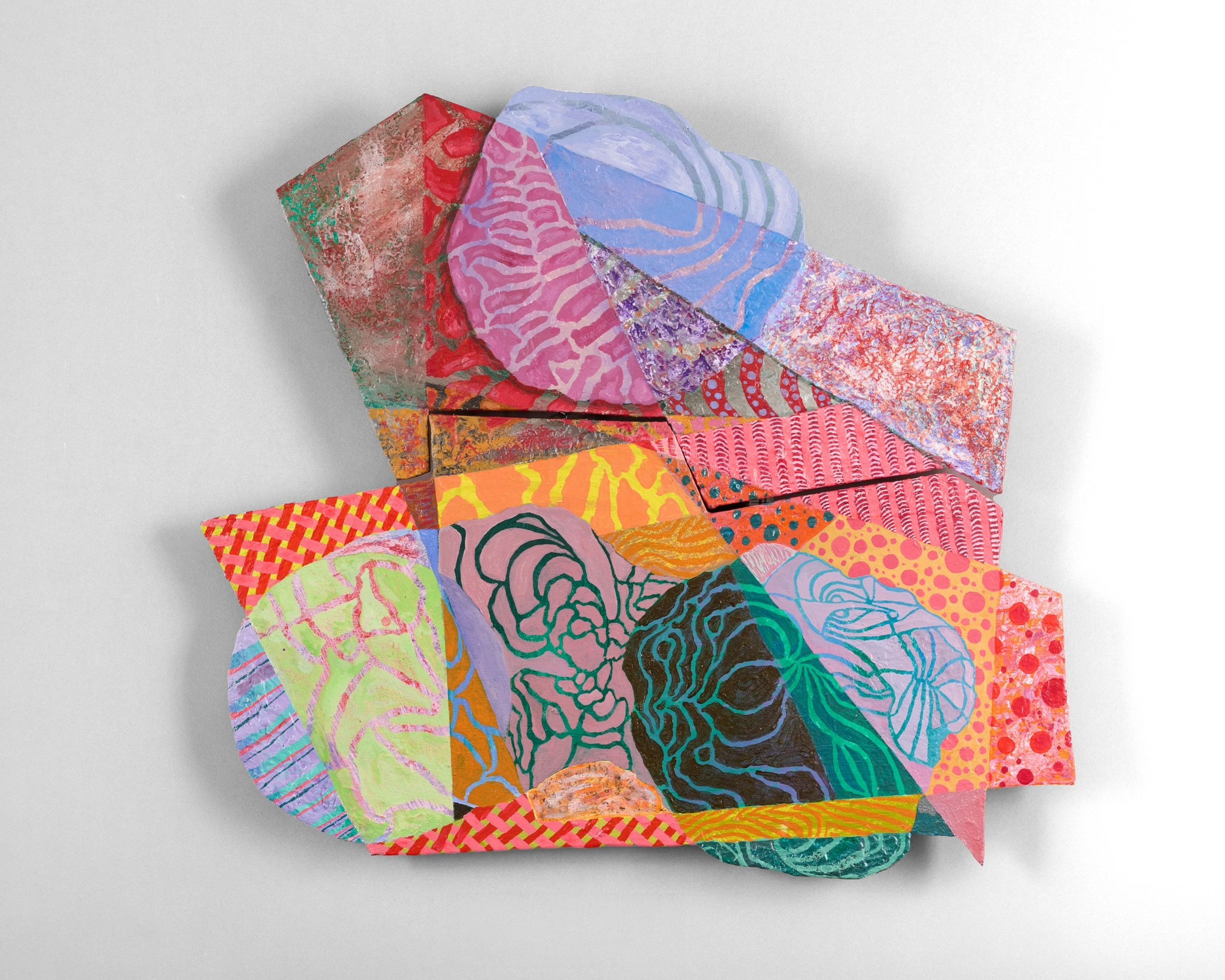
It was and still is important to me that my painting style would be completely non-objective. I enjoy building textures, patterns and colours on rigid formats that resemble nothing recognizable (to me). The term “abstract art” (taking what you see and adapting it) is not what I do, although over time, the meaning and usage of the term seems to have changed.
I create what is on the surface, in the moment. It is what evolves based on aesthetic and practical decisions. It has no meaning or objective or story. I set up parameters, regions within which I experiment, before moving on to an adjacent area on the piece. What I create sometimes looks appealing to me as I start adding wet layers of paint that mottle and muddle and puddle together, and sometimes it does not appeal to me after it dries. And sometimes it is glorious. In any case, I paint over it, while leaving channels unpainted to show through. I keep building up layers in this fashion. Sometimes the result is beautiful to me, and I love the mottled marbled region, and then I may force myself to paint over those areas. Sometimes I don’t completely paint over those areas. Making decisions is often tough!
I tend to be impatient when I’m painting and therefore I use acrylic paint because it dries quickly. It’s ready for another layer in a few minutes.
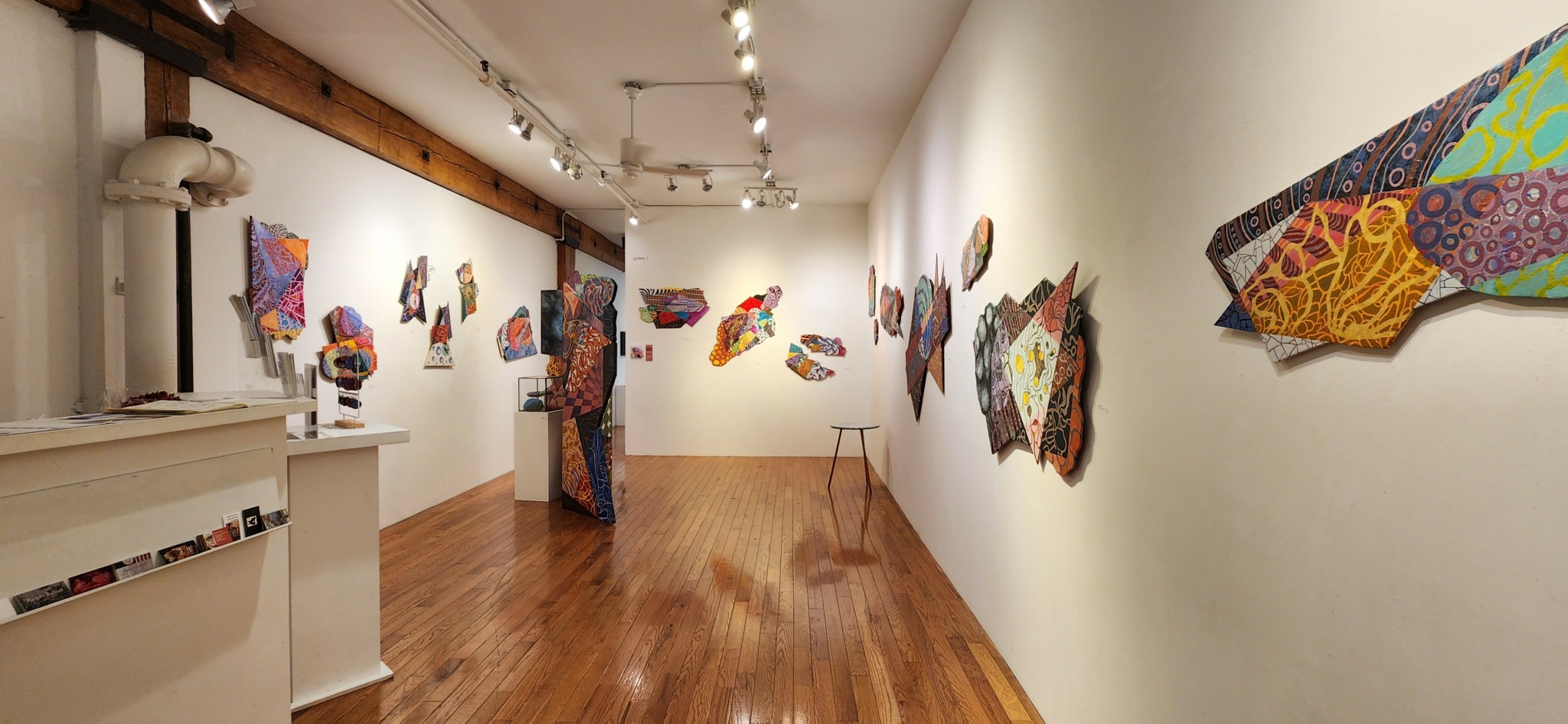
In the early 1980s I broke out of the rectangular restrictions of the stretched canvas, and began working on rigid surfaces. I discovered Masonite – also known generically as hardboard. It stays flat, and claims to be archival and I can cut it into any shape I desire. At first I explored cutting the works with a geometric outline. These shapes dictated the regions which would then appear to crisscross and seemingly overlap each other. A transparency effect was something I learned about in art school and this became a feature that I enjoy playing around with. I had also learned the technique of building up surfaces using modelling paste before I start painting. Its texture is reminiscent of a rock’s surface. I also have experimented making large papier maché “rocks”. I love painting on rocks, but they’re too heavy to cart around! And then eventually my pieces broke out into a combination of organic and geometric shapes. When I think of artistic breakthroughs, I remind myself of how ancient Greek sculptures were of people standing stiffly with their feet together, and then, over time, the sculptors discovered separating the feet into walking poses. A breakthrough indeed!
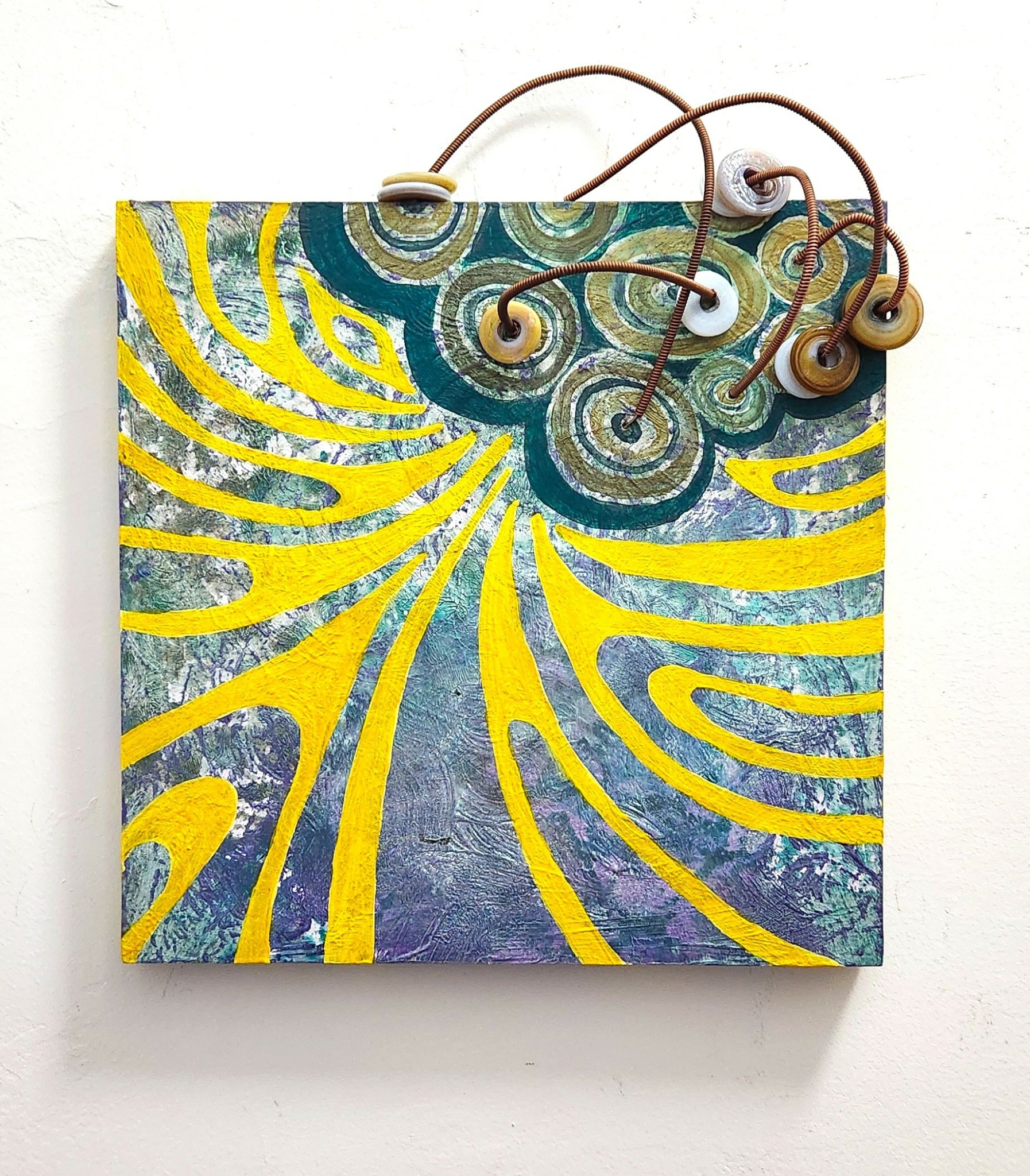
In the past few years, I have been affected by the concept of repurposing, recycling and incorporating found materials. Having collected all kinds of objects, especially beads, from dozens of countries I’ve visited, I often include them in my work. Broken jewelry, beads and even the innards of my piano that I recently disassembled one piece at a time have become additions. After recently acquiring a supply of square panels and not being accustomed to working in a square or even rectangular format, I have been using these additional elements and materials, to break out of the box.
Is there something you think non-creatives will struggle to understand about your journey as a creative? Maybe you can provide some insight – you never know who might benefit from the enlightenment.
I think everyone is naturally creative, right from the beginning of childhood. Depending on our personality and circumstances, we sometimes allow criticism and self-doubt to thwart our spirit and look elsewhere for our interests and career paths. We are pure mark-makers as children, and others will say something that may hurt our feelings and that may be the end of art as a form of expression. People who consider themselves to be non-creative appreciate creativity within the framework of what they understand. The conversation a person has with themselves when they see art is complex. I have given workshops on creativity that sufficiently proved to me that anyone can set aside their preconceived notions of what art is, and bring out their ability and talent if they’re willing to give it a go. It’s a matter of just accepting the marks we make, just as they are.
What do you think is the goal or mission that drives your creative journey?
There is a continuity to be found in my work since I began painting in the 1980s. It’s about the exploration of layering paint on rigid surfaces, leaving channels of previous layers showing through. I develop each piece as though there is a conversation going on from one area to another; the mission is to have each piece be like a fragment of nature – with no story and no meaning and its only purpose is to perhaps intrigue and entertain. Also, being a collector of artifacts, especially beads from world travels, I often include them and other materials, such as rhinestones, into my work. My process is a sort of conversational meditation with no locked-in goal. How a piece finishes is usually completely surprising to me. It also may be a tussle and a self-debate as I proceed. I generally work on several pieces at a time, but I will get there, wherever that is, in the end.
Two years ago I joined a cooperative art gallery in NYC (Pictor Gallery 547 West 27th St. 2nd Floor, NYC). Every 18 months or so the gallery presents a solo exhibition of my work. I also exhibit in group shows at Pictor and elsewhere during the year. My next solo show is in April 2026 and as of right now (summer 2025) I am completing the Beadsquare series and building up a new body of work using the innards from a piano I disassembled this summer. That project also will involve a piece of music that includes sounds from the piano.
Contact Info:
- Website: www.ruthantrich.com
- Instagram: ruth.nyc
- Facebook: https://www.facebook.com/RuthNYC
- SoundCloud: https://soundcloud.com/ruthnyc