



We caught up with the brilliant and insightful Rome Harris a few weeks ago and have shared our conversation below.
Hi Rome, thanks for joining us today. How did you come up with the idea for your business?
I founded Coachable AI in 2019, while enrolled in the entrepreneurship minor at UCLA, however, the origins of the company are much earlier.
My mom was an educator for over 20 years, teaching at both public and private schools, going on to open her own school of photography and modeling. One school in particular that she taught at stood out to her, and she decided that if she ever had a son he would attend there. It was a premier, private, all-boys, leadership, military academy called San Antonio Academy (SAA). The school’s motto was, “Be Honest. Be Kind. Be the Best you can Be”. While my mom was still pregnant with me, the head of admissions recalled my mom’s interest and reached out to ask if she had enrolled me on the waiting list. My mom replied that I hadn’t even been born yet, to which the admissions director told her the waiting list was that long, so she enrolled me, and I would eventually attend from Pre-K to 8th grade.
SAA had amazing teachers, small classes, one-on-one attention, a focus on leadership and ethics, and personalized learning resources. My passion for education began there, so much so that by the time I was in first grade, my primary goal in life was to attend UCLA. SAA had roughly 300 students in the entire school with small class sizes. After I graduated, I went from that intimate and personalized learning environment to a high school with nearly 4,000 students, where the educational experience was entirely different. Many of the teachers and students were disengaged and constrained by the public school system. I ended up skipping classes, drawing in my notebooks when I did go to class, and putting in the bare minimum of effort, graduating in the bottom half of my class, despite a B plus average. Needless to say, my grades weren’t good enough to get into UCLA.
I ended up moving to California anyway, opting for the junior college route, and attending Santa Monica College (SMC), hoping to transfer to UCLA in pursuit of my lifelong dream. My goal at that time was to become a lawyer in order to help people, but I soon found that law was based on precedent and not necessarily ethics or what helps others, so I became disillusioned with the idea of going into law. I was mostly still going to SMC at that point because my mom wanted me to get a degree, and I ended up doing poorly my first year, failing a class, drawing in my notebook (again) during lectures, and eventually dropping out. I was unmotivated and decided to focus on music instead of school. Music had been one of my greatest passions from the time I was 12 years old, and I thought I could probably do more good with music than with law.
After taking a year’s hiatus from school altogether, I decided to go back to college for music, this time on my own terms, enrolling at the Musicians Institute in Los Angeles, a premier trade school for musicians, studying Audio Engineering. I rediscovered my passion for learning there. It was a private school, with amazing teachers, small classes, and personalized one on one instruction. I found it easier to do well studying something I loved and was passionate about, getting As, studying for the sake of learning alone, rather than forcing myself to go to classes that I didn’t want to be in, for a degree I didn’t care about, failing, and dragging my feet the whole way. I finished MI with practically straight As, and my love for learning was rekindled.
I decided to go back to SMC after that, this time choosing to only take classes that I really wanted to take, curating tools to personalize my education like Rate My Professor to pick teachers I thought I would really like. I ended up finishing with several different Associates Degrees, from behavioral sciences, multimedia storytelling, arts and humanities, to journalism. I also took several classes breaking down pedagogy, andragogy, heutogogy, and learning psychology, unknowing that those courses would aid me later in life when I would design Coachable AI. I went out of my way to seek one-on-one instruction during office hours to get more personalized attention and graduated from SMC with straight As for the duration of my time there. This time my grades were good enough to get into UCLA.
I ended up enrolling at UCLA as an English major and would be accepted to both the entrepreneurship minor and the music industry minor. In the entrepreneurship minor I was elected by classmates and teachers to lead three teams of my peers, ranging from five to eight students, in business development and startup projects, mostly centered in social media.
By that time, I was fully aware that my educational journey and love for learning were areas that I was truly passionate, and I decided I wanted to make an impact in education. In 2019, I discussed one of my ideas for an app called LifeCoach, that would help with personal organization, learning, and productivity, to a group in one of my entrepreneurship classes and began working on the idea further from there. Over the course of my educational journey, I learned that I thrived with structure, but struggled to implement it personally. I thought that if I could create a learning interface that provided structure for personalized learning and productivity, it could help me stay focused, achieve my goals, and perhaps be useful to other learners.
Eventually I pitched an adaptation of this idea in one of my entrepreneurship classes as a social media platform for coaching and self improvement, one that connects students to personalized learning resources and great minds, all driven by proprietary active and passive AI and a superintelligence engine. My idea was selected by my classmates and a professor from UCLA’s Anderson School of Business (also an instructor at the University of Chicago’s Booth School of Business) as the most viable startup idea from a competitive pool. After that, I decided to pursue Coachable AI full-time and would go on to conduct research for Coachable for my capstone entrepreneurial project, interviewing teachers and students, across the U.S. and at UCLA, on the process of improving education through a learning app, all this culminating in not only my capstone paper, but also a final research paper on my findings that would inform Coachable’s development.
While initially designing the app, I had the idea for a conversational chatbot LLM AI. I spent months thinking about how AI could be applied to learning and designed five AI models on top of a passive AI infrastructure. I initiated a provisional patent for Coachable’s driving AI chatbot, eCoach, an educational, generative, chat-based LLM AI that helps improve learning and teaching by generating personalized content like responses, materials, and learning/teaching insights. I filed the patent in Feb. of 2020, almost three years before the public launch of ChatGPT-3 and months before OpenAI began working on their own breakthrough chat interface that could conversationally provide useful information. GPT-3 would prove to be the linchpin for AI’s mass adoption and OpenAI’s success. I was working on principally the same technology months before when there was virtually no other technology like it on the market. Coachable AI was ahead of its time and was recognized by several organizations in 2020 for its innovative model. I was fortunate to have initiated a patent, as proof of my early innovation. We were accepted to the Blackstone Launchpad x Techstars, UCLA’s 3DS, and advanced in the Graziadio Most Fundable Companies competition with the idea.
Within a month of launching a targeted ad campaign in California in 2020 to attract investors, a copycat website popped up with the same name as us (changing only one letter of their company name to differ from ours) and exhibiting a mirror image of our concept. I watched as they made realtime changes to their website to reflect changes I had made on our site. The person who launched the company did so a few weeks after our targeted investor and tech-focused ad campaign launched on Facebook. He was a former VP for a major media company, living in California, and he claimed to have helped raise over a billion dollars working with industry giants, so he was quickly able to raise their first round of funding, however they never launched the product, coinciding with the fact that we never put the interface out publicly for them to copy (we began operating in semi-stealth mode thereafter). This was exciting and nerve wracking, validating my idea but at the same time threatening it. This period taught me a lot about cybersecurity and how to mitigate real world business threats.
We briefly sought investment, but since the AI market had not been validated yet and we needed millions of dollars for our college team to build an advanced LLM, it was difficult to secure funding. I remember pitching to the head of online education at a major university and her not grasping the concept, saying, “So basically, it’s just like Lynda.com”. I tried to explain how it was a much more advanced interface, but AI wasn’t mainstream at that point and it was hard to articulate my vision without a working demo on hand, which, again, would have cost millions of dollars to build.
… So I went to work in the corporate world for two years, working as a business consultant for fortune 500 companies and small businesses, gaining really valuable insights into what a successful unicorn looks like from the inside, including participating in a full rebrand and marketing launch for SpotOn, a multi-billion dollar SaaS and fintech company, and participating in the full sales system for TQL, a leading multi-billion dollar logistics company, gaining deep insights into these companies’ technical and operational practices.
All of this helped prepare me for November of 2022 when ChatGPT changed the world and validated the LLM chat-based generative AI market, proving the value of many of my initial concepts. They would also validate my financial and user projections from 2019, which outlined a freemium subscription model, similar to the one OpenAI would go on to employ. My projections seemed ambitious at the time, but would turn out to be conservative if anything. My original projections were for one billion dollars in revenue and one hundred million users by year five. OpenAI hit these milestones just two months after launching ChatGPT-3 publicly, becoming the fastest growing company in human history. I also had built other features in my 2019 model, aspects that would later be adopted by LinkedIn and Meta, further validating my technological foresight and understanding of valuable features to both users and companies.
After the massive wave of AI adoption in November of 2022, I quit my corporate job to focus on Coachable AI full-time, developing and advancing some of my other parallel education companies and programs to support the overall educational infrastructure I envisioned. In 2023, I formed the LLC for EduForward, a systemic educational innovation company that I had been working on since my time at UCLA, and the Educational Standards Board, an organization focused on ensuring nine core pillars in all learning practices: diversity, equity, inclusion, ethics, transparency, reliability, (technological) advancement, (social) progress, and accessibility. I secured top team members for Coachable AI, including the former head of Google’s cloud education program and the former CSO of and current advisor to MSU Denver, building an infrastructure to roll out our platform at scale. I also initiated a developmental partnership with one of the leading edTech development firms, a company valued over ten billion dollars. They expressed interest in enrolling us in their startup program and helping build out some of our programs with extremely favorable terms. Our early position, history of foresight, and partnerships with industry leaders have set us up to be a leader in the education sector. Today we are ten to fifteen years further in our vision then when I first came up with eCoach. Our innovations are still a quantum ahead of where the market currently is and we are innovating new AI models with hallucination-proof generative processes firmly in sight. We’re finally opening our initial round of investment in November of 2024 for our anticipated 2025 launch and are excited to share our platform and vision with the world.
Great, appreciate you sharing that with us. Before we ask you to share more of your insights, can you take a moment to introduce yourself and how you got to where you are today to our readers.
I actually grew up in and around business from the time I was born. Both of my parents were entrepreneurs and ran a major photography studio in San Antonio, Texas, Cody-Harris Photography. Cody-Harris grossed millions of dollars before it was sold. My grandfather and namesake, Jerome K. Harris Sr., came up with the idea and coined the name for Hemisfair, San Antonio’s world’s fair, which helped boost San Antonio to a major economic center in the United States. Hemisfair led to the development of the Tower of the Americas (Hemisfair Tower), Institute of Texan Cultures, expansion of the San Antonio River Walk, and Hemisfair Arena (which was a major factor that drew the San Antonio Spurs to San Antonio). I have always been inspired by my family’s work ethic, commitment to civic duty, and success through perseverance, particularly the vision and determination my grandfather showed in bringing Hemisfair to fruition, despite years of obstacles.
I never thought I would go into education or business when I was younger, being inundated with both as a child. I actually have been a practicing artist, writer, and musician for over twenty years, and fourteen or fifteen years ago I thought that I would pursue those fields or go into a traditional high earning job. It was only when I came to entrepreneurship and education on my own terms that I could see the path I feel I was always meant to take, however, looking at my family’s history, I probably should have anticipated or considered it earlier. I have always been creative and inventive, coming up with new technologies since elementary school, but it was always the passion for creating something new that worked or learning something interesting that captivated me. It wasn’t until I was equipped with the skills to make these visions a reality that becoming an entrepreneur and inventor became clear as a practical life path.
Currently I’m working as CEO for two companies that I founded, with major organizational partnerships on the horizon:
1. Coachable AI
We are entering our launch seed investment round in November of 2024 and are using an innovative investment structure to scale Coachable AI and launch our platform in 2025. We have been developing our breakthrough learning interface in semi-stealth mode for 5 years and are excited to launch our platform to the public. We are in discussions with a leading edTech developer to potentially join their Startup Program. They have developed key infrastructure for Google and develop learning modules for some of the leading eLearning platforms. They are currently valued at a market cap of over 10 billion dollars.
2. AccomplishmentPro
AccomplishmentPro is an AI-driven platform for remote work, freelance collaboration, and upskilling, targeted at the professional and enterprise markets. Our platform aims to revolutionize remote collaboration and professional development by leveraging AI and innovative integrated systems.
Some of the promising technologies we are developing across our educational ecosystem include:
-Hallucination-proof AI
-A super-intelligence engine
-A revolutionary learning platform
-A revolutionary work platform
-Breakthrough educational standards and management systems
-Inclusive and accessible learning programs and resources
-Free educational resources for communities that need them the most
We’d love to hear a story of resilience from your journey.
Despite the challenges I’ve faced, like not beating OpenAI to the punch on practical generative LLM AI, having a competitor/s copy ideas, facing cybersecurity threats, and facing early push back from potential partners and investors who couldn’t see the vision I so clearly saw in my head, I have learned to appreciate these challenges, as they have prepared me for the road ahead and taught me how to navigate obstacles with poise and understanding.
There were points in my journey where I struggled with founders depression, but I have learned to appreciate the struggles through these challenges because they ultimately build strength and prepare you for life’s obstacles, which beyond business, inevitably come with any pursuit. I have learned to maintain balance in spite of enormous pressures. I’ve become a more pragmatic agent of change, which ultimately has prepared me for what I feel my life’s purpose is, innovation and helping to improve the quality of life for all through optimized systems and inventions that can benefit humanity as a whole.
We often hear about learning lessons – but just as important is unlearning lessons. Have you ever had to unlearn a lesson?
Growing up, I was typically directed toward a fixed and somewhat limited career path. Although I was taught by my mom that I could be anything I set my mind to if I worked hard enough, I was also guided by authoritative voices in my life toward a certain job or degree that could provide security. Society and many of the people who care about you often put out the notion that you can only be one thing or have one role, albeit likely in the perceived interest of your security and success (by typical societal standards), but the truth is human potential is infinite and we can do so many incredible things if we believe in ourselves and keep an open mind.
Just as one can study many different subjects in school and excel in all of them, you can manage a large number of roles and interests and have many great accomplishments if you believe in yourself and work hard. Some of the people I’m most inspired by are Nikola Tesla, Leonardo da Vinci, and Isaac Newton, historic figures who achieved great works prolifically in various fields, works that steered the course of civilization. I believe it is the unbound creative mindset and unshakable belief in one’s self that opens the door to accomplish such great things and push the bounds of human innovation and society at large. These qualities, combined with a learner’s mindset and tenacious work ethic, can open as many doors as one can dream of, build, and walk through.
Contact Info:
- Website: https://www.coachable.ai
- Instagram: https://www.instagram.com/jerryharris3
- Facebook: https://www.facebook.com/JerryHarrisIII
- Linkedin: https://www.linkedin.com/in/romeharris
Image Credits
In some of the images:
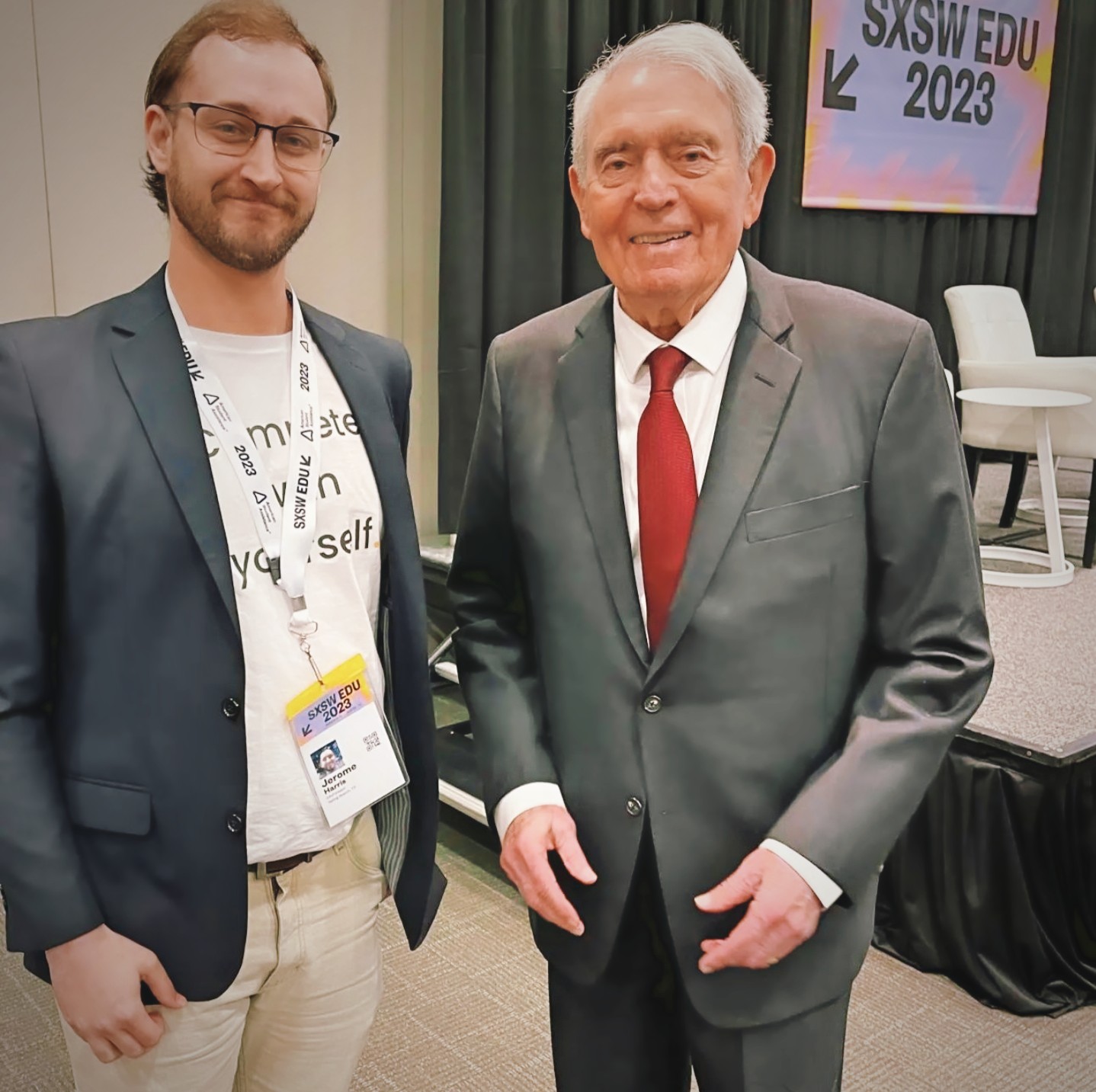
Rome Harris and Dan Rather
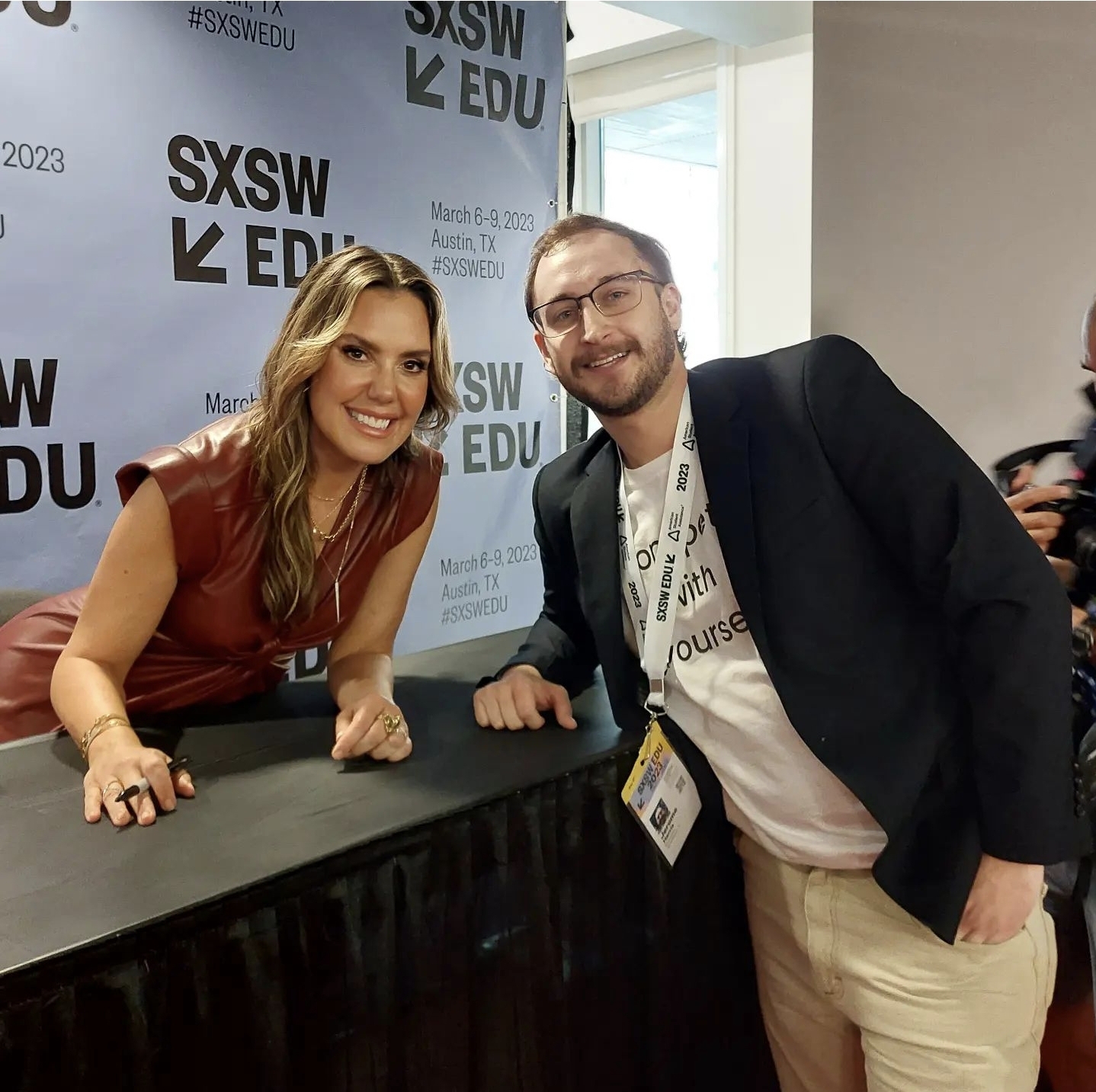
Rome Harris and Kendra Scott
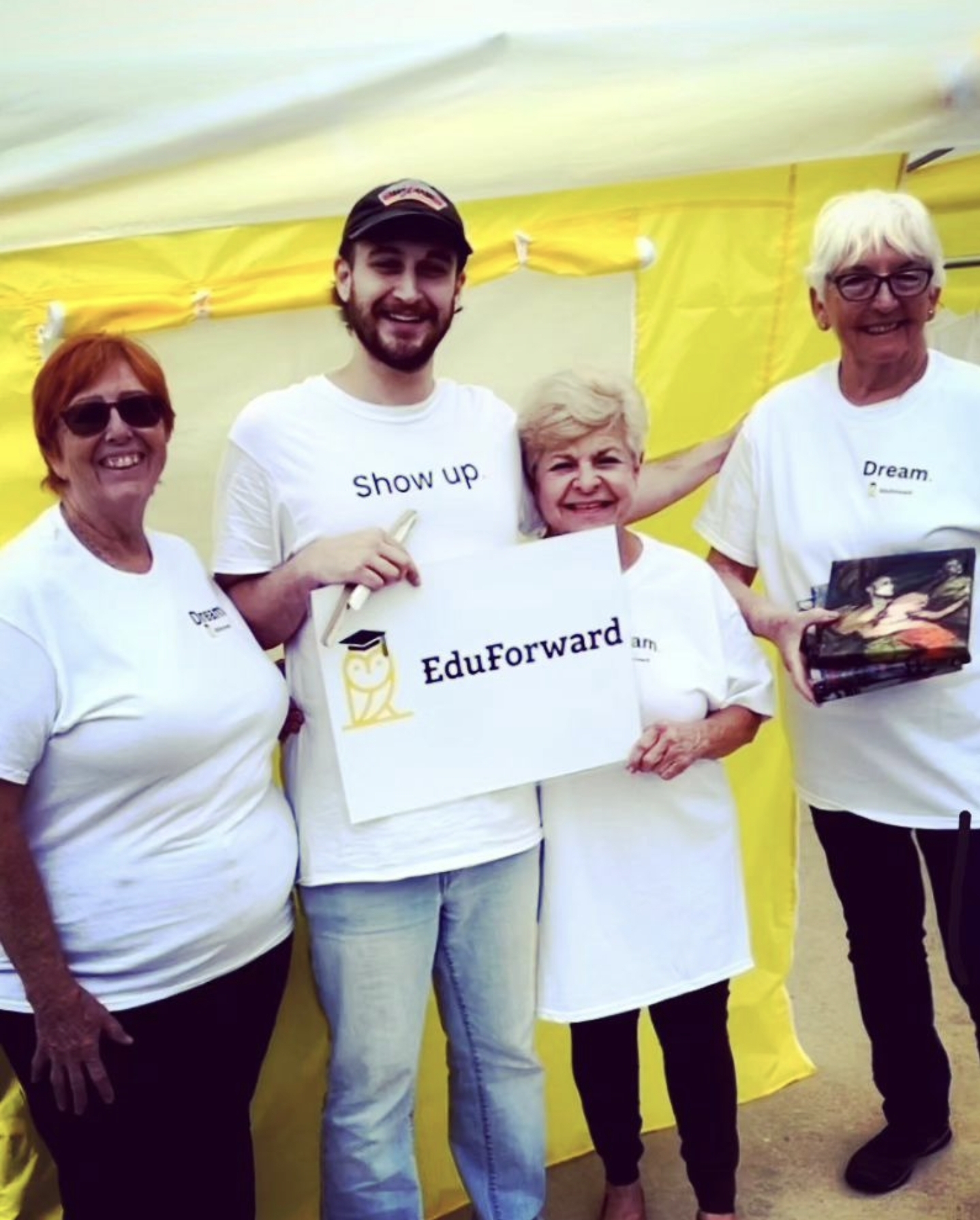
Rome Harris with team members and volunteers: Jan Gennusa, Vickie Martinez, and Alyce Bridges