



We recently connected with Robin Rippey and have shared our conversation below.
Robin, thanks for joining us, excited to have you contributing your stories and insights. Can you open up about a risk you’ve taken – what it was like taking that risk, why you took the risk and how it turned out?
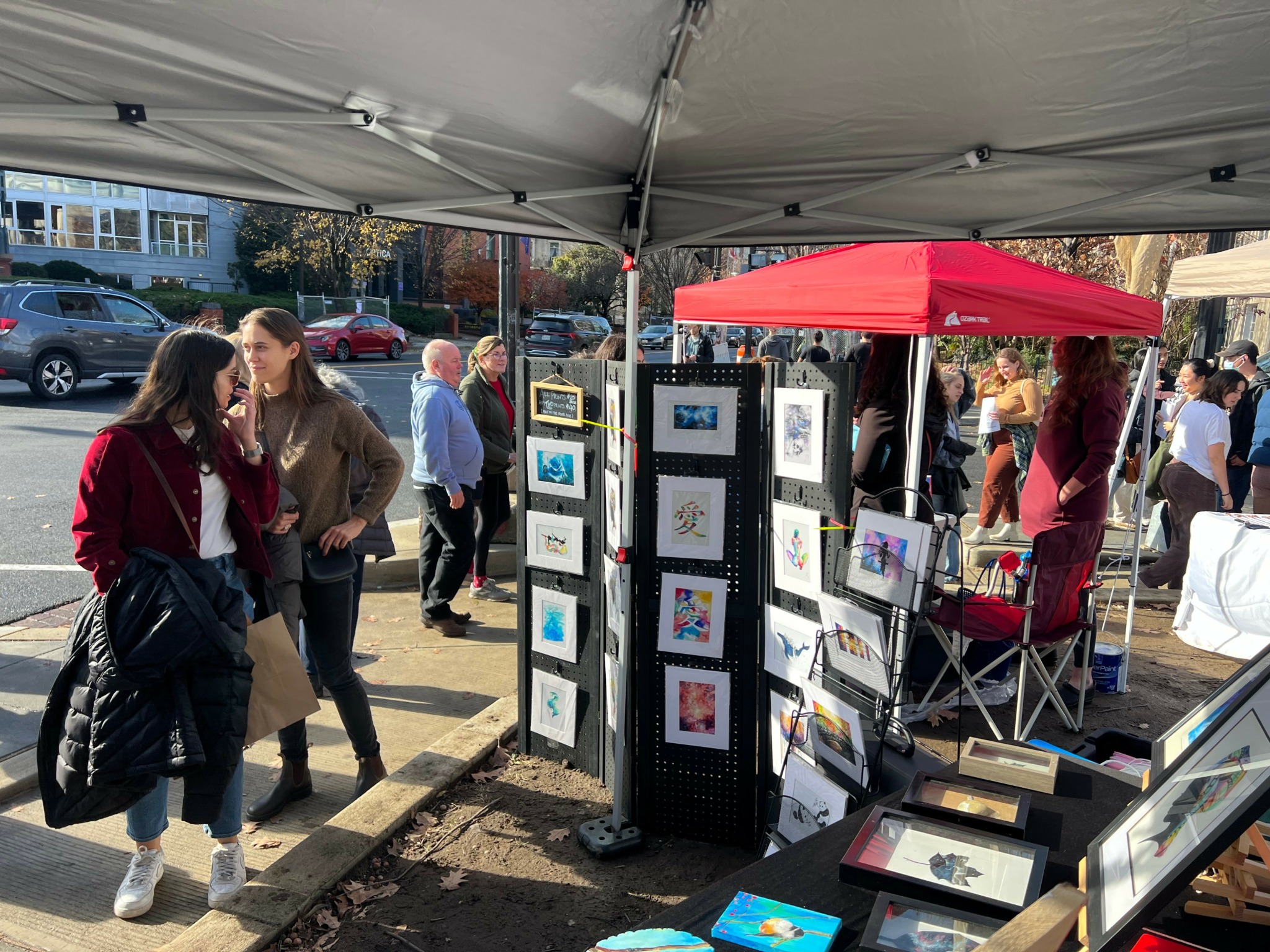
It was a risk to start vending with pop up in public markets. It takes a time and monetary investment. You need to buy supplies, a tent, stands, weights, vendor fees, etc. Then there is you time spent out there, submitting applications for shows, researching shows, marketing and meeting other professionals to network yourself. Then there is the biggest risk, do you have a product will buy? Every artist wonders during their first few shows, is this risk worth it? We’re all very sensitive about our craft, no matter how small or big, and to put ourselves out there for the world to see if anyone wants to take a piece of it home…we’re so aware of it, of people looking, critiquing, maybe they like maybe they don’t. Then the time it takes to navigate social media (I definitely missed the first few boats there, lol!) because you have to branch out, you have to be actively seeking, always seeking.
For me, it’s an ever evolving work in progress. I am definitely glad i took the plunge and started with those few small pop ups. And right before the pandemic, at that! Despite the set backs of the time, the no sale shows, the long hours and the hauling materials by myself, I wouldn’t change it for anything. Every year, every show I’m learning. I’m learning to pack better, to produce better products, to display them better, and broadening my overall reach. I’m learning and growing as a small business woman on her own and an artist, and in my most deepest heart of hearts, I’m proud of myself.
Robin, before we move on to more of these sorts of questions, can you take some time to bring our readers up to speed on you and what you do?
I have always been a little artsy. Always been drawing or doodling as long as I can remember. Comic books were my gateway drug of choice to the big leagues: the costumes, the character design, the action panels. You have to convey such emotion through a single panel, or navigate the story along. I loved the intricate details each artist dedicated to their characters, what they had to do to bring them to life, and the colors, oh the colors! Colors that caught your eye but didn’t seem real. I remember wondering how that was even possible to achieve.
It took until my later 20’s, early 30’s to find myself in a situation where things changed. I had a new full-time job that allowed me a better living wage than the various retail jobs I had had before. I had a steady roof over my head, a dedicated art space, and a tiny bit of disposable income. All of those supplies I had limited inventory of in school because I couldn’t really afford them? Now I could.
Better quality watercolor paper? I’ll take two pads, please!
The largest Prismacolor colored pencil set? Don’t mind if I do!
I was able to practice more, experiment with new mediums. I cracked open art books I hadn’t touched in years, and forced myself to get better with watercolors. I took a Japanese woodblock class. I took up gouache.
But I really noticed a significant change during the pandemic.
As awful as it was for millions of people, I was one of the fortunate and blessed few that not only didn’t run the risk of losing her full-time job and livelihood, but had an opportunity to really focus on my craft. I couldn’t go anywhere, and the job worked us to a reduced schedule, so I had more time at home in my happy space aka art studio.
Suddenly, I was consistently producing projects. My inventory of paintings and drawings grew. I was excited. I was exhilarated. I was finding inspiration. I molded my space into a cocoon for me, full of my delights and positive décor. I filled out completed pages in sketch books and signed a finished canvas piece.
Now there was another problem; I didn’t really have the space for these things.
A friend recommended: why don’t you try to sell your art?
It started with small businesses, putting my paintings and prints on the shelves and vending at small local pop ups. When the store fronts weren’t successful, the pop ups still held up. I liked the flexibility and the exploring different areas. It allowed me to expand my customer base, and build my business model. I have a small presence on social media (still a WIP, don’t judge!). I even expanded my products base; I taught myself how to crochet (thank you, YouTube!); I produced jewelry; I designed some original stickers; and learn a little more everyday about marketing yourself.
The greatest satisfaction I can get out of doing this is providing someone with a piece that speaks to them. I want people to have something that they love to look at, something that brings a slice of beauty and wonder to their lives. Something that they look at and it makes them smile.
I think art can be a multitude of different things at once, but, above all, I think it should be something that make you *feel* something deep inside.
Can you share your view on NFTs? (Note: this is for education/entertainment purposes only, readers should not construe this as advice)
They’re not sustainable; an electronic piece of artwork does not have the same permanence as a physical piece.
For you, what’s the most rewarding aspect of being a creative?
It is my release. My M-F 9-5er job can be very stressful and aggravating, so working on my art is a solace to my raging mind. It calms me down, lulls me into a semi-meditative state, gives me a release for my stress. And when I get to pull back and see the full results, theres a sign of relief.
Contact Info:
- Instagram: https://www.instagram.com/reileen_chan/
- Facebook: https://www.facebook.com/profile.php?id=61558872633103