

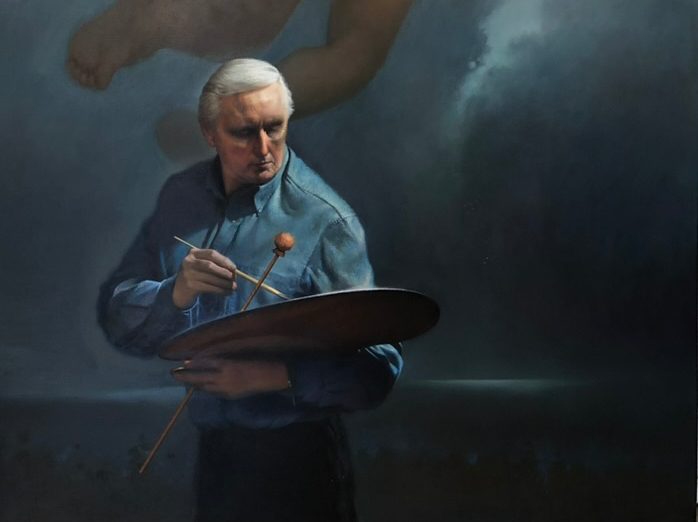

We caught up with the brilliant and insightful Rob Gutteridge a few weeks ago and have shared our conversation below.
Rob, thanks for taking the time to share your stories with us today Let’s jump right into how you came up with the idea?
$6,000 and a good idea…
As both an artist and an educator, it is the case that art found me, rather than me having found my art. I knew from about the age of 5 that I wanted to be an artist who draws and paints. The need to do this has been with me ever since, and I have lived as an artist to the fullness of my capacity. I entered my first art school 54 years ago. Living as an artist has meant making a lot of sacrifices in order to pursue an activity that is at the heart of my authentic self. Leaving art school in the mid ’70’s I quickly became aware I could not survive by selling my work. I found a job as a scientific illustrator at the South Australian Museum where I worked until 1979. I had, by then, spent 5 years drawing there every day. I left when I received a scholarship to study at the New York Studio School. This confirmed me in my chosen path, but there was still no way to make money from selling art. So I came back to Australia and started teaching part time to support my art practice. Since then I have undertaken art related travel in Provence France, Kuala Lumpur, Malaysia, London, UK, Beijing, China, Helsinki, Finland, Gothenburg, Sweden, and St. Petersburg, Russia. I started as an abstract painter and have found myself now teaching and practising the realist skills of Western Renaissance art albeit in a contemporary context.. Quite a turn around.
By the mid ’80’s I had exhausted all that I could obtain from abstraction. Over the ensuing decades I worked my way toward realism which has since sustained me. It is apparently inexhaustible. In 2012 I came to a crossroad. Having come back from a year in Kuala Lumpur as the Malaysia/Australia Visual Artist in Residence at Rimbun Dahan, I was reluctant to go back to my job as Head of Drawing at Adelaide Central School of Art. The responsibilities were increasingly distracting, but more so, I felt that the direction the school was going in did not accord with my feelings about what was valuable in art making, and the path of university based visual art education in general.
in 2016 I had $6,000 and a good idea. It was all the money I had. And the idea was to open an atelier style art school in Adelaide to teach traditional Western skills in drawing, painting, and anatomy for artists. Thankfully the idea worked. The school has just celebrated its 10th anniversary. I model my teaching and the school on artists’ workshops of the 15th Century. There is 1 teacher, me. I teach no more than 8 students per class. There are about 23 students enrolled at any one time. I teach 2 days per week so that I can spend the rest of my time drawing and painting. My art school is unlike any other in Adelaide, and probably Australia.


Great, appreciate you sharing that with us. Before we ask you to share more of your insights, can you take a moment to introduce yourself and how you got to where you are today to our readers.
Much of this is included in the previous section. However, in addition…
I felt it important to make this venture as pure and distinctive as I could. There were to be no compromises or shortcuts. It was a point of difference for it to provide skills-based art education at the highest level possible. In doing so the art training would be unlike anything else on offer anywhere else. The school is unique. In designing the school ethos and curriculum, I say to students: I respect your ability to produce work of very high quality, provided you are given enough time, and the right training. This has proved to be right, often to the amazement of my students. The quality of their work is equivalent to, or better than atelier work being produced internationally.
School website:
www.rgcr.com.au


Let’s talk about resilience next – do you have a story you can share with us?
My school is a start up business. The resilience issue has to be based on some real knowledge that it can and will succeed. Your finances generally tell you the answer to this. So keep a close eye on your profit and loss statement. Resilience won’t work if there is not enough money coming into your bank account to sustain the business.
My story with the school is now 10 year’s old and I don’t feel it is ever complete. I worried a lot at the start of the business. Take care as it can affect your health. But there are ways to deal with this: some of the adversities I had to continue working through were:
development of kidney stones (stress)
development of atrial fibrillation – heart (stress)
Covid pandemic
Father passed away
Mother passed away 7 years later
Wife diagnosed with breast cancer
My ensuing depression treats with anti depressants
For your business to survive you have to put things in perspective. One of the great things I have learnt is that your problems are temporary, but if you can address them early, seek advice, support, and treatment. your business can not only survive the problems, but can actually help you to overcome them.
Having kept the school open for 10 years, I think that this year is the first, I have stopped worrying about its survival. You have to keep a sense of humour.


Is there mission driving your creative journey?
My mission is simple – I want to help people. In my case it takes the form of teaching people skills they have wanted to learn all their lives, in a studio environment that is welcoming, warm, and always supportive. This gives me a great deal of joy and purpose. It doesn’t feel like going to work at all.
Contact Info:
- Website: www.rgcr.com.au
- Facebook: Rob Gutteridge
- Youtube: Art in Adelaide Youtube interview


Image Credits
Image credit: Rob Gutteridge