



We recently connected with Raven Zhan and have shared our conversation below.
Raven, thanks for taking the time to share your stories with us today Can you talk to us about how you learned to do what you do?
Since I did not go through a BFA program, I did not receive a structured conservatory training in the craft of scenic and lighting design. I will categorize myself as a semi-autodidact.
I have liked to draw since childhood, but never learned it formally. In middle school, I designed posters and bulletin boards, which was my earliest exposure to the idea of “design”.
In high school, by being in a stagecraft class and working as a carpenter/electrician, I learned more about technical theatre than design. It was at the theatre summer schools (Carnegie Mellon University Pre-college, and Northwestern University Cherubs program) that I actually had a taste of the conservatory training and fell in love with the rigor and the creative freedom.
And then I ended up in a liberal arts BA program, whose theatre department provided only introductory training in design. Learning the craft involved mostly self-teaching and simply just doing it. So the way I learned to draft on Vectoworks was through watching hundreds of YouTube videos and a visiting lecturer who was so kind that she gave me private sessions each week to work on some drafting projects. The way I honed my lighting programming skills was to work as a board operator and to design and program my own shows for student theatre groups. Things like model-making, drawing, and designing, I would say it is just intuition and figuring it out myself one way or another.
So when I designed the set of my first big department show, I felt wildly unprepared. I spent ungodly long hours in my windowless basement studio drafting and making models in a trial-and-error fashion.
I was lucky that I met some really good mentors in my college years. I am now assisting the NYC-based set designer who taught the first scenic design class I have ever taken in my life (in my senior year of college, after the big department show). In his own word, he is paying me to learn. And I did learn. The intensive studio work of model-making and drafting really gave me the pre-professional training that I sorely need.
I am looking forward to further developing my skills in grad school, which I am planning to go after a year of working in the field.
Great, appreciate you sharing that with us. Before we ask you to share more of your insights, can you take a moment to introduce yourself and how you got to where you are today to our readers.
I was born into a lineage of Minnan hand puppeteers in Zhangzhou, PRC. My grandfather is a nationally renowned puppet master; my grandmother designs costumes for puppets; and my mother directs a theatre troupe and a puppetry museum. As the designated heir to this UNESCO-recognized intangible cultural heritage, I spent my childhood backstage helping around before stepping onto the stage myself. So since I had memories, the love for art, especially visual and performance art, was infused in me. I toured across provinces, appeared on television, led workshops, translated for international guests, and delivered TEDx talks about young people’s responsibility in carrying on traditions. Puppetry was not just an art form—it was the language of my family, identity, and inheritance.
Yet by adolescence, I began to feel that inheritance tightened into inevitability. In the PRC, preservation is often synonymous with fossilization. Every time we performed the same few old/classic productions. The creation of new productions was thwarted by the strict guidelines of the Propaganda Ministry. Traditions, curated to serve an official narrative or preserved in their unchanging form, became a butterfly in amber, with little room to expand and innovate. In this environment, I began to feel less like an artist and more like a relic on a pedestal without a choice.
I have always craved new and different stories—real or imagined—that could move me to feel, dream, and connect emotionally and intellectually to other human beings across time and space. This longing led me to literature, history, and eventually, Western theatre. My adolescent rebellion against what felt like an immovable future and my emerging passion for Broadway led me to the U.S. at the age of seventeen. I thank my parents for supporting my decision.
I attended a Quaker high school, George School, where my hero Stephen Sondheim graduated from. GS nurtured an open, welcoming, innovative, and intellectually-challenging artistic environment. I started my theatre career here as a stage manager, a job that required me to organize, coordinate, and take care of my actors. The skills of communication and sensitivity to others’ emotions and thoughts stayed with me even after I shifted to designing, which was encouraged by my stagecraft class teacher and mentor Scott Crandall.
For college, I chose Williams College instead of a BFA program partly because of financial reasons, partly because I wanted to have a well-rounded education that can allow me to pursue my academic interests (and partly because Stephen Sondheim went here). I double-majored in Theatre and History, and spent a year abroad at Exeter College, Oxford University, reading modern history and dramatic literature. This education provided me with a strong foundation in literary analysis and historical research.
As a student of history, I approach any narrative through empathy and a psychoanalytical lens. Understanding individuals—whether heroes, villains, or ordinary people—on their own terms helps to dissolve hate, prejudice, and misunderstanding that have made humans kill one another since time immemorial. In an age of polarizing propaganda, history as a discipline became a tool to divide rather than connect.
I see live theatre as the most powerful medium for bridging these divides. The communal experience of witnessing stories acted out by real people on stage—where laughter and tears are shared and thinking prompted—fosters empathy and understanding, not only with the characters but with the audience around us. As a set and lighting designer, my goal is to construct a visual bridge between the story and the audience, externalizing the emotional and psychological subtext, the intellectual themes, and the bigger context of the work and the artistic vision. In a theatre, where history, memory, and fiction merge, I hope the audience can look beyond their immediate reality and discover the shared humanity that unites us across diverse perspectives and experiences.
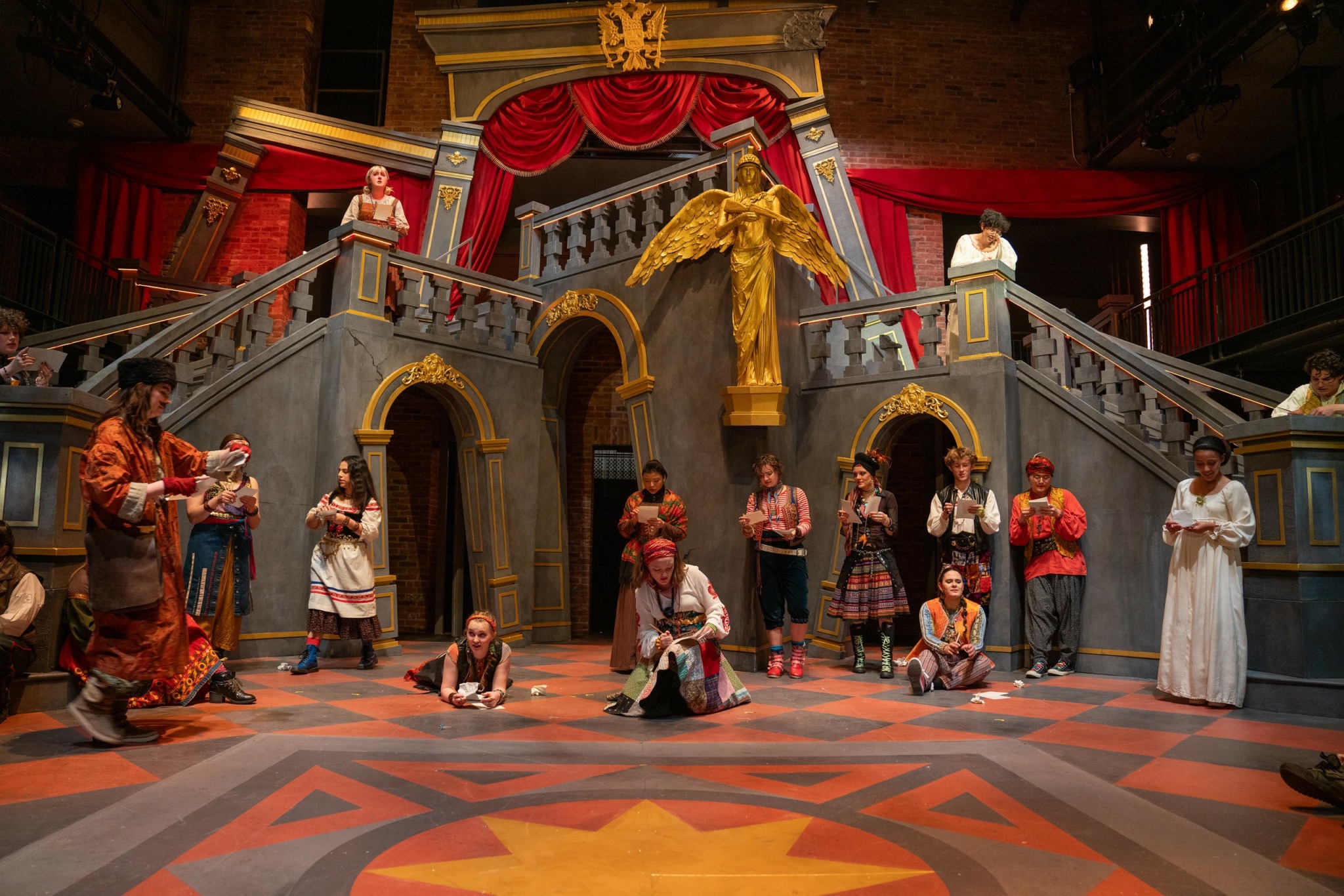
In my design for Dave Malloy’s musical Natasha, Pierre and the Great Comet of 1812, based on Tolstoy’s War and Peace, our creative team decided to stress the opening line “there is a war going on somewhere out there.” My set design, inspired by WWII bunkers, contrasted the opulence of the Moscovite palace with the destruction of war by fusing the neo-classical architectural style with material of modern warfare, like concrete, and inserting clues of violence in the forms of a chandelier made out of bullets and a statue holding a rifle. I tried to visualize the larger context of the story and, at the time, remind the audience of the world at war that they live in today.
After 7 years abroad, at this junction of my life, I decided to reconnect with my family and my root. I am designing a new hand puppet production with a script written by my mother. It is going to be about Koxinga, the Ming loyalist pirate who repelled the Dutch colonizers from Taiwan in the 17th century. I am excited to utilize my training in history and theatre design to create new works for the art form I have always loved. I seek to reclaim my family’s tradition not through nostalgia but through inquiry, by engaging with it as a designer, historian, and daughter/granddaughter. In doing so, I hope to build a bridge between inherited memory and future possibility.
What’s the most rewarding aspect of being a creative in your experience?
The people you work with. I enjoy working with a community of passionate, committed, kind, and talented artists who love theatre as much as I do.
Is there a particular goal or mission driving your creative journey?
I kind of answered this in the long essay. But I can state it again. In history, the focus of my study is the lowest moments of humanity, such as the Second World War, the Holocaust, the Cultural Revolution, and so on. My interest in 20th-century wars and mass dictatorships stemmed from my curiosity about the human psyche and potential of “evil” (is it evil or is it just human nature?). Art is the glimmer of hope in such a depressing outlook of humanity.
In an age of polarizing propaganda, history as a discipline became a tool to divide rather than connect.
I see live theatre as the most powerful medium for bridging these divides. The communal experience of witnessing stories acted out by real people on stage—where feelings are shared and thinking is prompted—fosters empathy and understanding, not only with the characters but with the audience around us.
As a designer, my goal is to construct a visual bridge between the story and the audience, externalizing the emotional and psychological subtext, the intellectual themes, and the bigger context of the work and the artistic vision. In a theatre, where history, memory, and fiction merge, I hope the audience can look beyond their immediate reality and discover the shared humanity that unites us across diverse perspectives and experiences.
Contact Info:
- Website: https://www.ravenzhan.com
- Instagram: @quothinevermore
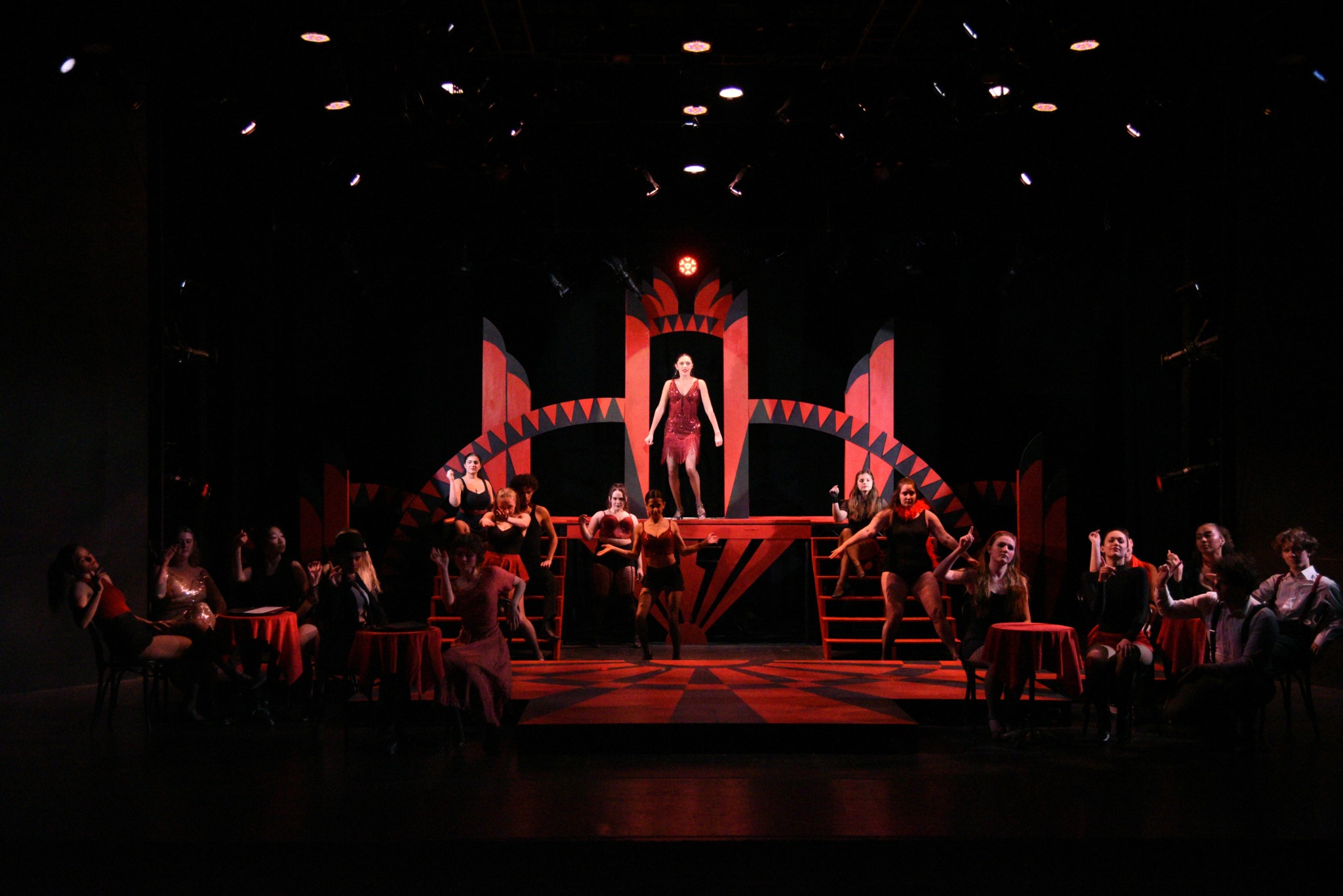
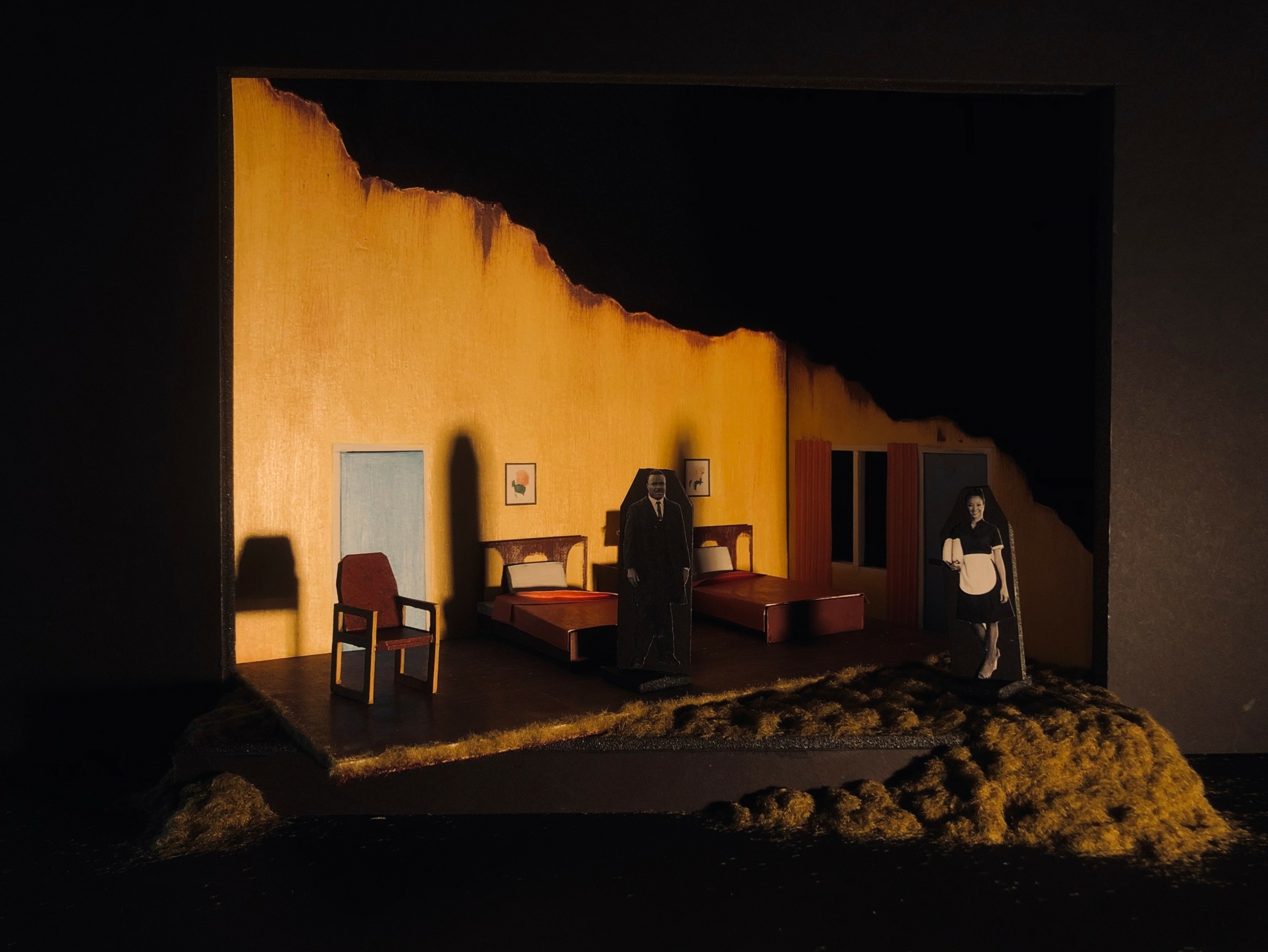
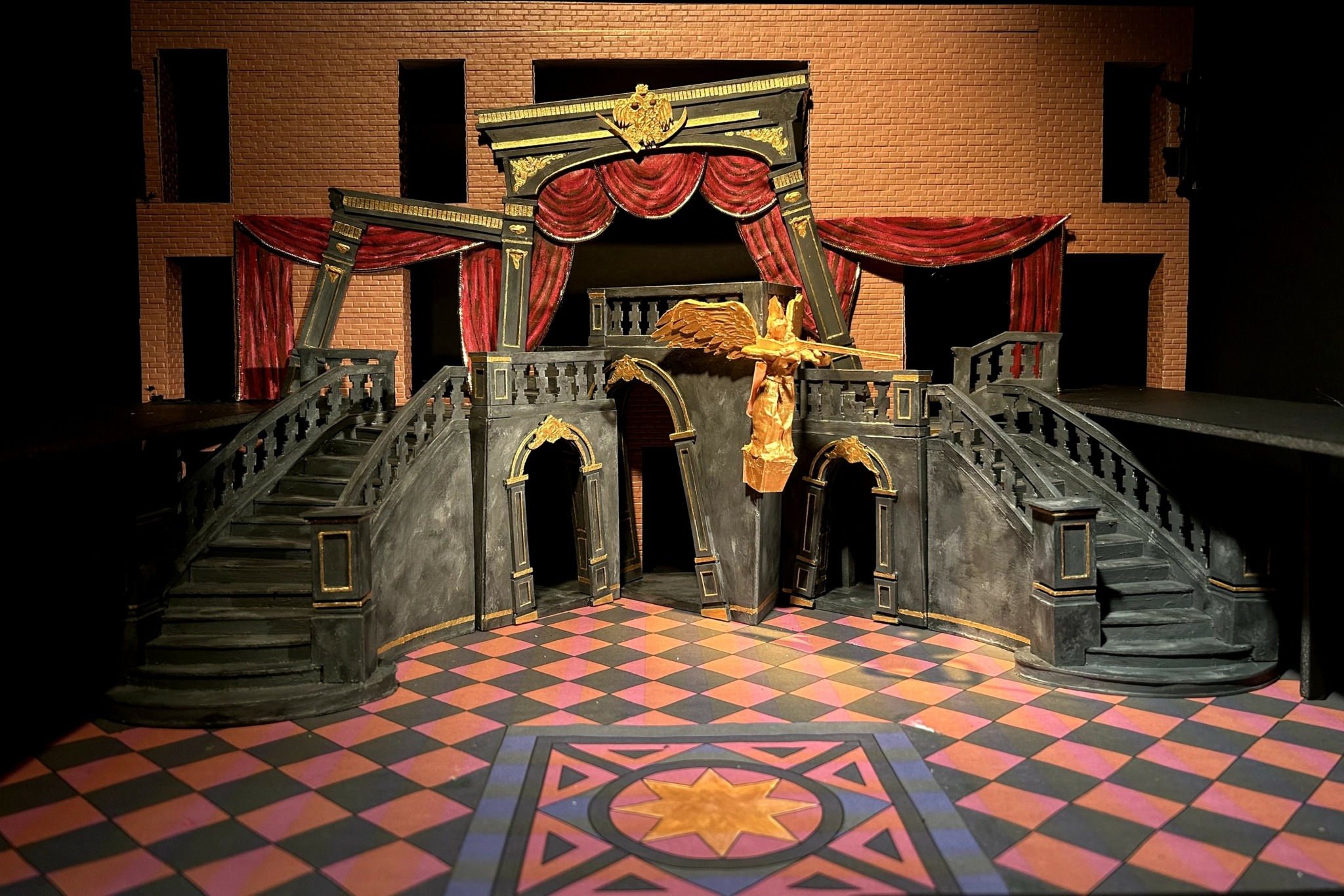
Image Credits
Keith Forman, Zoe Mitchell, Jessica Jiang, Cassie Aretsky