

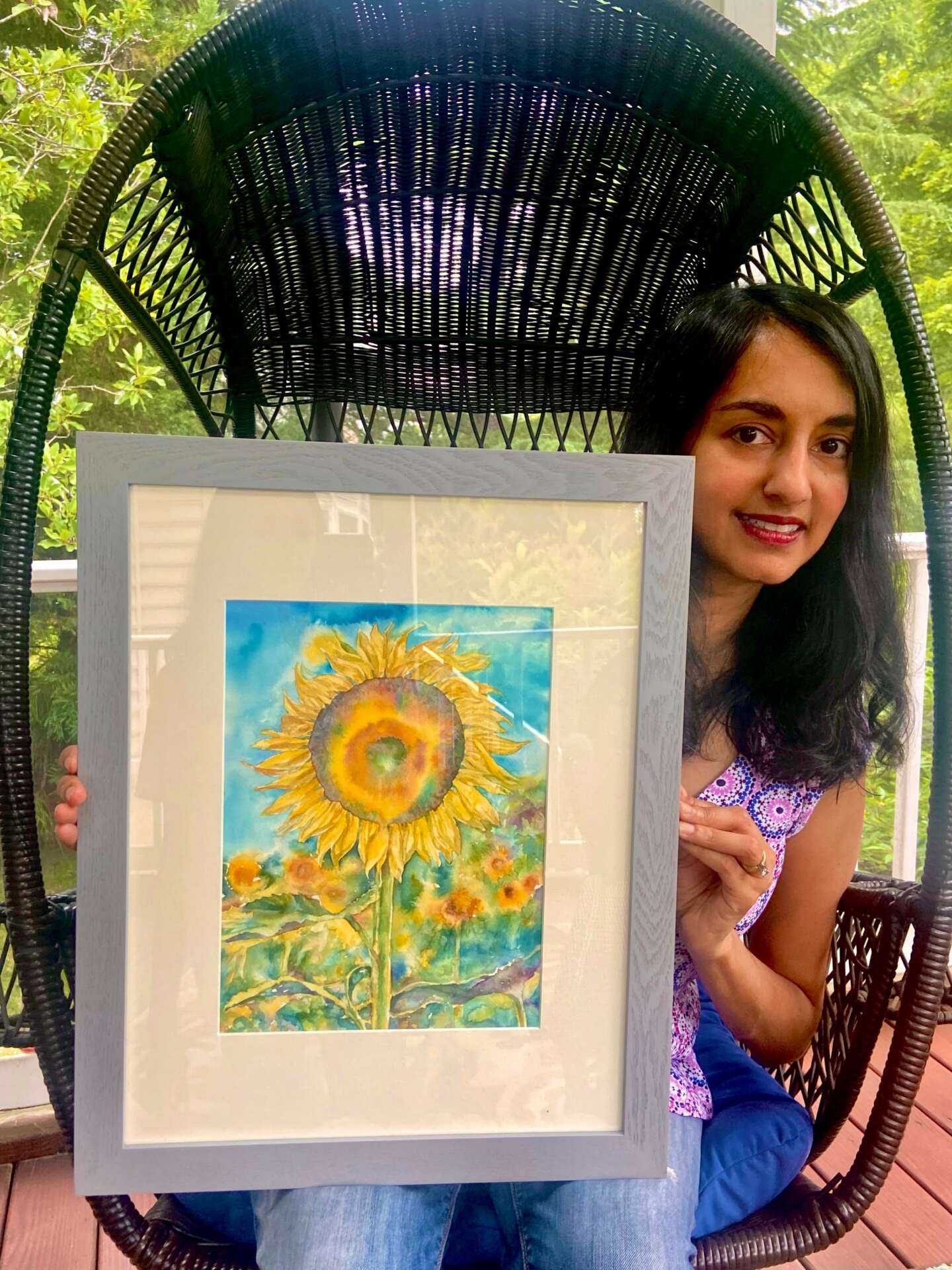

We were lucky to catch up with Pritha Srinivasan recently and have shared our conversation below.
Pritha, thanks for taking the time to share your stories with us today Can you open up about a risk you’ve taken – what it was like taking that risk, why you took the risk and how it turned out?
I think to be human is to take risks daily. We make countless decisions, each inherent with possibility. My first job out of graduate school was working for the Detroit Prosecutor’s Office as a grief and loss therapist for families who had experienced a homicide of a loved one. Within this challenging job, I also used art therapy skills with bereaved children who had directly witnessed a homicide. At the time, I did not think of this as a risky job, but looking back there was not only the element of very real physical danger but also tremendous emotional risk. Every day I carried the shattering grief of others and had to find a way to process it and start anew the next day. I learned a lot about myself as well as learning to choose paths in the future that were less perilous. Many years and jobs later, I have been able to devote myself towards being a full-time artist and mother. There is risk in this path as well I’ve found. Painting for me is a highly personal process, a visual diary of sorts. Each painting reveals a mood, a memory, a feeling, a poignant fleeting moment, maybe joyful and full of hope. When I share my artwork with the world, there is always the distinct possibility that someone will say its not for them. Or a juried show will reject my submission, when I thought I was entering my very best most original creation. As an artist, I’ve found that the only way to create authentic art is to be vulnerable and allow others into one’s world. Even if there is a risk of rejection. Because ultimately, there is also the beauty of connection and the commonality of our experiences that is uplifting. That is why I take the risk to share my artwork with the world and will do so over and over again.


Pritha, before we move on to more of these sorts of questions, can you take some time to bring our readers up to speed on you and what you do?
I am a self taught watercolor artist. But I have always been a creative person and some of my earliest memories include endless hours drawing. My mother is also an artist and as children my sister and I would accompany her to art fairs. I have vivid memories of her painting gorgeous impressionistic landscapes, and exhibiting in local venues. As an adult, for several years I worked as a licensed clinical social worker, in many different capacities, feeling fulfilment from helping people heal from trauma. But I would sketch and paint before and after my day job, always dreaming of a time when I could devote myself to art more. Suddenly that chance presented itself, when I moved across the world to live in Japan with my husband. There I found in my tiny home, a window both literal and symbolic. It was a chance to paint as creatively as I wanted to, hours when I could devote myself to incorporating inspiring mythology into my artwork. I read poetry by Rumi and Mary Oliver, while absorbing the rich culture and visual beauty of Japan. I collected stories from around the world, and started amassing breathtaking art and fashion tomes. I bought tube after tube of Holbein watercolors from the local art store and just started painting, immersing myself in the challenges and joy of watercolor. It was then that I realized how sacred and sustaining the art of painting would be for me. My art was my lifeline to transcend the day to day ordinary. There was magic, discovery, and reinvention within my reach. I felt all was possible. I entered local art shows and sold my artwork, and that was a phenomenal feeling for me. Not only did I love painting, but others wanted to buy my work!
With that in mind, I continued painting for the next 20 years, through motherhood and multiple moves. The learning curve for a watercolorist is steep, and I spent hundreds of hours learning about the unique quality of each paint, and even now I continue to be learn every time I pick up the brush. Also towards that end, I joined artist leagues and societies, and entered countless shows to start showing my artwork. A proud moment was when I was accepted to the Baltimore Watercolor Society and The Potomac Valley Watercolor Society, both esteemable watercolor organizations. In the past 10 years I have also been a part of many DMV group exhibitions, painted numerous commissions, and treasured awards that are won, which inspire me to keep learning and grow. I continue to refine my style to highlight portraiture, flora and fauna, and landscapes. I believe that artists are storytellers, and I worked on conveying my unique narrative through watercolor painting. My artwork is deeply influenced by my cultural heritage, my travels around the world, a love of nature and literature. With a combination of loose flowing color and careful attention to detail, my artwork transforms both the mysterious and familiar into something radiant and visionary. I am passionate about color and hope the viewer can feel how much color can impact one’s mood. My watercolors are defined by a celebration of luminous color while blending the surreal and magical with realism. I would describe my art is visionary and expressive in nature, if I had to choose a category.


What do you find most rewarding about being a creative?
There are so many rewarding aspects, its hard to choose! One of the most gratifying aspects for me is the ability to share my unique way of seeing the world with others. I find inspiration everywhere, and paint to summon the viewer in for a deeper, intimate look. The every day is magical and unrepeatable, whether it is capturing the way one can wander through a sunlit garden, the graceful heron that visits our local river, or the tender gesture of a grandparent holding their grandchild’s hand. In short, I want to convey the beauty in the universal AND individual moments we share on our respective life journeys. I paint what inspires in me, a sense of mystery and awe. I use color to evoke an emotional response and tell a story. It is the greatest pleasure to me to be able to bring these moments to life. When someone shares that my artwork moved them deeply or that they fell in love with the color in a painting, that is where the reward lies for me. Perhaps equally important is the daily nature of painting and how life sustaining it is for me. There is a certain flow and meditative aspect to painting that has seen me through difficult times. I consider myself fortunate to have found this practice and ability to nurture my voice. And finally, connecting with other creatives is the icing on the cake! Most recently I have joined two groups that have been rewarding beyond my expectations: The Aligator Watercolor Community, spearheaded by the master watercolorist Ali Cavanaugh and a wonderful everyday connection with a local artist mother group of six fabulous artists, which keeps me both grounded and motivated. These bonds are life sustaining, and yet another another wonderful aspect about being a creative. Meeting fellow creatives in one’s local community, and around the world!


How can we best help foster a strong, supportive environment for artists and creatives?
Two ideas come to mind. I think having more public venues to display art is critical. Artists’ artwork need to be seen. Artists also need to be able to talk about their work and engage with the public. There is energy and magic in that! While social media gives all artists that opportunity, it is equally important to see artwork in person. To be able to lean in closely and examine the color, the texture, the way an artist portrays a subtle gesture is an extraordinary experience. Or to be able to sit back and meditate upon the myriad of feelings that arise when viewing a larger artwork. There is no substitute for that. If local government and businesses could partner up with local artists to help promote visibility that would be immensely helpful to artists. When large and small cities have within their infrastructure a hearty budget that includes supporting local artists that gives art an equal footing with the dining and entertainment industry that would assist in creating a balanced, thriving ecosystem.
Secondly, it is of utmost importance that exposure to the arts starts early, during the preschool and elementary years. I have witnessed the immeasurable positive impact that art has upon children and cannot emphasize enough its significance in providing balance and joy. Every child is born with the ability to be a natural artist. To be able to access that creativity for the rest of one’s life is a gift that can be cultivated from the very early school years.


Contact Info:
- Website: https://mayuramoon.com/
- Instagram: @prithasfineart
- Facebook: https://www.facebook.com/pritha.srinivasan