
We recently connected with Oliver Polzin and have shared our conversation below.
Hi Oliver, thanks for joining us today. Do you feel you or your work has ever been misunderstood or mischaracterized? If so, tell us the story and how/why it happened and if there are any interesting learnings or insights you took from the experience?
People sometimes see my work through the lens of existing historical genres like Romanticism. The light filled landscapes of the 1800s are many peoples’ touch point for realistic landscape painting and while this falls short of all that is happening in my work, it is an excellent portal to the conversations about our relationship to the natural world that I would like to have.
I see Romantic Painters creating sensitive renditions of landscapes with gorgeous light and subtle attention to natural features like pools and trees and rocks. They took the care to reinvigorate the collective vision of wild places in their era. But much of that work has an air of displaying or even advertising land for the taking – A vision of prospective dominion, almost akin to a nude laid out on a couch. At worst, paintings by the American Romantics of the American West are considered a key part of Manifest Destiny – driving the colonial project by creating lascivious views of “pristine” land, ready to be “tamed.”
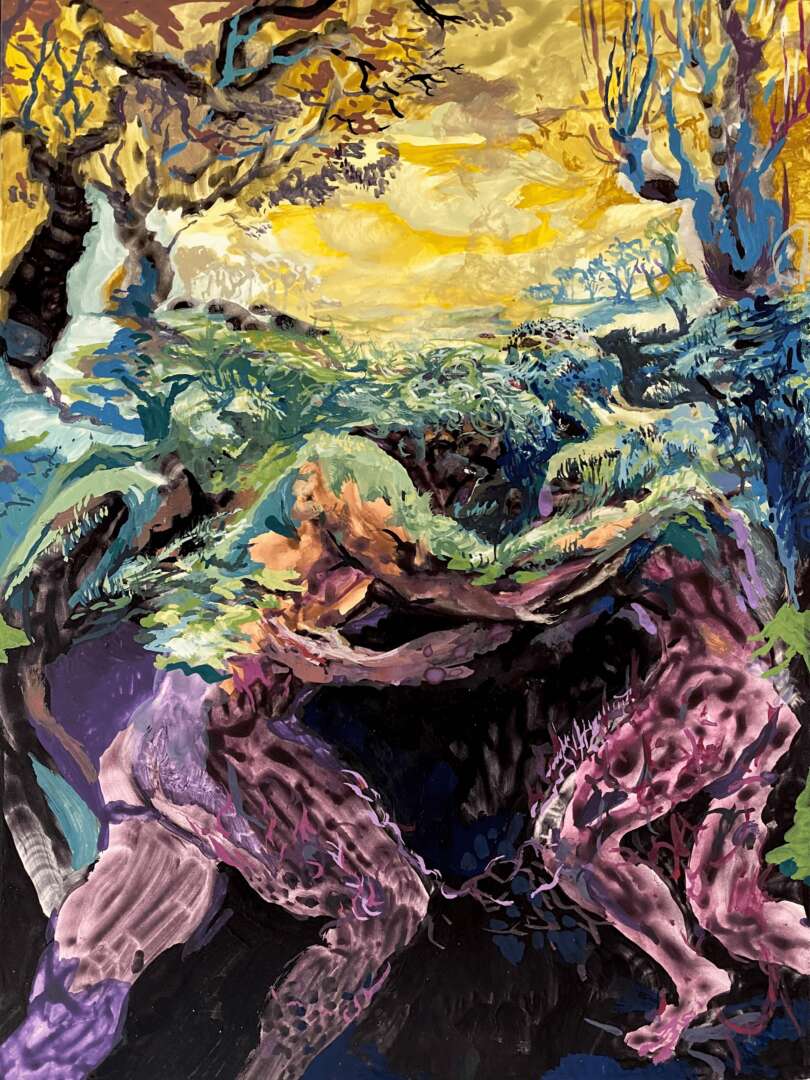
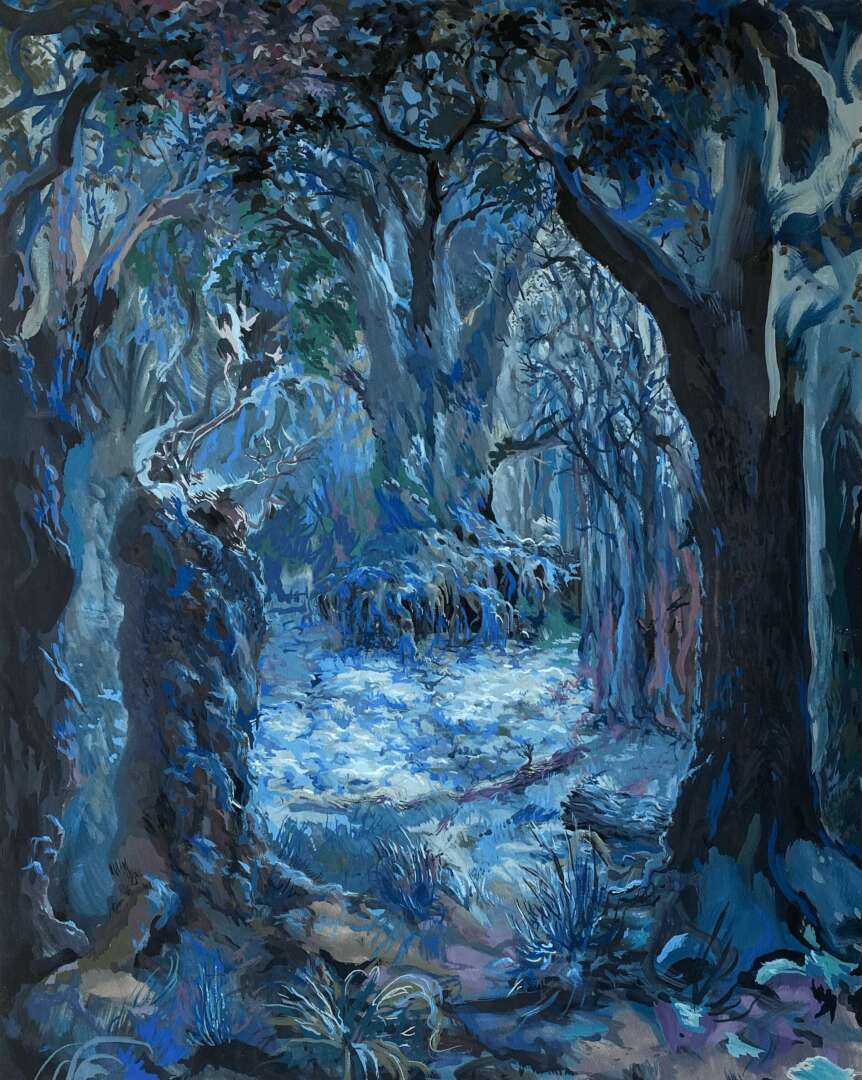
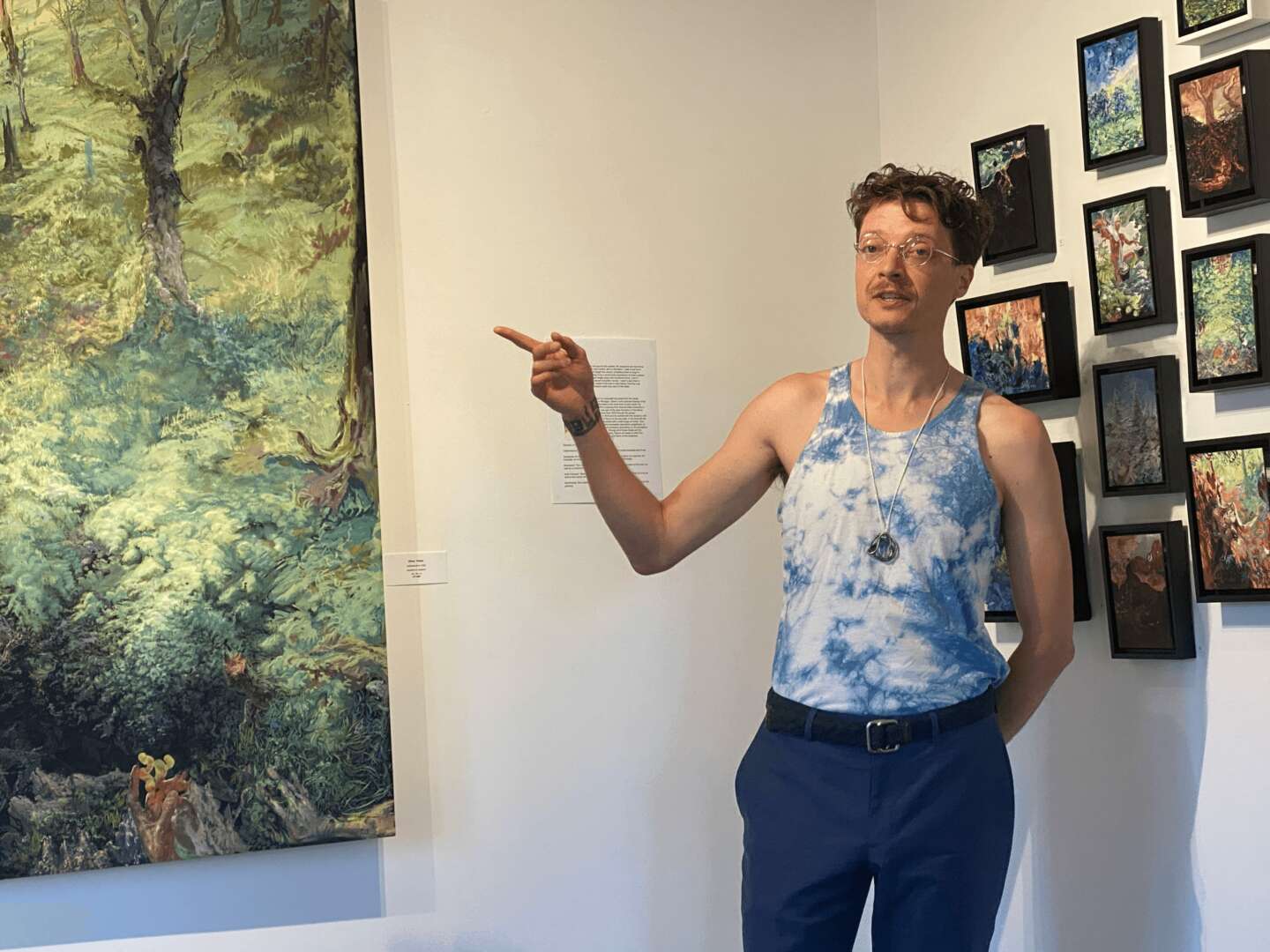
When I paint landscapes, I seek to cast a vision of relational complexity. I want to give a prefigurative view of a new collective relationship for humanity not just to land, but to ecosystems. I want a painting of a tree to feel like a confrontation, a meeting, an invitation to reciprocal beingness. I want a viewer of my work to think, what type of life has this tree lived, and who are its friends?
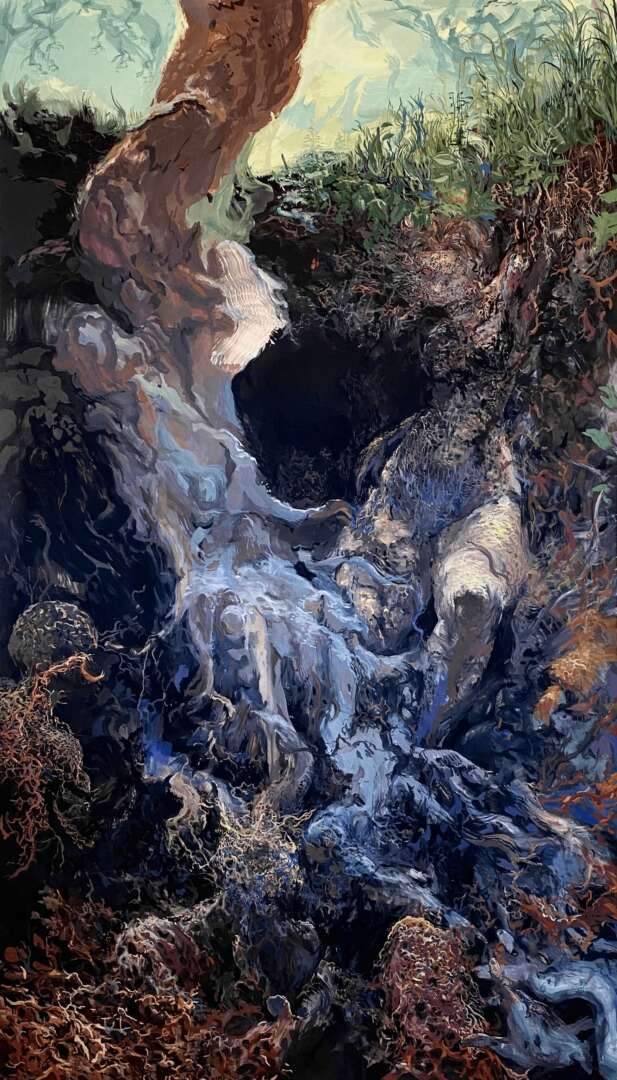
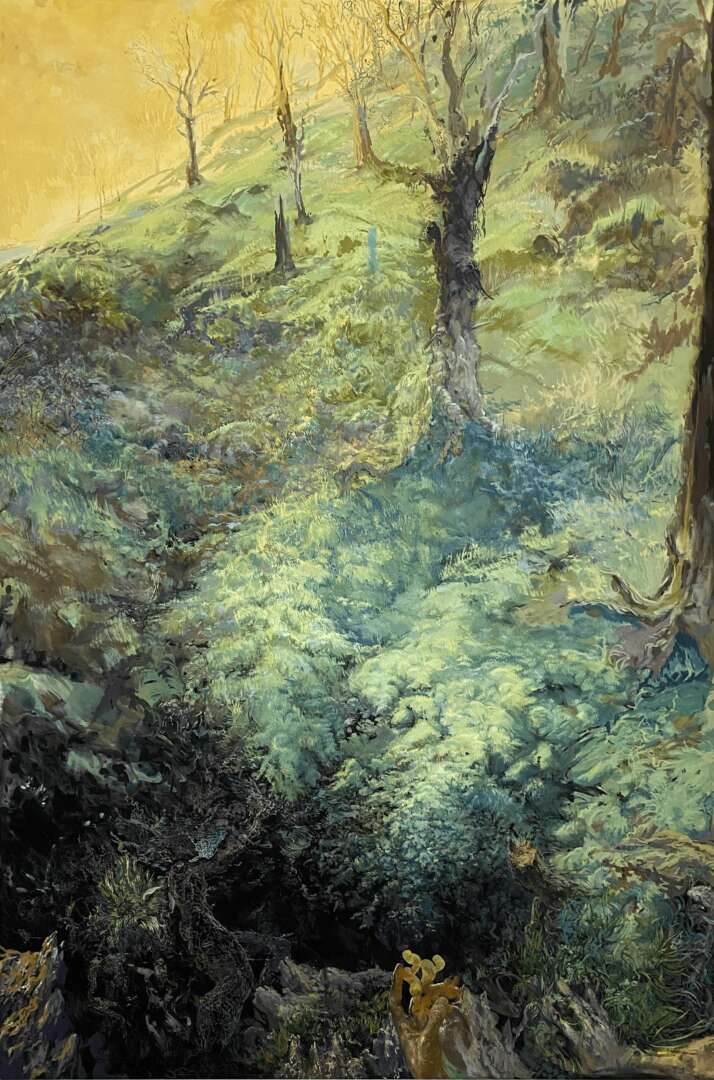
The truth is that we are part of these forests, we are members of these ecosystems. We should first consider ourselves as equal members, then afterwards we can talk about our uniqueness as humans, our stewardship, our abilities. This is why I often include hands or feet at the bottom of my landscapes, as if to say “this is you, touching grass, part of this scene.” This is also why much of the space in my compositions is devoted to looking at the ground. The soil, the small plants, the tiny elevation changes that effect how the water flows, and especially the fungi that there reside are critical for understanding a relational approach to ecosystems.
Oliver, love having you share your insights with us. Before we ask you more questions, maybe you can take a moment to introduce yourself to our readers who might have missed our earlier conversations?
I studied painting in college and made some work that I was really proud of. But when I moved to Santa Fe at the end of 2009 I fell into the nascent Meow Wolf art collective. We were a wild bunch, devoted to an absurdity. We had a non-hierarchical structure, sat in a circle, and made decisions by consensus or by the law of will. We made installations out of whatever we could find. I took this period as an opportunity to explore whatever medium struck my fancy and I had a whole mud phase, cardboard phase, old carpet phase. I built cob caves, acted in performances, wrote historical documents and made old maps to be displayed as part of the worlds we were building. I also painted in this time – some of the paintings were concept pieces to show a vision of where we were going with a project together, and some of them were personal art too.
There are too many stories to tell from this era, but when we incorporated in 2014 a lot began to change. I’ll keep it personal and say that I grew a lot during this time. I built some of the biggest and most complex installations that I ever have, I lead teams of diverse thinkers and makers, I got into the study of how immersive experiences can tell open stories and the way that both physical and digital elements can serve that process. I studied animation and more traditional storytelling mediums and leveled up my understanding of what makes a story grip a person. I also had to learn a lot about building codes, new more durable materials, and so much about the pitfalls of the corporate model. The circle was broken, and money was more heavily involved – stories for another time.
When I left in 2022 I had already returned to painting as a personal practice. I decided to make the leap and see if my little art raft could carry me away from the behemoth battleship that Meow Wolf had become. I knew that I wanted to make work that spoke to humanity’s relationship to nature, and I knew that I wanted to make work that took a lot of time and devotion. My work needed to be fully my own after years of collaboration and timelines and compromises. The paintings that began to come out of that process were better than I thought they could be. I rapidly matured into making work that surprised even people who had known me for years.
Now, a few years into this solo practice I want to keep making more and more impactful art. I want to continue to hone my practice of integrating emotions and somatic experiences into my work. I do read a lot about biology and ecology, early human history, psychology, health, and many other topics and I love to inform my art with those studies – but it’s so important to keep that live wire to the physical, the bodily in order to make art that speaks to a person’s whole being. It can be easy to over intellectualize or over conceptualize creativity, but I find that when I push my energy out of my brain and back into the rest of my body my paintings are more powerful. After years of making enterable exhibits, I want a painting to feel as impactful as that full body experience.
What do you think is the goal or mission that drives your creative journey?
Art is the most effective vehicle that we have for envisioning new ways of seeing and being. This is true on both the personal and societal levels. Just as an individual can create new ways of thinking of themselves by making art, so too does society grow with every imaginative act. I take this task both seriously and with humor and humility, since so much of the power in this creative process is subconscious and grandiosity kills.
But what I see is that at this moment in history it is imperative that we reconnect to the long long arc of human existence, some hundreds of thousands of years in which we knew that we are crewmembers aboard Spaceship Earth with all of the lifeforms that are here. It’s only since the agricultural revolution, or maybe since the first industrial revolution that we thought we could see it any other way. We need to realize the “humanity” of the more-than-human world, and reconnect to the more-than-human aspects of ourselves.
In a nutshell, we need to bring back Animism.
For you, what’s the most rewarding aspect of being a creative?
One of the most rewarding aspects of the creative life that I have lived is encouraging others to make art. Whether it’s backing up my artist friends and talking through the difficulties of being an artist, or pushing a non-artist to draw or make something up. I find great joy in helping others make things. The creative act is a gift. To create is to utilize and practice free will, and interact most intimately with reality.
Contact Info:
- Website: https://oliverpolzin.com
- Instagram: @oliverpolzinart