



We caught up with the brilliant and insightful Nicole Emanuel a few weeks ago and have shared our conversation below.
Nicole, looking forward to hearing all of your stories today. Looking back on your career, have you ever worked with a great leader or boss? We’d love to hear about the experience and what you think made them such a great leader.
I have had 2 spectacular bosses whose manners demonstrated inspirational leadership. First was Patricia Rodriquez of Mujeres Muralistas in 1980s San Francisco’s community mural movement. She was unflinching in her clarity about the role public art plays. As a Chicana, her persistent joy about her culture and total respect for the spectrum of other cultures opened my eyes. She was a kind communicator, full of patience and always kept the big picture in front of her personal moods. She didn’t waiver from her commitment to collaboration and being mutually uplifting in our work. There was never competition, jealousy or acting out personal moods in the process of work. There were no mercurial shifts in direction nor repetitive looping over basic decisions; we moved forward cleanly. She was my mentor and I was motivated by watching her weave her personal life, professional life and community beliefs so kindly, with such joy and humor. I could count on what she said and a kind consistency of temperament that she prioritized as a leader.
Second, was Kelly Lindquist of ArtSpace Projects a nonprofit that transformed underutilized buildings into affordable live/work communities for artists and their families. He magnetized motivation from people. Again, his moods and personal shifts always took a backseat to his leadership. He held a clear vision of where we were going, while being responsive everyday to the details of his team. He was kind, joyful and funny, like Patricia. I WANTED to do well for him. I WANTED to take his trust and blow his mind with how well I could do my part. He invited, encouraged, expected and TRUSTED me to put life into my portion of our work. He did not constantly shift tracks, change his mind or confuse his team with scattered decisions. His leadership felt smart, kind, exciting. He never put his moods in front nor spoke harshly, impatiently or unkindly. As a boss, he understood how to generate mutual respect and trust, so we could do our jobs together respectfully.


Nicole, love having you share your insights with us. Before we ask you more questions, maybe you can take a moment to introduce yourself to our readers who might have missed our earlier conversations?
At 22, I was lost. But by accident, I fell into the world of community murals in the streets of 1980s San Francisco. The circle of artists I discovered were all community activists and culture keepers. This loose clan was Black, White, Central American, Asian, gay, disabled, young, old…everything. It wasn’t an organization, it was a connection between us as Creative Artists, working from our authenticity within the context of neighborhoods and social issues. Most of us had “jobs” and did a portion of our community art without pay. But we also formed alliances and pursued funding to accomplish important projects. In the Latinx Mission District, we painted an entire alley, both sides, every surface, to illustrate the nuances of the culture and on going strife in Central America. In downtown, we created a 12,000 lb painted steel sculpture that memorialized the blood spilled during the formation of the International Longshore and Warehousemen’s Union.
Since most of my peers lived illegally in warehouses, I invented a job for myself that extended 40 years to the present. At first I worked with the City Planning Department to form and implement the “Live/Work Code”. This Code, recognized the treasures artist created in warehouses with hundreds of people lived and worked in self-made spaces with galleries and theaters. Rather than condemn the building, the new City Code laid the groundwork to make these spaces safe for artists and their families.
At first, the challenges of avoiding gentrification were not so clear as there were not stopgaps to keep developers from snapping up the idea and making high-end lofts for YUPPIES. But, a persistent swath of people moved this work into a more requitable conversation and the field Creative Placemaking was coined. It became clear that artists ownership or nonprofit ownership through community development is part of the antidote. Maintaining access, affordability and inclusiveness remains a big challenge in the field.
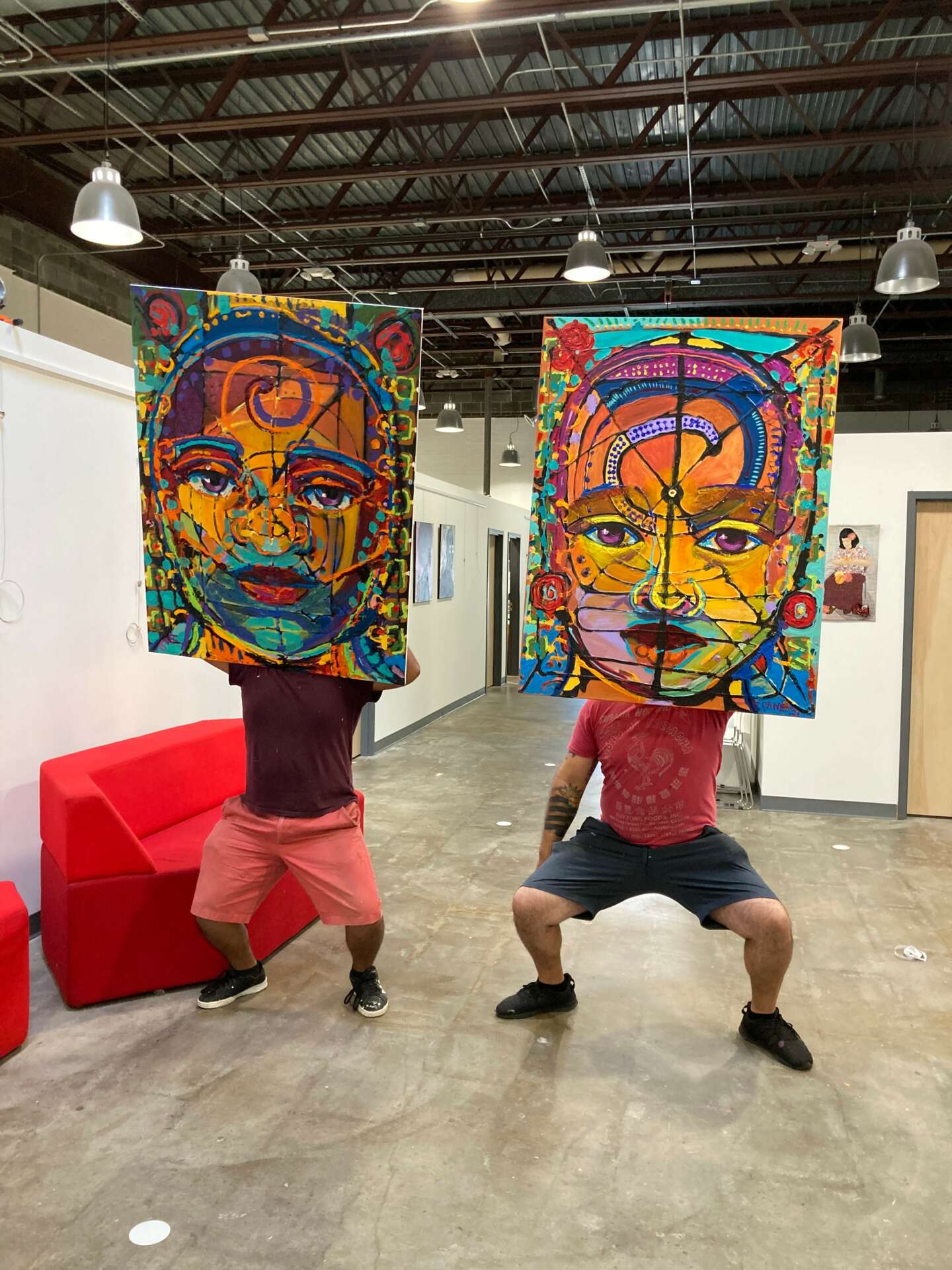
I’ve spent decades participating in redeveloping underutilized spaces for affordable community cultural spaces. Throughout I maintained a variety of studio practice for my own art, paintings, sculptures, commissions, etc.
My studio practice and my world-view never stray far from a community context that recognizes social issues and my belief that my art and my skills are not just about me, but that I hold responsibility to use my skills to uplift my peers, to honor culture and struggle to keep creativity in its natural place within the middle of society.
In mainstream society, artists spaces are treated as commodities for developers to sweep in and reap the value of areas that artists have helped make beautiful. Similarly, the artist as a Worker – with materials and skills – is often undervalued and offered “exposure” in lieu of pay. So, in my work, I have always emphasized that Artists bring meaning, change and dialogue. Artists’ work link across all media and senses to bring beautiful tastes, sounds, images events and environments to every level of our everyday lives in fashion, design, music, film, paintings, architecture…
I approach my art work in three simultaneous ways: first, I have a sense of responsibility to advocate for Artists to have stable, accessible, affordable and inclusive spaces; second, I present evidence that proves the value of art and culture in our built environment and quality of life; third, I feel gratitude for my own creativity and the absolute joy in materials, play and the process of invention I share with my friends.
How can we best help foster a strong, supportive environment for artists and creatives?
I believe in evolving role of Equitable Creative Placemaking. There is a role for the Arts as part of the social engine that positively, directly contributes to community health, our built environment, education, our economy, our leisure and our sense of meaning. Stereotypes about art and Artists is wrong and counterproductive. The nature of capitalism has separated music, art, dance, poetry, design and creativity from our systems. These primal human activities have slowly been recategorized out as though they were separate, disposable elements. Art relates grounds us through our senses to connect our experiences at the neurological level. Music is related to math; language is related to thought; movement is related to wellbeing; design is related to everything. When artistic elements are isolated, defunded, removed, considered extras or expensive luxuries, we remove the soul and the senses from meaning. Systems without art are unsustainable because they deny the human element. Concretely, I mean that the arts should remain in their proper place, grounding us in human experience through our senses, whether it be in the classroom, what we see walking down our streets or they way our Cities allocate funds. Art has the ability to bridge across cultures, naturally including everyone, regardless of disability or wealth. The cold mechanisms of efficient profit and productivity do not prioritize the inclusion and support of Artists and art in our health care, the design of our communities and as a contributing element of our economy. We all suffer from the mass production of culture denuded of its natural place in all human endeavor.
Funding for local arts should be considered core to every investment, whether financial incentives for developers or budgets for schools or programming in hospitals. If we monetarily funded the arts commensurate with its actual value, the benefits would grow exponentially. It is hard to monetize what authentic, healthy neighborhoods would provide humans and the planet. But we all see what is happening to the earth and the human race when we ignore the health of our cultures.


Are there any books, videos or other content that you feel have meaningfully impacted your thinking?
I love and highly recommend “Art and Fear”. It is a funny, honest and revealing book about the narratives we hold inside our heads as artists.
Contact Info:
- Website: NicoleEmanuelStudios.com and InterUrbanArtHouse.org
Image Credits
Self portrait, Painting on mirror by Nicole Emanuel