

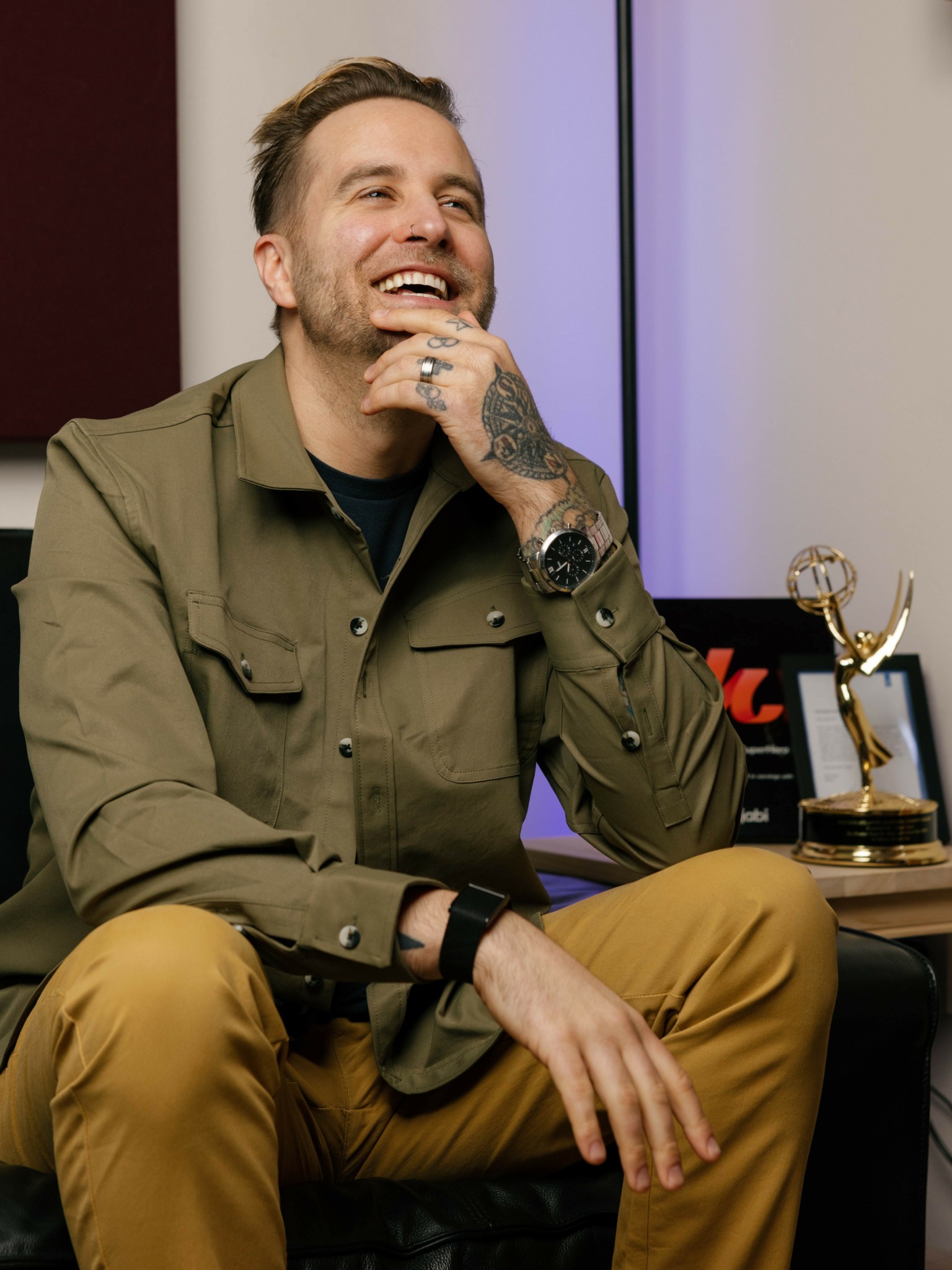

We’re excited to introduce you to the always interesting and insightful Mike Meiers. We hope you’ll enjoy our conversation with Mike below.
Mike, thanks for taking the time to share your stories with us today Alright, so you had your idea and then what happened? Can you walk us through the story of how you went from just an idea to executing on the idea
Honestly, there wasn’t one single lightbulb moment. It was more like a slow, unavoidable realization that I kept ignoring until I couldn’t anymore.
I was deep in my music career, writing songs, producing records, scoring for film and TV, winning an Emmy, and I kept getting the same messages and emails from guitarists and songwriters. “How do you write better melodies?” “How do I make my songs sound like a real record?” “How do you actually make a living doing this?” At first I just answered them. Individually. Over and over. And then one day I thought, what if I just started teaching this?
The first thing I did wasn’t build a website or hire anyone, it was just start putting content out. I already had a home studio. I already had the gear. So I started making videos and putting them on YouTube. No grand strategy. No branding meeting. Just, here’s what I know, here’s a camera, here’s transparency – let’s go. That was the real first jump. Just going for it with thoughtful intention.
The podcast came next. I launched the Songwriting for Guitar Podcast because I wanted a longer-form way to go deep on topics and eventually bring in guests from the industry. Recording it out of my own studio meant the overhead was basically zero. Again, I used what I had.
Then came the question of, okay, what do I actually sell? That took more figuring out. I had to learn what online course platforms even existed, how to build a curriculum, how to structure an offer, how to write a sales page. None of that was natural to me as a musician. I had to study it like I had once studied music; obsessively, and by doing it badly first before doing it better.
The coaching program, The 90 Day Songwriter Accelerator, came later. Once I understood that what students really needed was accountability, feedback, and a real structure, not just information. Building that out meant figuring out how to run calls, create a community, manage students, onboard coaches, and deliver results. That’s when it stopped feeling like a side project and started feeling like a real company.
What I didn’t do, wait until I had it all figured out. I built it in motion. The YouTube channel grew while I was still learning to edit. The podcast launched before I had a huge audience. The course went live before it was perfect. If I had waited until everything was ready, I’d still be waiting.
The moment it really shifted from “thing I do” to “business I run” was when I started treating audience-building like a craft the same way I treated songwriting. Every video, every episode, every email; it was all part of building something. And over time, that consistency compounded into something real.

Awesome – so before we get into the rest of our questions, can you briefly introduce yourself to our readers.
I’m Mike Meiers, Emmy Award-winning composer, guitarist, songwriter, and the founder of Songwriting for Guitar. But honestly, the title that matters most to me is this, I’m someone who figured out how to build a real life around music, and now I spend my days helping other guitarists and songwriters do the same.
My story starts the way most musicians’ stories start, with a guitar and a dream that felt equal parts thrilling and completely impractical. I grew up obsessed with the instrument. Not just playing it, but understanding it. How chords create emotion, how a melody can say something words can’t, how a great song can stop you in your tracks. That obsession eventually led me into the professional world of music: writing songs, producing records, and scoring music for film and television. My work has been placed on MTV, Showtime, Fox Sports, the History Channel, NPR, and for brands like Target. I won an Emmy. By most measures, I was living the dream.
But here’s what nobody tells you about the music industry, being talented isn’t enough. Being credentialed isn’t enough. The feast-or-famine cycle is real, and sustaining a creative career over the long haul requires a completely different set of skills than the ones they teach you in music school or that you pick up playing clubs and recording sessions. I had to learn the business side the hard way. Marketing, audience building, packaging expertise, creating offers, understanding what people actually need versus what they say they want. It took years. It was humbling. And it turned out to be the most valuable education I ever got.
At some point, the questions from other musicians started piling up. How do you write better songs? How do you produce your own music at home? How do you make a living doing this? I started answering them and realized I had something worth teaching. That’s when Songwriting for Guitar was born.
Today, SFG is a creative education company built specifically for guitarists who want to write better songs and build a real music career. We have a YouTube channel, a podcast with over 130 episodes featuring industry guests from across the music world, online courses covering songwriting, production, and music business, and a flagship 90-day coaching accelerator where I work directly with students to help them level up their craft and their confidence. I’ve also co-founded Hitmakers, a joint venture with Judy Stakee, the former VP of Warner Chappell Music, where we run high-level retreats and coaching for serious songwriters ready to play at the highest level.
What I think sets us apart is this, I’m not a guru who read some books and built a course. I’m a working professional who did the thing, got the placements, scored the shows, won the award, and then figured out how to teach it in a way that’s practical, honest, and actually gets results. I’m also not just a music teacher. I’m an entrepreneur who built a seven-figure business from expertise and consistency, with no investors, no shortcuts, and no inherited platform. Everything was earned.
What I’m most proud of? It’s not the Emmy, as cool as that is. It’s the clients. The songwriter who finished their first EP after years of being stuck. The guitarist who finally believed their songs were worth sharing. The musician who stopped waiting for permission from the industry and started building their own path. That’s what this is really about.
What I want people to know about me and SFG, we have high standards and a punk-rock work ethic. We believe great songs can be learned, not just born, and that building a music career in today’s world is absolutely possible if you’re willing to do it with intention, consistency, and the right guidance. We’re not here to sell you false hope. We’re here to give you real tools and a real community that meets you where you are and pushes you further than you’d go alone.
If you’re a guitarist who writes, or wants to write, and you’re serious about getting better and going further, this is the place for you.

What’s been the most effective strategy for growing your clientele?
Consistency of content over a long period of time. That’s the honest answer, and I know it’s not as sexy as some growth hack or viral moment, but it’s the truth.
The YouTube channel and the podcast were not overnight successes. They were a long game. I showed up, episode after episode, video after video, for years. And what that did was build trust with an audience that actually wanted what I was offering. By the time someone finds Songwriting for Guitar and watches a few videos or listens to a handful of episodes, they already feel like they know me. They’ve heard how I think. They’ve gotten real value for free. So when they’re ready to invest in coaching or a course, the decision isn’t hard for them. The relationship was already built.
The second thing that made a massive difference was niching down. I’m not trying to teach everyone. I’m specifically speaking to guitarists who write songs, or want to. That specificity means the people who find us feel like we were made for them, because we basically were. Generic content attracts generic audiences. Specific content attracts the right people, and the right people become great students and great clients.
Third, I’d say community. When your students get results and they’re fired up about it, they tell other people. Word of mouth inside a niche is incredibly powerful. A recommendation from a fellow songwriter or guitarist carries more weight than any ad I could run.
And then the collaborations have mattered too. Building a joint venture with Judy Stakee through Hitmakers put me in front of a serious, high-caliber songwriter audience that I wouldn’t have reached as quickly on my own. Strategic partnerships with the right people in your space can accelerate everything.
But if I had to strip it all the way down to one thing, it would be this, show up consistently, give real value, and play the long game. The internet rewards people who don’t quit.

Are there any books, videos or other content that you feel have meaningfully impacted your thinking?
A few come to mind immediately, and they’re probably not all the ones you’d expect.
Blue Ocean Strategy by W. Chan Kim and Renée Mauborgne changed how I think about competition, or rather, how to stop competing altogether. The whole premise is that fighting for space in a crowded market is a losing game, and the real opportunity is in creating your own space where the rules don’t exist yet. That landed hard for me as a musician turned educator in a world full of music coaches. It pushed me to stop trying to be a better version of what already existed and start asking what I could build that didn’t.
Who Not How by Dan Sullivan and Dr. Benjamin Hardy rewired how I approach growth. The default mindset for most entrepreneurs, especially creative ones, is to ask “how do I do this?” when the better question is almost always “who can do this?” Learning to think that way freed up an enormous amount of mental energy and helped me stop being the bottleneck in my own business.
Building a StoryBrand by Donald Miller clarified something I had been doing wrong for a long time without knowing it. I was making myself the hero of my own marketing, when the customer needs to be the hero and I need to be the guide. That reframe quietly changed everything about how I write, how I talk about what I do, and how I show up in my content.
Be Your Future Self Now by Dr. Benjamin Hardy reframed how I think about identity and decision-making. The idea that your future self should be driving your present choices, not your past habits or current circumstances, is something I’ve applied both personally and in how I coach students. A lot of musicians are stuck because they’re making decisions from who they were, not who they’re becoming. That book gave me a framework and a language for something I had felt intuitively but never been able to articulate clearly.
And I’d be doing a disservice if I didn’t mention the mentors who gave me the real talk when I needed it most. Having people in my corner who had already walked the road, who could cut through the noise and tell me the truth, was invaluable in ways that books alone never could be. That kind of direct, honest guidance has a way of compressing time and saving you from mistakes that would have cost me dearly.
But honestly, the resource that has probably shaped my thinking more than anything else is the music itself. Studying great songs, breaking down why they work, understanding structure and emotion and tension and release. That way of thinking, the way a songwriter thinks, maps directly onto business in ways most people don’t expect. A great offer has a hook. A great brand has a through-line. A great customer journey has a beginning, a middle, and a resolution. I think about business like I think about songs, and I genuinely believe that creative instinct is one of the most underrated entrepreneurial advantages out there.
That creative obsession has also pushed me to contribute to the conversation in my own way. I wrote an ebook called The Songwriting Guitarist Transformation in Just 15 Minutes a Day, which came out of a simple but powerful belief that meaningful progress doesn’t require endless hours, it requires the right focused practice done consistently. And right now I’m deep in development on a full nonfiction book called The Songwriter’s Guitar, which is really the culmination of everything I’ve learned at the intersection of the instrument, the craft, and the creative life. That one feels like the book I was always supposed to write, and I can’t wait to get it into people’s hands.
Contact Info:
- Website: https://mikemeiers.com/ and https://www.songwritingforguitar.com/
- Instagram: https://www.instagram.com/mike_meiers/ and https://www.instagram.com/songwritingforguitar/
- Facebook: https://www.facebook.com/mikey.meiers/ and https://www.facebook.com/SongwritingForGuitar
- Linkedin: https://www.linkedin.com/in/mike-meiers-b127bb73/
- Youtube: https://www.youtube.com/songwritingforguitar
- Soundcloud: https://soundcloud.com/mike_meiers


Image Credits
Dylan Depaul Photography