



We caught up with the brilliant and insightful Manish Chandwani a few weeks ago and have shared our conversation below.
Manish, thanks for joining us, excited to have you contributing your stories and insights. How did you come up with the idea for your business?
The idea came from seeing how much unnecessary admin exists behind an artist’s work. From the outside, people mostly see the finished artwork, exhibitions, collectors, and social media posts. But behind that, artists are managing inventory, pricing, images, certificates, invoices, collectors, content, follow-ups, and a lot of small operational work.
A lot of artists are still handling this through spreadsheets, folders, random notes, and multiple disconnected tools. That felt wrong to us. Professional artists deserve software built specifically for the way they work.
Since Aprajita Lal, my co-founder, is an artist herself, we were not looking at this problem from far away. We were seeing the daily reality of an artist’s practice very closely, from managing artworks and images to handling collectors, invoices, follow-ups, and the constant admin around the studio. That helped us understand that artists don’t just need “another tool.” They need one place that understands the full studio workflow.
Manish, before we move on to more of these sorts of questions, can you take some time to bring our readers up to speed on you and what you do?
I’m Manish, co-founder of Brushly. My background is in product and technology, and most of my career has been focused on taking complicated, messy workflows and making them feel simple for the people using them. Over the years, through countless conversations with my co-founder Aprajita Lal, who is a full-time artist, I started seeing a pattern that was hard to ignore. What began as casual discussions about her art practice gradually became deeper conversations about the business behind being an artist. Again and again, the same problems kept coming up: managing artworks, collectors, sales, invoices, marketing, portfolios, and all the invisible admin work that sits behind a creative career. The more we talked, the clearer it became that this was not just one artist’s frustration. It was a real, persistent problem across the art world, and one that deserved to be solved properly.
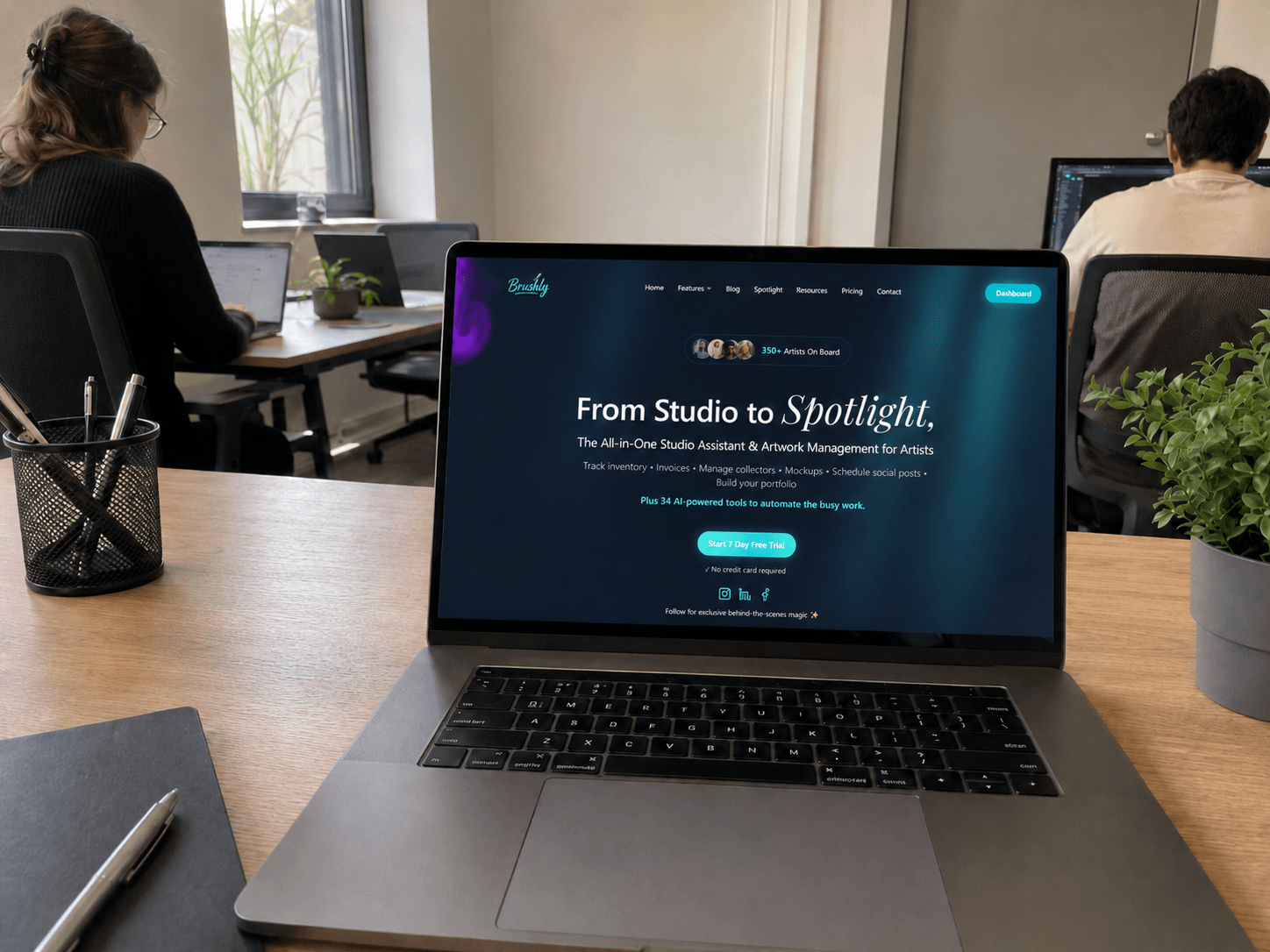
The pattern was always the same. From the outside people see the finished work, the exhibitions, the collectors. Behind that sits everything that never goes into making art at all: organizing artwork images, tracking what sold and to whom, sending certificates, building invoices, keeping collector records straight, preparing content, chasing the email that slipped. None of it is the work an artist signs up for, but all of it has to happen, and most of it lives across spreadsheets, folders, and tools that don’t talk to each other. That admin quietly drains the one thing an artist can’t get back, which is time and attention for the actual work. That’s where Brushly comes from. It’s an AI-powered studio and gallery management platform that puts the business side of an art practice in one organized place: inventory, portfolios, invoicing, collectors, marketing, mockups, and studio workflows.
One thing matters a lot to us: Brushly is not an AI art generator. We use AI for the boring, repetitive parts like drafting descriptions, organizing information, and prepping content, while the artist’s voice and judgment stay completely at the center. What sets us apart is that we build around how artists and galleries actually work, not a generic small-business template, because an art practice isn’t an ecommerce store. The inventory has context, collector relationships are personal, and presentation matters. Brushly is for serious artists and galleries who want more clarity and less chaos, so they can spend more of themselves on the work that actually matters.
Any advice for growing your clientele? What’s been most effective for you?
The most effective thing we’ve done is stop guessing what to build. Early on it would have been easy to sit in a room, decide what we thought artists needed, and ship it. Instead we built a feedback loop where the people actually using Brushly drive what gets made next. Every meaningful feature on our roadmap traces back to a real user request, not an internal assumption.
The way it works is simple. Users tell us what’s slowing them down or what they wish existed, those requests get collected openly, and whatever gathers the most upvotes is what we build next. So our development cycle isn’t shaped by what looks impressive in a demo, it’s shaped by the tasks artists are genuinely tired of doing by hand. That keeps us honest and it keeps us close to the real problem.
What surprised me is how much this does beyond just producing good features. When someone asks for something and then actually sees it show up in the product, they feel heard in a way that’s rare with software. They stop being a passive user and start feeling like part of how Brushly is built. That sense of ownership has done more for growth than any marketing line we could have written, because the people whose requests we shipped become the ones who tell other artists about us. We grow by making the tedious parts of an art practice genuinely faster, for the exact people who told us where it hurt most.
What’s a lesson you had to unlearn and what’s the backstory?
The lesson I had to unlearn is that solving the right problem is what matters most. I used to believe that if you simply pointed yourself at a real, valuable problem, the rest would follow. What I’ve come to believe is that solving it with the right team matters even more, because building anything meaningful is teamwork and the people you build with decide whether you actually get there. The backstory is really a shift in how I trust. I used to trust people based on their potential, on what I could see they were capable of becoming. I’ve learned to trust people based on their actions instead, on what they actually do, repeatedly, when it counts. The difference shows up fast. With the right team and the right co-founder beside you, you can take on almost any problem and stay aligned through the mess. With a sluggish, out-of-sync team you can’t even outrun a single focused solopreneur, because everything turns messy and misaligned and the lack of sync quietly costs you more than the problem itself ever did.
Contact Info:
- Website: https://brushly.art
- Instagram: https://www.instagram.com/brushly.art/
- Linkedin: https://www.linkedin.com/in/manish-chandwani/