



We caught up with the brilliant and insightful Lou Anna Claveau a few weeks ago and have shared our conversation below.
Alright, Lou Anna thanks for taking the time to share your stories and insights with us today. We’d love to hear about how you went about setting up your own practice and if you have any advice for professionals who might be considering starting their own?
When I took the scary first step of entering private practice it was a definite leap of faith. I started on literally $20.00 in my hand. Someone I knew had an open office and said if I wanted it I could move in and they would worry about rent the next month. Scared out of my mind I started. Now I had been with groups prior to this so I wasn’t used to paying rent, finding furniture, getting utilities and services. I think I spent my first month looking like I worked out of a shoebox and might be a scam artist! My skills however and the time I spent with clients and grew became a point when I realized I did not want to be part of a group, although I did go back briefly due to circumstances. I always make the joke I don’t play well with others. The truth is when you find your tribe you work beautifully. I grew by leaps and bounds. A brief return to group practices and companies was all it took for me to decide that private practice and co-workers who thought like I did were the answer.
No one tells you what to charge. No one tells you to get a biller. No one tells you much of anything and being tight lipped is an understatement. I floundered ALOT. So when others began to flounder I decided to stop gatekeeping all the knowledge. I helped them learn about what it meant to “get on panels”, how to file insurance, how to call an insurance company, that billers are vital but if you can’t afford one and you want to take the time to learn do it yourself. There is so much that goes into maintaining a private practice. When you are the one who everyone turns to or in my case for many years THE ONE because you are solo…..well things can get crazy and you can second guess yourself. So you network. Go to conferences. Talk to other providers. Create ways for you to connect. Sometimes it works other times it does not.
The best advice I could give someone is there is never a “good” time to take that leap. You can prepare all the checkboxes. You will always forget one or ten. Clients don’t follow the plan. Being prepared for every eventuality is not possible. You can only use broad brushstrokes to get things done. Delegate! Allow others to help you and train you. Don’t gatekeep knowledge. There are plenty of clients to go around. The first year is the hardest. Preparing yourself by checking the cycle of patient flow is ultimately the most important thing. Know your slow months, yes months and know the months that will drain you with overflow. Keep a steady flow of clients and remember that you count on the steady flow not the influx.

Lou Anna, love having you share your insights with us. Before we ask you more questions, maybe you can take a moment to introduce yourself to our readers who might have missed our earlier conversations?
How did I get here? That question revolves around having seen a counselor and being made to feel like my worth was in my looks. I originally was in civil engineering. I did not intend to work with people at all. But being told I was flirting as I was having the most painful breakthrough with the tears and a box of used tissues at my feet made me realize that just because you are in the field you may not be there for the right reasons. I did not want another abused woman to experience what I did. So I left that appointment, went straight to my advisor and changed my declared major.
I had visions of saving the world as is normal when you are bright eyed and new to the field. I was going to be the best at my job and do all the research and find the right thing for each client. That was soon washed away with the reality that clients aren’t books and they don’t come with the professor’s scripts. So I found that my greatest was in brief therapy. Short term solutions for immediate problems. This grew into trauma treatment. This eventually grew into learning EMDR (Eye Movement Desensitization Reprocessing) treatment, a favorite of mine in school and quite new at the time and finally into a world I knew so well, geek therapy.
Geek therapy is a specialized place for people who use anime, books, movies, songs, video games and table top role playing games to escape and work through their problems. Playing as an adult is different than playing as a child. The effects are very similar but understanding the value of play and escape in dealing properly with life stressors of everyday life. That isn’t to say to use them exclusively and avoid the real life work but using the lessons within the theoretical framework provided can usually assist where traditional therapy fails. Removing oneself from the situation by using a stand-in or avatar interacting with other stand-ins allows for safe expression and provides an understanding that cannot be attained due to the personal and painful nature of some issues in treatment.
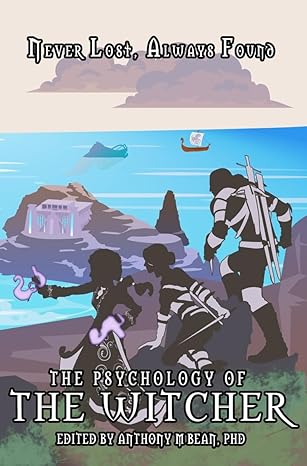
While Geek Therapy is in its infancy and I am not the only one in the nation I am in the only one in my area. Through the use of ACT (Acceptance Commitment Therapy) techniques we can learn to adapt to our surroundings, accomplish resolution of painful pasts, presents and find joyful futures. I have the honor of being published within a variety of works most notably The Psychology of The Witcher and an upcoming book on the psychology of the Teenage Mutant Ninja Turtles.
The one thing I would say is I live in the same circles as most of my clients. I video game. I play and run campaigns based in fantasy worlds. I binge watch anime and I can definitely call myself a book dragon. I have too many to be called a bookworm. I design my costumes and my interests are varied and skills set probably as varied and vast as you can find. Electronics, sewing, knitting, art all can be a part of what I use within the session setting to help create understanding and build a relationship that offers support and eventually the confidence to face daily life.
Do you think you’d choose a different profession or specialty if you were starting now?
No. I think I would have chosen either an attorney or the medical field. I was always interested in both and find that I sometimes yearn for the solid yes and no that those fields that mine cannot.
Can you share a story from your journey that illustrates your resilience?
I have closed my offices partially or lost them altogether a total of 3 times. Once was to go back into a group and try to work with others because working alone is a lonely spot to be in. When you have no support you can burn out and make mistakes. You need to have back up. As a solo practitioner if you get sick or you have to stop being the office for any reason you are then stuck with no income. The other two times were just as bad. My husband’s first bout with cancer which almost took his life. I was his only support and with teenagers at home and a business along with his medical made for a very thin line between resting and competency. In my field you must step away when you cannot practice ethically. With no income our life was coming to a halt. Fortunately telehealth was an option and I operated on a shoestring of $1000/monthly. Cue a five long battle with cancer which has resulted in him being on hospice currently. Cue the third and final loss. I have since rebuilt as I maintained contacts, had a co-worker to step in and was able to return to work at his behest. I had clients that refused to not be seen and waited patiently for telehealth. Those clients saved my business. I however lost my offices. I found myself having to find and set up a new office space. During this time I also lost my father and my brother. It has been a slow recovery process and this interview has given me new hope that I can survive this final pitfall.
Contact Info:
- Website: https://www.geekgamingtherapy.com
- Other: Podcast on Spotify: Owner’s Manual for The Brain
Amazon: https://www.amazon.com/Psychology-Witcher-Never-Always-Found/dp/195540626X

Image Credits
Neal Allen Stone