


We caught up with the brilliant and insightful Leona Yang a few weeks ago and have shared our conversation below.
Leona, looking forward to hearing all of your stories today. What’s the kindest thing anyone has ever done for you?
One of the kindest things anyone has done for me happened during my first year of graduate school, while I was working on my final location drawing project. For this project, I chose to draw inside a courthouse, making quick observational sketches of judges, defendants, lawyers, officers, and people waiting in the hallways.
At the beginning, almost no one noticed me. I was just sitting quietly with my sketchbook, observing the space and trying to capture what was happening around me. But as I kept going back, more people started to recognize me. Some came over to encourage me, some complimented my drawings, and some even asked if I could include them in my work. Many of them were unexpectedly kind.
One of them was a court officer named Paul. One day, he noticed me drawing and came over to look at my work. He seemed genuinely surprised and excited by it. He told me that I should try drawing the judges, because some of them might really enjoy seeing themselves captured during a trial.
Around that time, I had also met Christine Cornell, a very well-known courtroom artist, and I was learning from her how to observe and capture people in court — their gestures, expressions, colors, and the composition of the scene. So I followed Paul’s suggestion and drew a portrait of one of the judges.
What moved me most was what Paul did next. He immediately brought me directly to the judge and showed him my drawing. The judge really liked it. After that, Paul told me I should make more drawings and give him more business cards so he could help introduce my work to other people.
Then he said something I will always remember: “I really like helping young people who are pursuing their dreams. You all have so much potential, and I hope I can give you a little help at the beginning.”
That moment meant a lot to me. As a young artist, especially while still in graduate school, it is easy to feel that many people do not really care whether you succeed or struggle. A lot of people do not take art seriously, or they see it as something separate from real life. But Paul is not an artist, and still, he truly respected what I was doing. He saw value in my work, and he was willing to support me in a real, practical way.
To thank him, I also drew a portrait of him.
What made his kindness so meaningful was that it happened in a completely unexpected place, from someone who had no obligation to help me. He could have simply complimented my drawings and walked away, but instead, he used his position, his connections, and his genuine enthusiasm to open doors for me. In that moment, I felt seen — not only as a graduate student sitting in a courthouse with a sketchbook, but as an artist whose future was worth believing in.

Leona, before we move on to more of these sorts of questions, can you take some time to bring our readers up to speed on you and what you do?
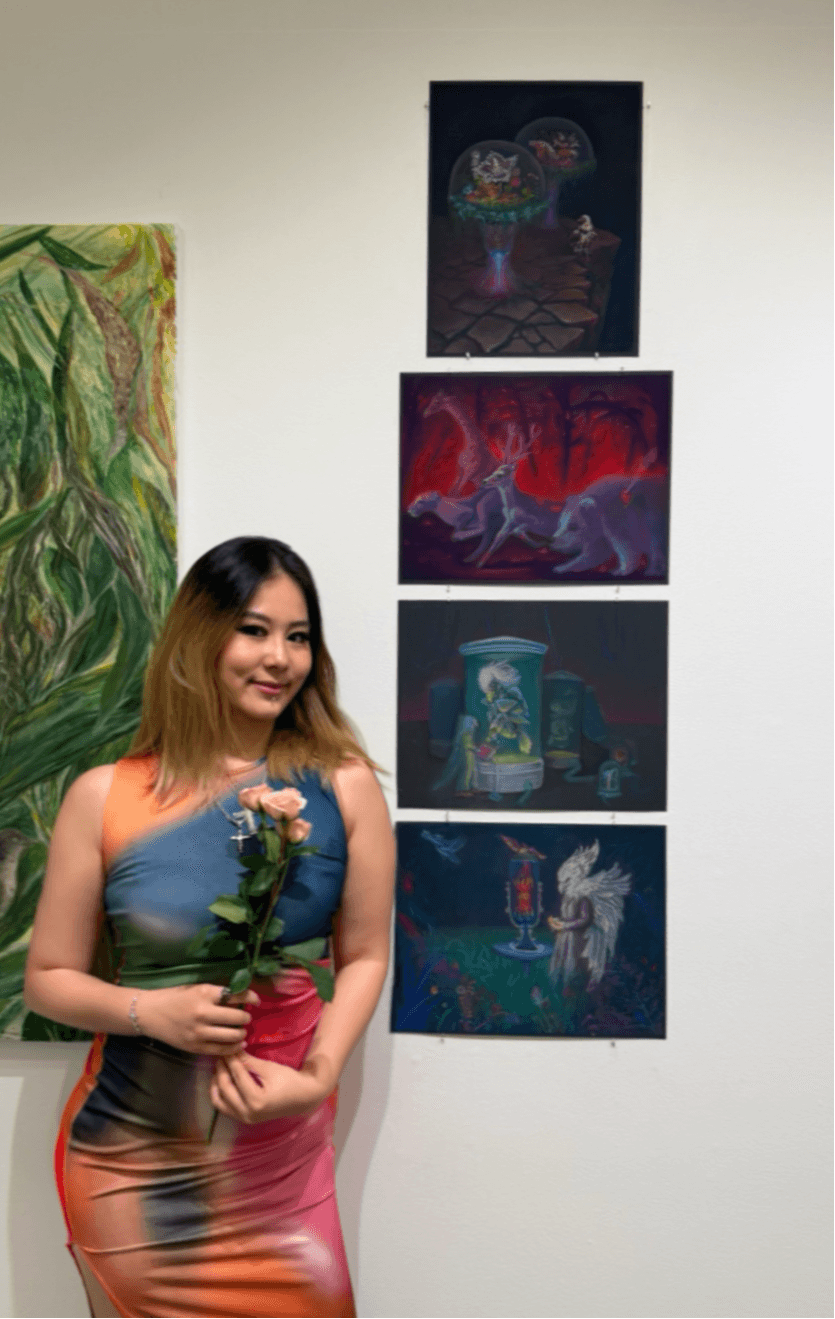
I am an illustrator and MFA Illustration student currently based in New York. My work is rooted in observation, storytelling, and human psychology. I am especially interested in the hidden emotional and social structures behind ordinary moments — the tension between intimacy and distance, the complexity of human nature, and the way people reveal themselves through gestures, expressions, environments, and silence.
I did not enter illustration simply because I wanted to make beautiful images. I chose this field because I see illustration as a powerful way to translate complex human experiences into visual form. I have always been drawn to stories that are layered, psychological, and sometimes uncomfortable — stories that show both the tender and darker sides of people. For me, illustration is not only decoration or image-making; it is a way of observing life, interpreting human behavior, and making invisible emotions visible.
My path into illustration has been shaped by both personal experience and academic training. During graduate school, I have been exploring different forms of visual storytelling, including editorial illustration, narrative books, location drawing, courtroom sketching, pastel work, and hand-made book projects. I am particularly interested in projects that combine strong observational drawing with metaphor, atmosphere, and emotional depth.
One important part of my recent practice has been location drawing. For my first-year graduate project, I chose to draw inside the courthouse. I observed judges, lawyers, defendants, court officers, and people waiting in the hallways. That experience deeply influenced the way I think about illustration. The courthouse is a place where real human conflict, fear, authority, vulnerability, and judgment all exist in the same space. Drawing there taught me how to capture people quickly, how to notice body language, and how to turn real-life observation into narrative images.
I also work with themes related to ecology, technology, memory, relationships, and social reality. In some projects, I use surreal or symbolic imagery to talk about environmental collapse and technological expansion. In others, I use quieter visual metaphors, such as sunlight, ships, doors, or repeated architectural spaces, to explore emotional encounters and separation. Across all of my work, I am interested in how external environments reflect internal states.
In terms of medium, I often work with traditional, hand-drawn materials. I especially enjoy pastels, pastel pencils, oil painting, cyanotype, collage, and other tactile processes. I like the softness, imperfection, and physical texture of handmade images. My work often has a misty, atmospheric quality, with soft transitions of color and a strong sense of mood. I am drawn to images that feel emotional and slightly strange, but still grounded in real observation.
The creative works I provide include editorial illustrations, narrative illustration, book and zine projects, character-based visual storytelling, location drawings, courtroom sketches, and conceptual image series. I am also interested in collaborating on projects related to journalism, publishing, social issues, true crime, psychology, human stories, and cultural observation. My work can help clients and collaborators turn complex subjects into images that are emotionally engaging, visually memorable, and conceptually layered.
What sets me apart is the way I combine observation with psychological interpretation. I do not only draw what something looks like; I try to understand what is happening underneath. I pay attention to the emotional temperature of a scene, the power dynamics between people, and the symbolic meaning of small details. My goal is to create images that viewers want to stay with — images that are visually compelling at first glance, but also reveal deeper meaning the longer people look.
I am most proud of the fact that my work is becoming more honest and more personal. I used to focus more on whether an image looked technically good. Now I care more about whether it carries a real point of view. I am proud of the moments when people recognize something human in my drawings — when they feel that the image is not only beautiful, but also truthful.
I want potential clients, readers, and followers to know that my work is driven by curiosity about people. I care about stories that feel real, layered, and emotionally alive. I am not interested in making images that are only pretty or trendy. I want to create illustrations that hold tension, atmosphere, and meaning — work that reflects the complexity of being human.
Ultimately, my brand as an illustrator is built around visual storytelling, psychological depth, and human observation.

What’s the most rewarding aspect of being a creative in your experience?
For me, the most rewarding part of being an artist is that art has a healing effect on me.
My life has not always been smooth, and I have experienced many difficult and painful moments growing up. Drawing has become a very important way for me to express myself. Sometimes there are emotions, thoughts, and struggles inside me that I do not know how to explain with words. But through color, imagery, composition, and atmosphere, I can give those feelings a visible form.
That kind of expression is not only meaningful to me. It can also create a connection with people who have gone through similar experiences. They may not know my exact story, but they can feel the emotion within the image. That is very powerful to me. Through my work, viewers can also get to know who I am — my sensitivity, my thoughts, my pain, and the way I transform those experiences into art.
Another rewarding part of being an artist is the sense of freedom it gives me. In real life, we are often limited by other people’s expectations, social rules, practical pressures, or the idea of how we are “supposed” to live. But in art, I feel free. I do not have to please everyone, and I do not have to make myself easy to understand. I can express myself more honestly and directly. Art allows me to be the version of myself that may not always be fully visible in everyday life.
Finally, being an artist is rewarding because it helps me grow closer to the person I want to become. The process of pursuing art is also the process of understanding myself more deeply. The more I understand my emotions, desires, fears, and values, the more clearly I can see the kind of life I want to build.
So, being an artist is not only a career identity. It is a way of healing, understanding myself, and translating real emotions into visual form. It allows me to turn pain into images, experiences into creative work, and gradually become a more complete and freer version of myself.

Let’s talk about resilience next – do you have a story you can share with us?
One story that illustrates my resilience is my graduate school application journey.
Since graduating from high school, I had always dreamed of studying abroad for my master’s degree. Because I had to handle most things independently, the entire application process — researching schools, preparing materials, making decisions, and planning my future — was something I mostly carried on my own.
It took me about three years to get to where I wanted to be. During the first year, my mental state was very poor because of painful personal experiences, and I could barely make work. I lost confidence in myself and felt completely stuck. The second year, I applied again, but I still did not get into the schools I truly wanted.
After I came to the U.S., I still believed my work had more potential and deserved a stronger environment. During my first semester, I rebuilt my portfolio, improved my English, and prepared to apply again. Since English is not my first language, I had to work on both my artwork and communication skills at the same time.
One moment from that period still stays with me. To better understand how to improve my portfolio, I found an opportunity to meet the Chair of SVA’s MFA Illustration program in person. I flew alone from the southern United States to New York City, without knowing anyone there. The hostel I stayed in was very old, dirty, and unsafe-feeling; the room felt almost like a prison cell, and the door lock did not feel secure. I was exhausted from traveling and anxious about the meeting, so I barely slept that night.
But the next morning, I still got up, brought my portfolio, and went to meet the Chair. I listened carefully to his feedback and used it to keep improving my work. After that, I continued revising my portfolio and studying English for several months.
Eventually, I was accepted into the MFA Illustration program at the School of Visual Arts in New York, which was my dream school.
This experience taught me that resilience is not always one dramatic moment. Sometimes it means continuing for years, even when you feel lost, exhausted, rejected, or completely alone. For me, resilience meant not giving up on the life I wanted, even when I had to rebuild myself and my work again and again.
Contact Info:
- Instagram: leonaillu


Image Credits
Leona Yang